

How to Recover from a Bad GCSE English Literature Mock
Recover from a bad GCSE English Literature mock with a calm diagnosis, a focused revision plan and practical steps that protect your GCSE maths revision.

A disappointing mock result can feel strangely final. You see the grade before you see the comments, and one number appears to summarise months of lessons. It does not.
If you are trying to recover from bad GCSE English Literature mock results, the immediate answer is simple: separate the result into specific problems, choose the smallest useful actions, and schedule those actions without abandoning your other subjects. A mock is evidence about what happened in one paper under one set of conditions. It is not your final GCSE grade.
The most productive response is neither panic nor denial. It is diagnosis.
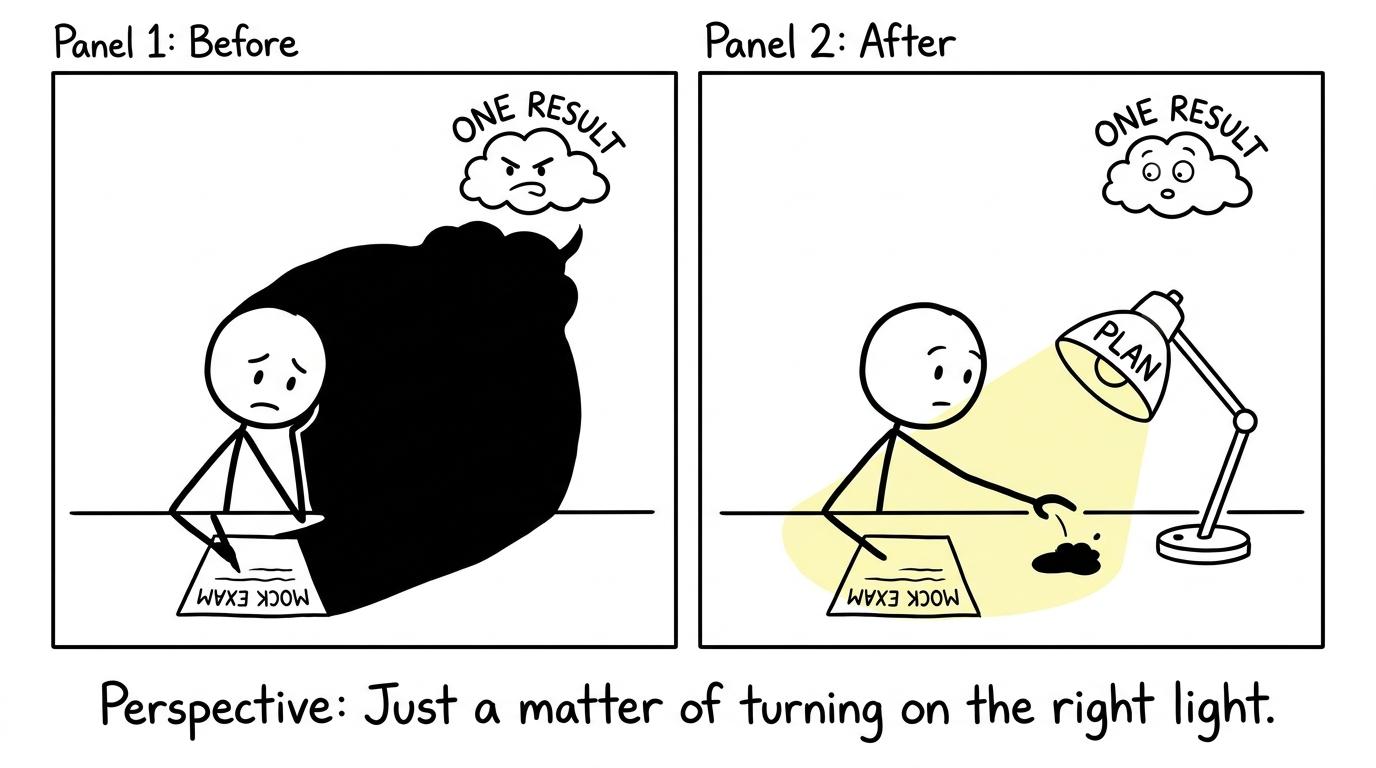 A mock result casts a large shadow until a student switches on a lamp labelled plan
Your recovery checklist
Before doing more revision, complete these steps:
- Read every teacher comment and annotation.
- Compare your response with the relevant mark scheme or success criteria.
- Identify whether marks were lost through knowledge, analysis, essay construction or timing.
- Choose no more than three priorities for the next fortnight.
- Practise short, targeted tasks before attempting another full paper.
- Keep enough time for maths and your other GCSE subjects.
- Review the plan after your next marked response.
This process turns an emotional verdict into usable information. That shift matters because vague disappointment produces vague revision. A precise diagnosis gives you somewhere to begin.
Start with the paper, not the grade
Your grade tells you where the performance landed. It does not tell you why.
Ask your teacher for the marked script if you do not already have it. Then inspect it like evidence. Look for repeated comments rather than isolated slips. One weak paragraph may be accidental; the same weakness across several paragraphs is a revision priority.
Sort each lost-mark issue into one of four categories:
Knowledge
Did you misunderstand the text, character, theme or relevant context? Were your quotations inaccurate or too general? Knowledge gaps require retrieval practice and careful rereading, not another timed essay immediately.
Analysis
Did you identify a quotation without explaining how the writer's language, form or structure creates meaning? Did your answer describe events instead of analysing choices? This usually calls for focused paragraph practice.
Essay method
Did your argument answer the exact question? Were paragraphs connected to a central interpretation? Did you spend too long writing an introduction and leave the final part unfinished? These are problems of selection and structure.
Exam conditions
Were you short of time, anxious or surprised by the question? Did you misread an instruction? Exam-condition problems need timed planning and gradual exposure to full papers, but only after the underlying knowledge and method are secure.
Your exam board matters. AQA, Edexcel, OCR and Eduqas use their own specifications, paper structures and mark schemes. Texts, question formats and the way assessment objectives are applied can differ, so use the board and specification confirmed by your school rather than generic advice from an unrelated paper.
Turn feedback into actions you can actually complete
Comments such as “analyse more closely” or “use context effectively” are useful descriptions, but they are not yet a plan. Translate each comment into observable work.
| Feedback pattern | Useful next action |
|---|---|
| Quotations are vague or inaccurate | Build a small quotation bank organised by character or theme and test retrieval regularly |
| Analysis becomes descriptive | Practise explaining the effect of one carefully selected word or structural choice |
| Context is bolted on | Connect context only where it changes or deepens the interpretation of the text |
| The argument drifts from the question | Plan a clear overall judgement before selecting evidence |
| The response is unfinished | Practise timed plans, then timed sections, before returning to a complete paper |
The smaller action often wins. “Revise the whole play” is too broad to guide a Tuesday evening. “Retrieve quotations for one theme, then plan one question” tells you exactly what finished work looks like.
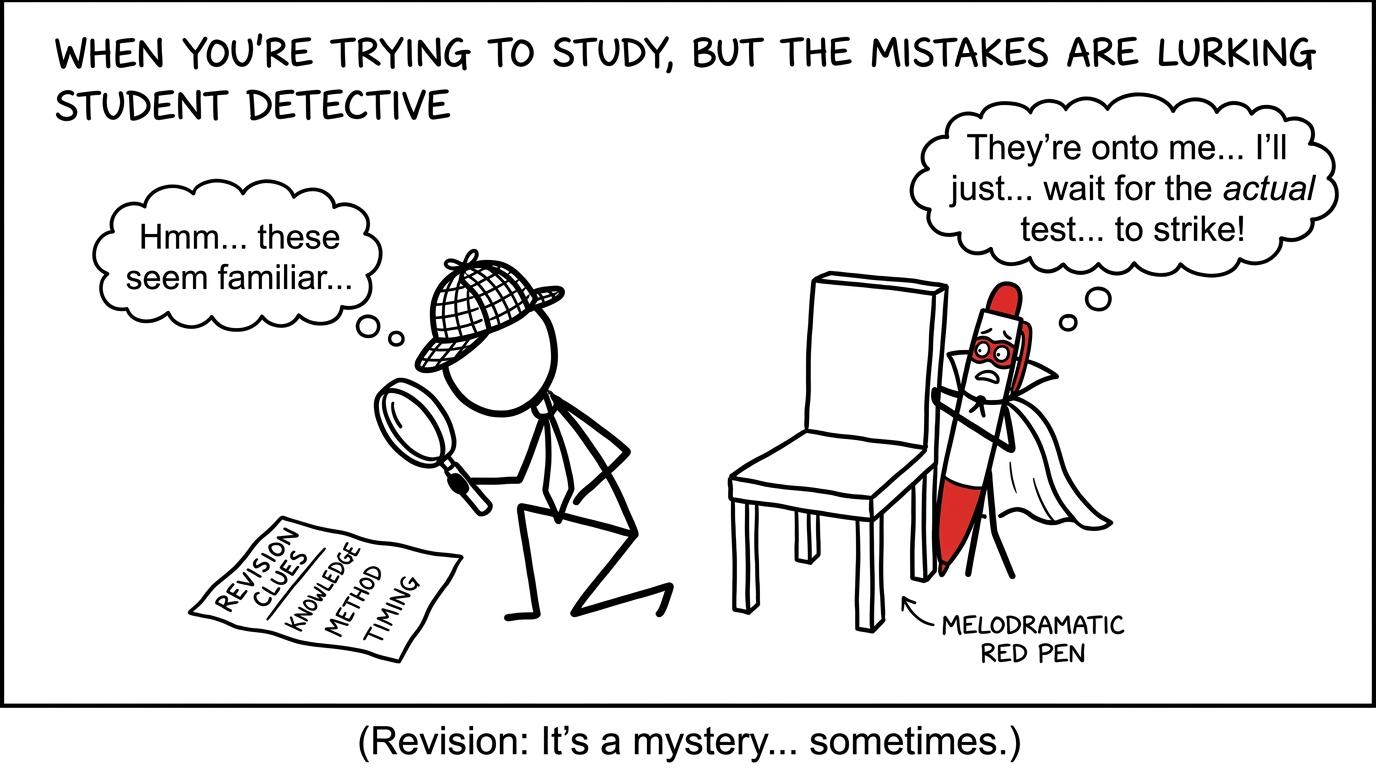 A student detective investigates knowledge, method and timing while a red pen hides
Build a focused two-week recovery plan
A bad mock can tempt you into giving English Literature every spare hour. That feels responsible, but it may simply move the problem into maths, science or another subject.
Instead, use short cycles. Over a fortnight, your English Literature sessions might include:
- quotation retrieval;
- one theme or character review;
- short analytical paragraphs;
- question planning;
- one timed section;
- feedback and correction.
Space these tasks across several days rather than placing them in one exhausting block. Start each session with retrieval from memory before opening notes. Finish by recording the next specific action.
You can use the same disciplined approach for maths. MathsGenie's GCSE maths revision resources organise topics by grade and include videos, practice questions and solutions. That makes it easier to preserve regular maths practice while repairing English weaknesses.
A balanced weekly plan could allocate subject time according to urgency, exam proximity and the size of the gap. It should not be based solely on which result caused the strongest emotion. MathsGenie's revision planner can help turn competing priorities into visible sessions.
Practise at the right level of difficulty
A full paper is useful for measuring performance, but it is often inefficient for repairing one weakness. If your argument is unclear, completing several full essays may allow the same habit to repeat.
Use a progression instead:
- retrieve the necessary knowledge;
- plan an answer without writing it;
- practise the weak section;
- receive or apply feedback;
- complete a timed section;
- return to a full response.
This resembles effective maths revision. You learn or revisit a method, answer targeted questions, check the solution and only then test yourself across mixed content. The MathsGenie mini tests support that shorter cycle, while GCSE past papers are better used once topic-level weaknesses have been addressed.
The distinction is important: practice helps you improve a skill; a mock measures how well several skills work together. Do not use measurement as a substitute for learning.
Protect your maths revision while recovering
Students preparing for several GCSEs face a portfolio problem. Time spent on one subject cannot be spent on another, so every revision plan needs limits.
Keep a minimum maths routine even during an English recovery fortnight. This could include a short topic session, a mixed mini test and a longer paper-based session each week. The exact pattern should reflect your tier, current topics and teacher guidance.
Use your maths results diagnostically too. If algebra is secure but probability is costing marks, your timetable should reflect that difference. The MathsGenie GCSE revision page lets you target individual topics rather than revising everything equally.
When exams are closer, MathsGenie predicted papers can provide additional exam-style practice. They should complement specification coverage and official past papers, not replace them. Always mark your work carefully, use the available video solutions and return to the topics behind each error.
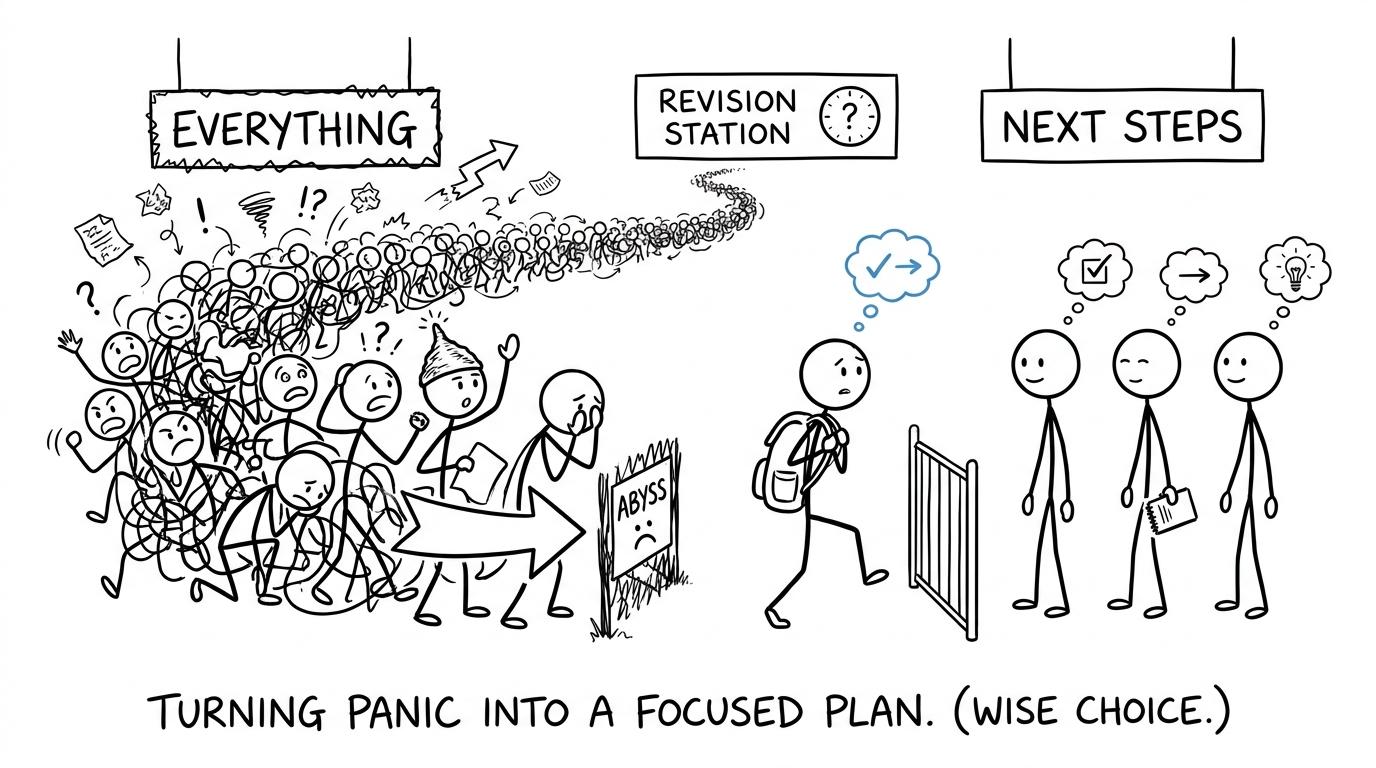 A student chooses the short queue labelled next steps instead of the chaotic everything queue
Measure improvement without obsessing over grades
Your next useful signal may not be an immediate grade increase. Look for smaller changes:
- quotations recalled without prompts;
- plans that answer the precise wording of the question;
- analysis that explains the writer's choices;
- paragraphs completed within the intended time;
- fewer repeated teacher comments;
- a complete response under timed conditions.
These are leading indicators. The grade is a later summary of them.
Keep a simple error log with four headings: issue, cause, correction and retest date. For English Literature, an issue might concern evidence or analysis. For maths, it might be a misconception, an arithmetic slip or an incomplete method. MathsGenie's GCSE mark schemes and exam papers help you compare your work with accepted solutions rather than relying on whether an answer merely looks convincing.
Common mistakes after a disappointing mock
Revising everything from the beginning
This creates a great deal of activity without addressing the reason marks were lost. Begin with the marked evidence and rank the weaknesses.
Memorising large essays
A memorised response may not answer the question set. Secure flexible knowledge, short quotations and adaptable interpretations instead. Follow your teacher's guidance on suitable preparation.
Ignoring the mark scheme
Effort alone does not earn marks. You need to understand what the question and assessment objectives require on your specific exam-board paper.
Completing full papers too soon
If the underlying weakness remains, another paper may rehearse it. Repair the component skill first, then test it under timed conditions.
Dropping every other subject
One mock should not take control of your entire timetable. Protect regular maths practice and use MathsGenie's free revision resources to keep those sessions focused.
Treating the mock grade as a prediction
A mock records one performance. Your final outcome depends on what you learn, practise and correct afterwards. Take the evidence seriously without treating it as destiny.
Your next step matters more than the last result
The useful question is not “How could I have done so badly?” It is “What will I do differently in the next session?”
Take the paper, identify the repeated weakness and choose one task small enough to complete. Ask your English teacher to clarify feedback where necessary. Then place that task into a balanced timetable alongside maths and your other subjects.
For maths, begin with the MathsGenie GCSE revision lessons, work through targeted practice questions and mini tests, and move on to past papers and predicted papers when you are ready for mixed exam practice. Use mark schemes and video solutions to understand every lost mark.
A disappointing mock is uncomfortable. But once it becomes a plan, it has already started to become useful.










