

Pythagoras GCSE Maths Resit: A Grade 4 Guide
Pythagoras GCSE maths resit guide for grade 4 students. Learn the method, avoid common mistakes and practise exam-style questions with MathsGenie.
Resitting GCSE Maths can feel strange. You recognise much of the course, yet individual questions can still stop you. Pythagoras is often one of them. The triangle looks familiar, but deciding whether to add, subtract or square root becomes harder under exam pressure.
For Pythagoras GCSE maths resit questions, the reliable method is simple: find the hypotenuse, write the formula, substitute the known lengths, rearrange if necessary, and take the square root. It is a useful grade 4 topic because the same structure appears repeatedly, even when the diagram changes.
This guide follows that method through two exam-style examples, then shows you how to practise it without wasting time on questions you can already answer.
Your Pythagoras grade 4 checklist
Before calculating anything, check the following:
- Is the triangle right-angled?
- Which side is opposite the right angle?
- Are you finding the hypotenuse or a shorter side?
- Have you written a2+b2=c2a^2+b^2=c^2a2+b2=c2?
- If finding a shorter side, have you subtracted?
- Have you taken the square root at the end?
- Does the answer need rounding or units?
That checklist matters because Pythagoras is not usually lost through difficult arithmetic. Marks disappear when the wrong sides are identified or the final square root is forgotten.
You can review the full lesson and practise questions on the Edexcel Pythagoras revision page. If you take AQA, use the corresponding AQA Pythagoras revision resources.
What Pythagoras' theorem actually says
Pythagoras' theorem applies only to a right-angled triangle. It states that the square of the hypotenuse equals the sum of the squares of the other two sides:
a2+b2=c2a^2+b^2=c^2a2+b2=c2The hypotenuse is the side opposite the right angle. It is also the longest side. In the formula, ccc represents the hypotenuse.
The letters printed on an exam diagram may be different. A side labelled xxx does not automatically become ccc. The position of the side, not its letter, tells you whether it is the hypotenuse.
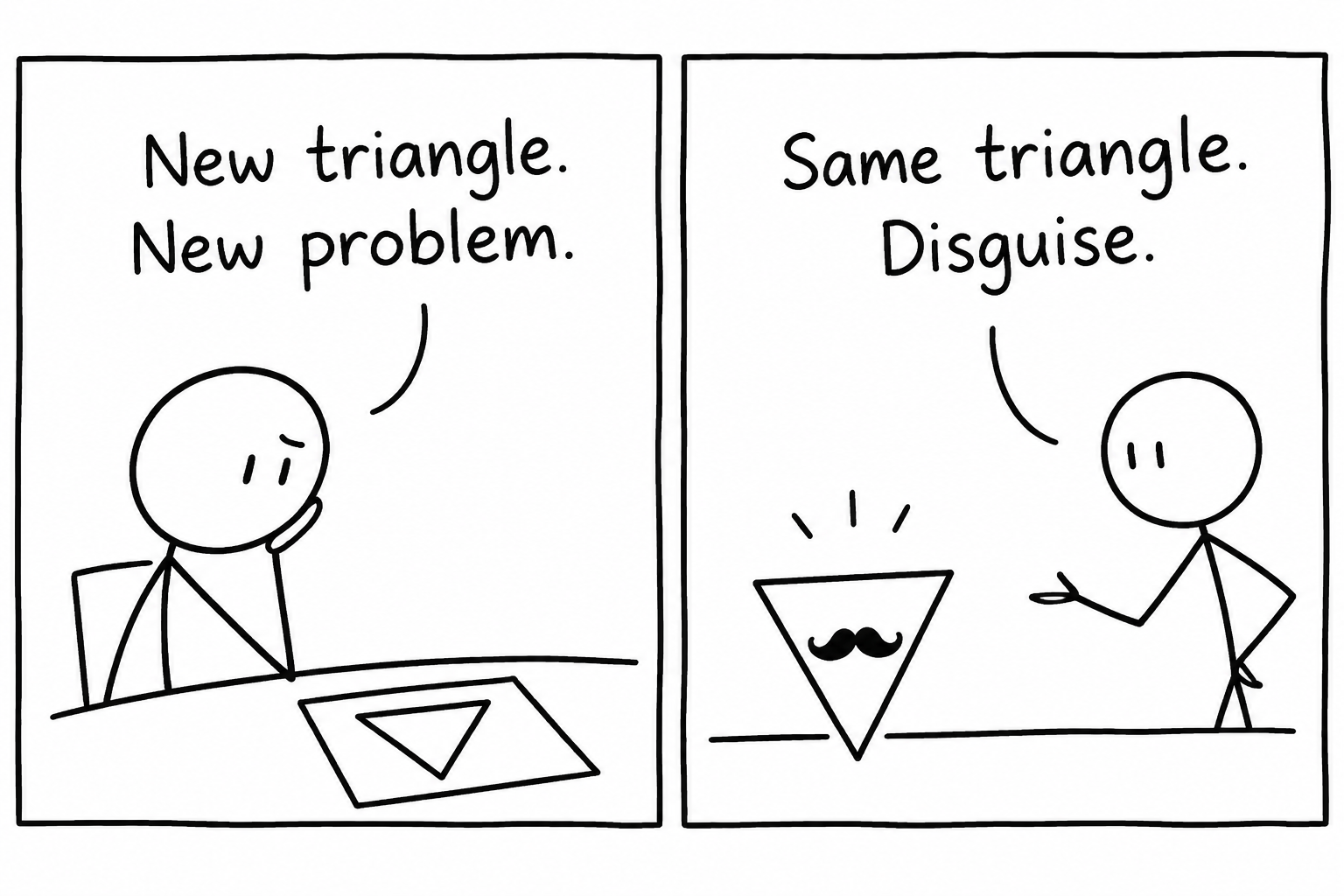 A triangle in disguise cannot fool a prepared resit student
Rotating the triangle does not change the method. The little square marking the right angle is your anchor. Look opposite it and you have found the hypotenuse.
Worked example: finding the hypotenuse
A right-angled triangle has shorter sides measuring 6 cm6\text{ cm}6 cm and 8 cm8\text{ cm}8 cm. Calculate the length of the hypotenuse.
Start with the formula:
a2+b2=c2a^2+b^2=c^2a2+b2=c2Substitute the two shorter sides:
62+82=c26^2+8^2=c^262+82=c2Calculate the squares:
36+64=c236+64=c^236+64=c2 100=c2100=c^2100=c2Take the square root:
c=100c=\sqrt{100}c=100 c=10c=10c=10The hypotenuse is therefore:
10 cm\boxed{10\text{ cm}}10 cmThe important decision came before the calculator work. Because the unknown side was the hypotenuse, the two known squares were added.
A clear solution also helps the examiner follow your method. Even if an arithmetic slip occurs, a correct formula and substitution may earn method marks, depending on the mark scheme.
Worked example: finding a shorter side
A right-angled triangle has a hypotenuse of 13 m13\text{ m}13 m and one shorter side of 5 m5\text{ m}5 m. Calculate the other shorter side, xxx.
Write the formula first:
a2+b2=c2a^2+b^2=c^2a2+b2=c2The hypotenuse is 13 m13\text{ m}13 m, so it must replace ccc. Substitute the values:
52+x2=1325^2+x^2=13^252+x2=132Calculate the squares:
25+x2=16925+x^2=16925+x2=169Subtract 252525 from both sides:
x2=169−25x^2=169-25x2=169−25 x2=144x^2=144x2=144Take the square root:
x=144x=\sqrt{144}x=144 x=12 m\boxed{x=12\text{ m}}x=12 mThis time subtraction was required because the unknown was a shorter side. A useful memory rule is:
- finding the hypotenuse means adding the two smaller squares;
- finding a shorter side means subtracting its known square from the hypotenuse squared.
For further written practice, use the Pythagoras exam booklet with answers. Work on paper rather than reading the solutions first. Recognition feels comfortable, but independent recall is what you need in the resit.
Mistakes that cost marks
Using Pythagoras without a right angle
Pythagoras works only for right-angled triangles. Never assume a triangle is right-angled because it looks close to one. Look for the right-angle symbol or information confirming an angle of 90∘90^\circ90∘.
Choosing the longest-looking drawn side
Exam diagrams are not necessarily drawn to scale. Find the side opposite the right angle rather than judging by appearance.
Adding when finding a shorter side
If the hypotenuse is known and a shorter side is missing, subtraction is needed. Keep the hypotenuse square on the right of the equation before rearranging.
Forgetting the square root
If your working ends with x2=61x^2=61x2=61, the side length is not 616161. You still need:
x=61x=\sqrt{61}x=61Rounding too early
Keep the full calculator value until the final line. Early rounding can shift the final answer outside an accepted range. Follow the question's instruction, such as giving an answer to 111 decimal place or 333 significant figures.
Leaving out units
A length needs a length unit, such as cm\text{cm}cm or m\text{m}m. Squared units are used for area, not for the final side length.
A focused GCSE maths resit revision routine
Post-16 resit revision competes with lessons, work and everything else in the week. That makes targeted practice more valuable than completing random pages.
Begin with one GCSE Maths revision lesson, then answer a short set of Pythagoras questions without notes. Mark them and classify each error: identifying the hypotenuse, choosing the operation, using the calculator, rounding or units.
Return to the exact weakness rather than restarting the whole topic. The MathsGenie revision planner can organise lessons and questions around your available time. Later, mix Pythagoras with other foundation topics so that you must recognise the method for yourself.
Turn the method into exam marks
Pythagoras becomes manageable when every question begins with the same calm decision: where is the right angle, and which side is opposite it? From there, the algebra has a familiar route.
Your next step is not another hour of reading. Use the free MathsGenie Mock Exam Builder to build a targeted practice paper containing Pythagoras and the other grade 4 topics you need. Complete it under timed conditions, check the mark scheme or video solutions, and use each mistake to choose the next piece of revision.















