Parents Involved in GCSE English Revision: Does It Help?
Parents involved GCSE English Language and Literature revision: discover when support builds confidence and when it creates stress or dependence.
Revision can make an ordinary question feel unexpectedly loaded. A parent asks, “Have you revised English yet?” The student hears, “You are falling behind.” The parent offers to improve an essay. The student sees their own voice disappearing beneath someone else’s sentences.
So, should parents get involved in GCSE English Language and Literature revision? Yes, but their most useful role is to provide structure, questions and calm encouragement, not to become the teacher, examiner or author. The best approach to parents involved GCSE English Language and Literature revision is supportive independence: helping the student do the thinking rather than doing it for them.
That distinction matters for students balancing English with GCSE maths. Revision time is limited. Support should make each session easier to begin and more productive, without creating another source of pressure.
A quick checklist for useful parental involvement
Parental support is usually constructive when it:
- follows the student’s exam board and school guidance;
- begins with the question, “What would help?”;
- uses short quizzes rather than long lectures;
- protects regular, manageable revision time;
- encourages the student to explain ideas aloud;
- leaves essay writing and interpretation with the student;
- uses mark schemes carefully rather than guessing a grade;
- notices tiredness and anxiety without turning every conversation into revision;
- leaves room for independent work.
The principle is simple: parents can hold the ladder, but the student still has to climb it.
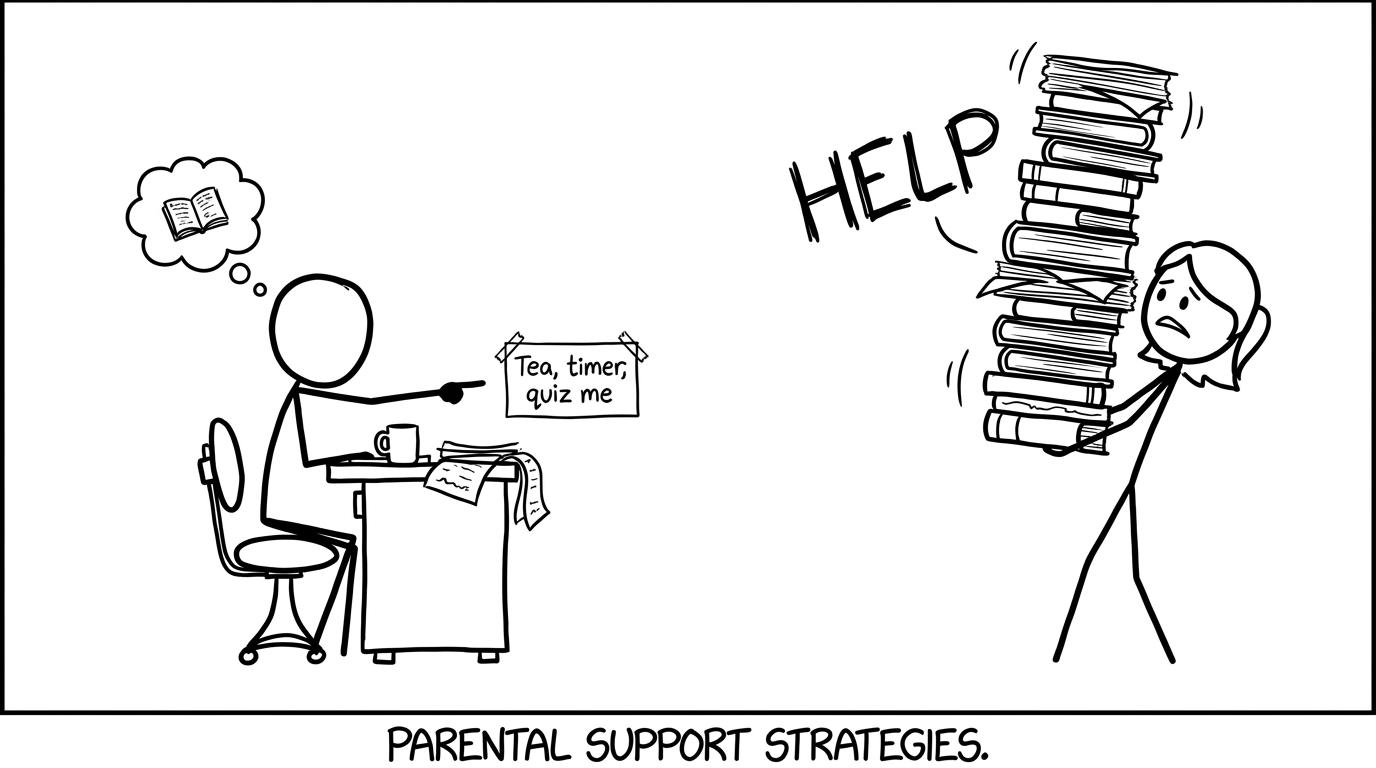 A student chooses a small revision checklist over an enormous stack of parental help
Where parental involvement actually helps
Broad educational evidence suggests that parental engagement can support learning, although the most effective methods vary by age and context. For secondary pupils, encouragement, high expectations, good communication and a suitable home routine are generally more appropriate than close control of every task.
GCSE students need autonomy. They also sometimes need help turning good intentions into action. Parents are particularly valuable where they reduce practical friction.
Creating a realistic revision routine
A useful routine does not need to account for every minute. It should identify what needs attention, establish a starting time and include breaks.
A parent might help a student decide that tonight’s English task is one quotation quiz or one timed paragraph, while tomorrow’s maths task comes from the GCSE maths revision resources. This is more effective than the vague instruction to “revise English and maths”.
Specific tasks are easier to start. They are also easier to finish, which gives the student visible evidence of progress.
Parents can help by:
- protecting a quiet place to work;
- reducing avoidable interruptions;
- agreeing when phones will be put aside;
- helping to spread English, maths and other subjects across the week;
- checking that breaks and sleep have not been sacrificed to an unrealistic plan.
For maths, the same routine can direct students towards topic-specific material. A student rebuilding core knowledge might begin with Grade 111 GCSE maths topics, while another may need Grade 444 revision resources or more demanding Grade 777 GCSE topics.
Helping with retrieval practice
Parents do not need specialist subject knowledge to run a useful quiz. The student can create the questions and answers first, using their specification, class notes or teacher-approved resources. The parent then reads the questions in a different order and records which answers need another attempt.
For English Literature, prompts could cover:
- short quotations;
- themes and character development;
- the sequence of important events;
- relevant contextual knowledge;
- links between a quotation and an interpretation.
For English Language, prompts could focus on:
- the purpose of each question;
- methods used by a writer;
- structural choices;
- planning persuasive or descriptive writing;
- proofreading priorities.
The exact papers, texts and assessment objectives depend on the exam board and specification. Students following AQA, Edexcel, OCR or Eduqas should use the materials provided by their school rather than assuming that advice for one specification applies unchanged to another.
A parent’s job during retrieval practice is not to reveal the answer immediately. A short pause gives memory a chance to work. If the answer does not come, the student can check it and return to the same prompt later.
Listening to explanations
Understanding often becomes clearer when a student has to put it into words. A parent can ask:
- “What makes that quotation useful?”
- “Which word would you analyse?”
- “How does this point answer the question?”
- “What would you do first in the exam?”
- “Which part are you least certain about?”
The parent does not have to decide whether the interpretation is brilliant. Their role is to notice gaps, ask for clarity and let the student hear their own reasoning.
This works in maths too. Explaining why a method works is more revealing than saying it looks familiar. After using a MathsGenie revision lesson or video solution, a student can attempt the accompanying questions and explain the key decision to someone else. Students targeting secure intermediate skills can organise this practice through the Grade 555 maths revision page.
English Language and Literature need different support
The subjects share reading and writing skills, but revision should not treat them as identical.
Support for GCSE English Language
English Language rewards the application of reading and writing skills to the material presented in the examination. Memorising a collection of impressive phrases is not a substitute for responding precisely to the question.
Parents can support Language revision by providing a timer, listening to a spoken plan or checking that a practice response has a clear beginning, development and ending. They can also invite the student to identify their own proofreading priorities, such as sentence boundaries, paragraphing or spelling patterns.
They should avoid rewriting sentences in an adult voice. A polished paragraph produced through heavy parental editing tells the teacher little about what the student can do independently.
Support for GCSE English Literature
Literature revision involves secure knowledge of the prescribed texts as well as the ability to build an argument from relevant evidence. Parents can quiz quotations, themes and character links even if they have not read the whole text.
What they should not do is insist that there is one “correct” interpretation because it appears in a guide. A convincing response needs a defensible argument supported by the text. The student’s interpretation must remain their own.
Parents should also avoid confidently marking essays unless they understand the correct exam-board criteria. Teacher feedback is more reliable for subtle judgements about analysis, structure and quality of argument.
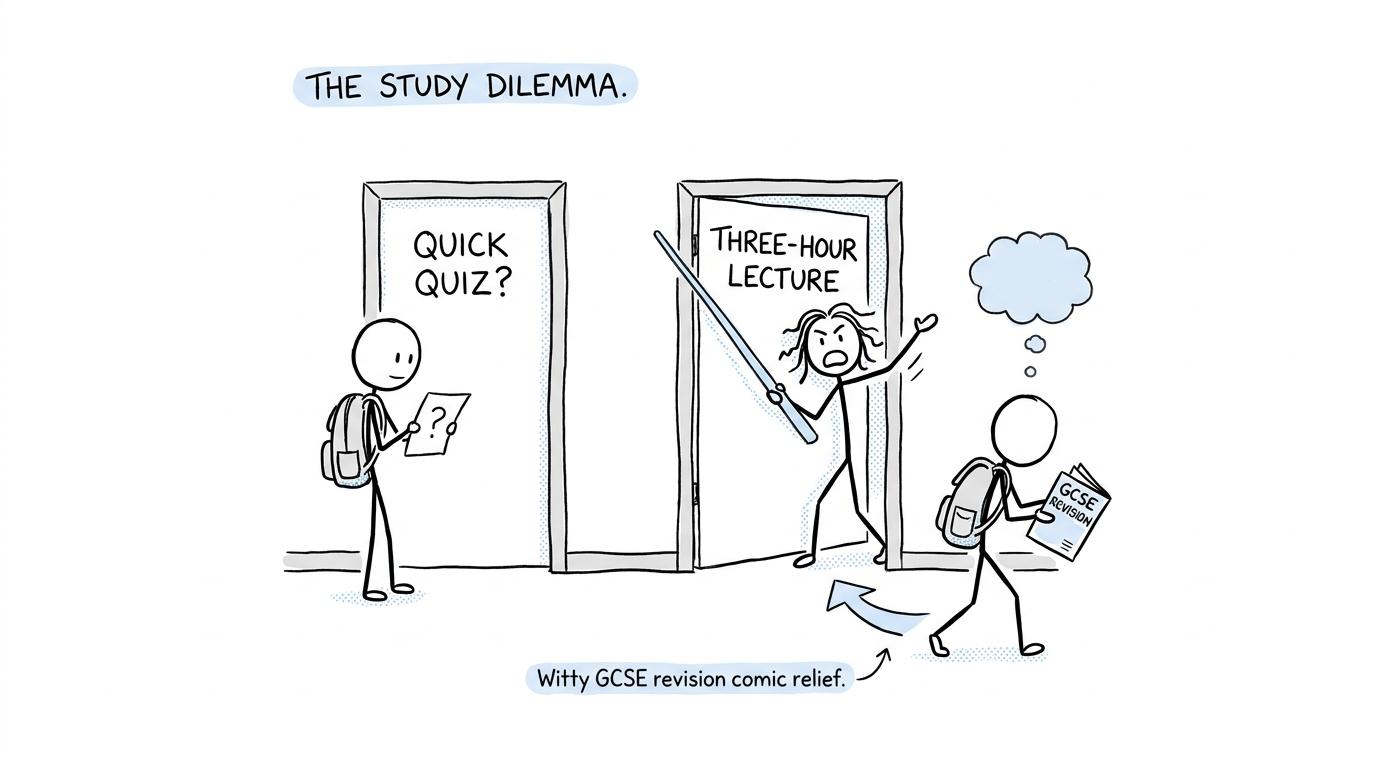 A student sensibly chooses a quick quiz instead of a three-hour parental lecture
Where involvement creates friction
Help becomes unhelpful when the parent takes ownership of the result. This can happen gradually: a reminder becomes repeated monitoring, a suggestion becomes a compulsory timetable, and an essay discussion becomes an argument about the “right” answer.
Constant checking
Frequent questions about revision can make students feel watched rather than supported. Agreeing one brief check-in is usually calmer than asking for updates throughout the evening.
A productive check-in might cover three points: what was completed, what remains unclear and what the next task will be. Then revision can stop being the background subject of every family conversation.
Taking over written work
Correcting every sentence may produce a better-looking essay today, but it can weaken the student’s confidence tomorrow. In the examination, the parent will not be there to select vocabulary or restructure paragraphs.
A better response is to identify a limited area for the student to review. For example, ask them to find where the paragraph answers the question or where evidence has been analysed. The thinking stays with the student.
Comparing grades and revision hours
Comparison rarely reveals what a particular student needs next. Two pupils can spend the same amount of time revising and use that time very differently. A completed task, an identified misconception or a stronger plan is more informative than hours counted.
The same applies to maths grades. Students should work from their own gaps, using appropriate resources such as Grade 666 GCSE maths revision, rather than copying a friend’s timetable.
Turning support into surveillance
A revision plan needs some flexibility. If every unfinished box becomes a confrontation, students may begin hiding difficulties instead of discussing them. Parents should distinguish between avoidance and a plan that genuinely needs adjusting.
The goal is not perfect compliance. It is an increasingly independent learner who can choose a task, attempt it, review the result and decide what comes next.
A practical agreement for students and parents
A short conversation before revision begins can prevent many arguments. Agree on:
- which subjects need attention this week;
- when the student wants reminders;
- whether they want quizzing, listening, timing or practical help;
- which feedback should come from teachers;
- when the working day will end;
- how the plan will change if school sets new priorities.
The student should be able to say, “I want help starting, but I want to complete the response alone.” A parent should be able to say, “I will remind you once, but I will not chase you all evening.” Clear boundaries protect both sides.
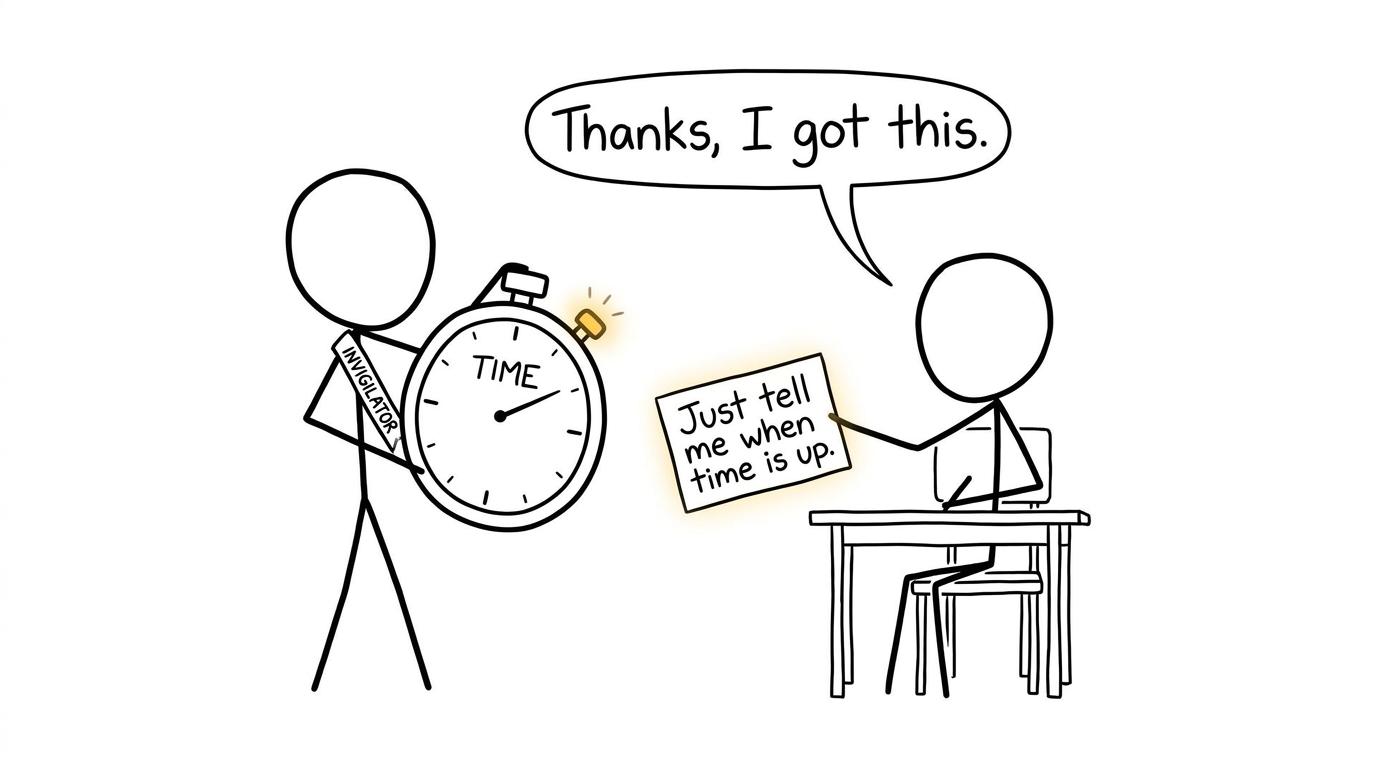 A parent uses a stopwatch while wisely leaving the actual GCSE practice to the student
Common mistakes to avoid
Using resources from the wrong exam board
Question structures, prescribed texts and mark schemes are not interchangeable. Students should confirm their English exam board and specification with their school. For maths, they should likewise select the correct papers from MathsGenie’s GCSE past papers collection.
Starting with a full paper every time
Full papers are valuable, but they are not always the best first response to a knowledge gap. A short quiz, one planned response or a focused practice question may reveal more without exhausting the student. Full papers become especially useful when practising selection, timing and stamina.
Treating a mark scheme as a script
Mark schemes describe how credit is awarded; they are not model essays to memorise. English responses can make different valid arguments. In maths, mark schemes and video solutions are useful for locating the exact step where a method went wrong, especially when reviewing higher-grade GCSE maths topics.
Giving feedback on everything at once
A page covered in corrections can make improvement feel impossible. Choose one or two priorities that the student can apply in the next attempt. Feedback should create a next action, not merely document every weakness.
Neglecting maths while concentrating on English
A difficult English essay can expand to fill an entire evening. Students preparing for several GCSE examinations need balance. MathsGenie’s topic pages, mini tests, practice questions and video solutions make it easier to define a manageable maths task rather than leaving revision as an open-ended instruction.
Support should make independence more likely
The best parental involvement is often quiet. It provides a place to work, a sensible question, a cup of tea, a timer or a reminder that one difficult response does not predict an examination result. Then it steps back.
For students, asking for specific help is a revision skill in itself. Say whether you need to be tested, heard, timed or simply left alone for a while. For parents, the question is not “How can I control revision?” but “What obstacle can I remove without taking over?”
Once English revision is planned, give maths the same clarity. Use MathsGenie’s free GCSE revision hub for revision lessons, practice questions, mini tests and video solutions, then build examination confidence with GCSE past papers and mark schemes and predicted GCSE maths papers. Choose one useful next task, complete it independently and let support remain what it should be: a foundation, not a substitute.