

OCR MEI Further Maths A Boundary Explained
OCR MEI Further Maths A boundary guide: see past marks, understand weighted option routes and calculate a realistic target for your A Level exams.
A student checking the OCR MEI Further Maths A boundary usually wants one number. The awkward truth is that there is not one permanent mark, and there may not even be one boundary for every student in the same exam series.
OCR Further Mathematics B (MEI), specification H645, has different combinations of optional papers. OCR publishes an overall boundary for each permitted route after marking has taken place. Your result therefore depends on your total weighted mark for the exact papers you took.
The short answer is this: find your route in OCR's grade-boundary document, read the figure in the A column, and compare it with your weighted total. Never assume that a previous year's boundary, or another route's boundary, will be your boundary.
A quick boundary checklist
Before turning a past boundary into a revision target, check:
- the qualification is Further Mathematics B (MEI), H645;
- the document is for the correct exam series and year;
- the row contains your exact combination of paper codes;
- you are reading the overall weighted boundary, not one paper's notional boundary;
- you have selected the A column rather than the A* column;
- you have left a sensible margin above any historical figure.
That last point matters. A boundary describes what happened after an exam. It is not a promise about the next one.
What mark has previously been needed for an A?
OCR's June 2024 grade-boundary document provides a useful dated illustration. For H645, one published overall route had a maximum weighted mark of 360360360, with the A boundary at 249249249.
As a percentage, that is
249360×100≈69.2%.\frac{249}{360}\times 100\approx 69.2\%.360249×100≈69.2%.This does not mean that every future student needs exactly 249249249 marks. It tells us only that, for that particular route and exam series, 249249249 weighted marks met the boundary for an A.
It is tempting to reduce the whole question to a percentage. But grade boundaries respond to the demand of the papers and the evidence produced by the cohort. A harder set of papers may have a lower boundary; a more accessible set may have a higher one. The final decision belongs to OCR, not to a revision calculator.
For planning, historical boundaries are better treated as landmarks than destinations. If a past A boundary was around 69%69\%69%, working towards roughly 75%75\%75% in timed practice gives more protection against normal variation, dropped method marks and a paper that happens to suit you less well. That is revision advice, not a prediction of OCR's next boundary.
How optional papers affect your total
The option structure is where many otherwise careful calculations go wrong. H645 students sit common core content and follow an approved route containing optional components. Different option papers can have different raw totals and weightings, so simply adding the marks printed on the front of every paper may not produce the overall figure used for grading.
OCR converts component results into weighted marks where necessary. Conceptually, the calculation is
weighted mark=raw markraw maximum×component weighting.\text{weighted mark}=\frac{\text{raw mark}}{\text{raw maximum}}\times\text{component weighting}.weighted mark=raw maximumraw mark×component weighting.Suppose, purely as an illustration, that a paper were worth 606060 raw marks but contributed 727272 weighted marks. A raw score of 454545 would contribute
4560×72=54\frac{45}{60}\times72=546045×72=54weighted marks.
This example explains the method; it is not a statement of the weighting for a particular H645 paper. Use OCR's specification and results information for the actual components in your route.
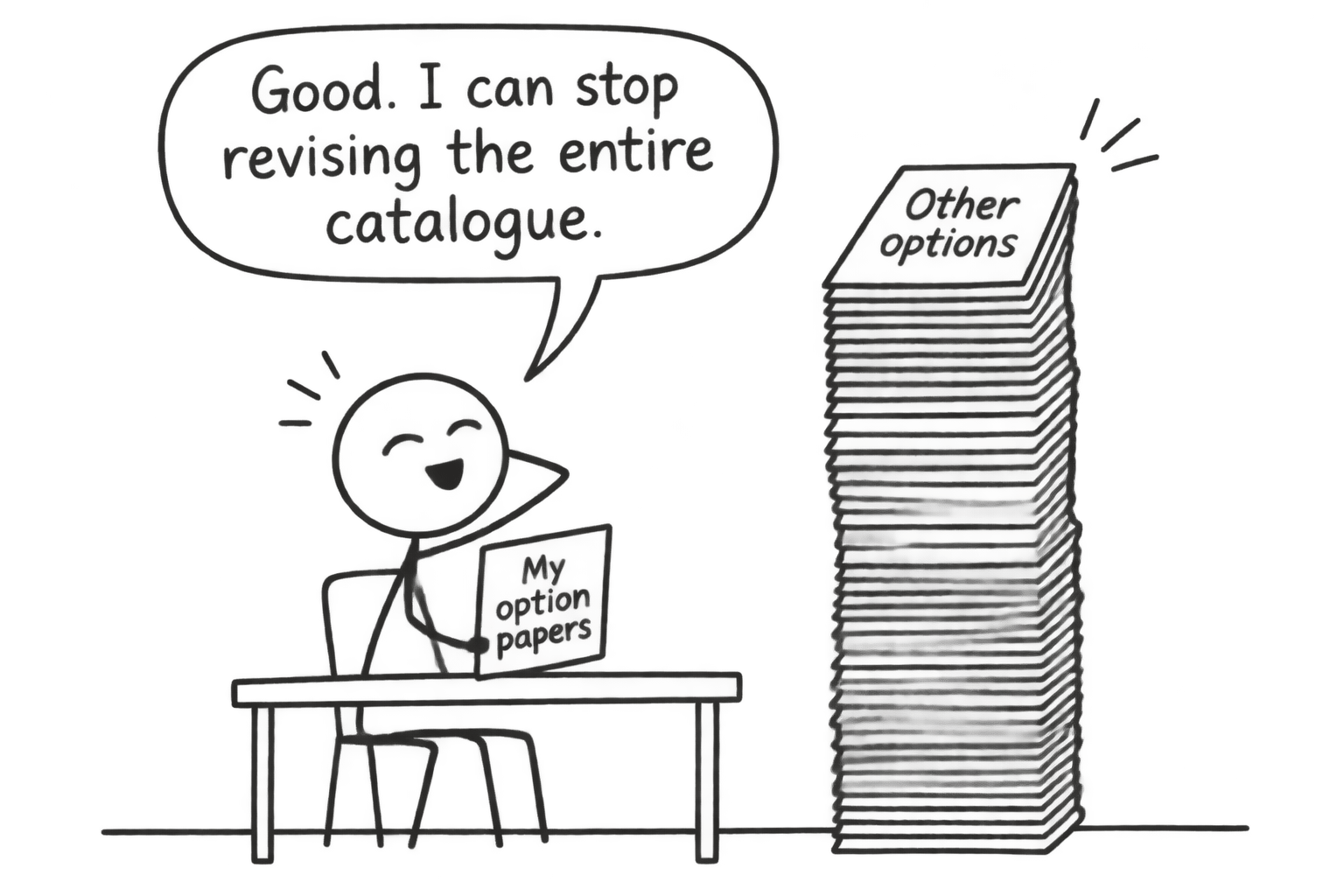 A student ignores a tall pile of irrelevant option papers and focuses on their own route
The safest process is simple:
- write down every component code from your timetable or entry information;
- locate that exact combination in the boundary document;
- calculate or obtain the weighted marks for those components;
- add the weighted marks;
- compare the total with the overall route boundary.
Two students can earn the same raw total across differently structured routes yet finish with different weighted totals. They may also face different published boundaries. That is not inconsistency; it is the mechanism that lets OCR combine valid option routes within one qualification.
Do individual paper boundaries decide your grade?
No. Your certificate grade is determined by the aggregate result for your complete route.
Component boundaries can still be informative. They help you judge how a paper performed relative to its difficulty, but they are described as notional because components do not receive separate qualification grades. A mark below the notional A boundary on one paper does not prevent an A overall if stronger marks elsewhere lift the aggregate total.
Imagine a student who finds mechanics difficult but is consistently strong in core pure and statistics. The weaker paper matters, but it does not stand alone. Marks can compensate across the route because the qualification grade is based on the combined weighted result.
This is good news for revision. You do not need every paper to look identical. You need a total that is secure.
Turning a past boundary into a useful target
Start with several complete past-paper attempts under timed conditions. Mark them strictly, including lost notation, incomplete reasoning and unsupported answers. A generous self-mark creates confidence for an afternoon; an accurate one improves the next paper.
Then record results by topic as well as by component. The biggest gains often come from recurring losses:
- a standard method that is not yet automatic;
- algebraic slips within longer pure questions;
- failure to state assumptions in applied work;
- calculator output without sufficient mathematical justification;
- leaving unfamiliar final parts blank rather than establishing useful intermediate results.
Use the Maths Genie A Level revision page to revisit the underlying ideas, then return to questions that demand those ideas in a Further Maths setting. The A Level Maths past papers are also valuable when a lost Further Maths mark traces back to an ordinary A Level skill such as integration, trigonometry or vectors.
A sensible tracker records three values:
raw mark,weighted total,margin above target.\text{raw mark},\qquad \text{weighted total},\qquad \text{margin above target}.raw mark,weighted total,margin above target.The third is often the most revealing. A student scoring one mark above an old boundary is not in the same position as one scoring comfortably above it across several papers.
Topics that can move marks most
There is no universal list because the best topic is the one repeatedly costing you marks. Diagnose before revising.
If a question collapses because the algebra underneath it is unreliable, strengthen that foundation with Maths Genie lessons on algebraic fractions, the binomial expansion and proof. If calculus is the bottleneck, revisit differentiation and integration.
The principle is quiet but powerful: revise the cause of the lost mark, not merely the page on which it appeared. One repaired technique can improve several components.
Common mistakes when checking the boundary
The first mistake is searching for “OCR Further Maths” and using a boundary for a different specification. OCR offers more than one Further Mathematics qualification, so confirm B (MEI) and H645.
The second is reading the wrong route. Optional components are part of the boundary calculation, not a footnote. Match every paper code.
The third is adding raw marks when the published overall boundary uses weighted marks. Check the units before comparing totals.
The fourth is treating a component's notional boundary as a required minimum. Your overall aggregate determines the qualification grade.
Finally, students sometimes aim exactly at last year's figure. That turns a historical observation into a fragile target. Build a margin instead.
From boundary checking to mark building
The OCR MEI Further Maths A boundary can tell you where an A finished in a completed exam series. It cannot tell you which five marks are easiest for you to recover next.
Your marked papers can.
Check the official route, calculate using weighted marks and use dated boundaries only as evidence. Then move from prediction to action. Open the Maths Genie A Level lessons, choose the topics behind your repeated errors, and practise until those marks stop feeling accidental.















