

OCR MEI A-Level Maths A Boundary Explained
OCR MEI A-Level maths A boundary guide: see recent marks, combine your three paper scores and set a sensible target for achieving an A grade.
A Year 13 student opens a search tab after completing a past paper. The question is simple: what mark is actually needed for an A?
The short answer is that the OCR MEI A-Level maths A boundary changes each year. For OCR Mathematics B (MEI), qualification code H640, the published June 2024 boundary for an A was 190190190 out of 275275275. That is about 69.1%69.1\%69.1%, but it should be treated as a dated illustration, not a guaranteed boundary for another exam series.
Your final grade comes from your combined mark across three papers. You do not have to earn an A on every component. What matters is the total after all three raw marks are added together.
OCR MEI A-Level grade boundaries at a glance
Here is the essential checklist before you turn one historic number into a revision target:
- OCR Mathematics B (MEI) is specification H640.
- The qualification has three written components.
- The available raw marks total 275275275.
- Your marks from the three components are added together.
- OCR sets the overall qualification boundary after the examination series.
- Grade boundaries can rise or fall when the demand of the papers changes.
- Aiming exactly at an old boundary leaves very little protection against variation.
In June 2024, the published overall boundaries included 231231231 for an A* and 190190190 for an A, both out of 275275275. The A boundary can be expressed as
190275×100≈69.1%.\frac{190}{275}\times 100\approx 69.1\%.275190×100≈69.1%.This calculation is useful for understanding the scale of the target. It does not mean that OCR promises an A at roughly 69%69\%69% every year.
How the three OCR MEI paper totals combine
OCR Mathematics B (MEI) has the following structure:
| Component | Maximum raw mark |
|---|---|
| Pure Mathematics and Mechanics | 100100100 |
| Pure Mathematics and Statistics | 100100100 |
| Pure Mathematics and Comprehension | 757575 |
| Qualification total | 275275275 |
Suppose the Year 13 student records these timed-paper marks:
64+70+58=192.64+70+58=192.64+70+58=192.The combined total is 192192192 out of 275275275. Against the June 2024 boundaries, that would have been above the A boundary of 190190190. It would not guarantee an A in a future series because that future boundary will be set using evidence from those particular papers.
This is the point students sometimes miss. The profile can be uneven. A weaker mechanics result can be balanced by stronger statistics or comprehension performance, provided the combined qualification mark reaches the overall boundary.
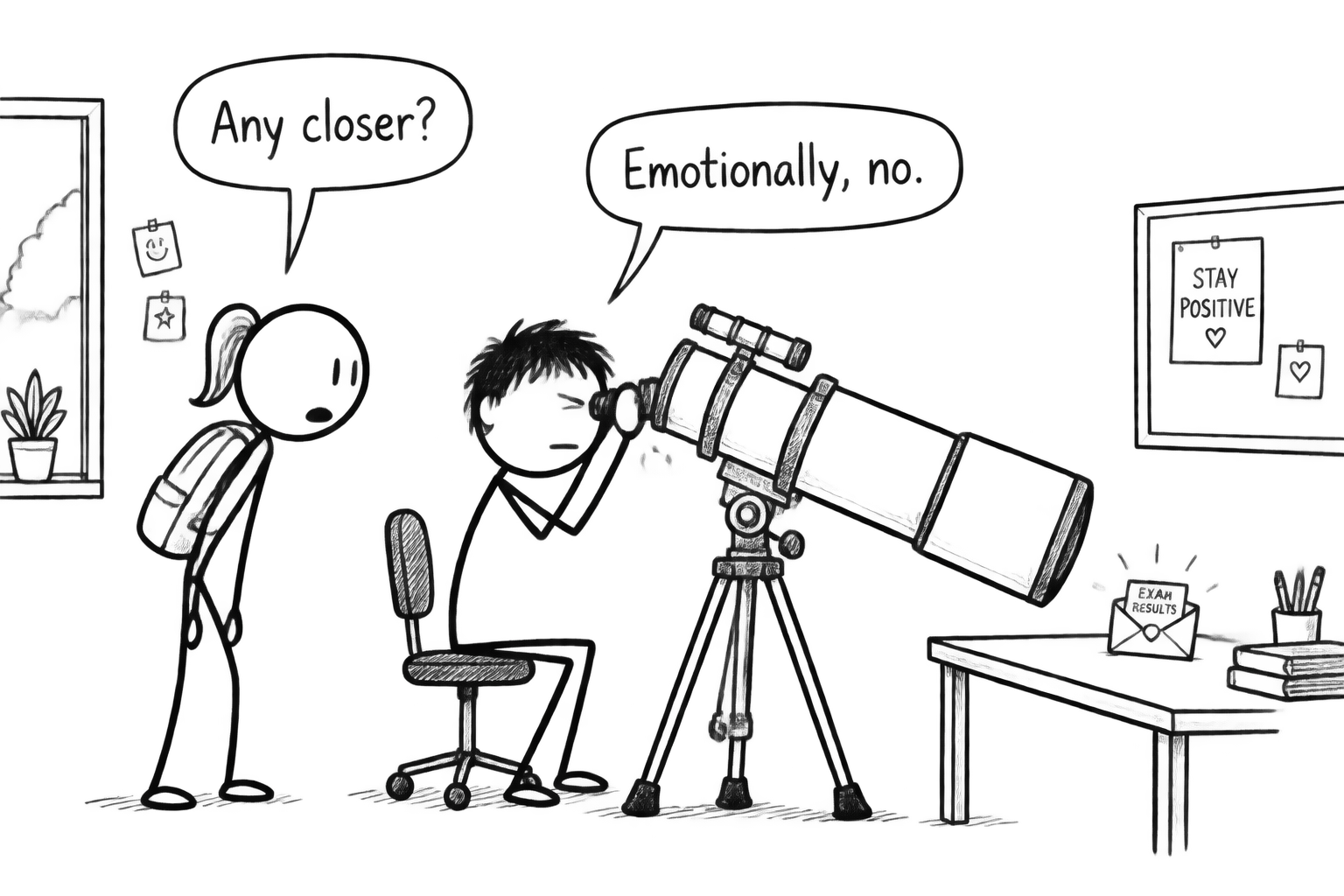 XKCD-style comic of a Year 13 student using a telescope to inspect an exam results envelope
What past OCR MEI boundaries can tell you
Past boundaries are evidence, not predictions. The official June 2024 figures give one reliable illustration:
| Exam series | Maximum mark | A* boundary | A boundary |
|---|---|---|---|
| June 2024 | 275275275 | 231231231 | 190190190 |
A student using this information well asks, “What does this reveal about my current performance?” A student using it badly asks, “How many topics can I safely ignore?”
The first question supports revision. If your recent total is 170170170, the June 2024 comparison suggests a gap of 202020 marks from that year’s A boundary:
190−170=20.190-170=20.190−170=20.Those marks do not need to come from one dramatic breakthrough. They might come from four extra marks on integration, three from clearer mechanics modelling, several from algebraic accuracy and the remainder from finishing the comprehension paper more effectively.
That is often how grades move. Improvement is less like finding a secret and more like closing several small leaks.
Why the A boundary changes each year
Exam boards do not simply fix one percentage forever. Grade boundaries are set after the papers have been taken and marked, using statistical evidence alongside expert judgement. Their purpose is to maintain a comparable standard when one examination series is more or less demanding than another.
If a paper proves more demanding, the boundary may be lower. If candidates generally find a paper more accessible, it may be higher. This is why comparing only percentages can create unnecessary panic. A harder paper may feel worse while you are sitting it, but the boundary-setting process exists to account for differences in demand.
Paper-level boundary information also requires care. Your qualification grade is based on the overall total, so a component boundary is not an additional hurdle that must be cleared separately. The safest number to use when assessing a complete set of papers is the published overall H640 boundary for the same series.
Set a target above the historical boundary
A sensible revision target includes a buffer. If a recent A boundary was 190190190, aiming for exactly 190190190 makes every careless sign error feel expensive and assumes that the next boundary will not rise.
A target around 200200200 or more can be more useful for planning, although no unofficial target guarantees a grade. For example, a balanced route to 205205205 could be
73+72+60=205.73+72+60=205.73+72+60=205.Another student might reach the same total through
78+68+59=205.78+68+59=205.78+68+59=205.The lesson is not that these exact component scores are required. It is that there are many viable routes to an A-Level maths A. Your revision plan should reflect your own mark profile rather than somebody else’s strongest topics.
Use complete timed papers to estimate your total, then use topic questions to repair the reasons marks were lost. Maths Genie’s A-Level Maths revision resources let you move between revision lessons, exam questions and video support without turning every weak area into a separate search project.
The topics most likely to move your mark
Start with topics that appear frequently and support other parts of the course. Algebraic fluency matters because a calculus method can be correct while manipulation afterwards loses the marks. Trigonometry connects equations, identities, differentiation and integration. Mechanics depends on setting up a model before applying familiar algebra.
Prioritise:
- algebra and functions, particularly rearranging, solving and checking;
- differentiation, including stationary points and connected rates of change;
- integration, especially recognising forms and handling constants correctly;
- trigonometric identities and equations;
- vectors and coordinate geometry;
- mechanics modelling, signs and units;
- statistical distributions, hypotheses and interpretation;
- comprehension practice under time pressure.
The most effective cycle is short: learn the method, answer questions without notes, mark them honestly and record the cause of each lost mark. Then return to the same skill several days later. Maths Genie’s A-Level Maths lessons are particularly useful here because you can target the topics that move marks most rather than revising the course in textbook order.
Common mistakes when checking the boundary
Treating a past mark as this year’s confirmed boundary
A historic OCR MEI A-Level grade boundary applies only to its stated series. The current boundary is not known in advance simply because last year’s figure is available.
Adding percentages instead of raw marks
Add the raw component marks first:
overall mark=paper 1+paper 2+paper 3.\text{overall mark}=\text{paper 1} + \text{paper 2} + \text{paper 3}.overall mark=paper 1+paper 2+paper 3.Do not average three component percentages without accounting for their different maximum marks. The third component is out of 757575, while the first two are each out of 100100100.
Assuming every paper must be at A standard
The overall total determines the qualification grade. One disappointing component does not automatically prevent an A if the other marks compensate for it.
Revising only comfortable topics
Repeatedly answering familiar questions can make a revision session feel productive while leaving the total almost unchanged. Your marked papers reveal where the recoverable marks are.
Using a boundary as the target ceiling
A boundary is the minimum mark awarded that grade in a particular series, not the ideal score to aim for. Build a buffer and judge progress across several full papers, not one unusually good result.
Turn the number into a plan
The Year 13 student who began with a single question now has a better one: where can the next 101010, 151515 or 202020 marks come from?
Begin with your three most recent timed components. Add the raw marks, compare them cautiously with the official boundary for the same past-paper series and categorise every lost mark. Separate missing knowledge from algebra slips, incomplete explanations and time-management problems.
Then act on the pattern. Use the free Maths Genie A-Level Maths lessons to revisit differentiation, integration, trigonometry, mechanics or statistics, and follow each lesson with practice questions. Return to past papers and mark schemes once the skill has had time to settle.
The boundary will always contain some uncertainty until OCR publishes it. Your preparation does not have to. Focus on the topics that move marks most, build a sensible buffer and let each marked paper make the next revision session more precise.















