

OCR Foundation Maths Grade Boundaries Explained
OCR foundation maths grade boundaries explained: available grades, combined paper marks and dated examples, plus focused revision advice from MathsGenie.
Finishing a practice paper can leave you with two questions: how did I do, and was it enough? OCR foundation maths grade boundaries answer the second question by setting the minimum total mark needed for each grade. Marks from all three papers are added together, giving a total out of 300300300. Foundation tier offers grades 111 to 555, and boundaries can change between exam series.
A past boundary helps you understand a past result; it cannot guarantee your next one. Used carefully, though, it gives your revision a useful direction.
The essentials at a glance
For OCR GCSE Maths foundation, specification J560:
- You sit three papers, each worth 100100100 marks.
- Each lasts 909090 minutes and contributes one third of your total.
- Papers 111 and 333 allow a calculator; Paper 222 is non-calculator.
- Your combined mark determines your qualification grade.
- Grade 555 is the highest foundation tier grade available.
- Boundaries belong to a particular exam series.
The MathsGenie OCR GCSE Maths revision hub brings the relevant revision resources together.
How OCR foundation maths grade boundaries work
A grade boundary is the minimum mark needed for a grade in a particular exam series. If your total reaches a boundary, you receive that grade unless you also reach a higher boundary.
You do not need to achieve a separate passing grade on every paper. A stronger performance on one paper can balance a weaker performance on another.
Foundation grades are 111, 222, 333, 444 and 555. A total below the grade 111 boundary receives U, meaning unclassified. Even a very high foundation mark cannot produce grade 666 or above, because those grades require higher tier entry.
Grade 444 is commonly described as a standard pass and grade 555 as a strong pass. For college courses or apprenticeships, check the provider’s stated entry requirements.
How your three paper marks combine
All three papers carry equal weight. There is no extra weighting for the non-calculator paper and no coursework contribution.
Overall mark=Paper 1 mark+Paper 2 mark+Paper 3 mark\text{Overall mark}=\text{Paper 1 mark}+\text{Paper 2 mark}+\text{Paper 3 mark}Overall mark=Paper 1 mark+Paper 2 mark+Paper 3 markThe maximum total is 300300300 marks. One uncomfortable exam does not decide the whole qualification: marks earned on the remaining papers still contribute fully.
OCR also publishes notional component boundaries for individual papers. These describe performance on a component but do not create three separate GCSE grades. Use the overall qualification boundary when judging a complete set.
Dated OCR foundation grade boundaries
These selected minimum totals come from OCR’s official June 2024 and June 2025 GCSE grade-boundary documents. Every figure is out of 300300300 and applies to foundation tier J560, combining Papers 111, 222 and 333.
| Grade | June 2024 minimum total | June 2025 minimum total |
|---|---|---|
| 555 | 180180180 | 182182182 |
| 444 | 131131131 | 134134134 |
| 333 | 939393 | 959595 |
| 222 | 555555 | 565656 |
These are historical boundaries, not predictions. Neither series establishes a permanent pass mark.
Always match the boundary to the papers you completed. A June boundary should not automatically be applied to November papers or a school assessment assembled from different sources.
Organise a complete practice set using OCR GCSE Maths past papers, with mark schemes and worked solutions where available. Keeping the year and series consistent makes your comparison meaningful.
Why grade boundaries change
Papers assess the same specification, but their overall difficulty can vary. Awarding uses evidence about the assessments and students’ performance to maintain grading standards across series.
A more demanding set may therefore have lower boundaries; a less demanding set may have higher ones. The aim is to maintain the standard represented by a grade.
A fixed percentage rule is therefore unreliable. Boundaries are established through awarding after the exams, so forecasts made beforehand remain uncertain.
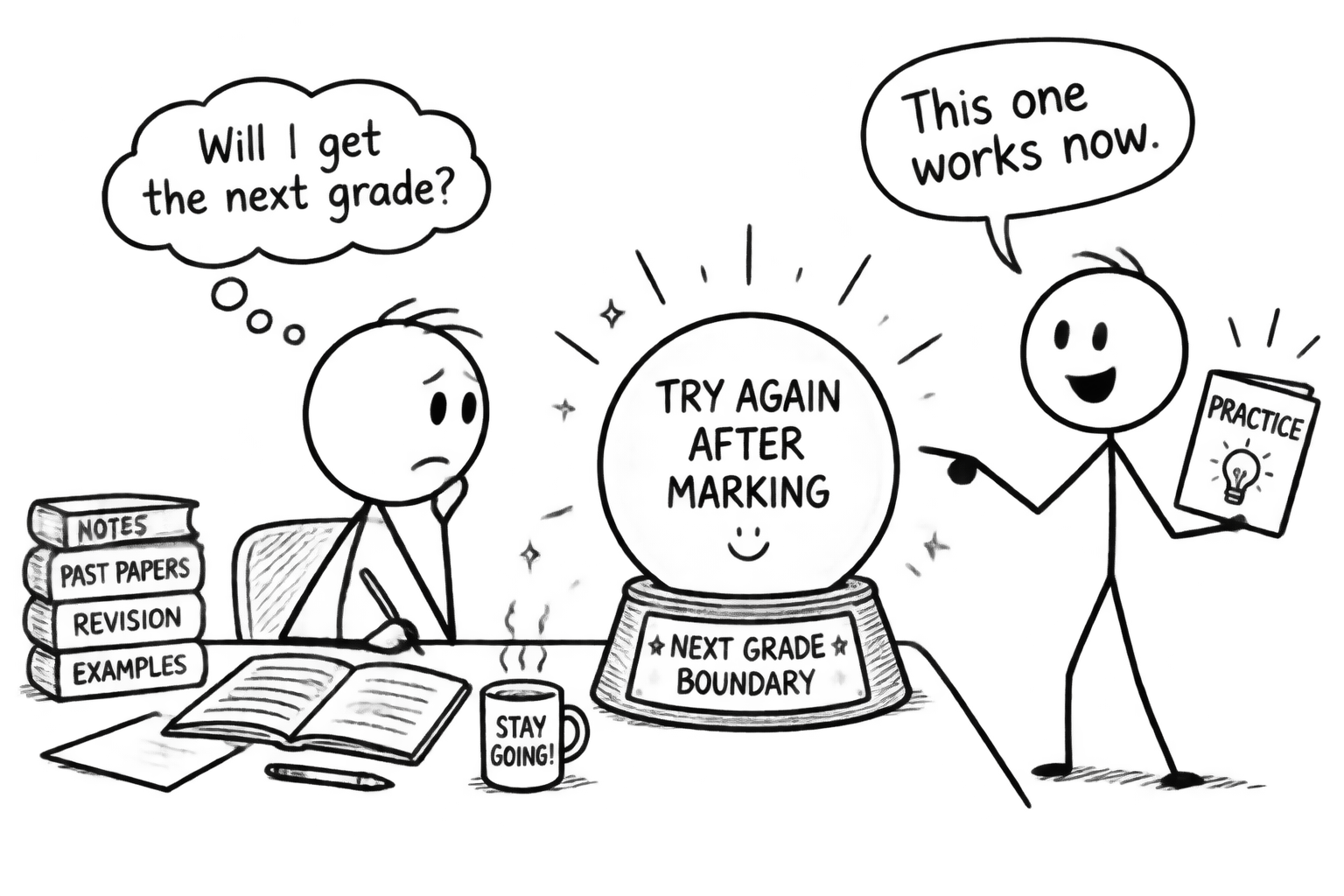 Stick-figure students compare a grade-boundary crystal ball with a practice book
Turn a boundary into a revision decision
A boundary tells you where a threshold was. Your marked script tells you what to practise next.
After completing a full set, use the mark schemes and record why you lost marks. Separate missing knowledge from arithmetic slips, misunderstood instructions and unfinished questions. Each needs a different response.
For a forgotten method, return to a lesson. For repeated errors, practise a short set and check each answer. For timing difficulties, build towards timed sections before another full paper.
Choose a working target above the historical boundary. This provides room for mistakes and boundary movement, although no practice target guarantees a grade.
Focus on gaps that affect several topics
Number skills support work throughout the course. Start with fractions, decimals and percentages revision if conversions repeatedly interrupt your progress. For percentage problems, use the OCR percentage change lessons before trying fresh questions independently.
Check ratio, equations, measures, graphs and interpreting data against your marked work too. Choose manageable gaps that cost marks, rather than only revisiting comfortable topics.
Use OCR topic exam booklets to check whether your revision transfers to exam questions. Watching a solution explains a method; completing a fresh question tests whether you can use it.
Common mistakes when reading grade boundaries
Treating one paper as the final result. Your qualification grade comes from the combined total.
Using the wrong table. Check OCR, J560, foundation tier, the year and exam series. Higher tier boundaries apply to different papers.
Comparing raw marks across exam boards. Qualifications with different maximum totals cannot be compared directly using raw marks.
Treating predictions as confirmed. Predicted papers provide practice but cannot establish an upcoming official boundary.
Stopping at last year’s threshold. A result close to a boundary leaves little room for variation. Keep improving the skills behind the score.
Make the next marks easier to earn
Keep your dated comparison, then return to the questions that reveal where improvement is possible.
Start with MathsGenie’s free OCR GCSE Maths lessons. Choose a topic that costs you marks, learn the method, practise independently and check your work. Small, specific improvements can change the total.















