

OCR A Further Maths A Boundary: Marks Needed
OCR A Further Maths A boundary explained with dated examples, optional-paper totals and a practical way to set your target mark for an A grade.
A student can finish an OCR A Further Maths paper with a strangely precise question in mind: was that enough for an A? The honest answer is that the OCR A Further Maths A boundary is not fixed before the exams. OCR sets grade boundaries after the series, once the papers have been taken and the overall standard of performance can be considered.
There is another detail that matters. OCR A Further Mathematics A has two compulsory pure papers and two optional papers, so the mark needed for an A depends on your assessed combination. You must compare your total with the published boundary for the correct route, not with an isolated paper boundary or another student's combination.
The short answer
For the full OCR A Level Further Mathematics A qualification, the maximum total is 300300300 raw marks:
100+100+50+50=300 100+100+50+50=300 100+100+50+50=300You take:
- Pure Core 1, Y540, worth 100100100 marks
- Pure Core 2, Y541, worth 100100100 marks
- two optional papers, each worth 505050 marks
The optional papers are Statistics, Mechanics, Discrete Mathematics and Additional Pure Mathematics. Your school or college chooses the route for which you are entered.
The precise A boundary changes by exam series and optional-paper combination. In OCR's published June 2025 boundaries, for example, an A was 198198198 out of 300300300 for the route combining Pure Core 1, Pure Core 2, Statistics and Mechanics. That is an illustration from one completed series, not a prediction for the next examination.
A sensible checklist is:
- confirm your paper codes and optional route;
- total all four raw marks out of 300300300;
- find the overall qualification boundary for that exact route and series;
- use historic boundaries as a guide, not a promise;
- build a safety margin into your revision target.
How the OCR A Further Maths total works
OCR's specification identifies H245 as A Level Further Mathematics A. Every student takes Y540 and Y541, the two Pure Core papers, plus at least two optional papers from Y542 to Y545. The qualification result is based on an overall route total.
That means a hypothetical student taking Statistics and Mechanics would calculate:
Total=Y540+Y541+Y542+Y543 \text{Total}=\text{Y540}+\text{Y541}+\text{Y542}+\text{Y543} Total=Y540+Y541+Y542+Y543Suppose the four marks were 686868, 646464, 343434 and 353535. The total would be:
68+64+34+35=201 68+64+34+35=201 68+64+34+35=201For the June 2025 Statistics and Mechanics route, the published A boundary was 198198198. A total of 201201201 would therefore have reached an A in that series. It does not follow that 201201201 will secure an A in a future series, because boundaries can move.
This aggregation has an encouraging consequence. You do not ordinarily need to reach an A-level notional boundary on every component. A weaker paper can be offset by stronger marks elsewhere because the overall route total decides the qualification grade.
Why optional papers affect the boundary
The phrase “the OCR A Further Maths boundary” can sound as if there is one universal number. In practice, OCR publishes separate overall options because candidates can complete different optional-paper combinations.
The compulsory core contributes two-thirds of the available marks:
200300=23 \frac{200}{300}=\frac{2}{3} 300200=32The two options together contribute the remaining third:
100300=13 \frac{100}{300}=\frac{1}{3} 300100=31Different combinations can have slightly different overall boundaries. The June 2025 OCR document, for instance, lists multiple H245 option routes rather than one result line for every candidate. Published A boundaries shown in the document include values such as 198198198, 196196196, 194194194 and 191191191 out of 300300300 for different listed combinations.
This does not make one route automatically easier. Grade boundaries respond to the demand of the papers and the evidence from that examination series. Nor should you compare one option's raw mark in isolation with another option's mark. The meaningful comparison is your total against your own route's overall boundary.
If a centre enters a candidate for more than two optional components, the entry and aggregation rules become more technical. Confirm the route being used with your exams officer rather than assuming that every optional mark is simply added. For normal revision planning, work from the four papers attached to your intended H245 route.
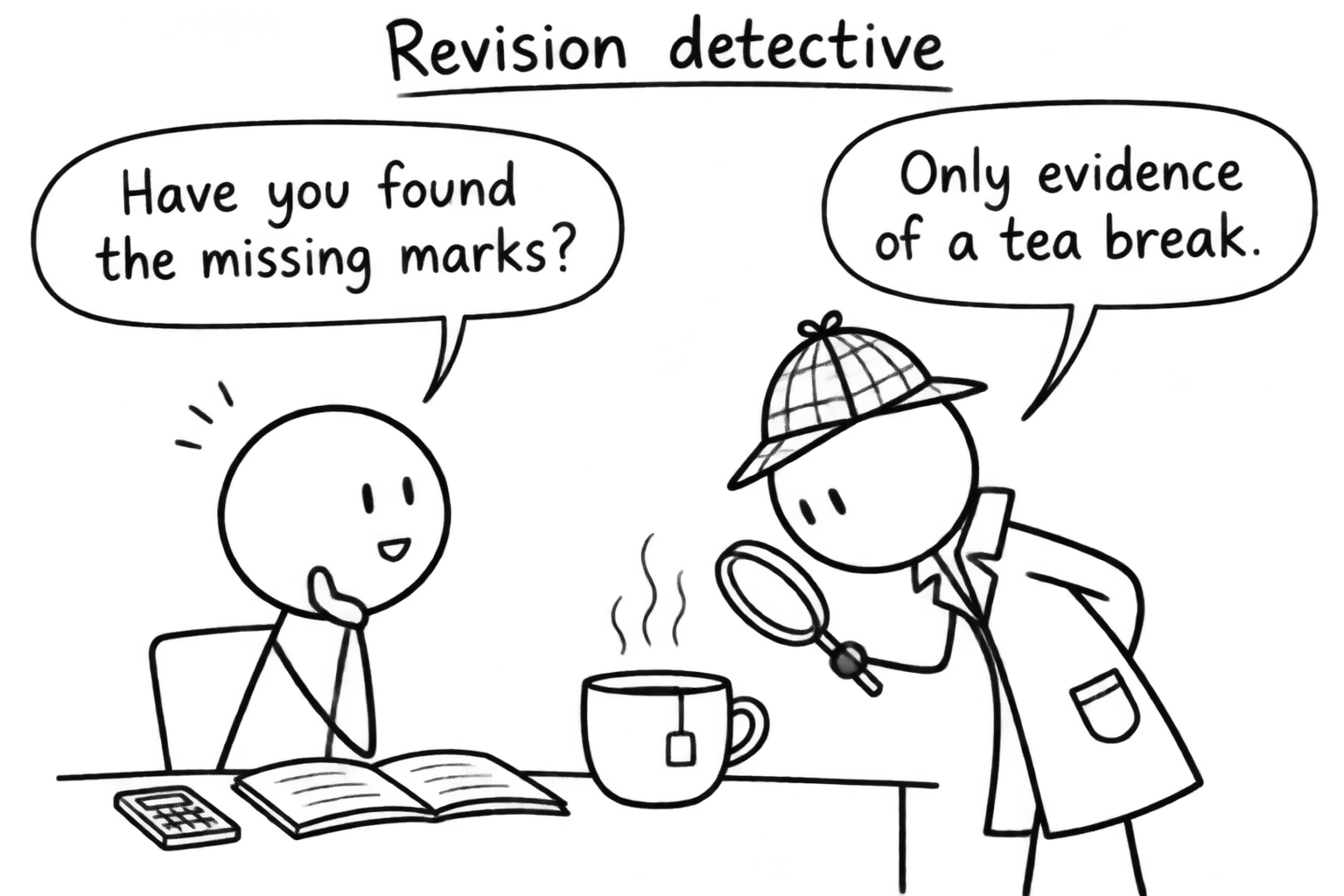 A revision detective searches for missing marks but finds evidence of a tea break
Using OCR A Further Maths grade boundaries properly
Past boundaries are useful because they turn a vague ambition into a mark target. They become misleading when treated as forecasts.
Start with the official boundary document for the relevant year. Find H245, then match all four paper codes. Check that you are reading the overall qualification line and the A column. Component boundaries may be described as notional. They can help interpret performance on an individual paper, but they do not replace the route total used for the final grade.
Next, calculate the percentage only if it helps you compare performances:
Percentage=raw mark300×100 \text{Percentage}=\frac{\text{raw mark}}{300}\times 100 Percentage=300raw mark×100For the June 2025 Statistics and Mechanics example:
198300×100=66% \frac{198}{300}\times 100=66\% 300198×100=66%That percentage describes a historic outcome for a particular route and series. It is not a permanent rule that an A always requires 66%66\%66%.
When completing Maths Genie A Level past papers, record the raw mark from the mark scheme before checking any boundary. This separates two questions: how accurately did you complete the paper, and what grade would that performance have represented in its original series?
Set a target above the historic boundary
Aiming exactly at one old boundary leaves little room for a difficult question, an omitted justification or a calculator error. A more robust plan is to choose a buffer.
If a relevant historic boundary is 198198198, a working target might be 210210210:
210−198=12 210-198=12 210−198=12That is a planning margin, not an official prediction. It gives your revision somewhere useful to go. You could distribute a total target as:
72+68+35+35=210 72+68+35+35=210 72+68+35+35=210Your own distribution may look different. A student strong in pure mathematics may collect more marks on Y540 and Y541; another may rely on an especially secure option. The total matters, but the paper-by-paper targets reveal where improvement is realistic.
Review several complete papers under timed conditions. Then group lost marks into categories:
- knowledge gaps;
- incomplete reasoning or proof;
- algebraic and arithmetic slips;
- misread instructions;
- unfinished questions caused by timing.
The categories matter more than the emotional label of “careless”. A missing method needs a lesson. A repeated sign error needs deliberate checking. A timing problem needs timed sets and decisions about when to move on.
Topics that can move your mark
The best revision target is not always the topic you dislike most. It is often the topic where a modest amount of focused work can recover several repeatable method marks.
Use Maths Genie A Level Maths revision to strengthen the algebra, calculus, vectors, trigonometry and statistical foundations that Further Maths questions frequently rely upon. A sophisticated Further Maths method can still collapse under an insecure rearrangement or differentiation step.
Then return to your marked OCR papers. Select the recurring gaps and use Maths Genie lessons, practice questions and video solutions to rebuild those methods. Finish with another timed paper and apply the official mark scheme consistently. This cycle is more useful than repeatedly reading solutions that already feel familiar.
Common mistakes when checking the A boundary
The first mistake is using a boundary from the wrong year. Boundaries belong to a specific examination series.
The second is using the wrong optional combination. Two students can both be taking OCR A Further Mathematics A but have different route codes and, potentially, different overall boundaries.
The third is adding percentages from separate papers. Add raw marks instead:
Overall raw mark=∑component raw marks \text{Overall raw mark}=\sum \text{component raw marks} Overall raw mark=∑component raw marksThe fourth is treating notional component boundaries as separate grade requirements. Your qualification grade is awarded from the relevant overall route total.
Finally, students sometimes revise towards the exact historic cut-off. That turns every lost mark into a crisis. A buffered target is calmer and more practical because it accepts that real examination performances vary.
Turn the boundary into a revision decision
The boundary cannot tell you what the next paper will ask. It can tell you whether your current performance is close, and your marked scripts can tell you where the next marks are likely to come from.
Confirm your optional route, mark a full set of papers, total the raw marks and compare them with the matching dated boundary. Then choose one or two recurring weaknesses rather than trying to revise the entire course at once.
Start with Maths Genie A Level lessons and revision resources on the topics that can move your mark most. Follow each lesson with practice, mark it honestly, and return to a timed paper. The grade boundary is only a line on a document. The useful work happens in the marks you learn how to recover.















