

OCR A A-Level Maths D Boundary Explained
OCR A A-Level maths D boundary explained with recent marks, paper totals and practical advice to help Year 13 students plan focused revision.
A Year 13 student opens a grade-boundary table looking for one number: the mark needed for a D. It feels as if that number will settle everything. In reality, it is useful, but it is not fixed.
The OCR A A-Level maths D boundary was 757575 marks out of 300300300 in June 2024. That is exactly 25%25\%25% of the available marks. It is a helpful historical benchmark, not a guaranteed boundary for another exam series. OCR sets grade boundaries after the papers have been taken and marked, so the mark required can change from year to year.
The practical answer is therefore simple: use published boundaries to understand the standard, but build a safety margin rather than revising towards one exact mark.
The short answer and revision checklist
When checking what you might need for an A-Level maths D, remember:
- OCR Mathematics A is qualification code H240.
- The qualification has three written papers, each worth 100100100 marks.
- Your raw marks are added to produce a total out of 300300300.
- The final qualification boundary matters, not three separate paper grades.
- In June 2024, the D boundary was 757575 out of 300300300.
- A future D boundary may be higher or lower.
- Your revision target should sit above the historical boundary.
You can use the free OCR A-Level Maths revision hub to move from checking boundaries to answering exam-style questions. It brings together topic revision and OCR papers in one place.
How the three paper totals combine
OCR A-Level Mathematics A is assessed through three papers:
- Paper 111: Pure Mathematics
- Paper 222: Pure Mathematics and Statistics
- Paper 333: Pure Mathematics and Mechanics
Each paper contributes 100100100 raw marks, giving:
100+100+100=300100+100+100=300100+100+100=300Suppose a student receives the following marks:
28+24+31=8328+24+31=8328+24+31=83Their qualification total is therefore 838383 out of 300300300. OCR compares that combined total with the overall qualification boundaries for that exam series.
This matters because a weak paper does not automatically prevent a particular grade. A stronger performance elsewhere can compensate. If mechanics goes badly but pure mathematics and statistics go better, all three marks still enter the same total.
The component boundaries shown in OCR documents are described as notional. They help explain performance on individual papers, but the overall H240 boundary determines the qualification grade. Do not treat a notional D boundary on each component as three separate hurdles that must all be cleared.
Maths Genie’s OCR A-Level grade calculator lets you combine paper marks out of 300300300. It can estimate a grade from available boundary data, although no calculator can know a new series boundary before OCR publishes it.
What the June 2024 D boundary tells you
OCR’s published June 2024 boundaries gave this overall H240 picture:
| Grade | Overall raw-mark boundary |
|---|---|
| A∗\mathrm{A^*}A∗ | 216216216 |
| A\mathrm{A}A | 168168168 |
| B\mathrm{B}B | 137137137 |
| C\mathrm{C}C | 106106106 |
| D\mathrm{D}D | 757575 |
| E\mathrm{E}E | 444444 |
The maximum was 300300300 marks. For a D:
75300×100=25%\frac{75}{300}\times 100=25\%30075×100=25%That percentage can look surprisingly low. It does not mean the course is easy or that knowing one quarter of the content guarantees a D. Raw-mark percentages and grades are not designed to have a permanent one-to-one relationship. Questions vary in demand, and grade boundaries account for the overall difficulty of a particular series.
It also matters where marks come from. A student does not need to complete every demanding final question. Method marks, accurate early steps and reliable performance on accessible questions can accumulate across six hours of assessment. The OCR A-Level Maths revision page provides exam-style questions and worksheets that help turn those opportunities into repeatable marks.
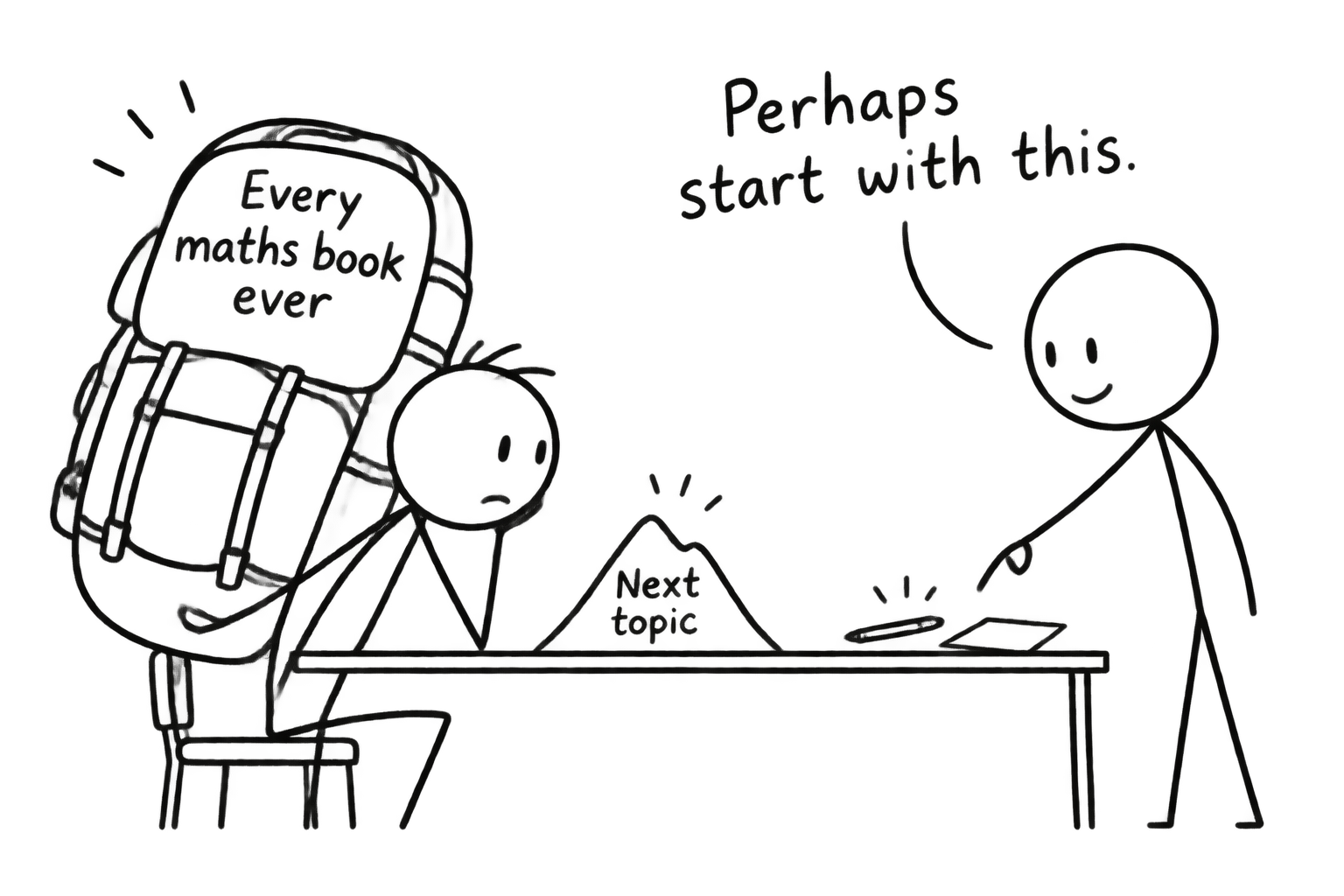 A Year 13 student swaps an enormous revision backpack for one useful practice sheet
Why OCR A-Level grade boundaries change
Grade boundaries are not chosen in advance as a permanent percentage. Awarding organisations set them after reviewing evidence from the exam series. Their purpose is to maintain a comparable standard when one set of papers is more or less demanding than another.
Imagine two papers testing the same specification. One contains unfamiliar wording that makes several questions harder to access. If students generally find that series more demanding, the same level of mathematical performance may be represented by a lower raw mark. If another series proves more accessible, a boundary may rise.
This is why dated past boundaries should always carry their exam series. Say “the June 2024 D boundary was 757575”, rather than “a D is 757575”. The first statement is evidence. The second turns a historical figure into a promise it cannot make.
Year-to-year movement can reflect the demand of the papers and the evidence used during awarding. It is not a reason to predict that boundaries must rise after a low year or fall after a high one. Boundaries do not move in a simple pattern.
Set a safer target than the published boundary
If a student needs a D for a university, apprenticeship or employment condition, aiming at exactly 757575 would be fragile. One misread question or difficult mechanics section could remove the entire cushion.
A better approach is to choose a working target above recent D boundaries, then divide it across the papers. For example, a target of 909090 gives:
903=30\frac{90}{3}=30390=30That suggests an average target of 303030 marks per paper. The marks do not actually need to be equal. A plan such as
34+29+27=9034+29+27=9034+29+27=90works just as well in the final total.
This is not a prediction of the next boundary. It is a revision buffer. The larger lesson is that the target should reflect uncertainty, rather than pretending uncertainty does not exist.
Start with a timed OCR paper from the OCR A-Level Maths past-paper collection. Mark it strictly, record marks lost by topic and separate knowledge gaps from avoidable errors. The available mark schemes show whether a correct method earned credit even when the final answer did not.
Lessons on the topics that move marks most
Students near a D often benefit more from dependable core skills than from spending an evening on the hardest question in a paper. Prioritise topics that recur and support other parts of the course:
- algebraic manipulation and solving equations
- functions, graphs and transformations
- trigonometry
- differentiation and integration
- exponentials and logarithms
- statistical distributions and hypothesis testing
- kinematics and forces
The exact priority should come from your own marked papers. If algebraic errors damage calculus, repair the algebra first. If mechanics methods are understood but signs are often wrong, practise drawing and labelling a clear model before calculating.
Use Maths Genie’s free A-Level Maths revision resources for focused revision lessons, questions and worked support. A productive cycle is short: learn one idea, answer questions without notes, mark them, then return to the precise step that failed. After topic practice, complete another OCR paper under timed conditions.
Common mistakes when checking the D boundary
Treating one past boundary as permanent
The June 2024 figure belongs to June 2024. It illustrates the standard but cannot guarantee the boundary in a later series.
Averaging paper percentages incorrectly
Because all three papers are worth 100100100 marks, adding raw marks is straightforward. Use the total out of 300300300. Do not round each paper to a grade and then average those grades.
Confusing notional component boundaries with the final grade
OCR may publish component boundaries for information. The overall qualification boundary is what determines the final H240 grade.
Aiming exactly at the line
A boundary is the minimum mark for that grade in that series. It is not a sensible revision target. Give yourself room for a harder paper, timing trouble and ordinary mistakes.
Reading mark schemes without attempting questions
A solution often feels obvious once it is visible. That feeling is not the same as being able to produce it under exam conditions. Attempt each question first, then use the mark scheme to identify the earliest point where your reasoning changed course.
Turn the boundary into a plan
The student who searched for one number now has something more useful. The June 2024 OCR A A-Level maths D boundary was 757575 out of 300300300, but the real task is to build enough secure marks that the exact next boundary matters less.
Complete a paper, total all three components honestly and identify the topics costing the most attainable marks. Then begin with Maths Genie’s OCR A-Level Maths lessons and practice. Focus on the skills that move your mark now, use mark schemes to understand credit, and return to timed papers to measure the change.















