

OCR A A-Level Maths C Boundary Explained
OCR A A-Level maths C boundary: check the June 2025 mark, compare 2024, see how three paper totals combine, and plan focused revision with Maths Genie.
A Year 13 student checking the OCR A A-Level maths C boundary usually wants one clear number. For the June 2025 OCR Mathematics A qualification, code H240, the overall C boundary was 130130130 marks out of 300300300. That is approximately 43.3%43.3\%43.3%.
But there is an important catch. That number applied to the June 2025 papers only. In June 2024, the C boundary was 106106106 out of 300300300, approximately 35.3%35.3\%35.3%. Grade boundaries are set for each exam series, so nobody can know the exact boundary for an upcoming examination in advance.
That uncertainty can feel uncomfortable. Yet the useful question is not whether this year's line will land on precisely 106106106, 130130130 or somewhere else. It is whether your current total gives you enough room above a plausible boundary.
The OCR A-Level Maths C boundary at a glance
Here is the short version:
- OCR A Mathematics is qualification code H240.
- There are three examination papers.
- Each paper is worth 100100100 marks.
- Your marks are added to produce a total out of 300300300.
- The June 2025 C boundary was 130130130 marks.
- The June 2024 C boundary was 106106106 marks.
- Boundaries can change because the difficulty of the papers changes.
- A sensible revision target should sit above the previous boundary, rather than directly on it.
You can find the relevant topic resources, questions and papers in the OCR A Level Maths revision hub.
How the three OCR A papers combine
OCR A-Level Mathematics A has three written components:
- Pure Mathematics
- Pure Mathematics and Statistics
- Pure Mathematics and Mechanics
Each component has a maximum of 100100100 marks. Your qualification total is therefore calculated as:
Overall mark=Paper 1 mark+Paper 2 mark+Paper 3 mark.\text{Overall mark}=\text{Paper 1 mark}+\text{Paper 2 mark}+\text{Paper 3 mark}.Overall mark=Paper 1 mark+Paper 2 mark+Paper 3 mark.Suppose a student receives:
41+44+45=130.41+44+45=130.41+44+45=130.Their qualification total is 130130130 out of 300300300. Using the June 2025 boundary, that would have reached a C exactly.
The marks do not need to be evenly distributed. A weaker mechanics performance can be balanced by stronger marks elsewhere, provided the combined total reaches the qualification boundary. For example:
52+47+31=130.52+47+31=130.52+47+31=130.This matters because students sometimes see a paper-level boundary and assume they must reach it on every paper. Paper boundaries published alongside results are generally notional. Your final A-Level grade is determined using the overall qualification total.
The broad A Level Maths revision collection can help you organise pure maths, statistics and mechanics as parts of one qualification rather than three unrelated challenges.
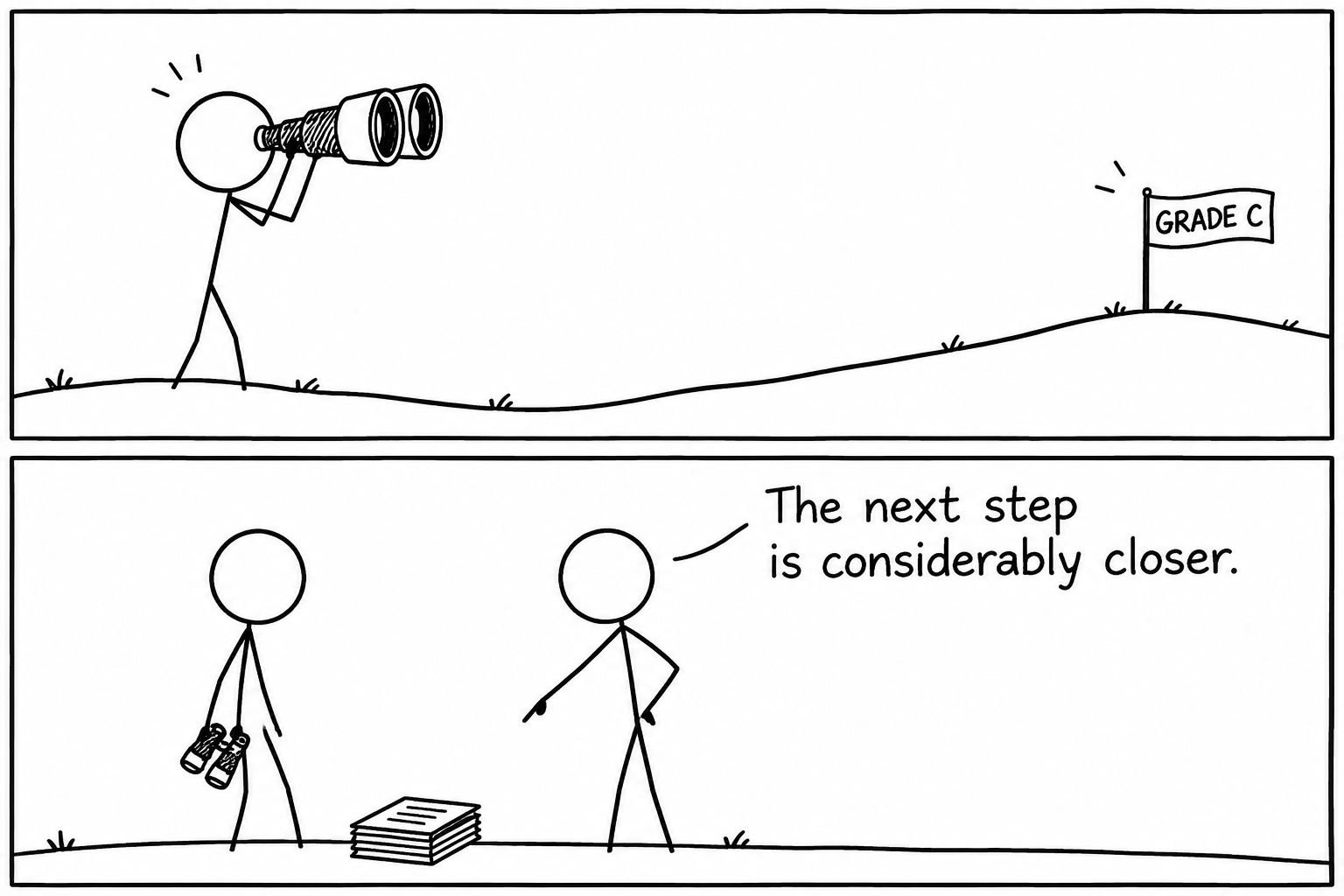 A Year 13 student looking for a distant grade while the next revision step is nearby
What past OCR A-Level grade boundaries show
Published OCR A-Level grade boundaries give useful context, but they are not predictions.
| Exam series | C boundary | Maximum mark | Percentage equivalent |
|---|---|---|---|
| June 2024 | 106106106 | 300300300 | 35.3%35.3\%35.3% |
| June 2025 | 130130130 | 300300300 | 43.3%43.3\%43.3% |
The boundary increased by:
130−106=24 marks.130-106=24\text{ marks}.130−106=24 marks.That is a significant change. It shows why revising towards the lowest recent boundary is risky. A student aiming only for 106106106 because that earned a C in 2024 would have fallen 242424 marks short of the June 2025 C boundary.
Past boundaries answer a historical question: what total was required for that particular set of papers? They cannot settle what will happen in a future series.
Why the A-Level maths C boundary changes
Grade boundaries exist partly because examination papers cannot be made identical in difficulty every year. One series may contain questions that students generally find more accessible. Another may combine familiar ideas in less familiar ways.
Boundaries are set after the papers have been taken and marked. If a paper is more demanding, a comparable grade may require fewer raw marks. If it is more accessible, the boundary may rise.
This protects the meaning of the grade. A C should represent a comparable standard between exam series, even when the raw mark needed to achieve it changes.
It also explains why statements such as “a C is always about 40%40\%40%” are unreliable. The June 2024 and June 2025 figures alone show that there is no permanent percentage.
What mark should a Year 13 student target?
If a C is essential for your next step, targeting the previous boundary exactly gives you no margin for an awkward question, a calculator mistake or an unexpectedly high boundary.
A stronger approach is to build a working target above the historical line. For example, a total of 150150150 marks would average:
1503=50 marks per paper.\frac{150}{3}=50\text{ marks per paper}.3150=50 marks per paper.That does not guarantee a C because future boundaries are unknown. It does, however, provide more protection than aiming for 130130130 exactly. Your best target should also reflect your course requirements, current paper scores and the time remaining before the examinations.
Start by completing a timed paper and marking it strictly. Then separate lost marks into three groups:
- content you did not know;
- methods you knew but could not apply;
- avoidable errors, including incomplete working and misread questions.
The distinction matters. Rewatching lessons may fix the first group. Exam-style practice is usually needed for the second. Slower checking routines can reduce the third.
Focus on the topics that can move your total
A boundary becomes less intimidating when it is translated into individual marks. You do not necessarily need one dramatic improvement. Finding an extra 444 marks on each paper adds:
3×4=12 marks3\times4=12\text{ marks}3×4=12 marksto your qualification total.
Use your marked work to identify where those marks are most available. If probability notation and conditional reasoning are recurring weaknesses, work through the conditional probability revision lesson. If mechanics is lowering your third-paper score, the OCR projectiles lesson and practice questions provide focused practice.
Pure maths appears across the qualification, so weaknesses in algebra, trigonometry, differentiation and integration can affect several parts of the course. The best lesson to complete next is not automatically the hardest topic. It is the topic where better fluency is most likely to recover marks across multiple questions.
Maths Genie supports this process with free revision lessons, exam-style practice questions, video solutions, mini tests, past papers and mark schemes. Predicted papers, when available, can help you rehearse unfamiliar combinations of content, while the revision planner can turn weak-topic lists into a manageable routine.
Common mistakes when checking the boundary
Confusing OCR A with OCR MEI
OCR Mathematics A H240 and OCR Mathematics B (MEI) are different qualifications. They have different assessments and grade boundaries. Confirm the qualification code on your timetable or paper before using a boundary.
Looking at one paper instead of the qualification total
Your final grade comes from the combined total out of 300300300. A published paper-level figure does not create a separate grade for that component.
Treating last year's boundary as a promise
The June 2025 figure of 130130130 describes June 2025. It is evidence for planning, not a guaranteed boundary for another series.
Using generous marking in practice
Method marks depend on visible, valid working. Apply the official mark scheme carefully and do not award yourself a mark merely because your approach felt close.
Revising everything equally
Equal time does not always produce equal gains. Let completed papers identify the lessons that can recover the most marks, then return to mixed practice so that the skill survives outside a familiar worksheet.
Turn the boundary into a revision decision
The OCR A-Level maths C boundary is useful, but only as a reference point. For June 2025, a C required 130130130 out of 300300300. In June 2024, it required 106106106. The movement between those figures is a reminder to create a margin rather than revise towards one fragile number.
Take a paper, calculate your combined position honestly and identify where the next 101010-202020 marks could come from. Then use Maths Genie’s free maths revision resources and the OCR A lessons on the topics that can move your marks most. A grade is decided by the total, but the total changes one well-practised question at a time.















