

OCR A A-Level Maths A* Boundary: Marks You Need
OCR A A-Level maths A* boundary explained using 2023-2025 marks, combined paper totals, yearly changes and a focused revision plan for Year 13.
A Year 13 student finishes an OCR A past paper, adds up the marks and reaches the question that feels more important than anything printed on the page: is this enough for an A*?
The short answer is that the OCR A A-Level maths A boundary changes each year*. For the June 2025 series, the published A* boundary for Mathematics A was 242242242 out of 300300300. It was 216216216 in June 2024 and 209209209 in June 2023. These are useful reference points, but they cannot tell you the boundary for a future series.
What they can do is help you interpret your past-paper marks intelligently. Your result comes from the combined total across three papers, not from earning an A* on every individual paper.
The essential boundary checklist
Before judging a mock or past-paper result, remember:
- OCR Mathematics A has the qualification code H240.
- You sit three written papers, each worth 100100100 marks.
- The maximum qualification mark is 300300300.
- Your three raw marks are added together.
- The official overall qualification boundary determines your grade.
- Boundaries are set after the papers have been taken and marked.
- Individual paper boundaries published by OCR are notional and do not award separate paper grades.
You can find the specification-matched resources, papers and mark schemes on the OCR A Level Maths revision page. If you are comparing exam boards, begin with the wider A Level Maths revision hub.
Recent OCR A A-Level grade boundaries
The following published boundaries show how many marks were needed for an A* in recent summer series.
| Exam series | A* boundary | Maximum mark | Approximate percentage |
|---|---|---|---|
| June 2023 | 209209209 | 300300300 | 69.7%69.7\%69.7% |
| June 2024 | 216216216 | 300300300 | 72.0%72.0\%72.0% |
| June 2025 | 242242242 | 300300300 | 80.7%80.7\%80.7% |
The percentage is calculated using:
Percentage=A* boundary300×100\text{Percentage} = \frac{\text{A* boundary}}{300} \times 100Percentage=300A* boundary×100For June 2025, for example:
242300×100≈80.7%\frac{242}{300} \times 100 \approx 80.7\%300242×100≈80.7%The movement from 216216216 in 2024 to 242242242 in 2025 is substantial. It does not mean the mathematical standard of an A* was simply raised by 262626 marks. Grade boundaries respond to the demand of that particular set of papers and the available evidence about student performance. A more accessible paper can produce a higher boundary; a more demanding paper can produce a lower one.
That is why treating 80%80\%80% as a permanent rule is unsafe. The official OCR A-Level grade boundaries for your exam series will only be known once they have been set.
How the three paper totals combine
OCR Mathematics A is assessed through three equally weighted papers:
| Component | Maximum mark | Weighting |
|---|---|---|
| Pure Mathematics | 100100100 | 3313%33\frac{1}{3}\%3331% |
| Pure Mathematics and Statistics | 100100100 | 3313%33\frac{1}{3}\%3331% |
| Pure Mathematics and Mechanics | 100100100 | 3313%33\frac{1}{3}\%3331% |
Suppose the Year 13 student records these marks in a mock series:
78+84+73=23578 + 84 + 73 = 23578+84+73=235Their combined mark is therefore 235235235 out of 300300300:
235300×100≈78.3%\frac{235}{300} \times 100 \approx 78.3\%300235×100≈78.3%Against the June 2024 boundary, 235235235 would have exceeded the A* threshold by 191919 marks. Against the June 2025 boundary, it would have been 777 marks short. The same performance can sit differently against different years because the papers were different.
This is also why one disappointing paper does not automatically end the possibility of an A*. A student scoring 686868 on one component could still reach 242242242 overall with scores such as 888888 and 868686 on the others:
68+88+86=24268 + 88 + 86 = 24268+88+86=242There is no requirement to hit the notional A* boundary on each component. It is the qualification total that matters.
You can enter separate paper marks into the OCR A Level Maths grade calculator to see how the total compares with boundaries from different years.
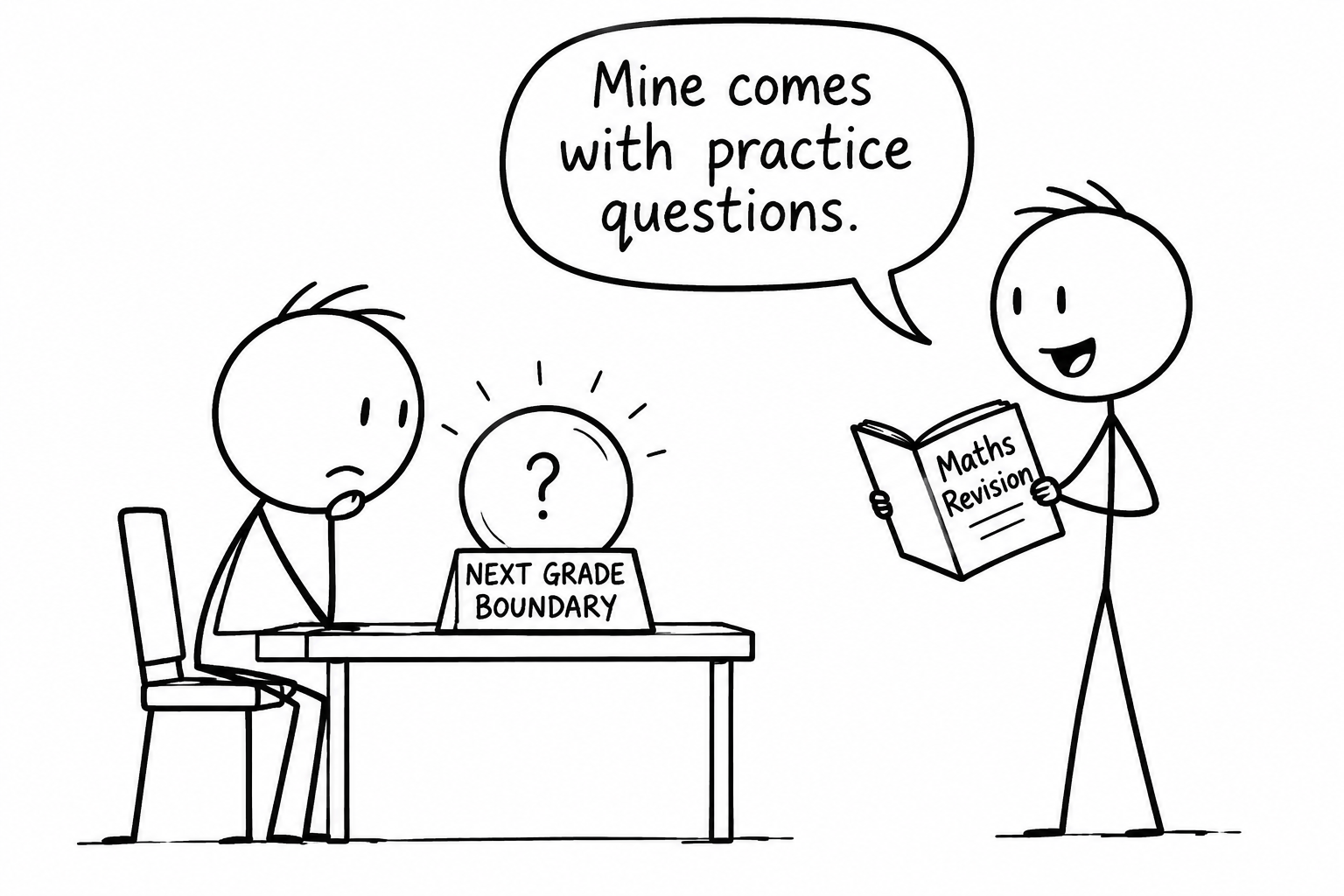 A Year 13 student chooses practice questions over trying to predict the next grade boundary
What mark should you aim for?
A past boundary is a measuring tool, not a promise. If your goal is an A-Level maths A*, aiming for exactly the previous threshold leaves no allowance for normal variation: an unfamiliar mechanics context, an algebraic slip or a boundary that rises.
A more useful process is to track three figures:
- your current combined total across three papers;
- the marks lost through missing knowledge;
- the marks lost through execution, timing or presentation.
If your total is 225225225, do not merely write “need 171717 more” beside the June 2025 boundary. Identify where those marks can realistically come from. Perhaps 666 were lost through incomplete differentiation and integration methods, 555 through mechanics modelling, and the rest through rushed algebra.
This turns a grade boundary into a revision plan. It also prevents a common trap: repeatedly completing full papers without repairing the same weaknesses between them.
Revise the topics that move your marks most
The best topic is not necessarily the hardest chapter in the textbook. It is the topic currently costing you the most recoverable marks.
Start by marking one full set strictly with the official mark schemes. Sort every lost mark into one of four groups:
- knowledge you did not recall;
- a method you could not start;
- an error during a correct method;
- poor timing or an unfinished answer.
Then use focused Maths Genie Lessons before returning to another full paper. The OCR trigonometric functions lesson is useful when identities, graphs and equations are creating repeated losses. For calculus, work through Reverse Chain Rule revision and Integration by Substitution practice.
Use the lesson, practise the questions, check the mark scheme and watch the video solution where available. A mini test can then show whether the method has become reliable rather than merely familiar. Predicted papers and the revision planner are most valuable after this repair work, when they help you combine topics under timed conditions.
The principle is simple: revise where another hour is most likely to recover marks. Improvement often comes from making familiar methods dependable, not collecting increasingly obscure questions.
Why the boundary changes each year
Exam boards aim to maintain a consistent grade standard, but no two sets of questions have exactly the same demand. One paper may contain accessible early questions but difficult modelling later. Another may make routine calculus more algebraically demanding.
Boundaries compensate for these differences. If a paper proves harder overall, fewer raw marks may represent the required standard. If it proves easier, more marks may be required. This is why comparing raw percentages from different years without considering the series can create false confidence or unnecessary panic.
It is also important to compare like with like. OCR A and OCR MEI are separate specifications. Resources for OCR MEI A Level Maths should not be used to interpret an OCR A H240 boundary.
Common mistakes when checking an A* boundary
Treating one historic boundary as a prediction
The 2025 figure is evidence about the 2025 papers, not an announced target for the next exam series. Use several years as context and build a sensible margin into your revision target.
Averaging paper percentages incorrectly
Because all three OCR A papers are worth 100100100 marks, adding the raw marks is straightforward. Always use:
Total mark=P1+P2+P3\text{Total mark} = P_1 + P_2 + P_3Total mark=P1+P2+P3Do not compare one paper with the overall 300300300-mark boundary.
Believing every paper needs an A*
Notional component boundaries help describe paper performance, but the qualification grade is decided by the combined total. A weaker mechanics paper can be balanced by stronger pure and statistics marks.
Marking generously
Method marks depend on evidence. If your reasoning is not written down, do not assume an examiner would award it. Mark strictly, study the accepted forms in the mark scheme, and record every doubtful mark separately.
Revising only favourite topics
Comfort feels productive, but marks usually move when weak recurring areas are repaired. Let marked papers choose your next Maths Genie Lesson.
Turn the number into a plan
The OCR A-Level maths A* boundary matters, but only after the exam series has been completed. Before then, the most useful number is the mark you can recover next.
Complete three papers under realistic timing, combine the totals and diagnose every lost mark. Then move from broad concern to focused practice using the free OCR A Level Maths lessons, past papers and mark schemes. Use video solutions to understand methods, mini tests to check retention, and the revision planner to decide when to revisit each topic.
A boundary tells you where the line was. Maths Genie Lessons help you become the student who can cross it consistently.















