

Negative Numbers GCSE Maths Resit: Grade 4 Guide
Negative numbers GCSE maths resit guide for grade 4: learn the rules, follow two worked examples, avoid common errors and build targeted practice now.
A minus sign is small enough to overlook and powerful enough to change an answer. For post-16 students, that can make negative numbers GCSE maths resit questions feel more difficult than they really are.
To work towards grade 444, you need to order negative numbers, calculate accurately with them and recognise what subtraction means when another negative sign appears. Learn those skills, then practise until the signs stop feeling surprising.
No single topic guarantees a grade because boundaries vary between exam series and boards. However, negative numbers also support algebra, coordinates, sequences and substitution.
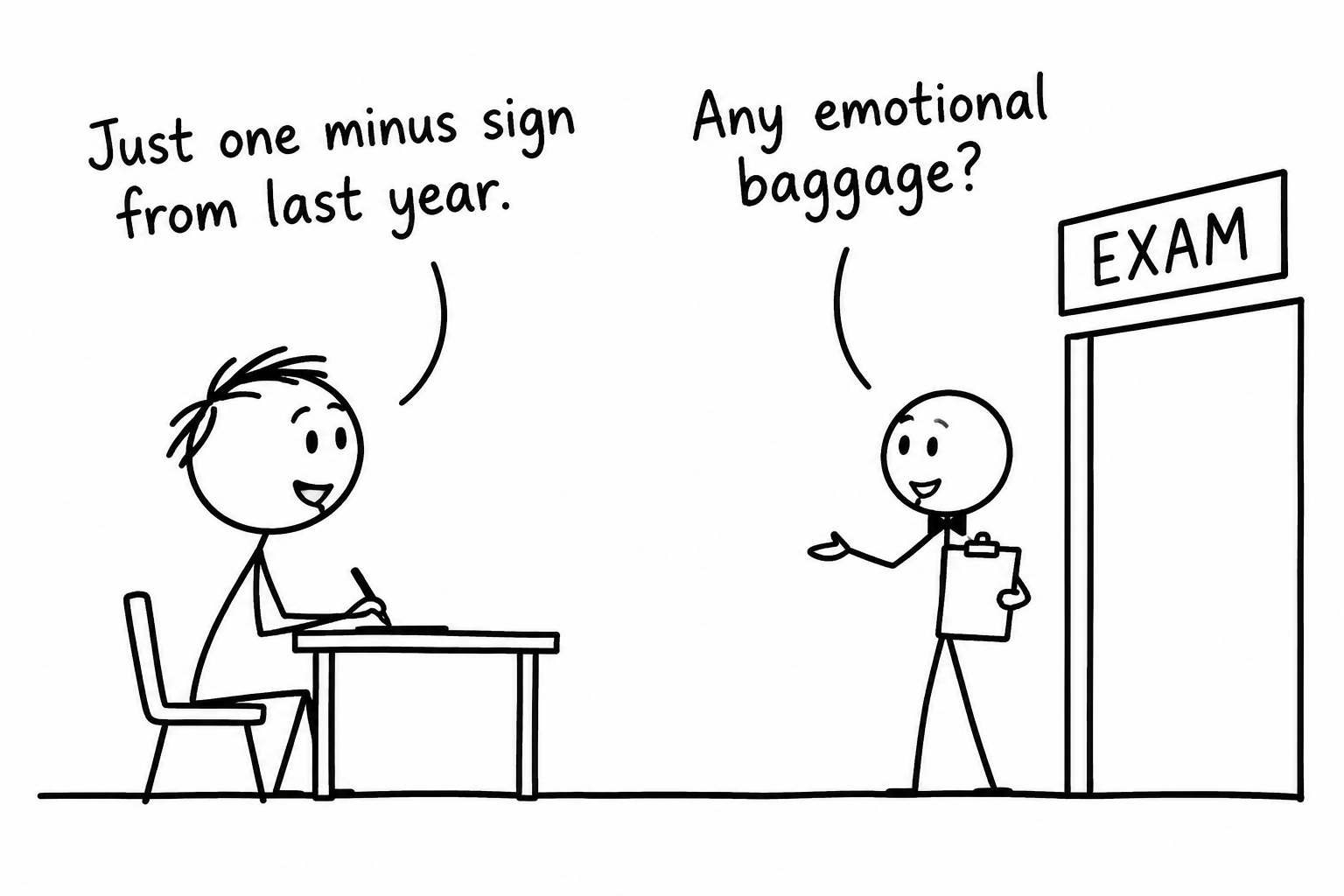 A post-16 student carrying one minus sign of emotional baggage into an exam
Your negative numbers checklist
Aim to be able to:
- order positive and negative numbers
- add and subtract across zero
- subtract a negative number
- multiply and divide using sign rules
- apply the order of operations
- enter negative numbers correctly on a calculator
- show clear working
Begin with the Edexcel negative numbers revision lesson or OCR negative numbers lesson. Choose resources matching your exam board.
Before watching, try a few questions independently. Your answers will show whether you need help understanding negative values or simply need more practice handling signs. That distinction helps you spend revision time on the skill causing difficulty.
Understand direction before memorising rules
Negative numbers describe values below zero, such as temperatures or floors below ground level. A number line makes their order visible:
−5<−2<0<3-5 < -2 < 0 < 3−5<−2<0<3The number farther right is greater. Therefore, −2-2−2 is greater than −5-5−5, which is farther below zero. Distance from zero differs from value: −5-5−5 and 555 are equally far from zero, but are not equal.
Adding and subtracting
Adding a positive number moves you right; subtracting a positive number moves you left:
−4+7=3-4 + 7 = 3−4+7=3Starting at −4-4−4 and moving seven places right takes you through zero to 333.
Pause when two signs meet. Subtracting a negative reverses the direction:
8−(−3)=8+3=118 - (-3) = 8 + 3 = 118−(−3)=8+3=11Replace subtraction of a negative with addition, then complete the calculation.
Multiplying and dividing
Multiplication and division share these sign rules:
- matching signs give a positive answer
- different signs give a negative answer
Decide the sign first, then calculate using the number values. Since 24÷6=424 \div 6 = 424÷6=4, we have −24÷6=−4-24 \div 6 = -4−24÷6=−4 because the signs differ.
Keep these rules separate from addition and subtraction. When adding, the answer depends on the sizes of the numbers as well as their signs. Naming the operation before calculating gives you a reliable starting point whenever several signs appear together.
Worked example: temperature change
Question: At 666 am, the temperature is −7∘C-7^\circ\text{C}−7∘C. By midday, it rises by 12∘C12^\circ\text{C}12∘C, then falls by 5∘C5^\circ\text{C}5∘C. Find the final temperature.
Begin at −7-7−7 and add the rise:
−7+12=5-7 + 12 = 5−7+12=5Then subtract the fall:
5−5=05 - 5 = 05−5=0The final temperature is 0∘C0^\circ\text{C}0∘C.
The language controls the operation: a rise means addition; a fall means subtraction. Ignoring the starting sign and calculating 7+12−57 + 12 - 57+12−5 gives the wrong result. Write the calculation before using your calculator.
Worked example: signs and order of operations
Question: Work out
−5+3×(−4)−(−6)-5 + 3 \times (-4) - (-6)−5+3×(−4)−(−6)Multiplication comes before addition and subtraction:
3×(−4)=−123 \times (-4) = -123×(−4)=−12Substitute this result into the expression:
−5+(−12)−(−6)-5 + (-12) - (-6)−5+(−12)−(−6)Adding a negative is equivalent to subtraction; subtracting a negative becomes addition:
−5−12+6-5 - 12 + 6−5−12+6Now work from left to right:
−17+6=−11-17 + 6 = \boxed{-11}−17+6=−11Working left to right before completing multiplication gives the wrong answer. So does changing −(−6)-(-6)−(−6) into −6-6−6. Rewrite one line at a time so each change remains visible.
Use your calculator carefully
On many scientific calculators, subtraction and the negative-number key are separate. Subtraction performs an operation; the negative key enters a number below zero. It may be labelled (−)(-)(−) or ±\pm±, depending on the model.
For 7×(−3)7 \times (-3)7×(−3), use brackets around the negative value if your calculator requires them. Check that the display represents your intended calculation.
Predict the sign before pressing equals. A positive number multiplied by a negative must give a negative result. This quick check catches keying errors, although it cannot correct a misinterpreted question.
Common mistakes with negative numbers
Comparing digits instead of values
It is incorrect to say −8>−3-8 > -3−8>−3. On a number line, −8-8−8 is farther left:
−8<−3-8 < -3−8<−3When comparing two negative values, the one closer to zero is greater.
Treating every pair of minus signs alike
Read the operation before applying a rule:
−4×(−2)=8-4 \times (-2) = 8−4×(−2)=8 4−(−2)=64 - (-2) = 64−(−2)=6Matching signs give a positive product, while subtracting a negative becomes addition. Avoid relying on the vague phrase “two minuses make a plus”.
Ignoring brackets
These expressions differ:
−32=−(32)=−9-3^2 = -(3^2) = -9−32=−(32)=−9 (−3)2=(−3)×(−3)=9(-3)^2 = (-3) \times (-3) = 9(−3)2=(−3)×(−3)=9Brackets show whether the negative sign belongs to the number being squared. Copy them carefully when substituting into a formula.
Hiding your working
Longer questions deserve intermediate lines. Clear working can earn method marks where available, even after an arithmetic slip. It also makes checking easier.
When checking, compare each line with the previous one. Look for a dropped negative sign, a missing bracket or an operation completed too early. This gives you something specific to inspect instead of repeating the same calculation and hoping for a different answer.
A focused resit practice routine
Watching an explanation builds familiarity. Answering questions independently shows whether your understanding is secure.
Use this cycle:
- review a lesson or video solution
- answer questions without notes
- check answers and the mark scheme
- identify ordering, operation, sign or calculator errors
- retry missed questions later without copying
Try the Edexcel negative numbers booklet, AQA negative numbers questions or Eduqas negative numbers questions. The GCSE maths revision hub provides broader revision resources, past papers and mark schemes.
Use the MathsGenie revision planner to revisit this topic alongside other resit priorities. Record the mistake you made, so your next session has a clear purpose.
Once individual calculations feel secure, mix them with substitution, coordinates and sequences. Recognising negative numbers inside another topic is a useful next step. Return to any question you missed after a gap, and explain the correction in your own words before checking the solution again.
Make your next paper more targeted
A resit gives you another opportunity to prepare deliberately. Read each operation, keep brackets visible and check whether your answer makes sense.
After practising individual skills, build a targeted practice paper with Mock Exam Builder. Complete it under timed conditions, mark it honestly and revisit sign errors using MathsGenie’s free revision lessons and questions. That cycle makes your next revision session more useful.















