

Moving Sets GCSE Biology: Will It Affect Your Grade?
Moving sets GCSE Biology need not decide your grade. Learn what may change, how exam tiers matter, what to ask your school and how to adapt revision.
A set change can feel like a verdict. Move up and expectations suddenly rise; move down and it may seem as though somebody has placed a ceiling over your result. But moving sets GCSE Biology does not, by itself, change the grade you can achieve. Your final result is determined by your exam entry, the marks you earn and the grade boundaries applied by the exam board, not the name of your classroom set.
What can change is the teaching pace, the topics emphasised, the level of challenge and, most importantly, the tier for which your school intends to enter you. That is why the right response is neither panic nor complacency. It is to find out precisely what the move means and build a revision plan around the answer.
The short answer: what actually affects your Biology grade?
Use this checklist after any set change:
- Ask whether your exam tier is changing.
- Confirm whether you are taking separate Biology or Combined Science.
- Find out which topics your new class has already completed.
- Compare your assessment evidence with your target grade.
- Request specific advice about the gaps you need to close.
- Keep revising independently rather than treating the set label as a prediction.
A move between sets may influence your classroom experience, but it does not directly award or remove marks. The two details with the greatest practical importance are your qualification route and your tier of entry.
Sets and exam tiers are not the same thing
Schools use sets to organise teaching. There is no universal national definition of “top set”, “set two” or “lower set”, and policies can differ between schools. One school may use sets mainly to adjust pace; another may connect them closely to likely tier entry.
Exam tiers are formal assessment arrangements. Under the current GCSE system in England, separate Biology is available at foundation and higher tier. Foundation tier offers grades 111 to 555. Higher tier targets grades 444 to 999, with a narrow allowed grade 333 for candidates who just miss grade 444. Below that safety-net threshold, the result is unclassified.
Ofqual also states that a grade 444 or 555 achieved on foundation tier represents the same standard as a grade 444 or 555 achieved on higher tier. The tier does not appear on the certificate.
This distinction matters. Moving down a set while remaining on higher tier does not formally restrict you to a lower maximum grade. Moving into a foundation-tier pathway could cap the available grade at 555. Equally, moving up may make higher-tier entry more likely, but it does not guarantee a high grade.
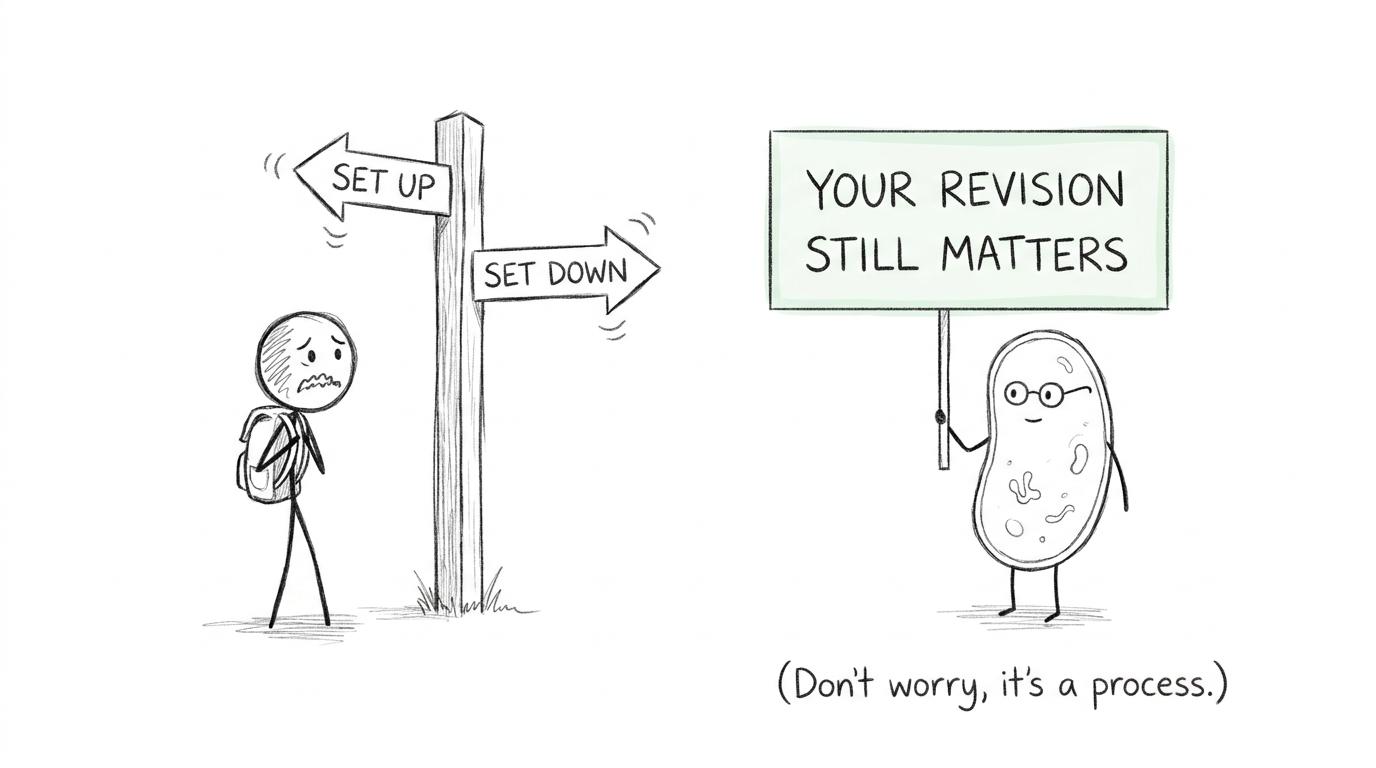 A student choosing between set directions while revision remains important
Could moving down a set lower your final grade?
Not automatically. A set move has no direct role in the exam board's calculation of your result. Examiners mark the responses on your paper using the same mark scheme as every other candidate taking that paper.
There are, however, indirect effects worth understanding.
Your intended tier might change
If your school connects lower sets with foundation-tier entry, moving down could alter the highest grade available. Do not assume that this has happened. Ask directly:
- Am I currently being prepared for foundation or higher tier?
- Is this decision final, or will it be reviewed after future assessments?
- What evidence would support a move to higher tier?
Schools are responsible for making appropriate entries, and teachers will normally consider assessment performance, consistency and the risk attached to each tier. The exact process is a school decision rather than a national set rule.
The pace and depth of lessons may differ
A new class may revisit core knowledge more slowly or spend longer developing exam technique. That can be helpful if insecure foundations have been costing you marks. A slower pace is not automatically easier in the unhelpful sense; sometimes it creates the space in which understanding finally becomes stable.
The possible disadvantage is that higher-demand material may receive less classroom time, particularly if the group is following a foundation route. If you are still aiming above grade 555, ask your teacher how you should cover the required higher-tier content.
Confidence may change before ability does
Students sometimes interpret a downward move as evidence that improvement is impossible. That belief can reduce effort, which then makes the original decision appear correct. The set label did not cause the final outcome; the response to it helped shape what happened next.
Treat the move as information. Which questions were weak? Was the difficulty biological knowledge, mathematical skill, practical understanding, command words or time management? A useful diagnosis is specific enough to produce an action.
Does moving up a set improve your grade?
Moving up can provide faster teaching, greater exposure to higher-demand questions and classmates working towards ambitious targets. It can also make higher-tier entry more likely. None of those benefits replaces revision.
A student who moves up may initially have gaps because the new class has covered topics in a different order. The workload can feel heavier, and a lower mark on the first assessment may simply reflect adjustment rather than a decline in ability.
Ask for the new class's topic list and compare it with your previous work. Separate gaps into three categories:
- content you have never been taught;
- content you were taught but cannot yet recall;
- content you understand but cannot apply to exam questions.
Each needs a different response. New content needs teaching. Forgotten content needs retrieval practice. Application difficulties need questions, marking and correction.
Separate Biology and Combined Science matter too
A set change may coincide with a conversation about qualification route. Separate Biology produces its own GCSE grade. Combined Science covers biology, chemistry and physics and produces an award worth 222 GCSEs, reported as a pair of equal or adjacent grades, such as 5-55\text{-}55-5 or 5-45\text{-}45-4.
These routes are not merely different set names. They have different specifications and assessment structures. If the move affects whether you take separate sciences or Combined Science, ask your school to explain:
- which qualification and exam board you will be entered for;
- whether any taught content must be caught up;
- whether your tier is changing;
- how the decision relates to your future course plans.
AQA, Edexcel, OCR and Eduqas publish their own specifications and assessment information. Your teacher should confirm the exact course because topic organisation and paper structure are not identical across boards.
For A Level Biology, sixth forms and colleges set their own entry requirements. Your achieved grades and the provider's published requirements matter more than the classroom set name you had during GCSE.
How to adapt after changing Biology sets
The first few weeks matter because uncertainty can quietly become lost time. A simple recovery process is more useful than trying to revise everything at once.
Get the facts in writing
Record your exam board, qualification route, current tier, topics already covered by the new class and the date of the next assessment. If a tier decision will be reviewed, note what evidence the school expects.
Build a topic-gap list
Compare exercise books, class checklists and the specification. Use three labels: secure, developing and not yet covered. Start with the topics that are both weak and likely to appear in the next assessment, while continuing short recall sessions for older material.
Protect the maths marks inside Biology
Biology papers assess more than memory. Depending on the specification and question, students may need to interpret graphs, calculate percentages, use ratios, substitute into equations, handle units or express quantities in standard form.
If calculations are a weak point, MathsGenie's free GCSE maths revision resources allow you to revisit skills through videos and exam-style questions. You can choose work at an appropriate level, including the grade 4 revision topics, grade 5 revision topics and grade 7 revision topics.
The aim is not to turn Biology revision into a maths lesson. It is to ensure that a correct scientific idea is not undermined by avoidable calculation errors.
Use a repeatable revision cycle
For each Biology topic:
- retrieve key knowledge without notes;
- check omissions against trusted course materials;
- answer questions matched to your specification and tier;
- mark them carefully;
- rewrite incomplete explanations;
- return to the topic after a short interval.
A plan reduces the temptation to revise only comfortable topics. MathsGenie's free revision planner can help you organise maths alongside science and your other GCSE subjects without allowing one approaching test to consume every evening.
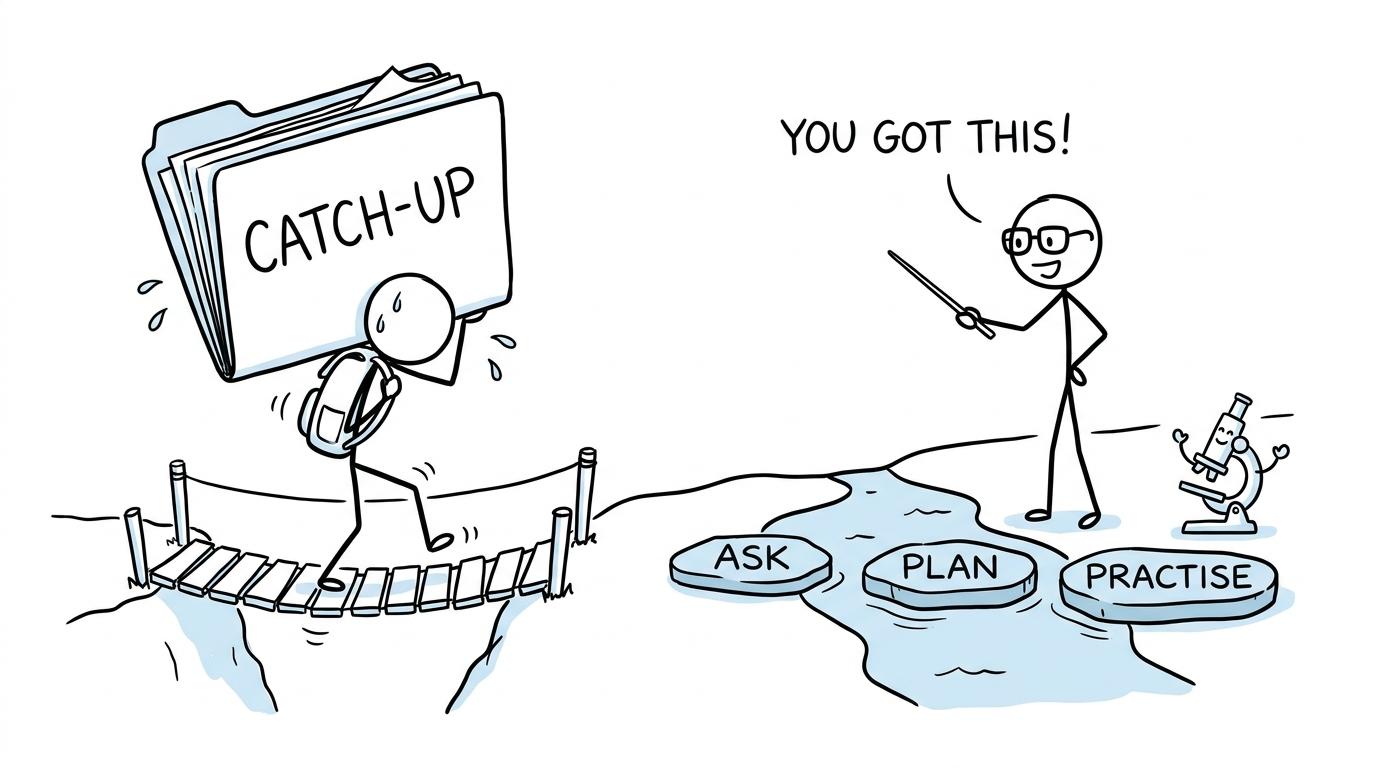 A student crossing the catch-up bridge using a simple plan
Review evidence, not classroom labels
Keep a record of assessment marks, question types lost and corrections completed. Raw marks cannot be converted reliably into a final grade without the relevant paper and grade boundaries, which can change between exam series. Their most useful purpose during revision is to show direction: what is improving, what remains inconsistent and what needs teacher support.
What to say to your teacher
A calm, precise conversation is more productive than asking only, “Why was I moved?” Try questions such as:
- Which evidence led to this decision?
- Does the move affect my qualification or tier?
- Which three areas would make the biggest difference to my performance?
- When will my placement or tier be reviewed?
- What should I complete independently to catch up?
If you believe relevant evidence has been missed, explain that respectfully and involve a parent, carer, head of science or pastoral member of staff where appropriate. Schools may have their own procedures for reviewing set placements. Focus on obtaining clear next steps rather than proving that a label is unfair.
Common mistakes after moving sets
Assuming the set fixes the final grade
It does not. Your paper is marked against an exam-board mark scheme. Concentrate on the knowledge and exam skills that produce marks.
Confusing a set move with a tier change
They may be connected, but they are not identical. Confirm your intended tier and qualification route instead of relying on rumours about which set “always” takes which paper.
Trying to catch up in one weekend
Large, unfocused revision sessions often hide what has actually been learned. Break missing content into manageable topics and revisit it over time.
Ignoring command words and practical work
Knowing a topic is not the same as answering the question asked. Practise explaining, comparing, evaluating and calculating, and revise the required practical knowledge listed for your course.
Letting Biology disrupt every other subject
A set change can create urgency, but GCSE preparation remains a portfolio of subjects. Keep maths moving through short practice sessions, GCSE mini tests and targeted correction.
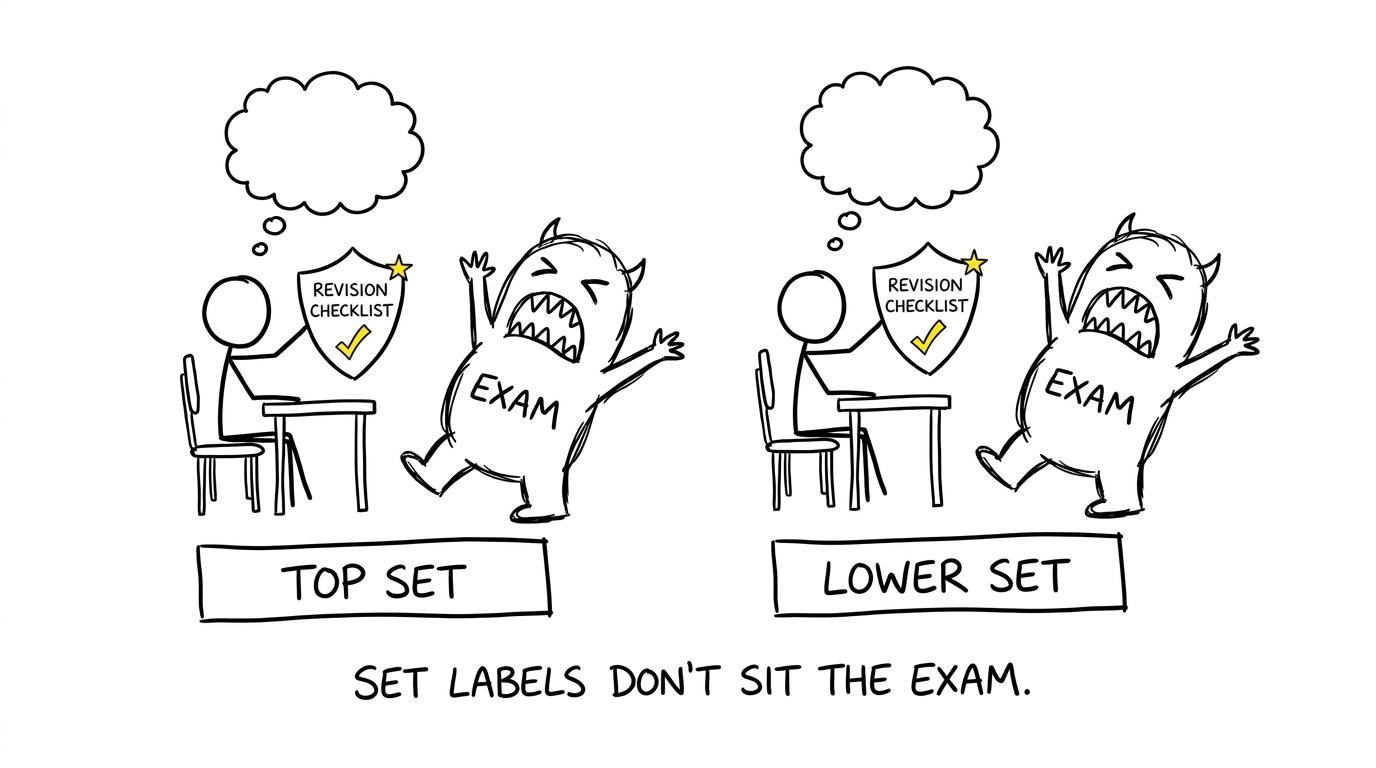 Students in different sets facing the same exam-paper monster
Your next step matters more than the set name
Moving up or down a GCSE Biology set can change the route through the course. It may alter pace, support, challenge or intended tier. But it is not a final grade, and it should never remain a vague source of worry.
Find out what has formally changed. Identify the gaps. Then build evidence through consistent recall, exam questions and careful correction. That process is less dramatic than a set move, but it is far more powerful.
MathsGenie can support the mathematical side of your GCSE preparation with free revision lessons, video solutions, practice questions and mark schemes. As the exams approach, use GCSE past papers to develop timing and MathsGenie predicted papers for additional practice. Your set is where the school places you today. Your preparation is what you can shape next.











