

HCF and LCM GCSE Maths Resit: Aim for Grade 4
HCF and LCM GCSE maths resit revision for grade 4: learn clear methods, follow two worked examples, avoid costly mistakes and build targeted practice today.
You recognise the words, but the question still makes you pause. Is this the one where you list factors, or keep multiplying? For HCF and LCM GCSE maths resit revision, the key distinction is simple: HCF finds the largest number that divides exactly into both numbers; LCM finds the smallest positive number that both numbers divide into exactly.
If you are fitting revision around college, an apprenticeship or work, that distinction gives you a useful starting point. You can practise choosing the method, then make the calculation reliable. Here are two exam-style worked examples and the checks that help protect your marks.
Your HCF and LCM grade 4 checklist
For this part of your grade 4 preparation, aim to:
- Explain the difference between a factor and a multiple.
- Find HCF and LCM by listing for smaller numbers.
- Use prime factorisation for larger numbers.
- Recognise which method a worded question needs.
- Show working and interpret your answer.
One topic cannot guarantee a grade, but mastering it gives you another type of question you can approach with a clear plan.
Imagine a resit student opening a short revision session after college. Their first task is simply to decide what the question is asking. That decision comes before any arithmetic.
Understand factors and multiples first
A factor divides into a whole number exactly, leaving no remainder. A multiple is obtained by multiplying a number by a whole number.
The highest common factor, or HCF, is the largest factor shared by the given positive whole numbers. It is useful when dividing quantities into the greatest possible number of identical groups without leftovers.
The lowest common multiple, or LCM, is the smallest positive multiple shared by the numbers. It is useful when finding when repeating events next happen together.
For small numbers, listing is a perfectly valid method:
- For HCF, list factors systematically in pairs, then choose the largest shared factor.
- For LCM, list positive multiples in increasing order, then find the first shared value.
If these words still blur together, use the factors and multiples practice booklet before moving on. Repairing that distinction makes the later method easier to remember.
Use prime factors to organise the calculation
A prime number has exactly two positive factors: itself and 111. Prime factorisation expresses a whole number as a product of prime numbers.
Start a factor tree by splitting the number into any convenient factor pair. Keep splitting composite numbers until every end number is prime. Multiply those prime factors together to check that you recover the original number.
Then apply these rules:
- HCF: multiply the prime factors shared by both numbers, using the smaller number of copies of each shared prime.
- LCM: include every prime that appears, using the larger number of copies needed by either number.
With a prime factor Venn diagram, the HCF comes from multiplying the factors in the overlap. The LCM comes from multiplying every factor inside the two circles, counting each placed factor once.
MathsGenie's prime factors, HCF and LCM revision lesson gives you a focused place to revisit the topic.
Worked example: finding HCF and LCM
Exam-style question: Find the HCF and LCM of 727272 and 909090.
First, write each number as a product of primes:
72=8×9=23×3272 = 8 \times 9 = 2^3 \times 3^272=8×9=23×32 90=9×10=2×32×590 = 9 \times 10 = 2 \times 3^2 \times 590=9×10=2×32×5For the HCF, take the shared primes with the smaller powers. Both numbers contain one copy of 222 and two copies of 333:
HCF(72,90)=2×32=18\operatorname{HCF}(72,90) = 2 \times 3^2 = 18HCF(72,90)=2×32=18For the LCM, take every prime with its largest power:
LCM(72,90)=23×32×5=360\operatorname{LCM}(72,90) = 2^3 \times 3^2 \times 5 = 360LCM(72,90)=23×32×5=360Check the meaning of each answer. Both original numbers divide exactly by 181818:
72÷18=4,90÷18=572 \div 18 = 4, \qquad 90 \div 18 = 572÷18=4,90÷18=5And 360360360 is a multiple of both:
360÷72=5,360÷90=4360 \div 72 = 5, \qquad 360 \div 90 = 4360÷72=5,360÷90=4The factorisation establishes why these are the highest common factor and lowest common multiple. The divisions provide a useful arithmetic check.
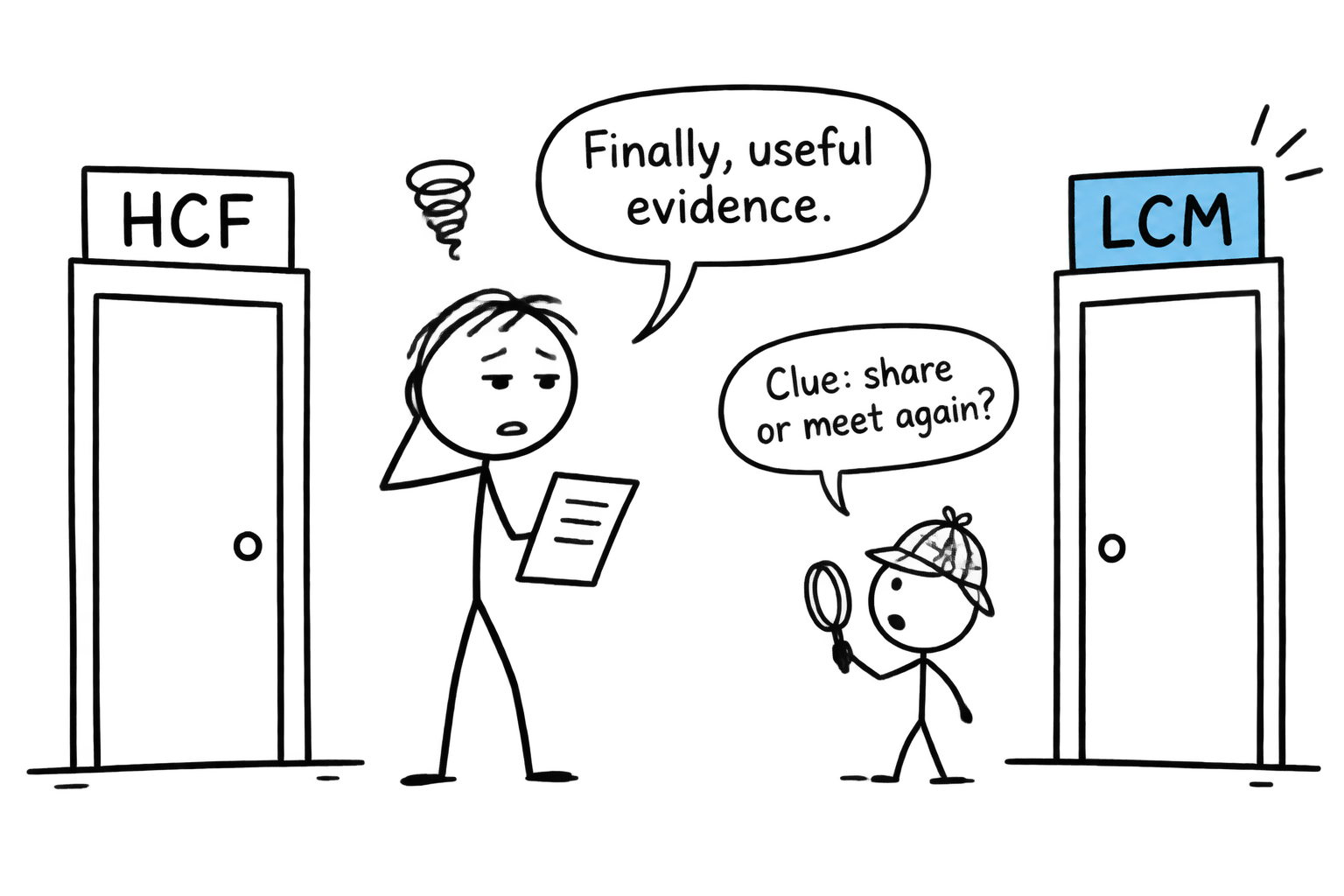 A stick-figure student uses a detective's clue to choose between HCF and LCM
Worked example: recognising HCF in a word problem
Exam-style question: A college has 484848 notebooks and 606060 pens. It makes the greatest possible number of identical revision packs, using everything. How many packs can it make, and what goes in each pack?
The number of packs must divide exactly into both quantities. We need the greatest possible number, so this is an HCF problem.
Write the prime factorisations:
48=24×348 = 2^4 \times 348=24×3 60=22×3×560 = 2^2 \times 3 \times 560=22×3×5Take the shared factors with the smaller powers:
HCF(48,60)=22×3=12\operatorname{HCF}(48,60) = 2^2 \times 3 = 12HCF(48,60)=22×3=12The college can make 121212 identical packs. Now calculate each pack's contents:
48÷12=4 notebooks48 \div 12 = 4 \text{ notebooks}48÷12=4 notebooks 60÷12=5 pens60 \div 12 = 5 \text{ pens}60÷12=5 pensEach pack contains 444 notebooks and 555 pens.
Stopping after finding the HCF would leave part of the question unanswered. Read the final sentence again before moving on.
For further questions, try the HCF and LCM exam practice booklets.
Common mistakes that cost marks
Choosing by a single clue word. “Greatest” does not automatically mean HCF in every problem. Ask whether your answer must divide the quantities exactly or be a multiple of them.
Losing repeated prime factors. A repeated prime must appear the correct number of times. Keep your factor trees clear and check their products.
Multiplying the original numbers for LCM. That produces a common multiple, but it may be larger than the lowest one because shared factors have been counted twice.
Stopping a factor tree too early. Every end number must be prime. Also, 111 is not prime.
Showing no method. Write down factor lists or prime factorisations. Clear working can support method marks where the mark scheme allows them and makes errors easier to find.
Turn this into targeted GCSE maths resit revision
Return to the student revising after college. A useful finish is a small set of independent questions: direct HCF calculations, direct LCM calculations and worded problems mixed together.
Use the GCSE maths question bank to practise choosing the method without a worked solution beside you. Mark your attempts, record whether each error came from the choice of method or the arithmetic, then retry the missed questions later. When you are ready for broader practice, use the GCSE exam booklets.
Your next step is concrete: open MathsGenie's revision lesson, access Mock Exam Builder through the Exam builder tool, and build a targeted practice paper on prime factors, HCF and LCM. Attempt it independently, then use your mistakes to decide what to revise next.















