

Have I Revised Enough for GCSE Biology?
Have I revised enough GCSE Biology? Use this realistic readiness test to check recall, exam technique, practical knowledge, timing and weak topics now.
Revision has an awkward habit: the more you learn, the more aware you become of what you might have forgotten. That can leave you asking, have I revised enough GCSE Biology, even after weeks of notes, flashcards and videos.
The honest answer does not come from counting hours. You have revised enough when you can retrieve knowledge without prompts, apply it to unfamiliar questions, explain required practicals, use data confidently and perform reliably under timed conditions. You do not need to feel completely calm. You need evidence that your preparation works.
This guide gives you a realistic way to collect that evidence. Always check your current Edexcel, AQA, OCR or Eduqas specification because topic organisation, required practical activities and paper structures differ between exam boards.
The GCSE Biology readiness checklist
A strong judgement should combine several measures rather than depending on one encouraging score. You are approaching exam readiness when you can:
- recall the main content across your specification without looking at notes;
- answer questions that present familiar biology in an unfamiliar context;
- interpret graphs, tables, diagrams and experimental data;
- describe and evaluate the practical work required by your exam board;
- use biological terminology precisely;
- complete full papers within the official time limit;
- mark answers honestly and identify why marks were lost;
- revisit weak topics successfully after a gap;
- obtain reasonably consistent results across more than one paper.
The last point matters. One good paper can reflect familiar questions. Repeated performance is much stronger evidence.
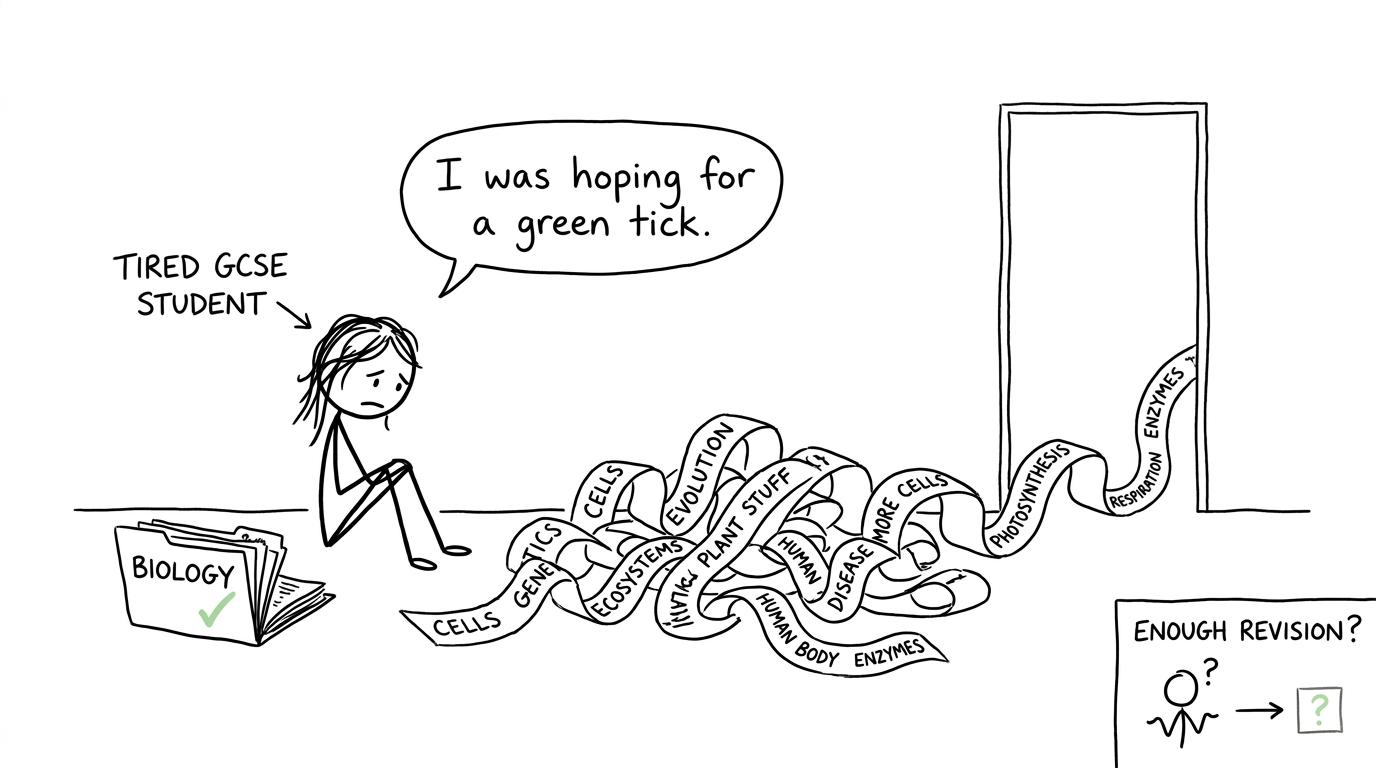 A student discovers that the Biology topic list is longer than expected
Replace the feeling of readiness with proof
Anxiety is not a reliable revision tracker. Neither is confidence.
A well-prepared student can feel nervous because the exam matters. Another student can feel relaxed because highlighted notes look familiar. Those feelings are real, but neither tells you what will happen when a six-mark question asks you to connect several ideas without a prompt.
Use three kinds of evidence instead: coverage, retrieval and exam performance.
Coverage: have you checked the whole specification?
Download the current specification for your qualification and turn it into a checklist. Separate each broad area into small, testable statements. Marking “ecology” as complete is too vague; being able to explain a particular process, interpret relevant data and answer questions about its practical investigation is meaningful.
Use a simple traffic-light system:
- Green: you can explain and apply the content without support.
- Amber: you partly remember it or make recurring mistakes.
- Red: you cannot yet produce a secure answer independently.
Be strict. Reading a page and understanding it at the time is not the same as remembering it tomorrow.
Retrieval: can you produce the knowledge unaided?
Close the book. Put the flashcards away. Then write, speak or sketch everything you can recall about one precise specification statement. Check your response afterwards and add what was missing in a different colour.
This is more diagnostic than rereading because it exposes gaps hidden by familiarity. Repeat the test after several days. If the idea can still be retrieved and explained accurately, it is becoming more secure.
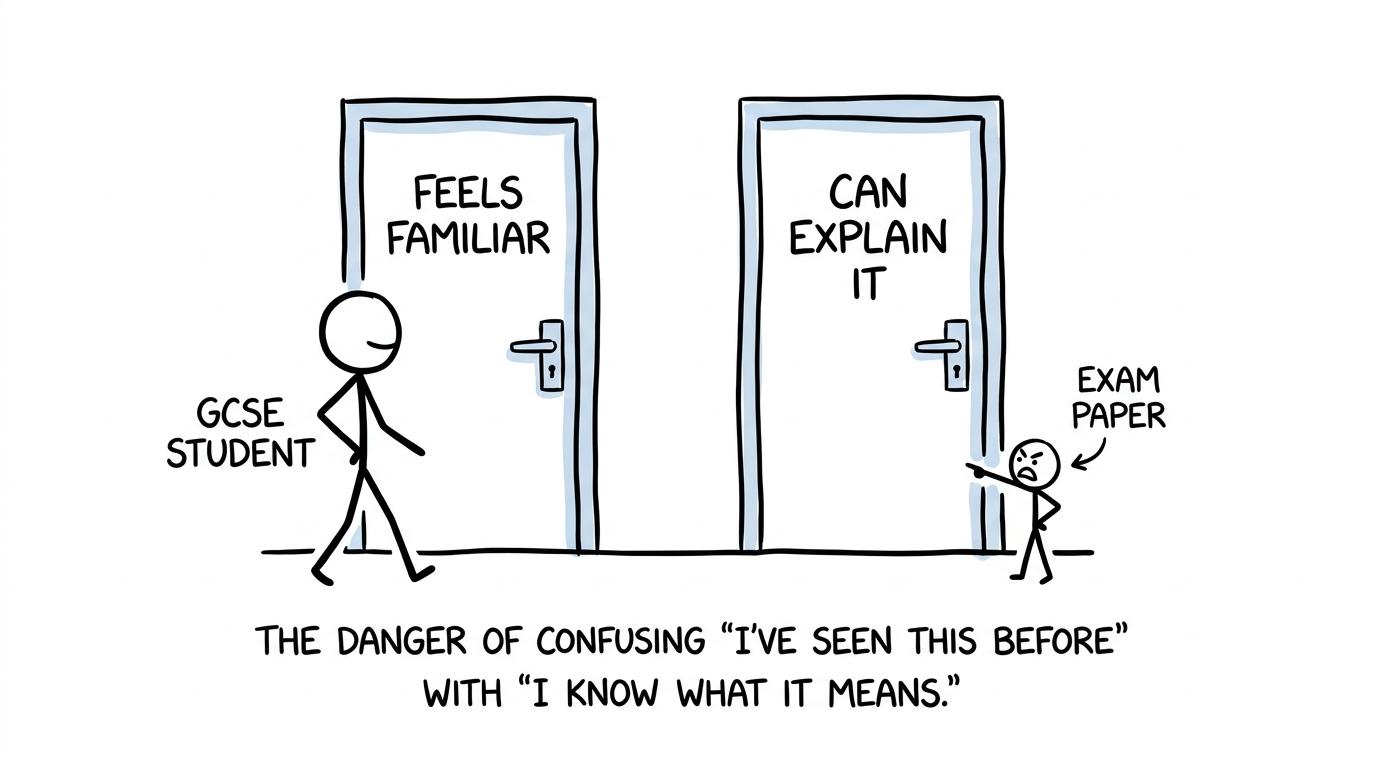 A student chooses between familiarity and genuine explanation
Exam performance: can you turn knowledge into marks?
Knowing biology is necessary, but GCSE questions also test whether you can select relevant knowledge, apply it and communicate it clearly. Use official past papers and mark schemes from your exam board under increasingly realistic conditions.
First, practise small groups of questions by topic. Later, complete whole papers without notes, interruptions or extra time unless you have an approved access arrangement. Record:
- your raw mark;
- the time taken;
- topics linked to lost marks;
- whether each error came from knowledge, application, terminology, calculation or question interpretation;
- whether you corrected that weakness later.
Do not decide that you are ready from a single percentage. Grade boundaries differ between qualifications and examination series, so use the relevant official boundary only as context. Your deeper question is whether performance remains stable across different papers.
Use a readiness score without pretending it is perfect
A score can organise your evidence, but it cannot guarantee an exam result. Rate each specification area from 000 to 222:
- 000: not secure;
- 111: partly secure;
- 222: secure in recall and exam questions.
You can calculate your coverage percentage using:
Coverage score=points earned2×number of areas×100\text{Coverage score} = \frac{\text{points earned}}{2 \times \text{number of areas}} \times 100Coverage score=2×number of areaspoints earned×100Then keep separate ratings for timed-paper performance, practical knowledge and quantitative skills. Do not hide a serious red area inside a reassuring overall average. If your total looks strong but you cannot evaluate an investigation or interpret a graph, that gap still deserves attention.
A useful final test is to ask: What evidence would change my mind? If one unfamiliar paper would immediately destroy your confidence, complete one now. Revision becomes calmer when uncertainty is converted into a task.
Check whether your knowledge survives unfamiliar questions
GCSE Biology is not simply a memory contest. Questions may place standard ideas inside unfamiliar organisms, treatments, investigations or environmental settings. The surrounding story can look new even when the biology underneath it is familiar.
When reviewing an answer, ask:
- Which specification idea was being tested?
- What information did the question provide?
- Which command word controlled the response?
- Did I state a fact, apply it to the context and explain the link?
- Did I include irrelevant knowledge instead of answering the question?
Command words matter. “State”, “describe”, “explain”, “compare”, “calculate” and “evaluate” require different responses. Use your exam board's published guidance and mark schemes rather than assuming every question wants a long explanation.
Test practical knowledge properly
Practical revision is often reduced to memorising a method. That is not enough. For every required or specified practical activity, check that you can identify:
- the purpose of the investigation;
- independent, dependent and control variables;
- suitable apparatus and measurements;
- important safety considerations;
- ways to improve accuracy, precision or reliability;
- possible sources of error;
- how results should be recorded and presented;
- whether the evidence supports a conclusion.
The exact practical requirements depend on your exam board and course, including whether you take separate Biology or Combined Science. Work from your current specification and your teacher's guidance.
You should also be prepared to apply practical principles to a new investigation. Memorising one polished paragraph is less useful than understanding why each stage exists.
Do not ignore the maths inside Biology
Biology papers include quantitative skills, data interpretation and mathematical relationships. These marks can be especially valuable because the methods are often highly practicable.
Check that you can confidently handle ratios, percentages, averages, rates, graphs, standard form, unit conversions and substitutions into equations relevant to your specification. MathsGenie's free lessons on percentages, averages, scatter graphs and standard form can strengthen the mathematical tools used when biological data appears.
Pay particular attention to units and graph scales. A scientifically sensible method can still lose marks through an incorrect conversion or an answer copied from a calculator without suitable interpretation.
Build a final revision loop
Once you have covered the course, revision should become a repeating loop rather than another journey through the textbook:
Test
Complete a closed-book retrieval task, topic question set or timed paper.
Diagnose
Mark it carefully. Label the reason for every lost mark rather than writing “careless”. That word does not tell you what to change.
Repair
Return to the precise idea or skill, using your specification, class materials and exam-board resources. Produce a short explanation from memory and answer fresh questions.
Retest
Come back after a gap. A correction made while looking at the mark scheme proves very little; a correct independent answer several days later is better evidence.
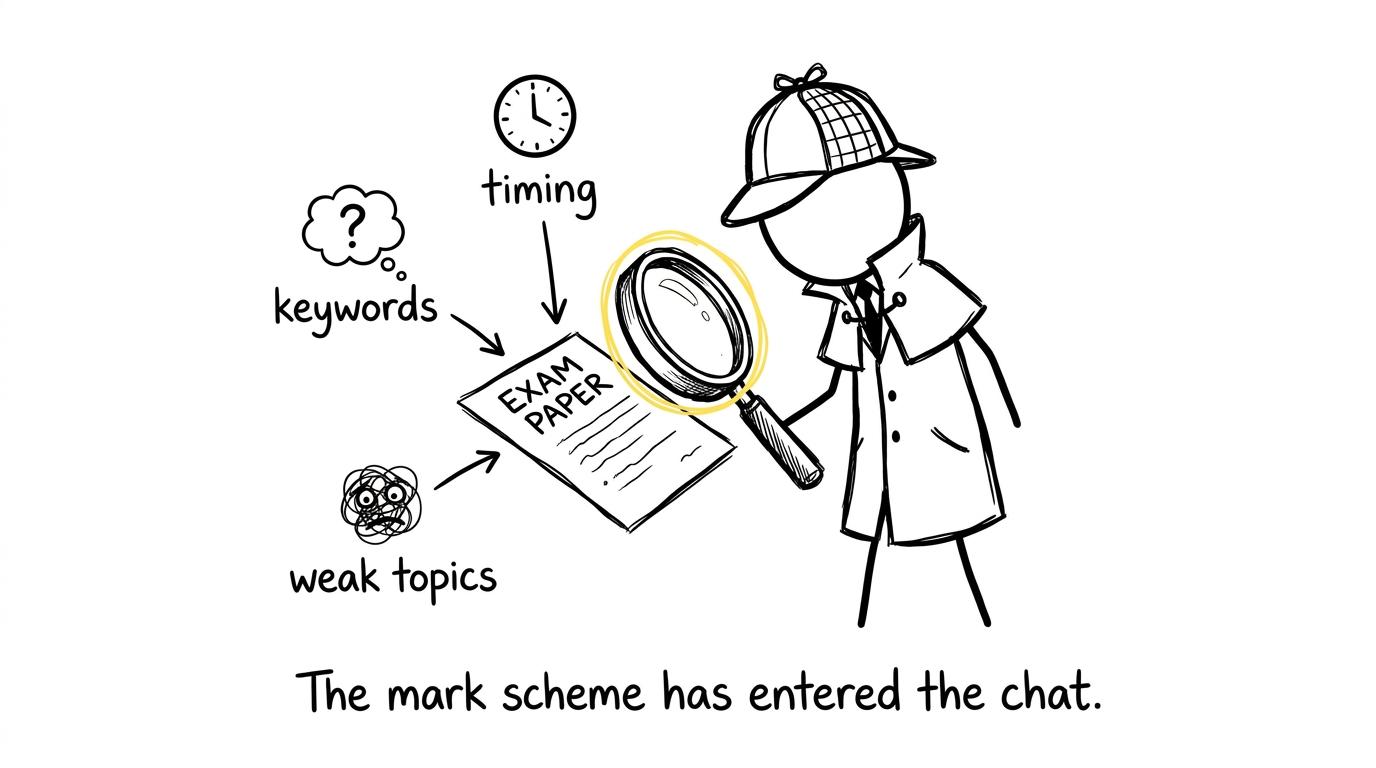 A revision detective investigates clues left by a mark scheme
This same loop is valuable across your timetable. For maths, MathsGenie's GCSE maths revision resources arrange lessons, questions and solutions by topic and grade. You can then test broader performance with GCSE past papers, use predicted papers for additional exam-style practice and organise the work through the revision planner.
Common mistakes when deciding whether you have revised enough
Counting hours instead of successful retrieval
Time spent matters less than what you can do afterwards. Replace “I revised for two hours” with “I can now explain this topic and answer unseen questions without notes”.
Revising favourite topics repeatedly
Comfort creates the impression of progress. Let your specification checklist and error log decide what comes next, especially when they point towards an uncomfortable topic.
Treating recognition as recall
A diagram or paragraph may look obvious when it is open. Close it and reproduce the key ideas. The gap between recognising and retrieving is where many hidden weaknesses live.
Marking generously
Do not award yourself a mark because you “basically meant” the mark-scheme statement. Compare your actual words with the required idea and note where terminology or logic was incomplete.
Doing papers without reviewing them
A pile of completed papers is not automatically progress. The improvement happens when errors are classified, repaired and retested.
Chasing a perfect feeling
There will nearly always be another fact you could revisit. The realistic goal is broad coverage, secure core knowledge and repeatable exam performance, not the complete absence of nerves.
When should you stop revising?
You do not need to stop all revision once you appear ready. You should change its shape.
When most specification areas are secure and timed performance is consistent, reduce frantic content gathering. Use shorter retrieval sessions, revisit a small number of genuine weaknesses and protect sleep, meals and ordinary routines. Starting a huge new resource at the last minute can create more uncertainty than value.
On the evening before an exam, your task is not to relearn the entire course. Check essential details, prepare what you need and give your memory the chance to work.
Turn uncertainty into your next action
The most useful answer to “have I revised enough?” is not yes or no. It is a piece of evidence: a completed specification check, an accurately marked paper, a practical you can evaluate or a weak topic that now survives delayed recall.
Take the next measurable step today. Test one Biology area without notes, mark it honestly and schedule a retest. Then apply the same disciplined process to maths with MathsGenie's free revision lessons and practice questions, past papers, predicted papers, mark schemes and video solutions. Confidence tends to arrive after the evidence, not before it.











