

GCSE WJEC Guide: Support Maths Revision Without Nagging
GCSE WJEC guide for parents: support maths revision without nagging. Use calm routines, past papers, mark schemes and YesGenie tools.
GCSE revision rarely fails because a student “doesn’t care”. It fails because the emotional weather at home changes: a parent gets anxious, a student feels watched, and maths becomes a daily referendum on confidence. If you’re revising for GCSE Maths (WJEC or Eduqas), you’ve probably felt it: the moment someone asks “Have you revised?” and your brain hears “Are you failing?”
This guide is designed to help parents support GCSE Maths revision without nagging, while giving students a plan that actually moves marks. We’ll keep it practical, WJEC-aware, and focused on what works: calm routines, exam-style practice, and feedback from mark schemes. YesGenie is the backbone here: free revision lessons, question banks, past papers, predicted papers and video solutions you can use without turning home into a classroom.
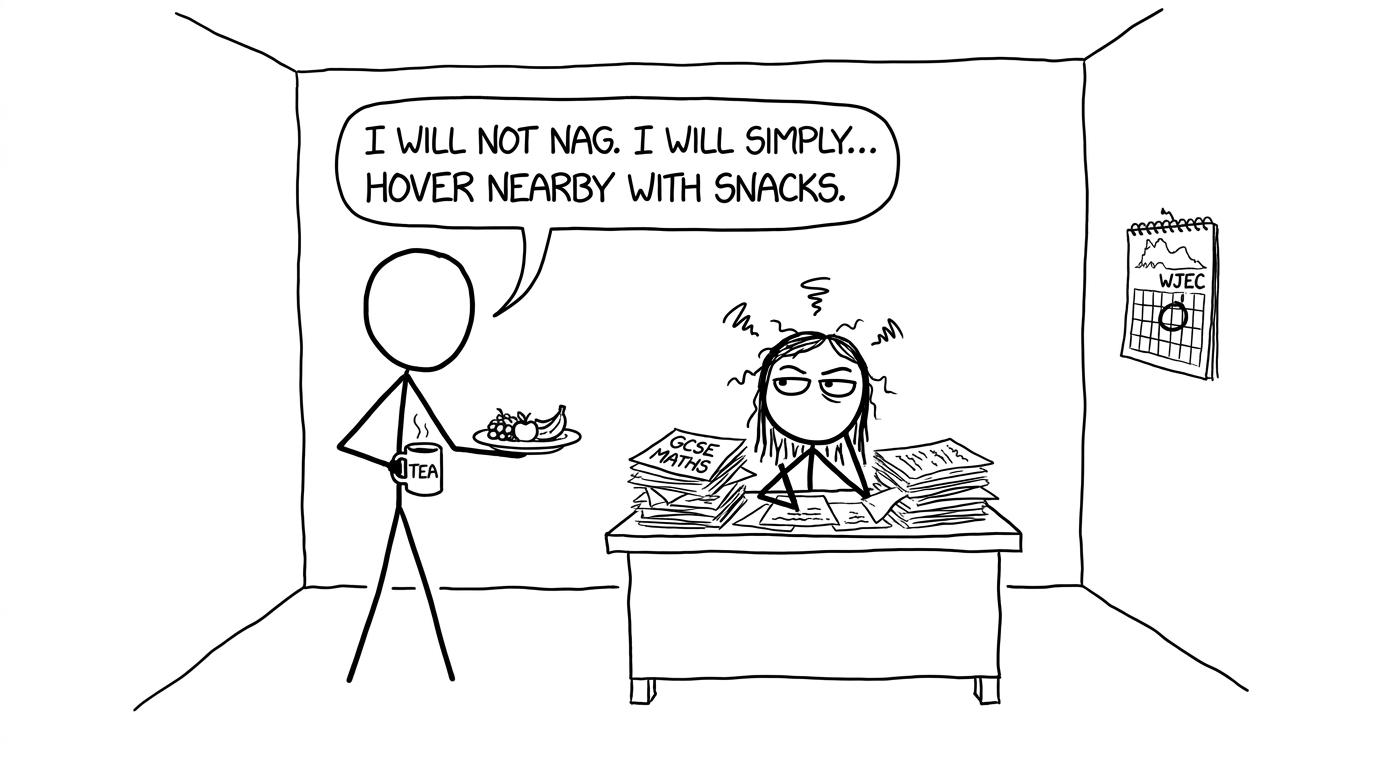 Parent hovering with tea, trying not to nag
The non-nagging support checklist (for GCSE Maths)
If you’re a student, treat this like a boundary-setting script. If you’re a parent, treat it like a job description.
- Agree one daily GCSE revision slot (short and consistent beats long and rare).
- Ask about the plan, not the feeling: “What’s your next question type?”
- Use exam feedback loops: past papers, mark schemes, and targeted topic work.
- Measure actions, not promises: time on task, number of questions, number corrected.
- Keep help “opt-in”: offer, then step back.
For WJEC students, start here: WJEC GCSE Maths Revision. It pulls together lessons, revision guides, a question bank and past papers so your revision doesn’t become a scavenger hunt.
Why nagging backfires (and what to do instead)
Nagging is usually a love language translated badly. It comes from a parent’s fear: “If I don’t push, nothing happens.” But GCSE Maths revision is not only about effort; it’s about control. When a student feels controlled, they protect autonomy by delaying, hiding, or doing “revision” that looks safe but doesn’t create marks.
A better approach is to make revision feel like a choice with support built in. You do that by changing two things:
- The question you ask: from “Have you revised?” to “What are you practising today?”
- The evidence you request: from “Tell me you’ve done it” to “Show me one corrected question.”
YesGenie helps because it creates neutral evidence: completed practice, marked papers, and video solutions. Parents don’t need to be the judge; the mark scheme is.
GCSE WJEC and Eduqas: a quick note on exam boards
In Wales, many students sit WJEC, and many schools use Eduqas (WJEC’s English-medium brand). Either way, your GCSE Maths revision needs to match your specification and paper style.
Use the correct board hub so you’re not revising the right topic in the wrong format:
- WJEC GCSE Maths Revision
- For broader paper practice across boards: GCSE Past Papers
The aim is simple: reduce uncertainty. When your revision is aligned, confidence stops leaking away.
The “quiet contract”: a revision routine that parents can support
Here’s the routine that tends to work for GCSE Maths because it’s boring in the best way. It’s also easy to support without nagging.
Set a fixed time, with a small start
Pick a daily slot (even 25 minutes). Parents can help by protecting it: fewer interruptions, quieter house, simple snack. Students can help by starting with something easy to reduce friction.
A strong “small start” is a mini topic warm-up or a single method question from a revision guide.
Try a focused topic page like Substitution (GCSE Revision Guide) if you need a gentle start.
Use a 3-step loop: learn, practise, prove
- Learn: read a short explanation or watch a walkthrough.
- Practise: do exam-style questions.
- Prove: correct with solutions/mark scheme and write one improvement note.
Parents support this loop by asking only one calm question: “Which step are you on?” That’s it.
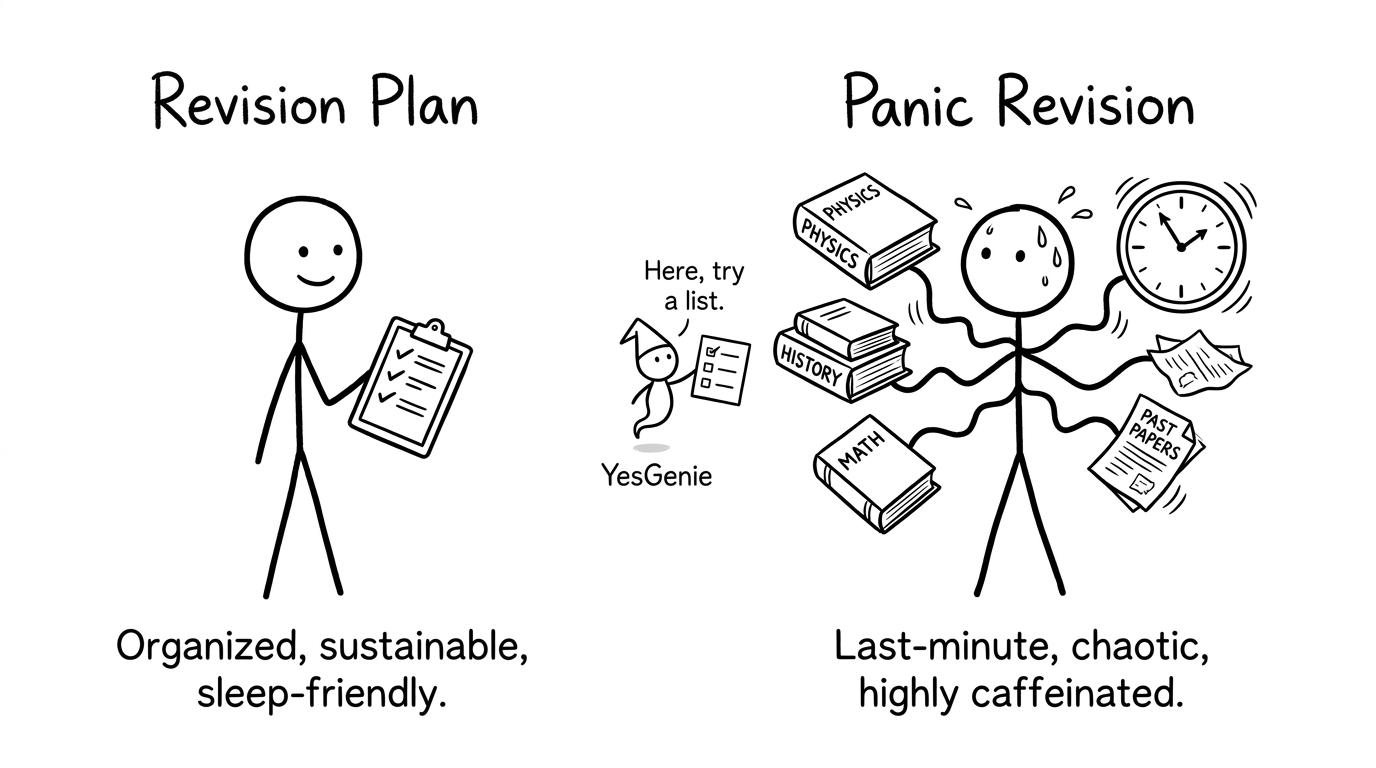 Revision plan vs panic revision
Worked example students can show parents (without a debate)
Parents often want to “help” by checking answers. Students often want them to stop. The compromise is to show a clean method once, then use the mark scheme for everything else.
Here’s a GCSE-style method question (quick, checkable, and common on WJEC).
Worked example: substitution with negatives
Evaluate 3a−2b23a - 2b^23a−2b2 when a=−4a=-4a=−4 and b=3b=3b=3.
Substitute carefully:
3a−2b2=3(−4)−2(32) 3a - 2b^2 = 3(-4) - 2(3^2) 3a−2b2=3(−4)−2(32)Work in order:
- 3(−4)=−123(-4) = -123(−4)=−12
- 32=93^2 = 932=9
- 2×9=182 \times 9 = 182×9=18
So:
−12−18=−30 -12 - 18 = -30 −12−18=−30Final answer: −30-30−30.
A parent can support by asking: “Did you put negatives in brackets?” and “Did you square before multiplying?” That’s support, not control.
For more practice in the same style, use a targeted revision guide like Substitution (WJEC GCSE).
The highest-leverage parent move: switching from topics to papers
GCSE Maths revision improves fastest when you do paper practice early enough to learn from it. The parent’s role is not to mark it (that creates arguments). The parent’s role is to make it easy to do one paper a week and review it.
For WJEC students, this is the best starting point:
A simple “paper review” script (10 minutes)
- Student: circles 3 questions they lost marks on.
- Student: writes one reason per question (forgot method / misread / arithmetic / time).
- Parent: asks only, “What topic is each question?”
- Student: chooses one topic to practise next.
Then jump into topic practice from the WJEC hub: WJEC GCSE Maths Revision.
Using mark schemes without melting down
A mark scheme can feel like judgement. Used properly, it’s relief: it tells you what the examiner rewards.
One helpful rule for GCSE Maths revision is: never argue with the mark scheme; learn its language. If the scheme gives method marks for a diagram, you draw the diagram next time. If it rewards rounding to a specific accuracy, you copy the convention.
A quick, parent-friendly way to support is to ask: “Where did the method marks go?” That question focuses on improvement, not blame.
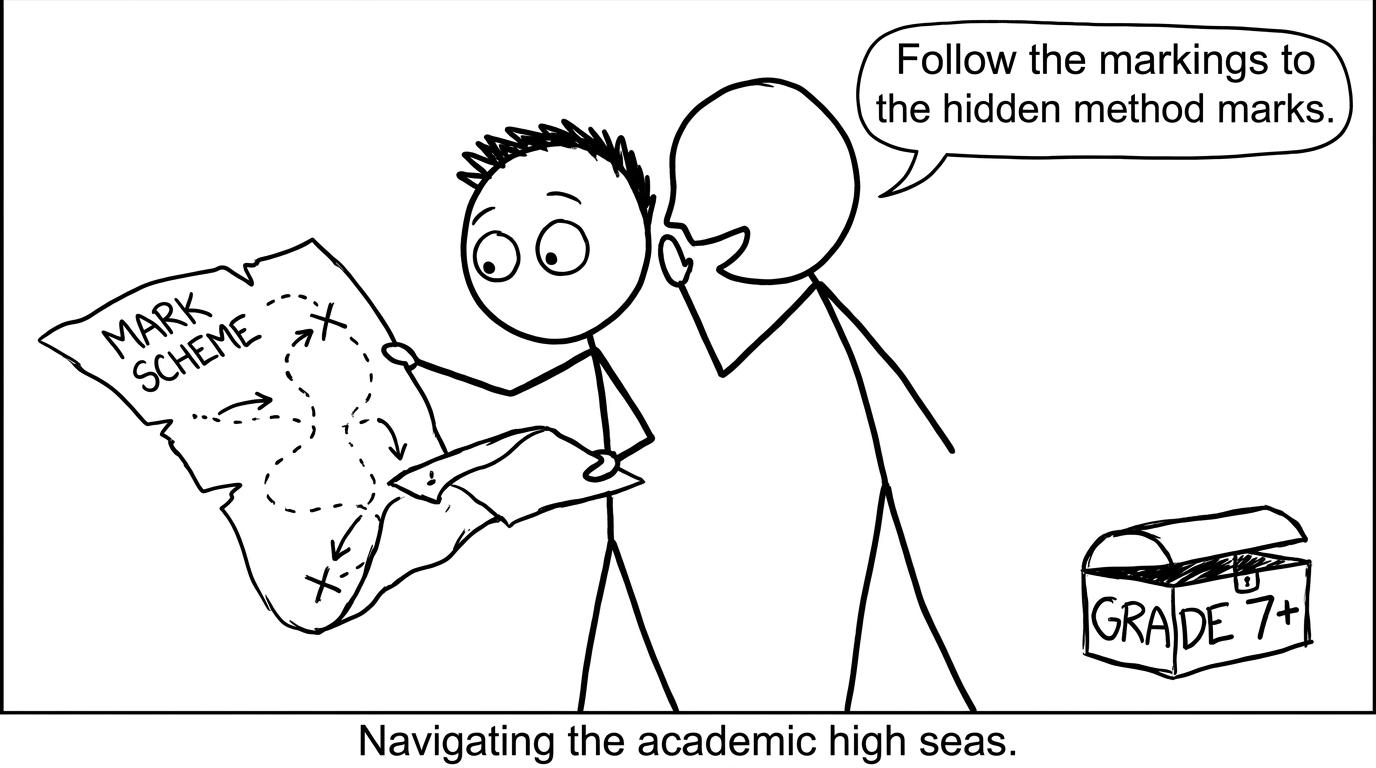 Mark scheme as a treasure map
From “help me” to “coach me”: what parents can actually do
Parents often feel useless because they can’t remember the maths. That’s fine. GCSE Maths revision support is mostly environmental and emotional.
Practical support that doesn’t feel like nagging
- Make revision visible but not monitored: a shared calendar, not a constant check-in.
- Provide the tools: printer paper, calculator batteries, ruler, protractor.
- Keep routines boring: same time, same place, same expectation.
- Be the timekeeper once a week: help run one timed paper section.
Students: if your parent wants to help, give them a job that doesn’t involve teaching. “Can you set a 45-minute timer while I do Paper 1?” is a safe request.
GCSE common mistakes (and how parents can spot them gently)
These are patterns across WJEC, Eduqas, Edexcel, AQA and OCR. They’re also the kind of mistakes that create a lot of stress for not many marks.
- Dropping negative signs: especially when substituting or expanding brackets. Use brackets: 3(−4)3(-4)3(−4) not 3−43-43−4.
- Wrong order of operations: students do 2(32)2(3^2)2(32) as (2×3)2(2\times 3)^2(2×3)2. Remind yourself: indices first.
- Rounding too early: keep exact values until the end, then round as instructed.
- Not showing working: many GCSE questions award method marks. A correct-looking answer with no method can lose marks.
- Topic drift: revising what feels comfortable (like easy number) instead of what papers reveal (often algebra, ratio, geometry).
A parent doesn’t need to correct the maths. They can ask one useful question: “Did you write enough working to earn method marks?”
A student-friendly weekly plan for GCSE Maths revision
This is designed so parents can support without chasing.
- Day 1: 25-45 minutes of topic revision + questions.
- Day 2: 25-45 minutes of a different topic.
- Day 3: mixed practice (harder, but powerful).
- Day 4: rest or light recap.
- Day 5: timed half-paper or full paper section + review.
- Weekend: fix the top 2 weaknesses from the week.
For topic-by-topic practice when weaknesses show up, use the board hub and its question bank: WJEC GCSE Maths Revision. For paper weeks, use WJEC GCSE Maths Past Papers.
Closing: GCSE revision works best when home feels safe
The quiet truth about GCSE Maths revision is that you can’t force confidence into someone by asking louder questions. Confidence is built in smaller ways: a routine that repeats, a paper that gets reviewed properly, a topic that stops being scary because you’ve seen it ten times.
Parents: your job is not to teach the maths. Your job is to make revision easier to start and less painful to continue. Students: your job is to keep the loop honest: learn, practise, prove.
If you want one place to do that without drama, use YesGenie. Start with WJEC GCSE Maths Revision, practise with WJEC GCSE Maths Past Papers, and build your marks through lessons, question banks, mark schemes, and video solutions. Then repeat. GCSE becomes manageable when the process becomes ordinary.










