GCSE: Stop Forgetting WJEC Biology Content (with Maths Habits)
GCSE revision for WJEC Biology: stop forgetting content using spaced retrieval, mini tests, and maths-style practice routines you can run weekly.

You sit down to revise. You open a WJEC Biology page you definitely understood last week. And somehow it feels like someone has quietly removed the knowledge overnight.
That feeling is common at GCSE. Not because you’re “bad at Biology”, but because remembering is a skill that needs training. In maths, you feel it quickly: if you don’t practise, methods fade. In Biology, it’s sneakier: you can re-read, nod along, and still blank when the question asks for four marks on enzymes or the carbon cycle.
This post is for WJEC students who want to stop forgetting GCSE Biology content, using the same disciplined habits that help you climb grades 9-1 in maths.
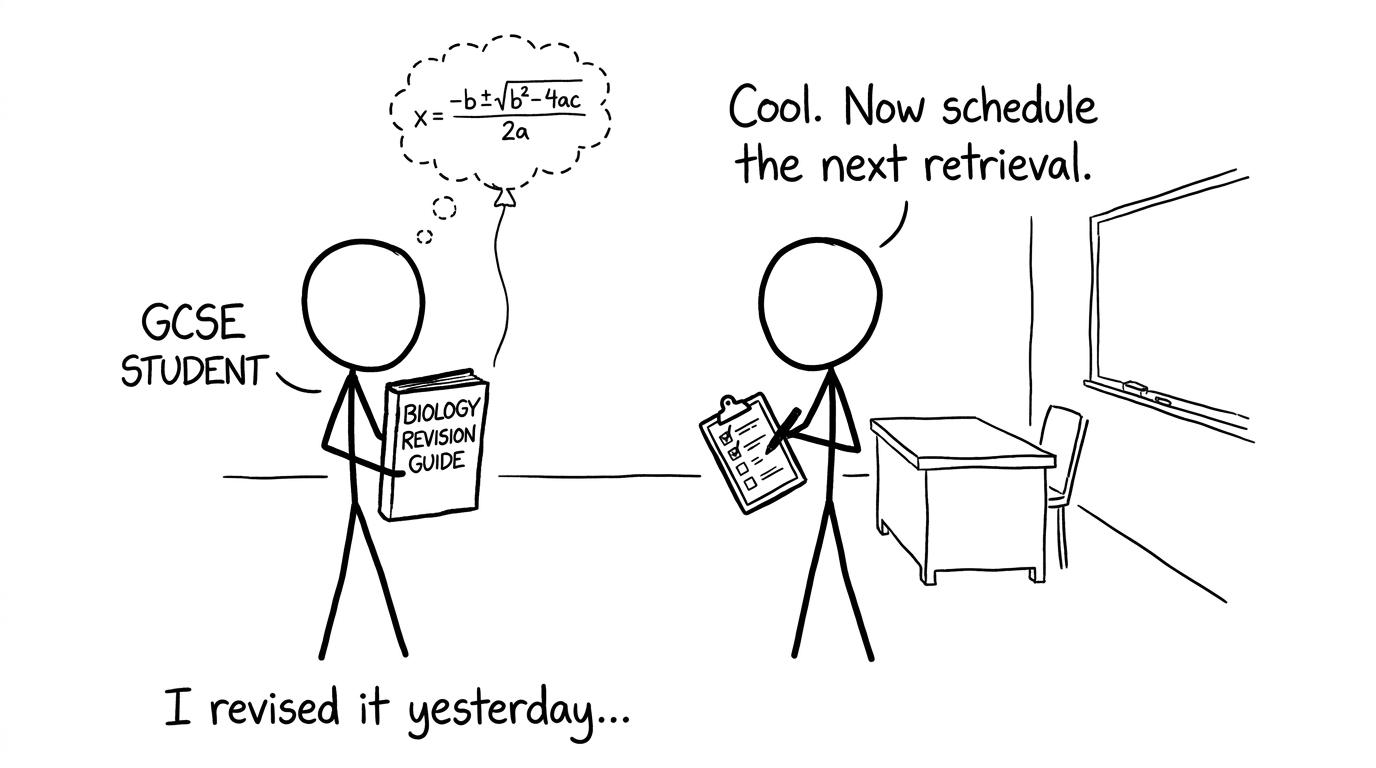 A student watches knowledge float away like a balloon
The quick checklist (what actually works)
If you only take one thing from this, take this routine:
- Retrieval first, notes second: test yourself before looking.
- Space it: revisit after 111 day, 333 days, 777 days, then weekly.
- Interleave: mix topics (and even subjects) so your brain learns to choose the right idea.
- Mark like the exam: train your wording using mark schemes.
- Mini tests beat marathons: shorter, repeatable sessions win.
- Track the weak list: keep a living list of “I forgot this” facts.
You can borrow this structure directly from how you should revise GCSE maths on YesGenie: short lessons, then practice questions, then past-paper style work with solutions.
Helpful YesGenie hubs to keep open in a tab:
- GCSE Subjects on YesGenie
- Resources (mini tests, predicted papers, and more)
- WJEC GCSE Maths Revision
- WJEC GCSE Maths Past Papers
Why you forget GCSE Biology (and why it’s not your fault)
Forgetting isn’t a character flaw. It’s the default.
Biology content has a lot of labels, sequences, and cause-and-effect chains. If those chains aren’t used, your brain compresses them. You remember the gist (“enzymes are important”) but not the marks (“active site”, “denature”, “optimum temperature”, “collision frequency”).
Maths gives instant feedback on forgetting because methods are procedural. Biology is partly procedural (required practicals, calculations, investigations) but heavily knowledge plus keywords. That means you can feel confident while re-reading and still underperform in a six-mark “explain” question.
So the fix is not “revise harder”. The fix is to revise in a way that forces recall.
Turn Biology into something your brain can practise
Build a “retrieval loop” like you do in maths
In maths, a strong session often looks like:
- Learn a method.
- Do 101010 similar questions.
- Do exam questions.
- Review mistakes.
Biology should follow the same loop, just with different materials.
A simple Biology retrieval loop:
- Write everything you remember on a topic from memory (one page max).
- Check notes and add missing keywords in a different colour.
- Answer 333 exam-style questions (short answer + one longer response).
- Mark with the mark scheme and correct your wording.
- Make a “weak list” of the facts you missed.
That correction step is what most GCSE students skip, and it’s where most marks live.
Use maths-style spacing: schedule reviews with a simple model
Spacing doesn’t have to be complicated. Think of it like repeated percentage decay in reverse: you’re topping up memory before it drops too far.
Here’s a simple schedule you can actually keep:
- Day 000: learn + retrieval loop
- Day 111: 101010-minute retrieval
- Day 444: 101010-minute retrieval
- Day 111111: 151515-minute exam questions
- Weekly: mixed-topic mini test
If you like structure, put this into a revision planner grid. YesGenie’s resources and maths pathways are built around the same idea: consistent, repeatable practice.
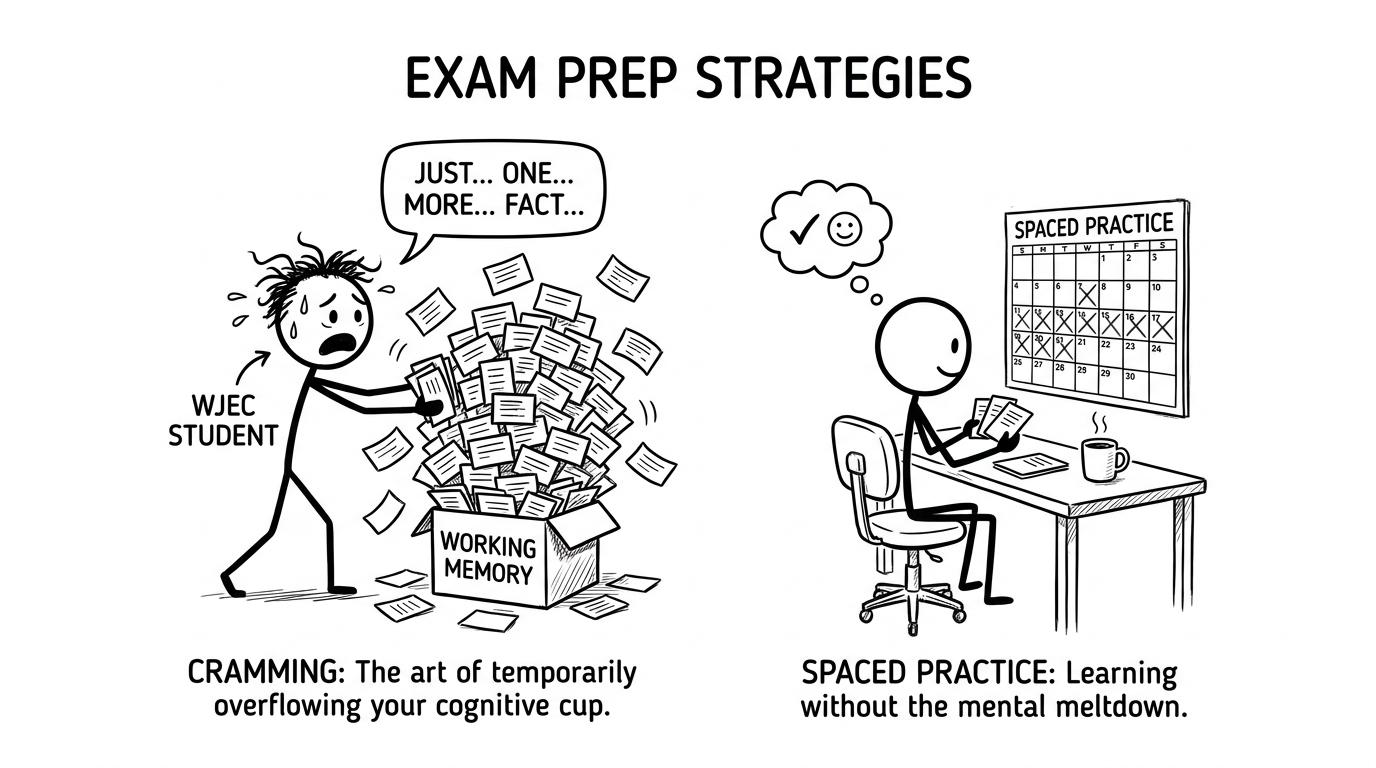 Flashcards crammed into “Working Memory” vs spaced practice calendar
Worked example: using maths to measure your forgetting (so you stop guessing)
WJEC Biology (like all GCSE sciences) often includes data, graphs, and required practical thinking. You can use maths to make your revision smarter.
Example: retrieval score tracker (percentages that actually guide revision)
Suppose you do a quick 202020-mark mixed Biology retrieval test.
- Week 1 score: 11/2011/2011/20
- Week 2 score: 14/2014/2014/20
- Week 3 score: 16/2016/2016/20
Convert to percentages:
1120=0.55=55% \frac{11}{20}=0.55=55\% 2011=0.55=55% 1420=0.70=70% \frac{14}{20}=0.70=70\% 2014=0.70=70% 1620=0.80=80% \frac{16}{20}=0.80=80\% 2016=0.80=80%Now the key move: don’t just celebrate improvement. Use it to decide what to do next.
- At 55%55\%55%, you still need content rebuild: short notes + flashcards + basic questions.
- At 70%70\%70%, shift towards exam wording: mark schemes and longer responses.
- At 80%80\%80%, maintain with weekly interleaving so it doesn’t slip.
This is the same logic you’d use in GCSE maths: if you keep dropping marks on algebraic fractions, you don’t “do more maths”; you target the topic.
To practise that targeting in maths, YesGenie’s board pages are ideal starting points (and the method carries to your Biology planning):
Make WJEC Biology stick with interleaving (without making it chaotic)
Interleaving means mixing topics so your brain practises choosing, not just repeating.
A good GCSE interleaving set might look like:
- Cell biology (microscopy, mitosis)
- Organisation (enzymes, digestion)
- Ecology (food chains, cycles)
Instead of doing one topic for two hours, do three 252525-minute blocks with retrieval at the start of each. That little struggle of switching is the point: it builds flexible recall.
Maths revision naturally uses this because exam papers mix topics. That’s why past papers are so powerful.
If you’re a WJEC student, the maths habit is easy to copy:
- Use WJEC GCSE Maths Past Papers as your model for what “mixed practice” feels like.
- Then build Biology mixed practice from WJEC past questions and mark schemes in the same way.
The mark scheme is your memory coach (use it properly)
Most forgetting at GCSE isn’t “I don’t know it”. It’s “I didn’t say it in the way that earns marks”. Biology mark schemes reward:
- the correct term (e.g. “diffusion gradient”, “active site”, “denatured”)
- the correct direction (increase/decrease)
- the correct chain (cause leads to effect)
Do what you already do in maths: write the exact phrasing that gets the mark.
A simple routine:
- Answer without notes.
- Mark brutally.
- Rewrite your answer as a model answer.
- Cover it and retrieve it again two days later.
If you want a maths parallel, look at how YesGenie supports this with solutions and mark-scheme-aligned approaches on board pages like:
Use “dual coding” the right way (simple drawings, not art)
Biology diagrams can be memory anchors if you keep them minimal:
- draw the process
- label key terms
- add one sentence explaining the arrows
Don’t spend ages making it pretty. Your goal is retrieval: redraw it from memory later.
This is similar to how you might sketch a graph quickly in GCSE maths to remind yourself of features, not to produce a masterpiece.
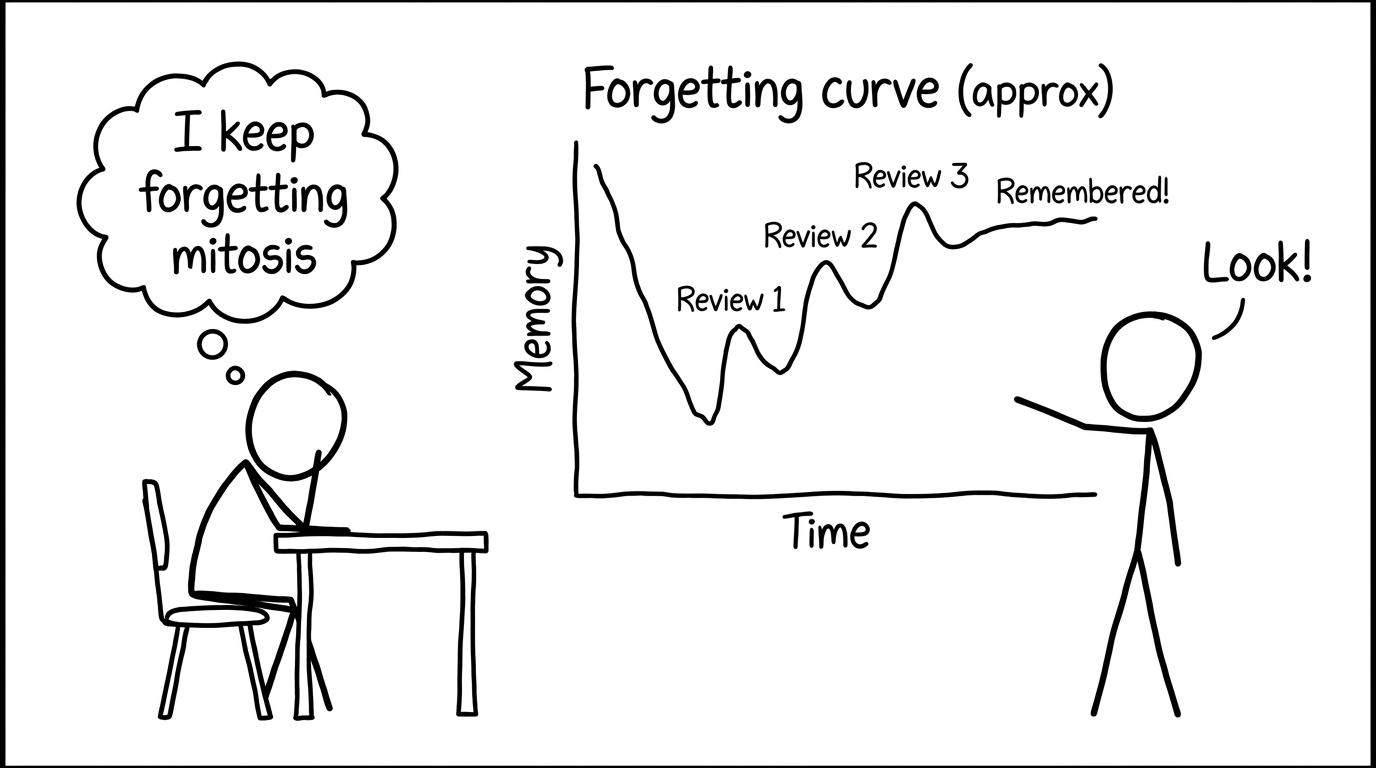 Forgetting curve with bumps after each review
Common mistakes that keep WJEC students forgetting
- Re-reading as “revision”: it feels productive, but it doesn’t force recall. Swap the order: retrieve first, then check.
- Cramming one topic per night: you get short-term familiarity but poor exam access. Interleave to train selection.
- Not correcting with the mark scheme: you repeat vague answers and wonder why you lose marks. Make model answers.
- Ignoring command words: “describe” vs “explain” changes the structure. Practise matching structure to command word.
- Only revising strengths: you feel calm, but your grade stays stuck. Build a weak list and attack it first.
- No data practice: graphs, rates, and percentage change appear in Biology. If the maths part feels shaky, fix it.
For the maths foundations that support science marks, build confidence with targeted topic guides like:
A closing thought (and a practical next step)
Forgetting GCSE Biology content can feel personal, like your effort is leaking away. But it’s usually just a systems problem. You’re doing revision that feels safe (re-reading) rather than revision that builds access (retrieval, spacing, and mark-scheme correction).
So make it simple: run a weekly mixed retrieval test, keep a weak list, and revisit on a schedule. Treat Biology like maths: practice is the point, feedback is the teacher, and consistency is the advantage.
When you want a revision routine that’s already built for consistency, use YesGenie as your anchor, especially for maths, where strong habits are easiest to learn and transfer. Start with WJEC GCSE Maths Revision, then commit to mixed practice using WJEC GCSE Maths Past Papers and the wider Resources section (mini tests, predicted papers, and focused practice). Keep the rhythm, and your GCSE memory stops being something you hope for and becomes something you train.