GCSE WJEC Exam Week Checklist (Simple, Calm, Effective)
GCSE exam week checklist for WJEC Maths: what to do each day, what to pack, and how to use past papers, mark schemes and YesGenie resources.
The week GCSE maths stops being “revision” and becomes logistics
You can know the content and still lose marks in GCSE Maths exam week. Not because you’re not capable, but because your brain is busy carrying too many small decisions at once: Which paper is first? Non-calculator or calculator? What do I revise tonight? What if I forget my protractor? The maths doesn’t change, but the pressure does.
This guide is a GCSE-simple checklist, written with WJEC GCSE Maths in mind (but it works for most exam boards). It’s designed to keep you calm, consistent, and focused on the questions that actually earn marks. And it pairs naturally with YesGenie’s free lessons, practice questions, past papers, mark schemes, predicted papers and mini tests.
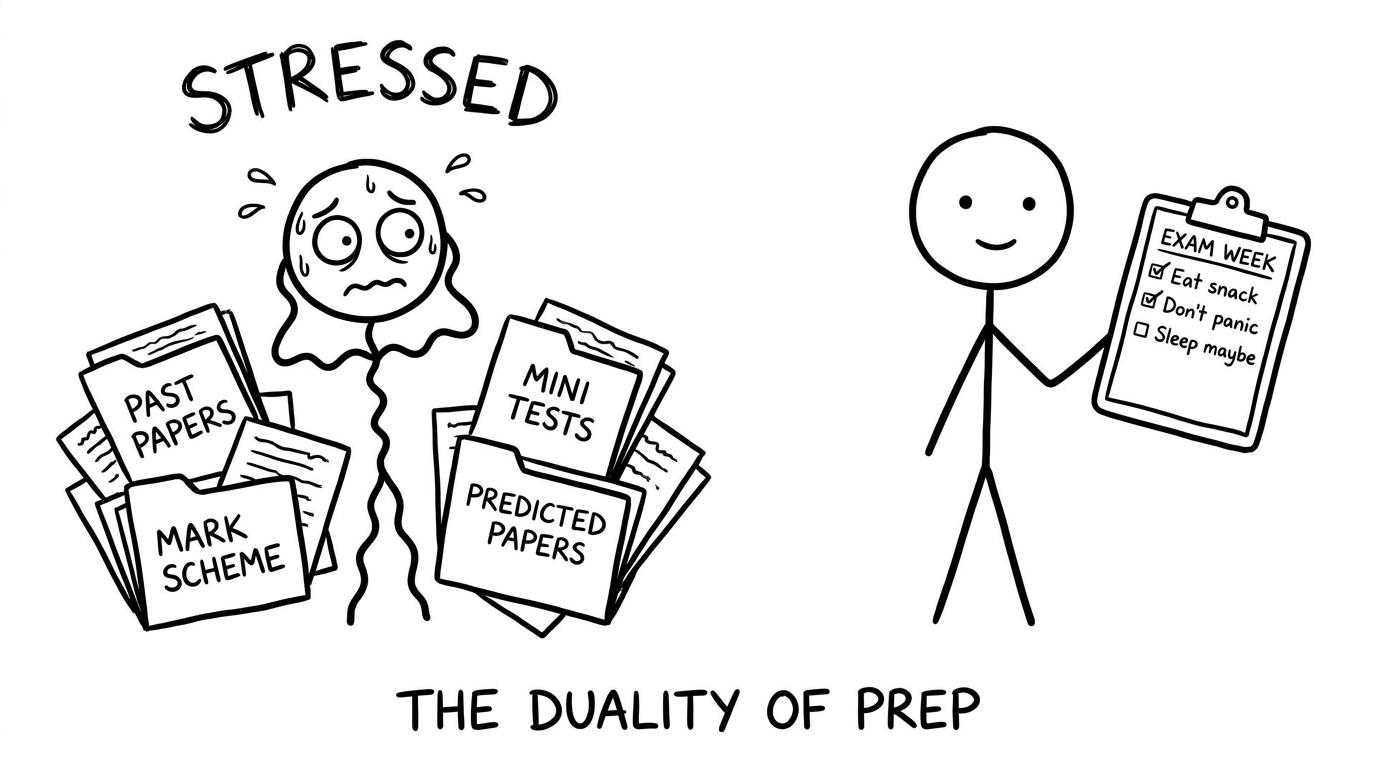 A calm exam-week checklist friend
A simple GCSE exam week checklist (save this)
Use this as your daily anchor during GCSE week:
- Check your timetable (paper, time, room, calculator or non-calculator).
- Do a 20-40 minute “targeted warm-up” (not a full paper) on your weakest area.
- Do one short burst of exam technique: one multi-mark question, marked properly.
- Pack your bag the night before.
- Sleep and eat like someone who wants their brain to work.
- After each exam, do a short reset, then move on.
Keep YesGenie open as your home base:
- WJEC GCSE Maths Revision
- WJEC GCSE Maths Past Papers
- GCSE Past Papers Hub
- Resources (Predicted papers, mini tests, more)
Your WJEC GCSE exam week plan (day by day)
The weekend before the first exam
Your goal is not “learn everything”. Your goal is to remove friction.
- Do one timed paper section (45-60 minutes) from the correct tier.
- Mark it with a mark scheme and write a short “Fix List”: three topics only.
- Relearn those three topics using a single source (YesGenie lessons or revision guides), then do a handful of targeted questions.
If you’re sitting WJEC, start here:
If you’re supporting a friend on AQA/OCR (or you want alternative topic notes), these revision guide hubs are also useful:
The night before each GCSE exam
Think “set-up”, not “cram”. Cramming feels productive because it’s loud. Effective revision is quiet.
- Prepare your equipment (see the packing section below).
- Choose one topic to warm up (20 minutes max).
- Do one exam-style question worth at least 4 marks and mark it carefully.
- Stop revision at a sensible time so you can sleep.
The morning of the exam
A good GCSE morning routine is boring. That’s the point.
- Eat something simple.
- Do 10 minutes of light recall (formulae, methods, common mistakes).
- Avoid full past papers right before the exam; they spike stress.
Between papers in exam week
Students often waste the gap either panicking or doing random revision. Try this instead:
- Do a “post-exam decompression” (walk, water, food).
- Write down one lesson (not a mark prediction).
- Switch to the next paper with a fresh plan: two topics, then one exam question.
What to pack for GCSE Maths (WJEC and everyone else)
A small checklist saves a surprising number of marks over a week.
- Black pens (at least two)
- Pencil, rubber, sharpener
- Ruler
- Protractor
- Compass
- Calculator (for calculator papers), plus spare batteries if possible
- Water bottle (label removed if required by your centre)
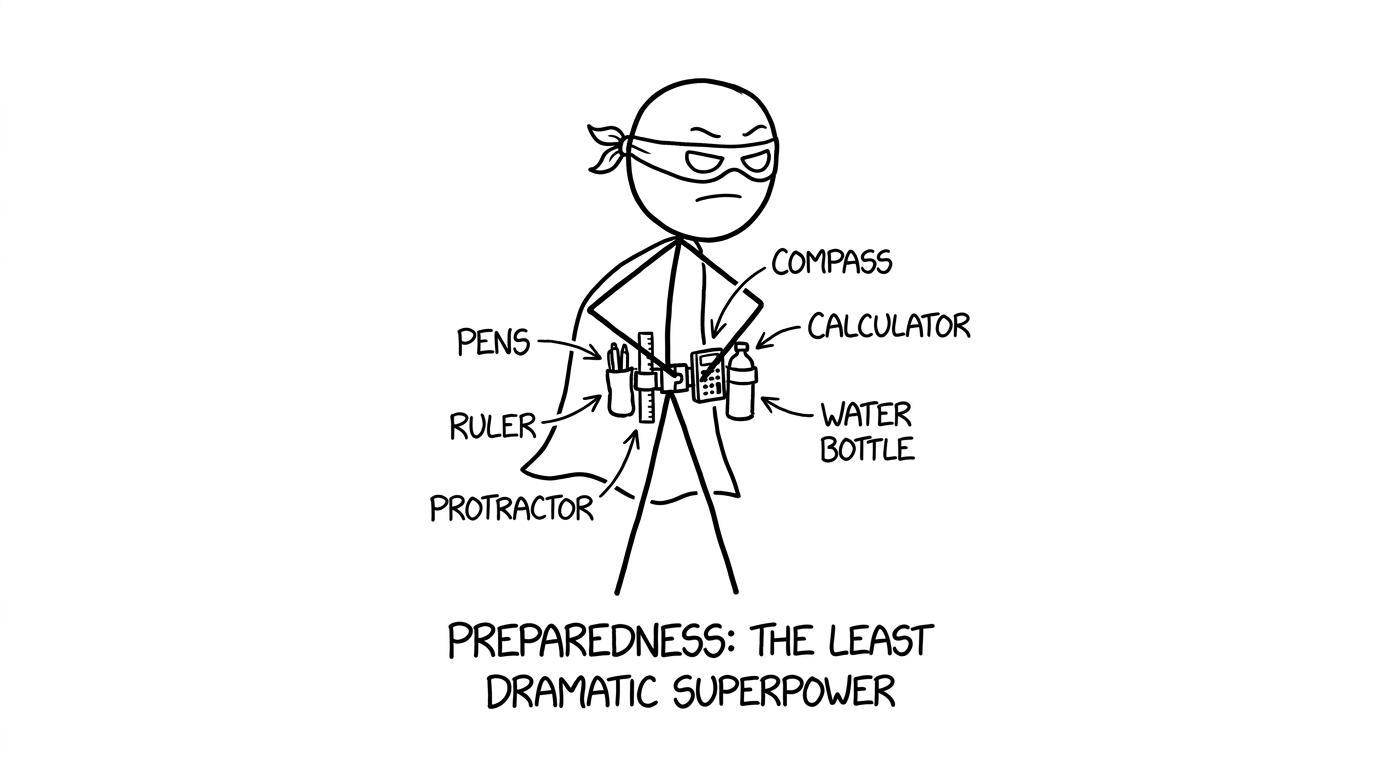 Exam bag packed like a superhero belt
Two quick worked examples to keep your GCSE marks safe
These are not “hard”. They’re the sort of questions where exam week pressure makes people rush. The aim is to practise a calm method.
Worked example: percentage change (a common GCSE trap)
A phone costs £240. It is reduced by 15%15\%15%.
A reliable method is: find 15%15\%15% then subtract, or multiply by 0.850.850.85.
15% of 240=0.15×240=36 15\% \text{ of } 240 = 0.15 \times 240 = 36 15% of 240=0.15×240=36So the new price is:
240−36=204 240 - 36 = 204 240−36=204Answer: £204.
If this is on your Fix List, use short targeted practice rather than whole papers. You can use topic resources through the main board pages such as WJEC GCSE Maths Revision, then switch straight into exam questions.
Worked example: solving a linear equation (easy marks if you show steps)
Solve 3(2x−5)=213(2x-5)=213(2x−5)=21.
Expand first:
6x−15=21 6x - 15 = 21 6x−15=21Add 151515 to both sides:
6x=36 6x = 36 6x=36Divide by 666:
x=6 x = 6 x=6In GCSE mark schemes, method marks often depend on seeing these steps. Even if you can do it in your head, write enough to get credit.
How to use GCSE past papers without burning out
Past papers are powerful, but only when you use them like an athlete uses footage: to find patterns, not to punish yourself.
The best way to mark a GCSE paper
- Mark with the official mark scheme.
- Circle every lost mark and write why underneath (e.g. “expanded incorrectly”, “units missing”, “rounded too early”).
- Rewrite one corrected solution neatly.
- Add the topic to your Fix List.
For WJEC students, keep your workflow simple:
- Choose a paper from WJEC GCSE Maths Past Papers
- Mark, fix, then practise that topic using your preferred YesGenie resource (lessons, revision guides, flashcards, worksheets).
Mini tests and predicted papers (the exam week sweet spot)
In the final week, many students don’t need another full paper every day. They need sharpness.
YesGenie’s Resources are ideal here because mini tests and predicted papers let you practise under time pressure without turning every session into a marathon. Use predicted papers as a way to keep revision broad, and mini tests to keep recall active.
Common mistakes that cost GCSE marks in exam week
- Rushing the first page. The first questions are usually accessible. Treat them as a mark-collection exercise.
- Not reading the command word. “Show that”, “work out”, “estimate”, and “write down” are different instructions.
- Calculator dependence. On non-calculator papers, students often freeze on arithmetic that they can do with a written method.
- Rounding too early. Keep full accuracy until the final line, then round as instructed.
- Forgetting units. Area in cm2\text{cm}^2cm2, volume in cm3\text{cm}^3cm3, money in £, time in minutes/seconds.
- Not showing method. In GCSE Maths, method marks are your safety net.
- Post-exam spiralling. One bad question does not predict your grade. Protect the next paper.
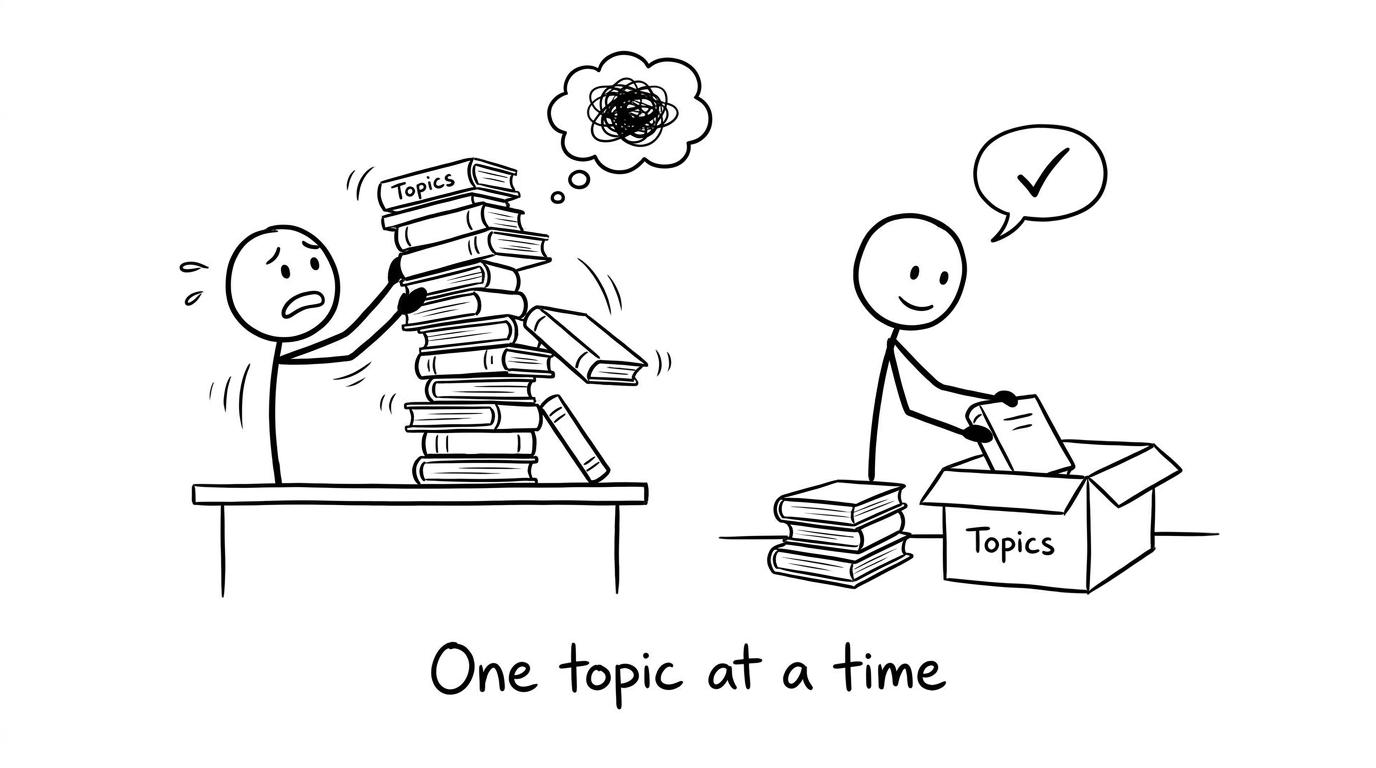 One topic at a time
Closing: treat GCSE exam week like a checklist, not a judgement
A strange truth about GCSE maths is that the final jump often comes from doing less, but doing it with intent. You don’t need to relearn everything in exam week. You need a routine that protects sleep, reduces decisions, and turns weak areas into dependable marks.
Make YesGenie your base camp: use WJEC GCSE Maths Revision for topic-by-topic lessons and practice, WJEC GCSE Maths Past Papers for real exam practice with mark schemes, and Resources for predicted papers and mini tests when time is tight.
Your job this week is simple: follow the checklist, collect the marks, and keep moving. That’s how GCSE grades are built, one calm decision at a time.