GCSE: Find Your Weakest Topics (WJEC Chemistry)
GCSE WJEC Chemistry: find your weakest topics fast using mark schemes, error logs and maths diagnostics. Target revision for higher marks.
GCSE revision has a quiet problem: you can feel busy for hours and still avoid the exact things that cost you marks. For WJEC Chemistry, that usually looks like re-reading a neat topic (say, bonding) while the messy bits: calculations, graphs, and awkward command words sit untouched. If you’re also a maths student (or you’re trying to be), you have a real advantage: you can treat “weak topics” as a data problem, not a personality flaw. The goal is simple: find what leaks marks, patch it, then repeat.
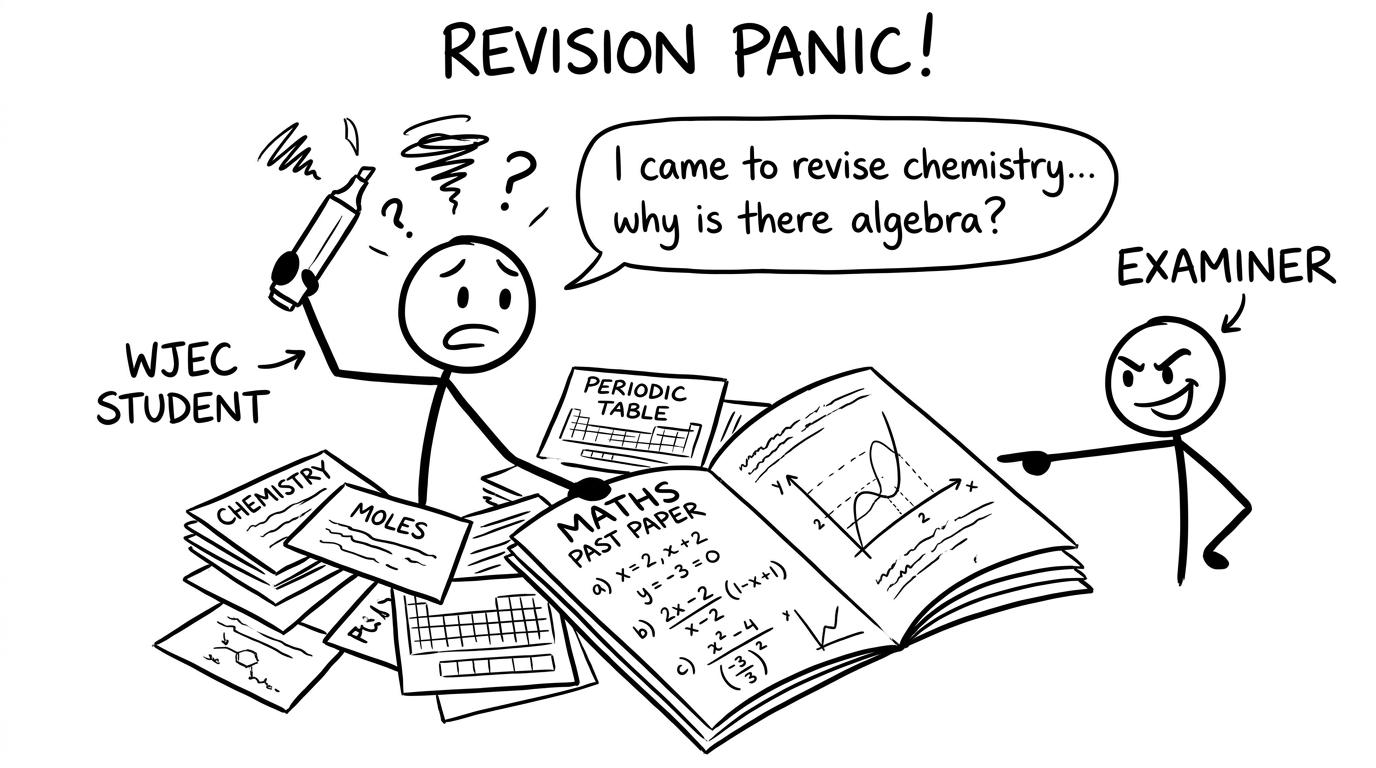 A WJEC student revising with unexpected algebra
The twist is that even though this is about WJEC Chemistry, the method is powered by GCSE maths habits: tracking mistakes, measuring time, and practising the exact skill until it becomes boring. YesGenie is perfect for that part of the process, because it gives you topic-by-topic practice, exam questions, mark schemes, and the structure to keep your revision honest.
The “weakest topics” checklist (fast, not fancy)
Use this as your one-page plan. You’ll come back to it after every paper.
- Do one timed paper (or a realistic section) and mark it properly.
- Log every lost mark into one of three buckets: knowledge, method, or exam technique.
- Tag each lost mark with the skill underneath (often a maths skill hiding inside Chemistry).
- Choose your top three weaknesses by marks lost, not by what feels hard.
- Fix each weakness with 30-45 minutes of targeted practice, then re-test.
If you want the easiest way to make the “fix” step happen, build it around YesGenie GCSE maths resources: GCSE Past papers, Resources hub, and board-specific maths pathways (for example GCSE Maths OCR). Even when the exam is Chemistry, your marks often depend on the same GCSE maths fundamentals.
Why WJEC Chemistry weaknesses often look like maths weaknesses
Students often describe their weakest topics as content areas: “rates of reaction”, “electrolysis”, “quantitative chemistry”. But in the exam hall, marks are lost for micro-skills: rearranging a formula, converting units, reading a graph, rounding correctly, using ratios, or choosing sensible significant figures. The topic is the wrapper; the skill is the engine.
This is why two students can revise the same chapter and get different outcomes. One has the knowledge and the method. The other has the knowledge but the method collapses under pressure.
To make your weakness-finding accurate, always ask:
- What did I do wrong on the page?
- Which step did I miss?
- What maths skill would have made this straightforward?
When you find that skill, you can practise it directly on YesGenie using short, focused pages rather than vague “revise chemistry” sessions.
Step 1: Use one paper to create a “marks lost map”
Pick a WJEC Chemistry paper (or a mixed set of questions) and sit it under timed conditions. Then mark it with the mark scheme as if you’re the examiner.
Now build a simple table (in your notebook is fine):
- Question/topic
- Marks available
- Marks scored
- Why marks were lost
- Underlying skill
The last column is where the GCSE maths student in you becomes valuable. “Didn’t know what electrolysis is” is a knowledge gap. But “forgot to convert cm3\text{cm}^3cm3 to dm3\text{dm}^3dm3” is a method gap. Method gaps are usually the easiest to fix quickly, and they show up again and again across papers.
A quick way to score your weaknesses
For each underlying skill, add up total marks lost across the paper. Your “weakest topics” are simply the biggest totals.
If you lost 9 marks to unit conversions and 2 marks to bonding definitions, unit conversions is your priority, even if bonding feels like the bigger topic.
Step 2: Turn Chemistry calculations into repeatable GCSE maths methods
WJEC Chemistry has plenty of questions where the science is simple but the arithmetic decides your grade. Here are three worked examples that double as weakness detectors.
Worked example: Percentage yield (often a hidden percentage weakness)
A reaction has a theoretical yield of 25 g25\text{ g}25 g. The actual yield is 18 g18\text{ g}18 g. Find the percentage yield.
Percentage yield is
Percentage yield=actualtheoretical×100 \text{Percentage yield}=\frac{\text{actual}}{\text{theoretical}}\times 100 Percentage yield=theoreticalactual×100Substitute:
Percentage yield=1825×100 \text{Percentage yield}=\frac{18}{25}\times 100 Percentage yield=2518×100Compute:
1825=0.72⇒0.72×100=72 \frac{18}{25}=0.72 \quad \Rightarrow \quad 0.72\times 100=72 2518=0.72⇒0.72×100=72So the percentage yield is 72%72\%72%.
Diagnostic clue: if you hesitated on the fraction-to-percentage step, your weakness is not “yield”; it’s GCSE percentages. That’s a perfect moment to practise percentage change and fraction conversions until they feel automatic.
Worked example: Concentration and unit conversion (the classic trap)
Suppose you dissolve 2.0 g2.0\text{ g}2.0 g of solute in 500 cm3500\text{ cm}^3500 cm3 of solution. Find concentration in g dm−3\text{g dm}^{-3}g dm−3.
First convert volume:
500 cm3=0.5 dm3 500\text{ cm}^3 = 0.5\text{ dm}^3 500 cm3=0.5 dm3Then
concentration=massvolume=2.00.5=4.0 \text{concentration} = \frac{\text{mass}}{\text{volume}} = \frac{2.0}{0.5}=4.0 concentration=volumemass=0.52.0=4.0So concentration is 4.0 g dm−34.0\text{ g dm}^{-3}4.0 g dm−3.
Diagnostic clue: if you wrote 2.0500\frac{2.0}{500}5002.0 you’ve found a real weakness: units plus structure. In GCSE maths terms, it’s “conversions and units” and “divide by a decimal”.
Worked example: Best-fit line reading (graphs are method, not memory)
A best-fit line passes through approximately (2,10)(2, 10)(2,10) and (8,34)(8, 34)(8,34). Find the gradient.
m=ΔyΔx=34−108−2=246=4 m=\frac{\Delta y}{\Delta x}=\frac{34-10}{8-2}=\frac{24}{6}=4 m=ΔxΔy=8−234−10=624=4Gradient is 444.
Diagnostic clue: if you picked two points that weren’t on the line, or you subtracted inconsistently, the science isn’t the issue. Your weakness is GCSE graphs and gradients, which you can fix by practising straight-line graphs and interpreting data.
For targeted practice, use YesGenie topic pages and exam-style practice. Start with something like Edexcel GCSE Maths Revision Guides to find the exact skill, then switch to your exam board pathway.
Step 3: Build a “weak topics radar” using three buckets
After you’ve marked the paper, sort every lost mark into one of these.
- Knowledge gaps: you genuinely didn’t know the fact/process.
- Method gaps: you knew what to do, but a step broke (algebra, arithmetic, units, graphs).
- Exam technique gaps: you rushed, misread, didn’t show working, ignored command words.
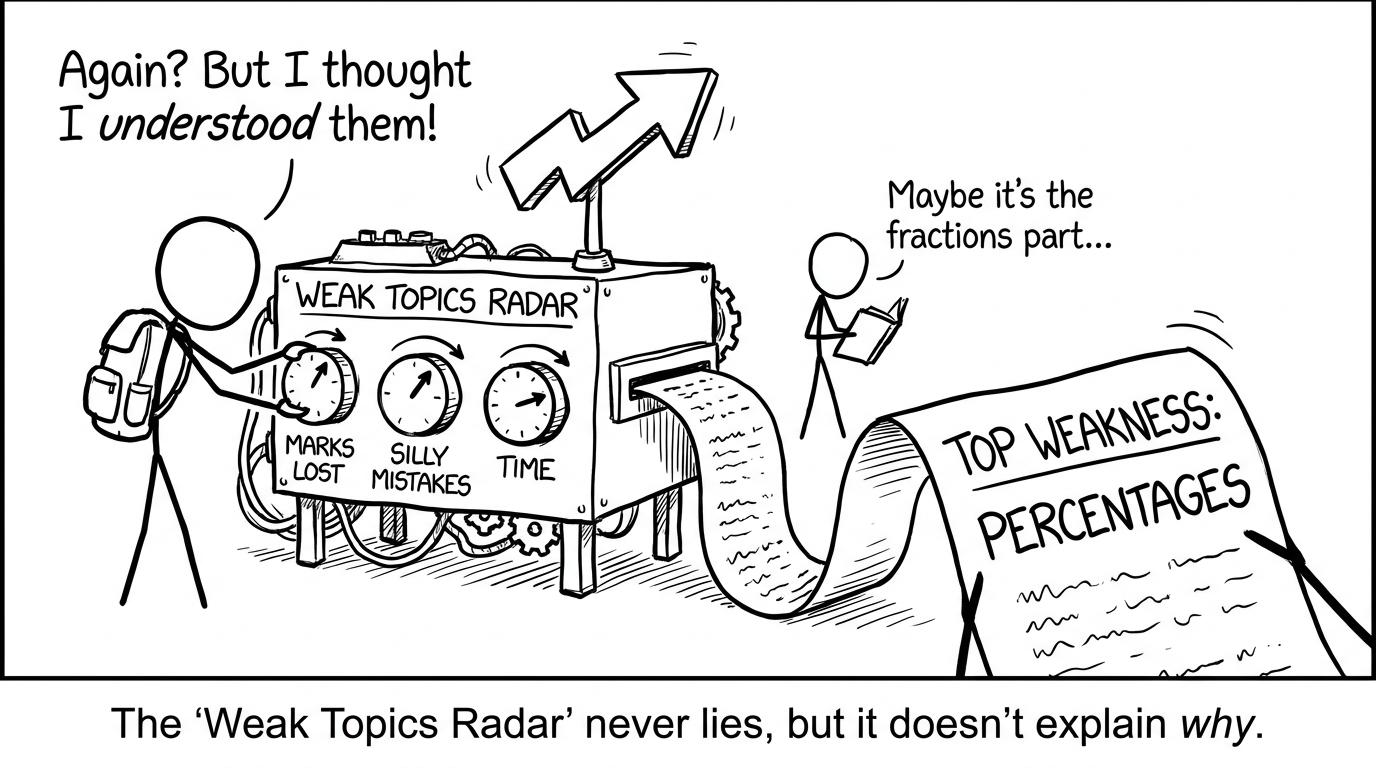 A silly machine that prints your weakest topic
Here’s the important part: your “weakest topics” list should prioritise method gaps first if you want fast improvement, because they pay you back across multiple topics. A student who fixes unit conversion doesn’t just improve “quantitative chemistry”; they improve any question that uses data.
A great maths-adjacent example is probability and ratios: even if it’s not Chemistry, the same precision is needed. If you want a model of how to revise a method-heavy topic, look at a structured guide like Probability: GCSE Maths Revision Guide. It shows how YesGenie breaks skills down into steps you can rehearse.
Step 4: The 30-45 minute repair loop (how to actually improve)
Once you’ve identified your top three weaknesses, use this loop:
- 10 minutes: re-learn the method (notes, a short video, a worked example).
- 20 minutes: practise the method on exam-style questions.
- 10 minutes: mark and write a correction that explains the mistake.
- 5 minutes: redo one similar question immediately.
This is where YesGenie becomes your revision engine: topic-by-topic practice, worked solutions, and exam question banks keep the loop tight. Use the broader Resources area to find mini tests and other printable practice options.
If you need an algebra-heavy tune-up that often appears inside science calculations, a page like Algebraic Fractions: GCSE Maths Revision Guide is ideal: it’s not Chemistry content, but it fixes the exact manipulation skills that stop you dropping marks.
Common mistakes that hide your real weakest topics
- Calling it a “topic problem” when it’s a “units problem”. If you keep losing marks for cm3\text{cm}^3cm3 to dm3\text{dm}^3dm3 or g\text{g}g to kg\text{kg}kg, your weakness is conversions, not Chemistry.
- Only marking with ticks and crosses. You need to write what the mark scheme wanted and what you wrote instead. The difference is your revision target.
- Not separating “wrong method” from “slip”. A slip still needs fixing, but it’s usually a timing or checking issue, not a knowledge gap.
- Ignoring the “show your working” marks. In many GCSE questions, method marks exist even if your final answer is wrong. If you don’t write the method, you can’t earn them.
- Practising comfort questions. Your weakest topics don’t feel nice. That’s why they’re weak.
 The tiny sticky note labelled “the bit I always skip”
Bringing it together: make GCSE revision measurable
The students who improve fastest aren’t magically more motivated. They’re simply more specific. They stop saying “I need to revise more” and start saying “I lost 6 marks to unit conversion and 4 marks to percentage calculations, so that’s my plan”.
 Time management with a cat on the mark scheme
If you’re a WJEC Chemistry student, finding your weakest topics is the difference between doing lots of GCSE revision and doing revision that actually moves your grade. Use one paper, mark it properly, and let the lost marks tell the truth. Then use YesGenie to fix the underlying GCSE maths skills that keep showing up in science: practise topics, use worked solutions, and pressure-test yourself with GCSE Past papers. If you want a structured route through skills, explore a board pathway like AQA GCSE Maths Lessons (even if your science board is WJEC) and focus on the methods that transfer across subjects.
Your weakest topics aren’t a verdict. They’re a map. And YesGenie is where you turn that map into marks.