GCSE WJEC Chemistry Exam Week Checklist (Simple)
GCSE WJEC Chemistry exam week checklist: what to do each day, how to stay calm, and how to use maths skills to secure marks under pressure.
GCSE exam week has a specific kind of noise.
Not the loud kind: the quiet kind. The moment you sit down to “revise Chemistry”, open a page on rates of reaction… and suddenly you’re thinking about your last maths paper, your calculator battery, and whether you’ve forgotten how to do percentages.
This GCSE WJEC guide is a simple checklist for Chemistry exam week, written for students who are revising maths too. Because the truth is: in the middle of exam week, you don’t need a perfect plan. You need a small, reliable one that you can actually follow.
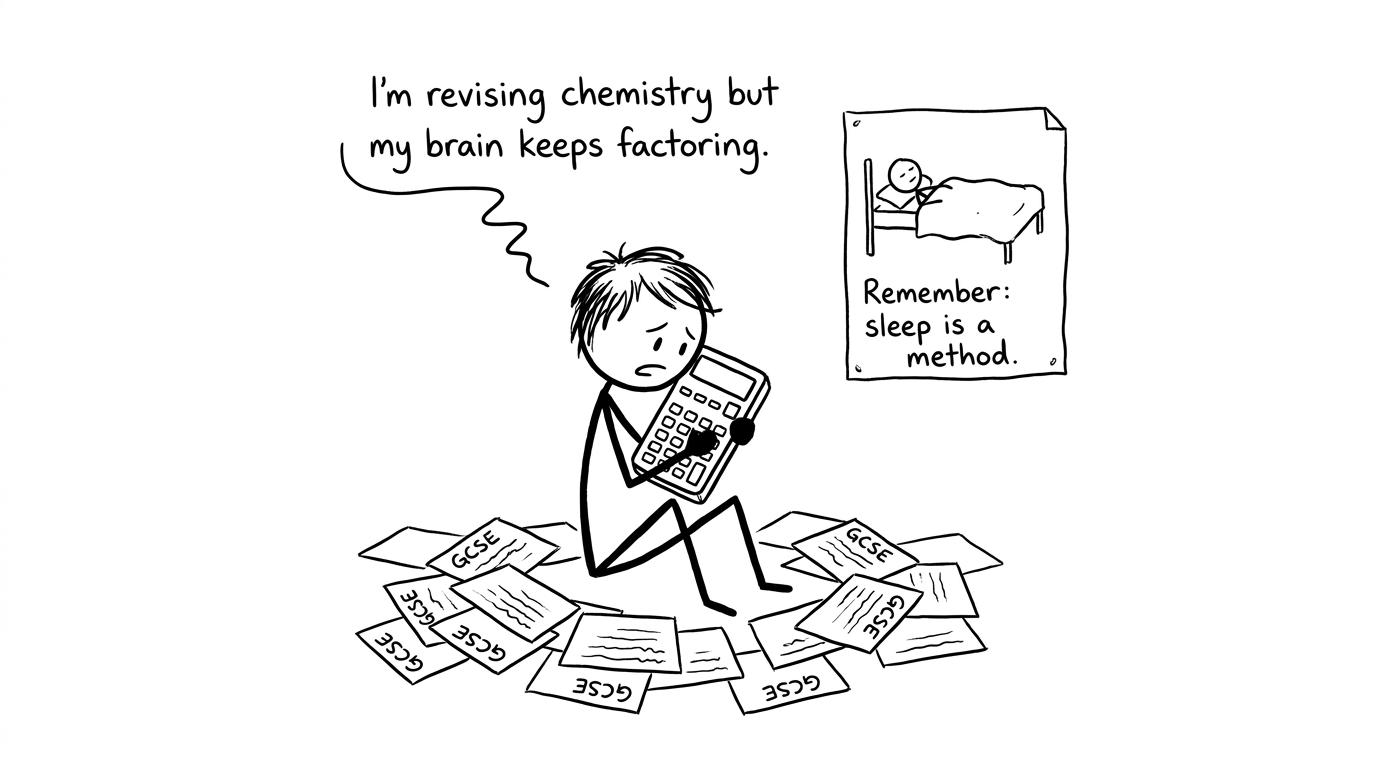 Stressed student revising with calculator comfort blanket
The simple GCSE exam-week checklist (save this)
Use this as your exam-week “default settings”. It’s designed to work even when you’re tired.
The night before
- Confirm your exam time, room, and travel plan.
- Pack your clear pencil case (and a spare pen).
- Pick one Chemistry area to lightly review (not five).
- Do one short maths skill check (10-15 minutes).
- Set a realistic bedtime.
The morning of
- Eat something basic and familiar.
- Skim key Chemistry definitions and required practicals.
- Do a 5-minute maths warm-up: fractions, standard form, rearranging.
- Arrive early enough to breathe.
After the exam
- Don’t do a post-mortem group chat.
- Note down 2-3 topics you found hard.
- Switch to the next subject with a clean start.
If you want everything organised in one place for maths revision during GCSE exam week, start from the YesGenie hubs for your board, like WJEC GCSE Maths Revision or Edexcel GCSE Maths Revision.
Why a Chemistry checklist belongs on a maths revision site
A lot of GCSE Chemistry marks are “maths marks in a lab coat”. The questions often look like science, but the method is pure maths: ratio, proportion, substituting into a formula, converting units, calculating percentage change, and interpreting graphs.
So if Chemistry is next and your brain feels scrambled, don’t just re-read notes. Rebuild the small set of maths moves that keep showing up.
On YesGenie, that means:
- revising the method (short lesson)
- practising the same skill in exam style
- checking against a mark scheme
Useful starting points:
- GCSE Past Papers (for maths exam practice alongside your Chemistry week)
- WJEC GCSE Maths Past Papers
- Edexcel GCSE Maths Mini Tests
- Edexcel GCSE Maths Predicted Papers
- Resources (mini tests, predicted papers, formula lists)
Your 7-day GCSE Chemistry exam week plan (that still protects maths)
This is a template. Adapt it around your timetable.
Two short blocks beat one long block
During GCSE exam week, the goal is not “revise for hours”. It’s “stay accurate when it counts”. Two blocks of 252525-353535 minutes usually beats one exhausted 222-hour session.
Try:
- Block A: Chemistry recall (definitions, required practicals, key equations)
- Block B: exam practice (short paper section + mark scheme)
- Micro-block: maths maintenance (10-15 minutes)
Day-by-day rhythm
Day -6 to -4 (build confidence)
- Chemistry: required practicals + one topic you dislike.
- Maths: one mini test or a short topic recap.
Day -3 to -2 (mark scheme training)
- Chemistry: do timed questions and mark them.
- Maths: do one timed set of calculator skills.
Day -1 (reduce, don’t expand)
- Chemistry: only your summary sheet + definitions.
- Maths: one short warm-up and stop.
Exam day (execution)
- 10-minute skim, 5-minute maths warm-up, then rest.
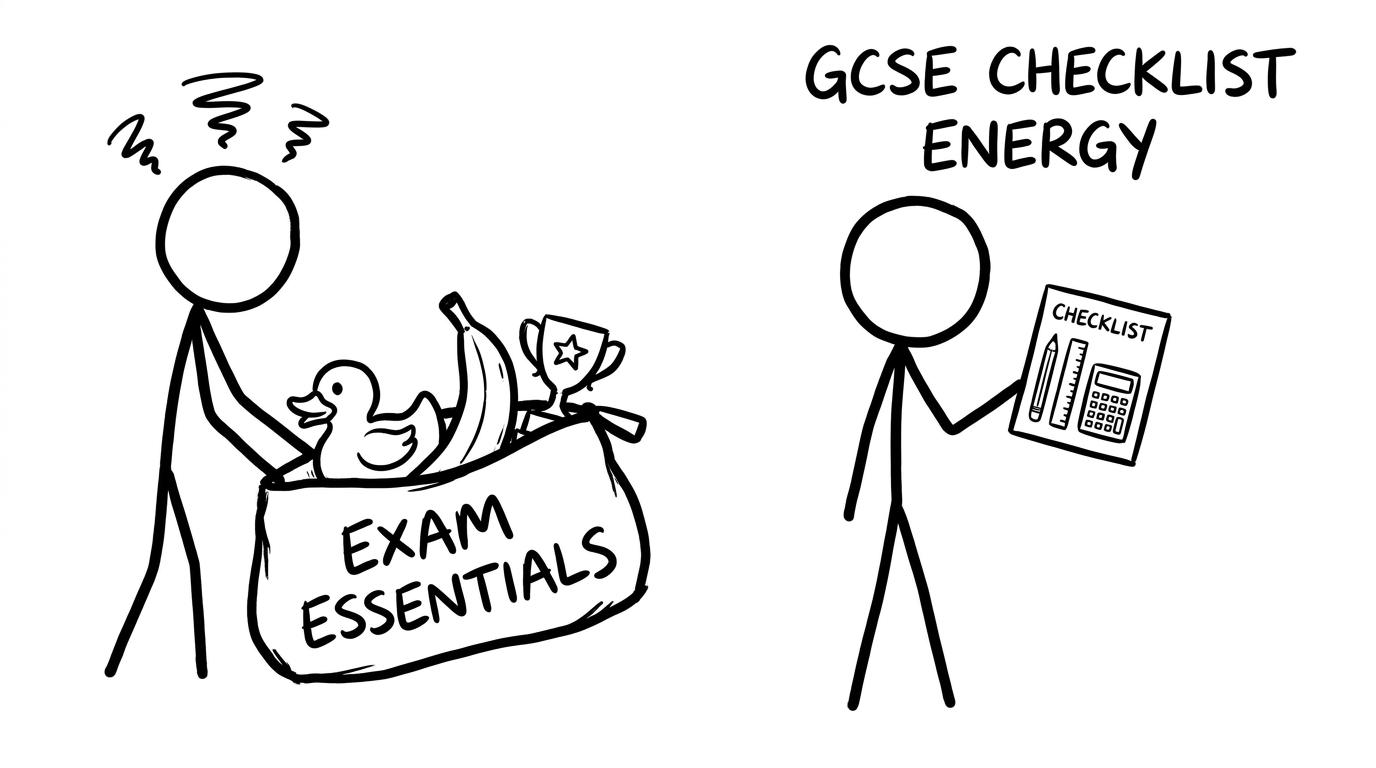 Exam essentials pencil case joke
The GCSE maths you’ll use most in WJEC Chemistry
Even though this is a WJEC Chemistry checklist, you’ll feel calmer if you know what maths is likely to appear.
Unit conversions and standard form
Chemistry loves prefixes: milli (10−310^{-3}10−3), micro (10−610^{-6}10−6), kilo (10310^{3}103). You don’t need to memorise every conversion if you can handle powers of 101010.
Worked example (standard form conversion) A solution has concentration 0.00045 mol/dm30.00045\ \text{mol/dm}^30.00045 mol/dm3.
Write in standard form:
0.00045=4.5×10⁻⁴ 0.00045 = 4.5 \times 10^{-4} 0.00045=4.5×10⁻⁴Now if another value is 3.0×10−33.0 \times 10^{-3}3.0×10⁻³, comparing is easier: 10−310^{-3}10−3 is 101010 times bigger than 10−410^{-4}10−4, so 3.0×10−33.0 \times 10^{-3}3.0×10⁻³ is larger.
If you want a quick, structured refresher, build the skill through your board’s revision pathway, like Edexcel GCSE Maths Revision Guides (the methods transfer across boards).
Rearranging formulas (the hidden Chemistry skill)
WJEC Chemistry uses equations constantly. The science part is knowing what the symbols mean. The marks are often for rearranging and substituting correctly.
Worked example (rearranging) Suppose you use a relationship like m=cVm = cVm=cV.
Make ccc the subject: \begin{align*} m &= cV \\ \frac{m}{V} &= c \end{align*} So c=mVc = \frac{m}{V}c=Vm.
That exact algebra move is the same one you need in GCSE maths when rearranging. Practise the habit of doing one operation to both sides, slowly.
Percentages and percentage change
This comes up in yield, purity, and changes in mass.
Worked example (percentage change) A mass increases from 40 g40\text{ g}40 g to 46 g46\text{ g}46 g.
Change =46−40=6= 46 - 40 = 6=46−40=6.
Percentage increase:
640×100=15% \frac{6}{40} \times 100 = 15\% 406×100=15%Notice what wins marks: using the original value in the denominator.
Graphs and gradients
Rates, heating curves, titration-style graphs (depending on spec and question style) reward students who can read scales and compute gradients carefully.
Worked example (gradient) If a line goes through (2,5)(2, 5)(2,5) and (8,17)(8, 17)(8,17), the gradient is:
gradient=17−58−2=126=2 \text{gradient} = \frac{17-5}{8-2} = \frac{12}{6} = 2 gradient=8−217−5=612=2In a science context, that “222” becomes a rate.
To keep this sharp during GCSE week, do short exam practice and check the method against mark schemes. For maths, that can be as simple as one paper section from WJEC GCSE Maths Past Papers.
How to use mark schemes without spiralling
The mark scheme is not a verdict on you. It’s a map of what the examiner rewards.
A strong GCSE exam-week routine looks like this:
- do a short set of questions
- mark honestly
- write a “next-time line” (the one change that would win the mark)
Example “next-time lines”:
- “Write the formula first, then substitute.”
- “Convert units before calculating.”
- “Round at the end.”
For maths, you can do the same with predicted and mini papers, using Resources to choose something the right length for your energy.
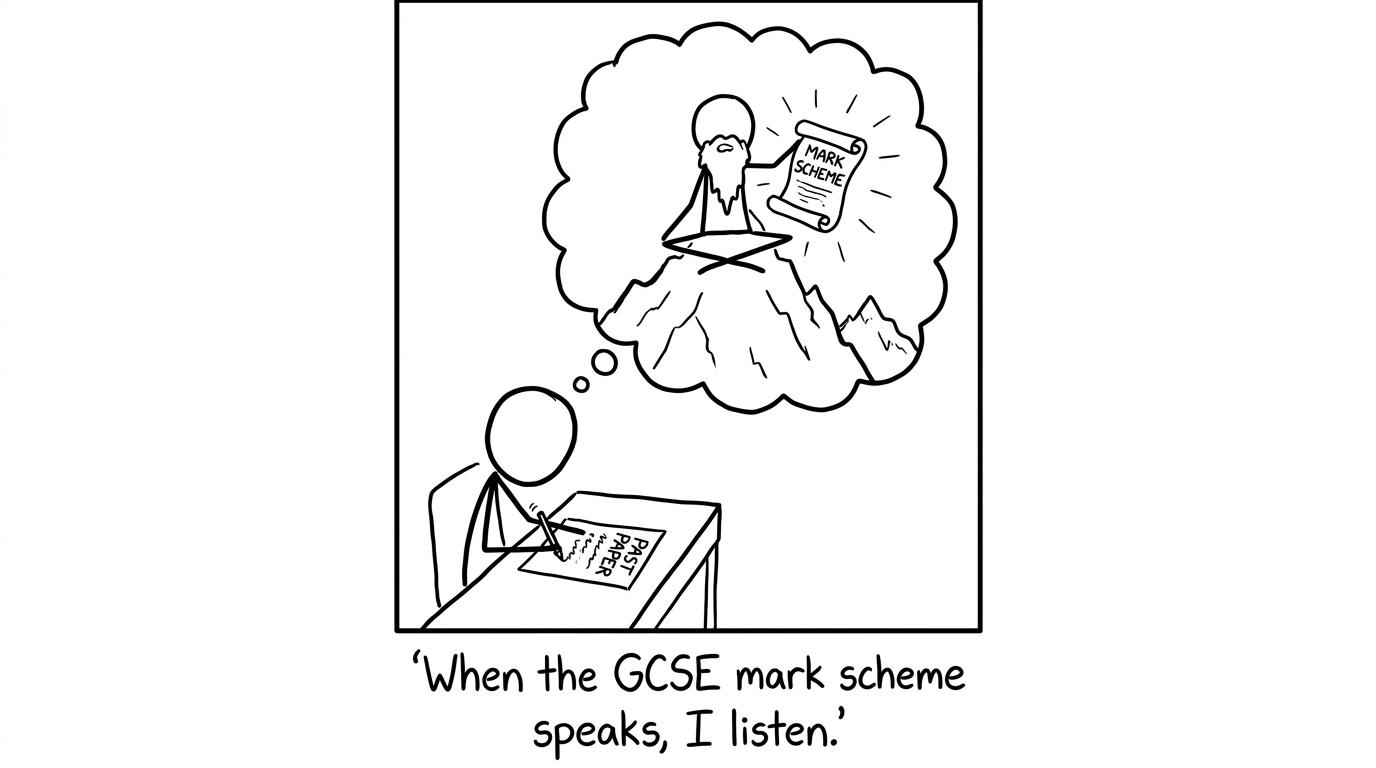 Mark scheme as wise oracle on a mountain
Common mistakes in GCSE exam week (and how to avoid them)
Revising what feels comfortable
In GCSE exam week, it’s tempting to re-read the topic you already like because it feels productive. But marks move when you fix weaknesses. Choose one weak Chemistry area and one weak maths area each day.
Doing “one more hour” instead of sleeping
Sleep is not a reward. It is part of the method. If you cut sleep, you usually lose accuracy on the simplest questions, the ones that should be free marks.
Mixing up maths methods under pressure
Students often know the content but pick the wrong operation: dividing instead of multiplying, using the final value for percentage change, or rounding too early. Under exam conditions, slow down and write a line of working even if the numbers look easy.
Forgetting units and standard form rules
In Chemistry, unit errors can wreck an otherwise correct method. In maths, it’s similar: misreading a scale, ignoring a conversion, or copying a number wrong. Build a habit: underline units, then check them once at the end.
Overreacting to one bad paper
One rough GCSE paper can poison the whole week if you let it. Treat it like feedback: note the topics, then move on. Your next exam deserves a fresh mind.
A calm GCSE finish: use YesGenie to keep your plan simple
The best GCSE exam-week checklist is the one you can follow when you’re tired.
Keep Chemistry focused (definitions, required practicals, exam questions). Keep maths maintained (standard form, rearranging, percentages, graphs). And keep your practice honest: do questions, mark them, learn the mark scheme language, then move on.
When you need structure without overwhelm, YesGenie is built for exactly this moment: free revision lessons, practice questions, mini tests, past papers with mark schemes, and predicted papers to help you target what matters.
Start here and keep it simple:
- WJEC GCSE Maths Revision
- WJEC GCSE Maths Past Papers
- GCSE Past Papers
- Edexcel GCSE Maths Predicted Papers
- Edexcel GCSE Maths Mini Tests
- Resources
Your GCSE week doesn’t need heroics. It needs a checklist, a pencil, and a method you trust.