

GCSE vs IGCSE Curriculum: What Maths Students Need
GCSE vs IGCSE curriculum explained for UK students. Compare topics, papers and grading, then revise smarter with Maths Genie lessons and past papers.
When someone says “I’m doing GCSE maths” it sounds simple. But if you’ve ever sat next to a friend doing IGCSE and realised their homework looks almost the same, and yet somehow not, you’ll know the quiet stress that follows. You start wondering whether you’re missing topics, whether your method is “allowed”, or whether your revision is pointed at the wrong target.
The good news is that the gap between GCSE and IGCSE is usually smaller than students fear. The better news is that, for maths, the overlap is big enough that smart revision habits carry across both. This post unpicks the GCSE vs IGCSE curriculum in a way that actually helps you revise: what’s shared, what’s different, and how to use Maths Genie to make your practice feel calm and targeted.
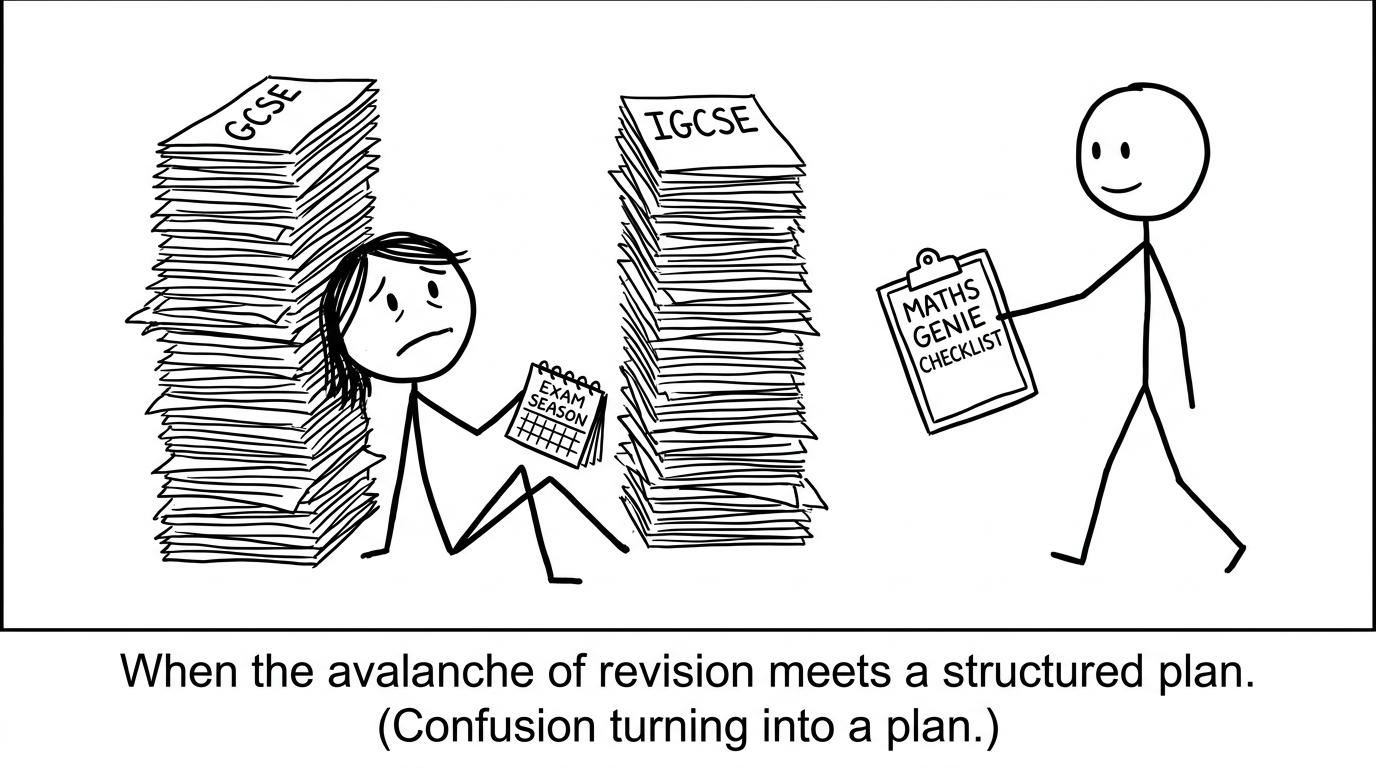 Student choosing between GCSE and IGCSE piles
GCSE vs IGCSE curriculum at a glance
If you only remember one thing, remember this: GCSE and IGCSE maths assess the same core ideas: number, algebra, geometry, ratio/proportion, statistics and probability, but they often package them differently.
Here’s a quick checklist to guide your revision:
- Specification differences: GCSE (England) is typically Edexcel, AQA, OCR, Eduqas; IGCSE often uses Cambridge IGCSE or Pearson Edexcel International GCSE.
- Assessment style: GCSE is usually three papers (with a non-calculator paper); IGCSE formats vary by board and can weight calculator/non-calculator differently.
- Grade boundaries and grading: GCSE uses grades 999 to 111; IGCSE may use 999 to 111 or A∗A^*A∗ to GGG depending on qualification.
- Topic emphasis: IGCSE may include a little more algebraic fluency and sometimes more formal geometry; GCSE often leans heavily on problem-solving and multi-step reasoning.
For your day-to-day revision, that means your best move is to build strong fundamentals and then practise with the right style of exam questions.
What stays the same between GCSE and IGCSE maths
The heart of maths is strangely loyal. No matter which course you’re on, you’re still learning the same habits: rearranging, substituting, interpreting graphs, and explaining why something is true.
Algebra is the shared language
Both GCSE and IGCSE expect you to handle the building blocks confidently:
- Simplifying expressions
- Solving linear equations and inequalities
- Working with sequences and graphs
- Expanding and factorising
If you sometimes feel like algebra is “random steps”, make it smaller: it’s just keeping an equation balanced.
Worked example (linear equations)
Solve 3(2x−5)=4x+73(2x-5)=4x+73(2x−5)=4x+7.
3(2x−5)=4x+73(2x-5)=4x+73(2x−5)=4x+7 6x−15=4x+76x-15=4x+76x−15=4x+7 2x−15=72x-15=72x−15=7 2x=222x=222x=22 x=11x=11x=11That method is identical whether you’re revising for GCSE foundation/higher tier or an IGCSE paper.
To build this fluency with exam-style practice, use the structured topic pathway on Maths Genie: Edexcel GCSE Maths Learning Journey. Even if you’re not Edexcel, the topic sequence mirrors the core GCSE curriculum well.
Geometry and measures overlap more than you think
Angles, Pythagoras, trigonometry, area/volume, and transformations are shared territory. The diagrams might look different, but the rules don’t change.
If you want a focused place to revise these consistently, the Maths Genie geometry hub is a strong anchor: Shape and Geometry Revision.
Worked example (Pythagoras)
A right-angled triangle has legs of lengths 666 cm and 888 cm. Find the hypotenuse ccc.
c2=62+82=36+64=100c^2=6^2+8^2=36+64=100c2=62+82=36+64=100 c=100=10c=\sqrt{100}=10c=100=10That’s a method you’ll reuse for years; it shows up in GCSE, IGCSE, and then quietly returns in A Level coordinate geometry.
The key differences in the GCSE vs IGCSE curriculum
Most student anxiety comes from thinking differences are everywhere. They’re not. They’re usually in three places: assessment structure, wording/style, and a handful of topic emphases.
Paper structure and calculator expectations
In England, GCSE maths is commonly assessed as three papers, with at least one non-calculator paper. IGCSE varies: some versions have two papers; some blend calculator and non-calculator differently.
So what? It changes how you prepare.
- If you have a non-calculator paper, mental maths and exact values matter more.
- If your papers are longer with fewer topics per paper, stamina and pacing matter more.
Maths Genie makes paper practice easier because you can choose by board and tier. For example:
Even if you’re doing IGCSE, these are still valuable for skill-building, especially in the run-up to A Level.
Topic weighting and style of questions
The GCSE courses (Edexcel, AQA, OCR, Eduqas) tend to emphasise multi-step problem-solving and interpretation: “show that…”, “hence…”, “explain why…”. IGCSE often includes more direct technique questions, and in some specifications you’ll see a bit more algebraic manipulation earlier.
This affects revision less than you’d expect: the same topic list, but a slightly different flavour.
A good way to cover both flavours is to revise a topic, then do mixed exam questions. Maths Genie’s topic-by-topic pages (lesson + questions + solutions) are built for that.
Here’s one example page to show the format:
Grading and tiers
For GCSE maths, students sit foundation or higher tier and are graded 999 to 111.
IGCSE grading depends on the exact qualification. Some use 999 to 111; others use A∗A^*A∗ to GGG. Some IGCSE routes don’t have “tiers” in the same way GCSE does.
For revision, your best move is to stop thinking in terms of grade labels and think in terms of skills you can reliably do under pressure. Maths Genie’s staged approach helps because you can master the early stages (foundation skills) before you stretch into higher-only content.
Two mini worked examples that travel well from GCSE to IGCSE (and to A Level)
Students often ask: “What should I revise if I’m switching from IGCSE to GCSE (or vice versa)?” The honest answer is: revise what A Level needs from you, because that’s the real bridge.
Rearranging formulae (pure algebra, pure marks)
Make xxx the subject of y=3x−4y=3x-4y=3x−4.
y=3x−4y=3x-4y=3x−4Add 444 to both sides:
y+4=3xy+4=3xy+4=3xDivide by 333:
x=y+43x=\frac{y+4}{3}x=3y+4This is the sort of step-by-step algebra that sits underneath A Level differentiation and mechanics. Getting it secure now is a gift to your future self.
Percentages and compound change
A phone costs £480. It decreases by 15%15\%15%. Find the new price.
A decrease of 15%15\%15% means multiply by 0.850.850.85:
480×0.85=408480 \times 0.85 = 408480×0.85=408New price: £408408408.
The core idea (multiplier) is identical in GCSE and IGCSE. What changes is how the exam question wraps it in context.
If you want extra practice on data-heavy questions that sometimes feel closer to IGCSE style, you can also use: GCSE Statistics Revision.
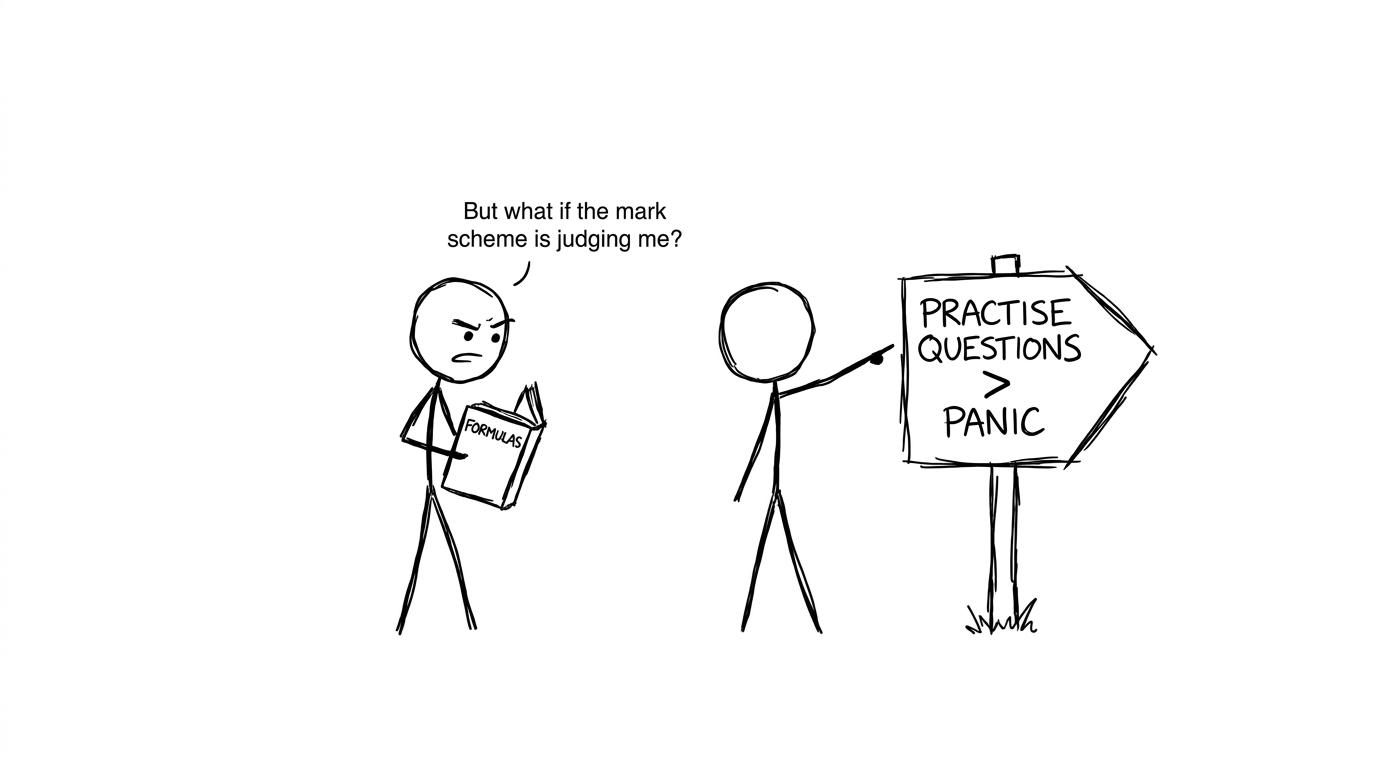 Practise questions beat panic comic
How to revise for GCSE if you’re comparing yourself to IGCSE (or the other way round)
Comparison is a strange kind of procrastination. It feels like planning, but it often leads to a loop: “They did that topic earlier… maybe I’m behind… maybe I should start again…”
A better approach is practical:
Build a shared core, then specialise
- Build the core using topic lessons and targeted practice.
- Specialise using past papers and predicted papers in your exact format.
Maths Genie is designed around that rhythm. Start with revision lessons and practice questions, then move into papers:
Use mark schemes like a mirror
Mark schemes aren’t there to judge you; they’re there to show you what the examiner counts as “mathematical communication”. Often, the difference between a method mark and zero marks is one clear line of working.
So after every set of questions, ask:
- Did I show the method clearly?
- Did I use the correct notation?
- Did I answer the question asked (including units and rounding)?
That habit helps in GCSE, IGCSE, and A Level.
Common mistakes students make when comparing GCSE and IGCSE
- Revising the wrong exam style: doing endless topic drills but no timed papers (or only papers, with no topic repair). The balance matters.
- Assuming one course is “harder” in general: difficulty is often in the wording and the mark scheme style, not the maths itself.
- Skipping non-calculator skills: even calculator-heavy exams reward exact arithmetic and number sense.
- Confusing fluency with understanding: getting one method right once is not the same as being able to repeat it under pressure.
- Not using solutions properly: reading the solution and thinking “I get it” doesn’t build recall. Re-do the question the next day without looking.
Bringing it back to GCSE revision that actually works
If you’ve been worrying about the GCSE vs IGCSE curriculum, you’re probably not really worrying about curricula. You’re worrying about time, confidence, and whether your effort will translate into marks.
The calm way through is simple: build the shared fundamentals, then practise the paper style you’ll sit. Maths Genie exists for that exact loop: revision lessons when you need clarity, practice questions when you need fluency, and past papers and predicted papers when you need exam confidence.
Use these pages to turn confusion into a plan:
- Maths Genie Resources Hub
- Edexcel GCSE Maths Learning Journey
- Edexcel GCSE Predicted Papers
- AQA GCSE Maths Past Papers
- Shape and Geometry Revision
- GCSE Statistics Revision
Whatever you’re sitting, GCSE or IGCSE, the aim is the same: practise until the methods feel ordinary. Then the exam becomes less of a surprise and more of a performance of skills you already own.










