GCSE: Use Eduqas English Lit Past Papers Properly
GCSE guide to using Eduqas English Literature past papers properly: timed practice, AO-marking, feedback loops, and a maths-style revision routine.
GCSE season has a particular sound. It’s the shuffle of papers, the click of a pen, and that quiet thought that turns up at 11:47pm: I’ve done past papers… but did I do them properly? If you’re revising maths, you already know the difference between “doing questions” and “improving”. This guide shows you how to use Eduqas GCSE English Literature past papers properly, with the same disciplined loop you use in maths: attempt, mark, diagnose, and reattempt.
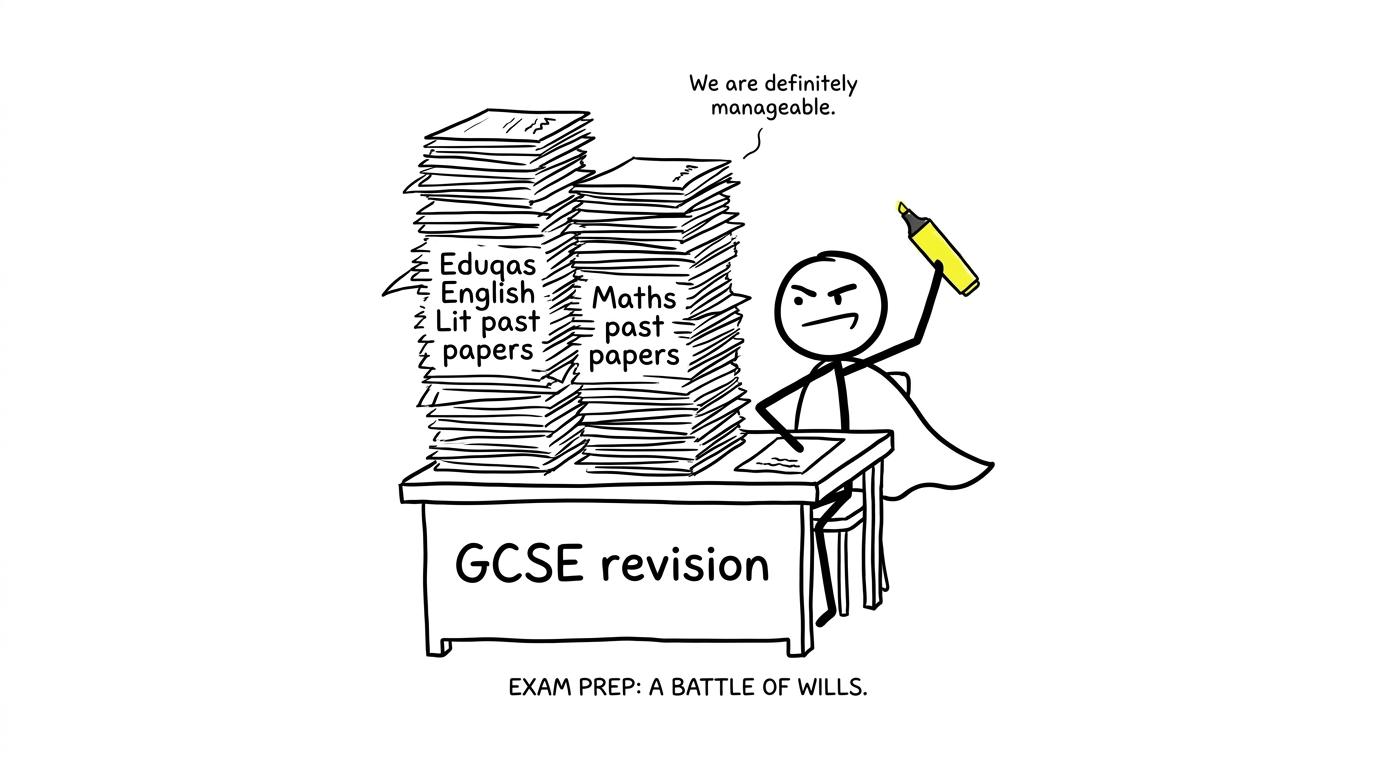 Student with towering past paper piles
The big idea: treat English Lit like maths practice
In maths, you don’t just complete a paper and hope for the best. You check the mark scheme, identify weak topics (maybe bounds, ratio, or quadratics), then practise those exact skills until they stop being weaknesses. English Literature works the same way, just with different “skills labels”: Eduqas assessment objectives (AOs), planning, quotation choice, and analysis depth.
If you’re already using YesGenie for GCSE maths, you’ve built the habit. Your job is to copy the structure.
A quick checklist for using past papers properly
- Choose the right Eduqas paper for the texts you study (and the correct component).
- Do one question properly, timed, planned, and written like the exam.
- Mark it against the AOs (not just “sounds good”).
- Turn feedback into a tiny practice plan for the next attempt.
- Repeat until you can do it reliably under time pressure.
Choose the right paper, then narrow the task
Past papers are only useful if they match what you’ll sit. Eduqas has specific components and set texts. Your first move is boring but powerful: match the paper to your course, then pick just one question to do well.
If you want to keep your revision ecosystem in one place, YesGenie is built around that same “correct paper, correct board” idea for maths. For example, you can quickly find Eduqas GCSE maths papers and mark schemes on Eduqas GCSE Maths Past Papers, or compare with another board on Edexcel GCSE Maths Past Papers. That same careful matching is what stops wasted effort in English.
The GCSE trap: doing too much, too loosely
A common pattern is: print three papers, skim them, write half an essay, then move on. It feels productive. But in terms of marks, it’s like doing three maths papers while skipping every topic you find hard.
Instead, narrow it:
- one question
- one timed attempt
- one honest marking session
- one targeted fix
Time your attempt like it’s a maths paper
Time pressure changes what you produce. The goal isn’t just to “know the story”; it’s to perform in a timed setting.
A simple timing model (adjust to your school’s guidance and paper structure) is:
- Plan: 555 minutes
- Write: 353535 minutes
- Check and improve: 555 minutes
That’s a total of 454545 minutes.
And here’s the maths student advantage: you already understand pacing. If you’ve ever done a timed set of questions on YesGenie, say from Edexcel GCSE Maths Mini Tests, you know that speed improves when method becomes automatic. In English Lit, “method” means a repeatable paragraph structure.
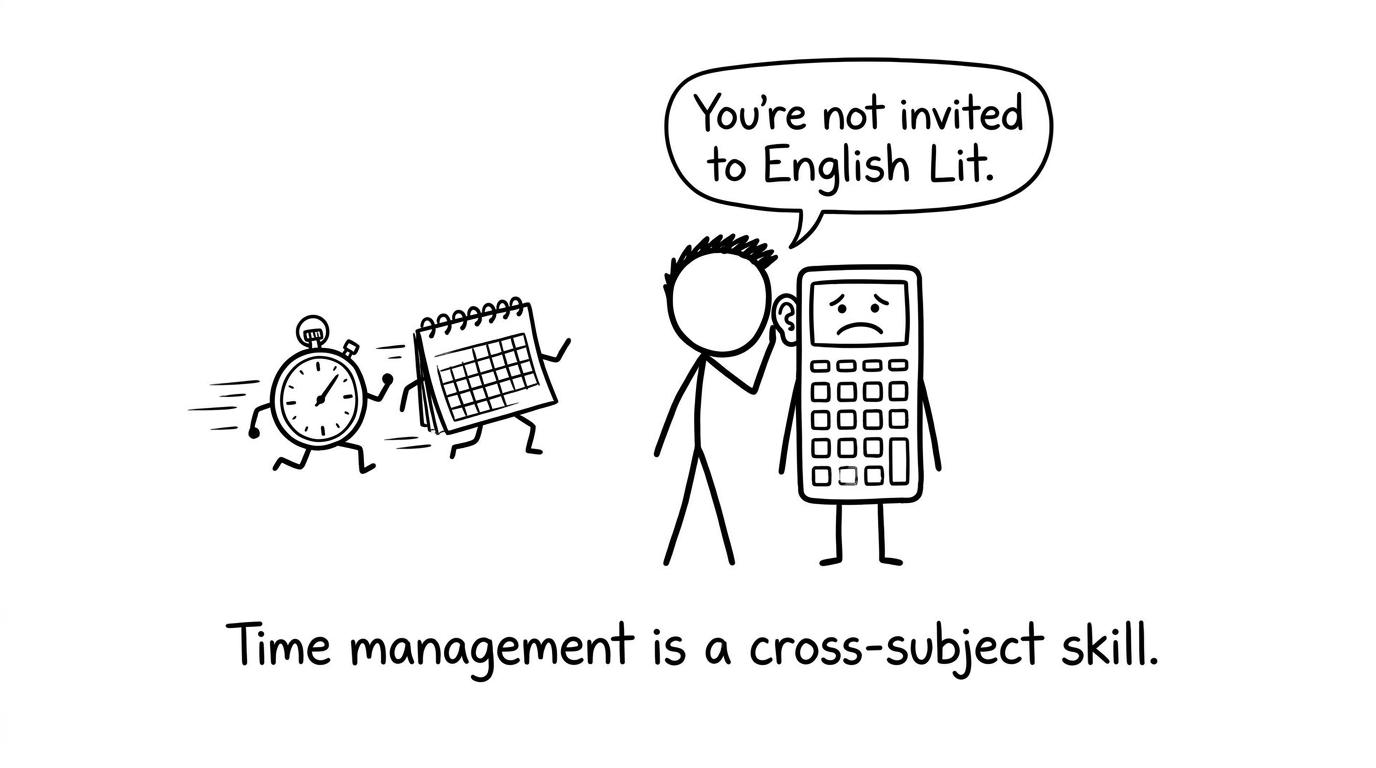 Stopwatch vs calendar, offended calculator
Worked method example: build a paragraph like a proof
In maths, if the question is “solve”, you show steps. In Lit, if the question is “how does the writer present…”, you show steps too; they’re just rhetorical steps.
Use a method you can repeat:
- Point (answer the question)
- Evidence (short quote)
- Explain (meaning)
- Analyse (methods: language/structure/form)
- Link (back to question and theme)
Here’s a mini worked example using a generic quote to demonstrate the method:
Question focus (generic): How does the writer present power?
Point: The writer presents power as unstable, because it depends on fear rather than respect.
Evidence: The character speaks in “short, cutting commands”.
Explain: This suggests the character needs control in every moment, not just in big decisions.
Analyse: The clipped phrasing (a structural/language choice) makes the voice sound sharp and urgent, implying that power is performed rather than naturally held.
Link: Therefore, power is presented as something constantly maintained, which connects to the wider conflict in the text.
You’re not memorising an essay. You’re memorising a process.
Mark like a scientist: use the AOs, not vibes
After you write, the most important moment is the marking. Not because it’s pleasant, but because it tells you what to practise next.
Eduqas English Literature marking rewards skills through assessment objectives. You don’t need to be perfect with the wording to use them effectively in revision. You do need to ask: Which skill did I actually demonstrate?
A simple self-mark grid:
- AO1: response to the question, references/quotes, coherent argument.
- AO2: analysis of writer’s methods (language/structure/form).
- AO3: context (when relevant and genuinely linked).
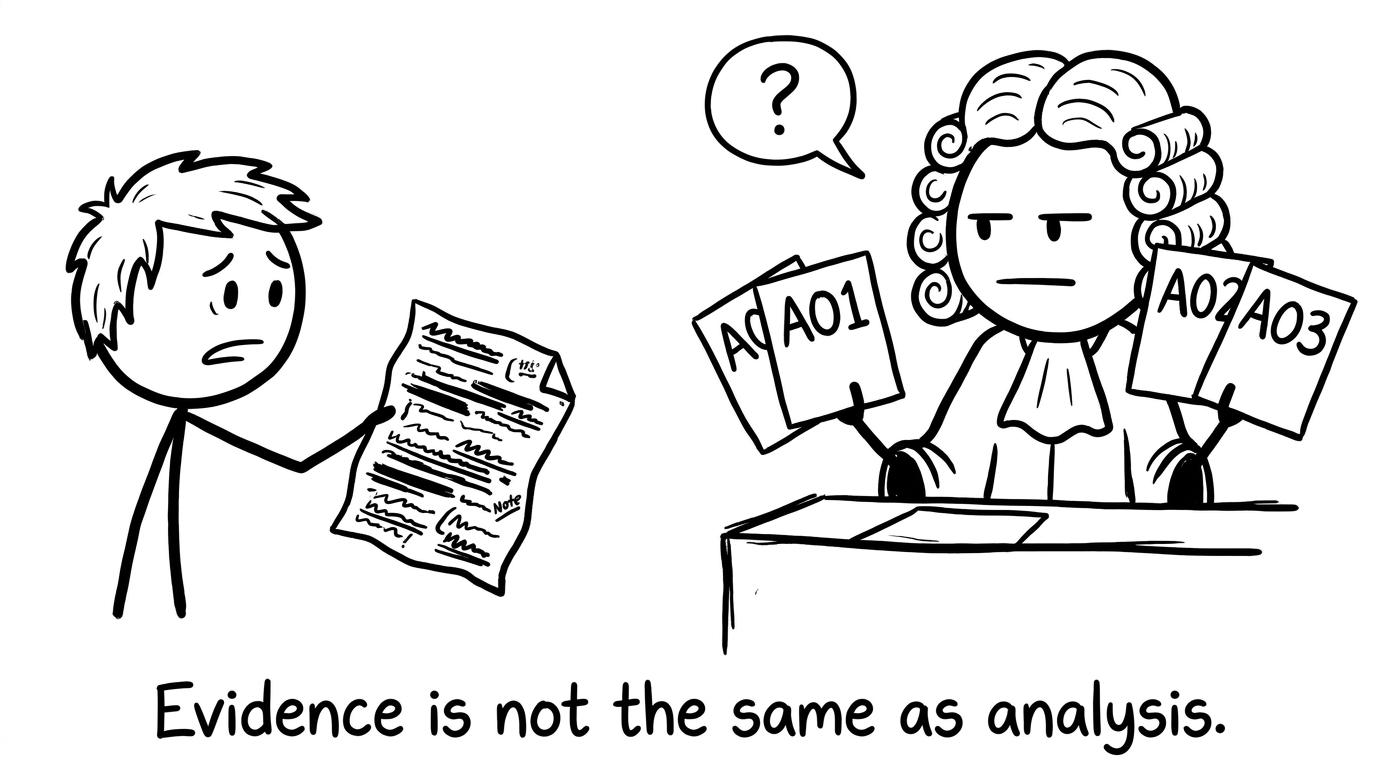 AO judge with scorecards
Worked marking example: turn feedback into the next drill
Let’s say you reread your answer and realise:
- You used 666 quotations (plenty of evidence).
- But you only analysed methods properly in 222 paragraphs.
That’s a proportion of
26=13. \frac{2}{6}=\frac{1}{3}. 62=31.So about one-third of your evidence is doing the job of AO2. Your next action is not “do another full paper”. It’s: write two new paragraphs where AO2 is the focus.
A practical target for your next attempt could be:
- same number of quotations, but analyse methods in at least 555 out of 666 uses.
That’s
56 \frac{5}{6} 65which is a big shift in the skill that earns marks.
This is exactly how you’d behave in GCSE maths. If you dropped marks on, say, bounds, you’d go straight to targeted practice. On YesGenie, you might use a focused lesson like Bounds (Eduqas GCSE Maths) or pull relevant items from the Eduqas GCSE Maths Question Bank. English improvement should be equally specific.
Build a two-week loop (without burning out)
The students who improve aren’t the ones who do the most papers. They’re the ones who close the loop.
A realistic past paper loop
- Day 1: One timed question.
- Day 2: Mark and annotate using AOs. Rewrite one paragraph.
- Day 3: Target skill practice (planning, AO2 methods, or context links).
- Day 4: Reattempt a similar question under time.
Do that loop three times and you’ve done fewer full essays than your friend who “smashed past papers all weekend”, but you’ve actually changed what you can do under pressure.
If you want structure for your wider GCSE schedule, browse the built-in resource areas on YesGenie: GCSE Past papers and the broader Resources hub. The point isn’t to revise everything every day. It’s to revisit the right things at the right time.
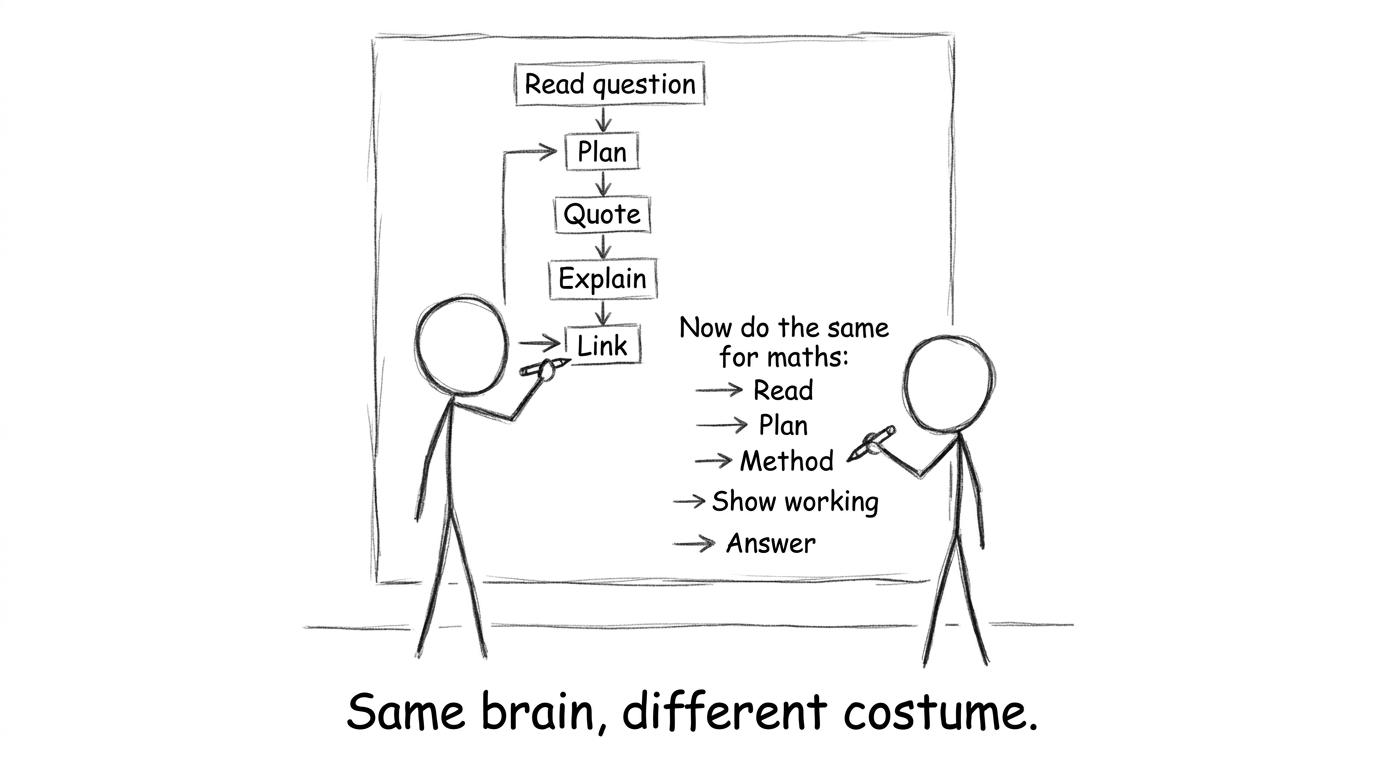 Flowchart wall: English steps and maths steps
Transfer your maths habits to English (it’s the same engine)
You might not feel like an “English person”. That’s fine. The exam doesn’t reward personality type. It rewards habits.
Here are three maths habits that translate cleanly:
Checking the question properly
In maths, misreading “solve” vs “show that” costs marks. In English, missing the focus (character, theme, relationship, moment) does the same. Before you write, rewrite the question in your own words.
Showing working (analysis)
In maths, answers without working are fragile. In Lit, quotations without analysis are fragile. Train yourself to treat every quote like a line of working.
Practising weaknesses on purpose
Maths students get good when they stop avoiding the topics that hurt. If AO2 is weak, practise AO2. If planning is weak, practise planning. The paper is just the test. The practice is the improvement.
Common mistakes students make with Eduqas GCSE English Lit past papers
- Writing without a plan: you end up retelling the plot because you haven’t built an argument.
- Dropping quotes in and moving on: evidence is not analysis, and Eduqas marks AO2 heavily.
- Forcing context everywhere: AO3 matters, but it must link to the point you’re making, not sit on top like decoration.
- Marking too kindly: if you only circle “good bits” you won’t see the pattern of lost marks.
- Never rewriting: in maths, you redo questions you got wrong. In English, you should rewrite paragraphs that didn’t meet the AOs.
- Doing too many papers too early: you burn through resources before your skills have changed.
Final thought: “properly” is a system, not a mood
Using Eduqas GCSE English Literature past papers properly isn’t about being naturally good at English. It’s about building a system: timed attempt, AO-based marking, targeted rewrites, and reattempts. That’s the same system that takes a shaky topic in maths and turns it into reliable marks.
If you want that same structure across your maths revision, YesGenie is built for it: revision lessons, practice questions, past papers, mark schemes, and focused resources like GCSE Past papers and the wider Resources hub. Choose one small action today: one timed question, one honest marking session, one specific fix. Then repeat. That’s how GCSE grades move.