GCSE: Stop Forgetting WJEC Physics Content (Using Maths)
GCSE revision for WJEC students: stop forgetting Physics content with spaced repetition, retrieval practice and maths methods to secure marks fast.
The problem is not your memory; it is your revision
There is a moment most WJEC students recognise. You sit down to revise, open your GCSE Physics notes, and realise you do remember it… sort of. The equation looks familiar. The keywords ring a bell. But when you try an exam question, your mind goes blank in the exact place the marks live. It feels personal, like your brain is refusing to cooperate.
It is not personal. It is predictable.
Forgetting is what happens when revision is built on recognition (re-reading, highlighting, watching) instead of recall (retrieving, applying, checking). The good news is that your GCSE maths habits can rescue your GCSE Physics memory, because physics is, quietly, a rearranging-and-reasoning subject.
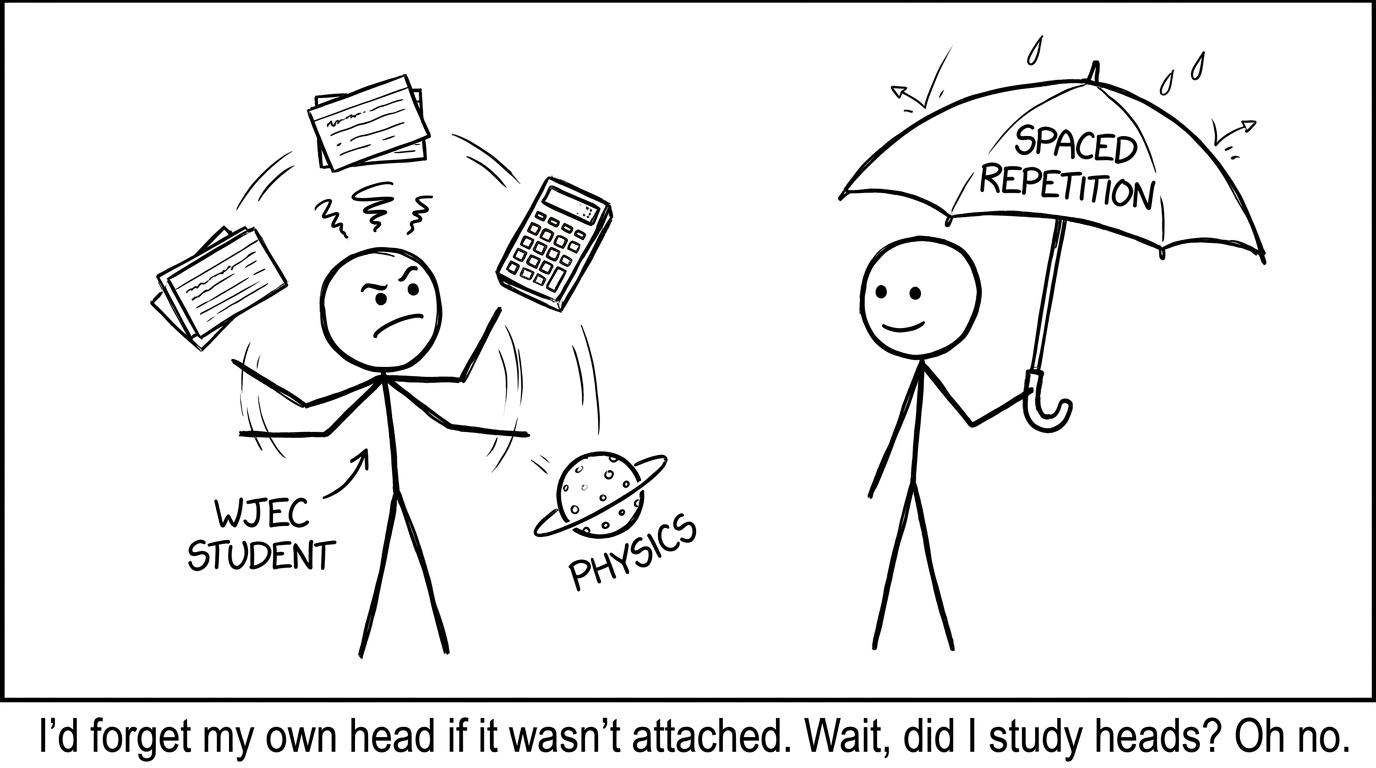 A WJEC student juggling revision and forgetting
A quick checklist to stop forgetting (in a WJEC-friendly way)
If you only take one thing from this post, let it be this: you do not need more hours of GCSE revision, you need better repetitions.
Use this simple loop:
- Daily (10-15 minutes): retrieval practice from memory (no notes)
- Every 2-3 days: one mixed set of questions (maths + physics style)
- Weekly: one longer exam-style session (timed, marked, corrected)
- Always: correct using a mark scheme, then create a “fix card” for what you missed
On YesGenie, that loop is easy to build using:
- Resources hub (mini tests, predicted papers and more)
- WJEC GCSE Maths revision home
- WJEC GCSE Maths past papers
- GCSE past papers across subjects
Even if your main worry is GCSE Physics, the mechanism of forgetting is the same, and your maths practice can train the exact skill physics demands: reliable recall under pressure.
Why WJEC GCSE Physics is easy to forget (and how maths fixes it)
WJEC GCSE Physics content tends to be assessed through a blend of:
- equations and units
- required practicals and method language
- graph interpretation
- explanations with precise keywords
Students often revise it like a story, but the exam rewards it like a toolkit.
Maths students already know this feeling. You can “understand” Pythagoras, but you only stop forgetting it when you have done it so many times that the first step arrives automatically.
That is why your maths revision habits are transferable. On YesGenie, topics are built around that toolkit approach: short lessons, practice questions, and mark schemes that force you to do the skill.
For example, if you want to rebuild confidence with multi-step reasoning (which physics questions often mimic), pick a GCSE maths topic where errors show up quickly:
- Substitution (revision guide)
- Fractions of an amount (revision guide)
- Algebraic fractions (revision guide)
When you practise these, you are not “doing maths instead of GCSE Physics”. You are training the part of revision that stops forgetting: accurate recall + correct steps.
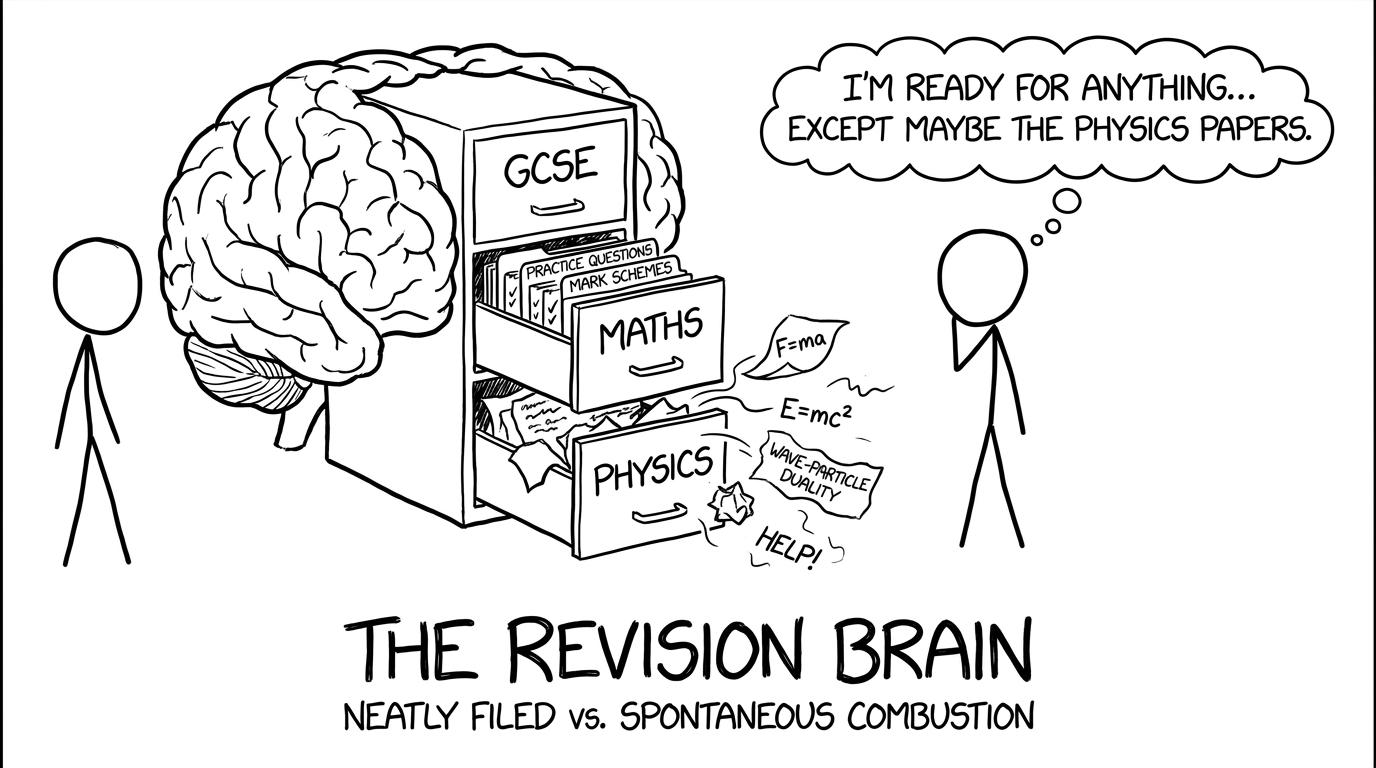 A brain filing cabinet with physics papers flying out
The memory method that works: retrieval + spacing + marking
Most GCSE revision fails because it is too smooth. Reading notes feels like progress because it creates familiarity. But familiarity is not the same as being able to produce an answer.
A stronger approach has three ingredients:
Retrieval practice (no notes)
You start by trying to write the equation, the method, or the explanation from memory. Even if you get it wrong, that effort is doing the learning.
Spacing (return after forgetting begins)
The aim is not to keep it fresh. The aim is to let a little forgetting happen, then rebuild. That rebuild is what makes the memory durable.
Marking (truth over vibes)
Every retrieval attempt must be checked. In maths, the mark scheme keeps you honest. Treat GCSE Physics the same way: you are not revising to feel ready; you are revising to be measurably ready.
A practical way to train this discipline is to keep your GCSE maths marking sharp alongside your science revision:
- Use WJEC GCSE Maths past papers weekly.
- Use the WJEC GCSE Maths revision home for topic-by-topic questions when you notice a weakness.
Worked examples: the maths that prevents GCSE Physics mistakes
A lot of “forgetting” in GCSE Physics is actually this: you remember the equation, but you cannot use it quickly, or you panic when it needs rearranging. This is where GCSE maths becomes your advantage.
Worked example: rearranging density
You may know the relationship between mass mmm, density ρ\rhoρ and volume VVV:
ρ=mV \rho = \frac{m}{V} ρ=VmIf a WJEC GCSE Physics question gives you ρ=800 kg m−3\rho = 800\ \text{kg m}^{-3}ρ=800 kg m−3 and V=0.015 m3V = 0.015\ \text{m}^3V=0.015 m3, find mmm.
Rearrange:
m=ρV m = \rho V m=ρVSubstitute:
m=800×0.015=12 m = 800 \times 0.015 = 12 m=800×0.015=12So:
m=12 kg m = 12\ \text{kg} m=12 kgWhat stops forgetting here is not “remembering density”. It is remembering the move: rearrange, then substitute carefully.
If substitution is where you slip under time pressure, build automaticity with Substitution (revision guide).
Worked example: speed, distance, time (and calculator accuracy)
A student travels d=3.6 kmd=3.6\ \text{km}d=3.6 km in t=12 minutest=12\ \text{minutes}t=12 minutes. Find the speed in m s−1\text{m s}^{-1}m s−1.
Convert units first:
3.6 km=3600 m 3.6\ \text{km} = 3600\ \text{m} 3.6 km=3600 m 12 minutes=720 s 12\ \text{minutes} = 720\ \text{s} 12 minutes=720 sUse v=dtv = \frac{d}{t}v=td:
v=3600720=5 v = \frac{3600}{720} = 5 v=7203600=5So:
v=5 m s−1 v = 5\ \text{m s}^{-1} v=5 m s−1In GCSE Physics, students often “forget” this because they forget the unit conversions, not the equation. That is why practising structured, stepwise working in GCSE maths is so valuable.
Worked example: percentages (common in energy efficiency and data)
If an input energy is 250 J250\ \text{J}250 J and useful output is 175 J175\ \text{J}175 J, efficiency as a percentage is:
efficiency=usefultotal×100 \text{efficiency} = \frac{\text{useful}}{\text{total}} \times 100 efficiency=totaluseful×100 efficiency=175250×100=0.7×100=70 \text{efficiency} = \frac{175}{250} \times 100 = 0.7 \times 100 = 70 efficiency=250175×100=0.7×100=70So the efficiency is 70%70\%70%.
If fraction work is where you stall, practise the “divide then multiply” rhythm with Fractions of an amount (revision guide).
Build a WJEC GCSE revision routine that sticks
The most effective GCSE students do something deceptively boring: they keep coming back.
Here is a routine that fits around school and works even when motivation is low.
Use a two-subject loop (maths to reinforce physics)
- Day A (20-30 mins): GCSE Physics retrieval + 10 minutes of GCSE maths rearranging/substitution practice
- Day B (20-30 mins): GCSE Physics questions + mark scheme correction
- Day C (20-30 mins): mixed review of the weakest topics (physics and maths)
This works because maths provides quick wins and clear feedback. It trains calmness: you learn to treat confusion as a step, not a verdict.
Use past papers as the “truth serum”
Past papers stop the comforting illusion that you know something because you have seen it.
On YesGenie you can run that habit through:
Then do the most important part: write a short correction note for every lost mark. That correction note becomes tomorrow’s retrieval practice.
 A student feeling calm with a revision planner calendar
Common mistakes that keep WJEC students forgetting
These are not character flaws. They are predictable traps.
- Re-reading instead of retrieving. If you never practise producing answers without support, your GCSE memory will not hold under exam conditions.
- Doing questions but not marking properly. A weak mark-scheme habit means you repeat the same mistake and call it “forgetting”.
- Avoiding the hard topics. Your brain interprets avoidance as a signal that the topic is unsafe, which increases panic later.
- Not writing units or conversion steps. In GCSE Physics, missing units loses marks. In GCSE maths, missing steps hides errors.
- Rearranging sloppily. One sign error turns knowledge into nonsense. Practise rearranging as a method, not a talent.
- Cramming a full topic once. One long session feels productive, but spaced repetitions are what reduce forgetting.
 Exam hall whisper about density and rearranging
A calm ending: turn forgetting into a system
For WJEC students, the frustration of forgetting GCSE Physics content is real. But the solution is not to “try harder” or “revise longer”. The solution is to build a system that expects forgetting, plans for it, and uses it.
Make your GCSE revision honest: retrieve, space, mark, correct. Use your maths practice to strengthen the exact skills that physics silently demands: rearranging, substituting, converting, and writing clean working under time pressure.
When you are ready to make it practical, YesGenie is built for this kind of revision: free revision lessons, topic practice, mark schemes, and exam preparation.
Go straight to:
- WJEC GCSE Maths revision home for topic-by-topic lessons and practice
- WJEC GCSE Maths past papers for timed exam practice
- Resources hub for mini tests and structured revision tools
- GCSE past papers to keep your weekly exam routine consistent
Do the next small repetition today. GCSE progress is rarely a breakthrough. It is a quiet decision to come back tomorrow with a better method.