GCSE: How to Stop Forgetting Physics Content
GCSE revision feels hard when Physics slips away. Learn how to stop forgetting using maths-style practice, spacing, past papers and YesGenie routines.
If you have ever walked out of a lesson thinking, “I get it”, and then blanked the next week, you are not lazy; you are normal. The frustrating part of GCSE Physics is that it often feels like remembering phrases and facts, not building a skill. And when your brain is full of algebra, angles, and exam timings, Physics can leak out like water through your fingers.
The good news: the same habits that lift GCSE maths grades (active recall, spaced practice, exam questions, calm routines) also stop you forgetting Physics content. This post shows you how to build a memory system that behaves more like maths revision: reliable, measurable, and hard to fake.
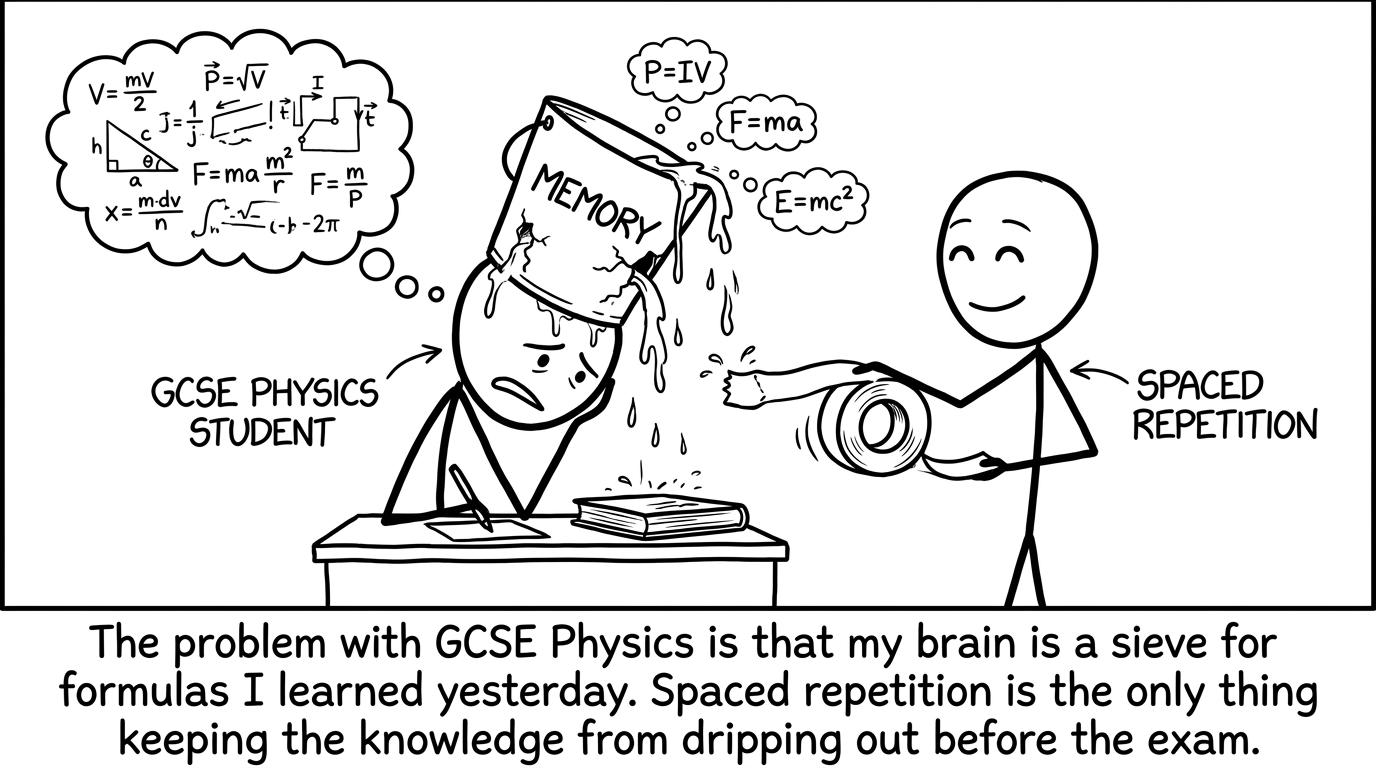 A leaky memory bucket gets fixed with spaced repetition
The simple checklist that stops forgetting
Keep this short, because you will only do what you can repeat.
- Use active recall every session (no rereading-only revision).
- Use spaced repetition: revisit after 111 day, 333 days, 777 days, 141414 days.
- Convert every topic into exam-style questions and mark them.
- Keep a formula list and practise rearranging it (maths does the heavy lifting here).
- Track weak areas with a mini-test or paper score, not with a “feeling”.
On YesGenie, that “measure, don’t guess” approach is built in: start from Resources, then move into GCSE Past papers and, closer to exams, Edexcel GCSE Maths Predicted Papers for timed practice habits that transfer brilliantly to Physics.
Why GCSE Physics disappears from memory
Forgetting is not a sign you did it wrong. It is the default setting.
Physics content is especially forgettable for three reasons:
It feels like “knowledge”, not “skill”
In maths, you do something: factorise, rearrange, substitute, solve. In Physics, students often try to read and recognise. Recognition gives comfort, but it does not create retrieval strength.
The topics are interleaved (but your revision isn’t)
Energy, electricity, forces, waves, particles: they connect, but revision often happens in blocks. Your exam won’t respect those blocks.
Most marks are earned by structured application
Even when a question looks wordy, it’s still a method: identify variables, choose a relationship, rearrange, substitute, interpret units. That is maths in disguise.
So the fix is to revise Physics like you revise maths: deliberate retrieval, spaced practice, and mark-scheme feedback.
Turn Physics facts into maths-style retrieval
The fastest upgrade you can make to GCSE Physics revision is to stop asking, “Do I understand?” and start asking, “Can I retrieve it under pressure?”
The “blank page” method
Pick one Physics subtopic (say, resistors in series and parallel). Set a timer for 333 minutes. Write everything you can remember on a blank page: definitions, equations, diagrams, units, and one common exam trap.
Then check. Be ruthless. Anything missing becomes a flashcard or a short-note.
This is exactly how strong maths revision works: you attempt first, then learn from the gap. If you want a maths warm-up that builds this habit, use the short, contained practice on Edexcel GCSE Maths Mini Tests.
Make retrieval unavoidable with “one-line prompts”
Instead of long notes, use prompts that force an answer:
- “Define density and give units.”
- “What happens to current in a series circuit?”
- “Describe the difference between transverse and longitudinal waves.”
You do not need beautiful flashcards. You need honest ones.
Spaced repetition that fits a GCSE timetable
A lot of revision plans fail because they ask you to become a different person overnight. Spacing works when it is small, scheduled, and slightly boring.
Use a 444-touch system for each topic:
- Touch 1: learn it (lesson/notes)
- Touch 2: recall it next day
- Touch 3: exam questions after 333 a few 777 days
- Touch 4: mixed questions after 141414 days
This mirrors how you improve at maths: you don’t do “percentages week” once and hope. You return.
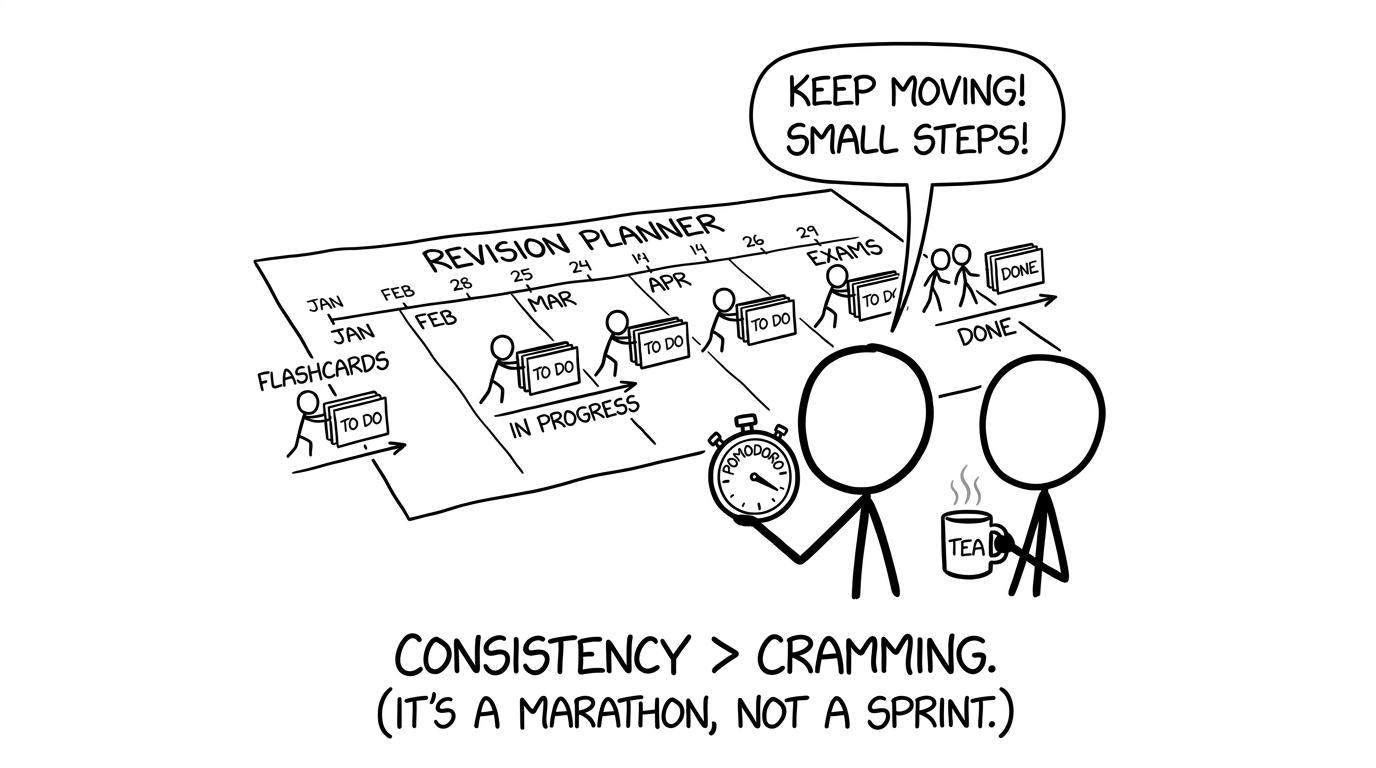 A revision calendar moves flashcards along a timeline
If you want a stable maths structure to copy, browse Edexcel GCSE Maths Revision Guides and notice how topics break into small, repeatable chunks. That same chunking is what makes Physics content stick.
Worked example: stop forgetting equations by mastering rearranging
One reason GCSE Physics feels slippery is equation recall. But in exams you often get the relationship (or can deduce it), and the marks come from rearranging and substituting cleanly.
Let’s practise with a classic:
Density is
ρ=mV \rho = \frac{m}{V} ρ=VmExample
A block has mass m=540 gm=540\text{ g}m=540 g and volume V=200 cm3V=200\text{ cm}^3V=200 cm3. Find the density in g/cm3\text{g/cm}^3g/cm3.
ρ=mV=540200=2.7 g/cm3 \rho = \frac{m}{V} = \frac{540}{200} = 2.7\ \text{g/cm}^3 ρ=Vm=200540=2.7 g/cm3That was straightforward. But the memory-strengthening step is the rearrangement.
Rearranging practice (the part that stops forgetting)
From
ρ=mV \rho = \frac{m}{V} ρ=VmMake mmm the subject:
Multiply both sides by VVV:
ρV=m \rho V = m ρV=mSo
m=ρV m = \rho V m=ρVMake VVV the subject:
Start with
ρ=mV \rho = \frac{m}{V} ρ=VmMultiply both sides by VVV:
ρV=m \rho V = m ρV=mDivide both sides by ρ\rhoρ:
V=mρ V = \frac{m}{\rho} V=ρmThis is exactly the same skill you use in GCSE maths topics like changing the subject. If that topic is a weakness, practise it directly on Changing the Subject of a Formula (YesGenie’s revision guides build the method step-by-step).
Use exam questions as the memory test (not the reward)
Many students treat past papers as something you do at the end, once you are “ready”. But readiness is not a feeling. It is a score.
A better approach for GCSE Physics is:
- Learn a small subtopic.
- Do 444 666 exam questions immediately.
- Mark them and write one sentence per mistake: what you missed and what you will do next time.
In maths, this is normal. You practise, you mark, you adjust. YesGenie makes that loop easy with past papers and video solutions (for example, the workflow on Paper 1 - Video Solutions shows how to learn from errors quickly).
Interleave Physics with maths to reduce forgetting
If you revise Physics in isolation, it can feel like a separate language. If you connect it to maths, it becomes more predictable.
Here are three maths anchors that reduce forgetting:
Units and conversions
If you always write units, you remember what the quantity means. That makes retrieval easier.
Proportion
Many Physics relationships are proportional. Treat them like the ratio and proportion work you already do for GCSE maths.
Graphs
The shape of a graph is a memory cue. Even a rough sketch can rescue you in an exam.
For a quick reminder of clean calculator habits (which matter in Physics too), dip into Using a Calculator.
Common mistakes that keep GCSE Physics forgetting in place
These are the quiet habits that look like revision, but don’t create recall.
Highlighting and rereading as the main method
You can recognise a page and still be unable to answer a 666-marker. Recognition is not retrieval.
Making notes that you never test
Notes are only useful if they become prompts. If you don’t turn content into questions, you are building a bookshelf, not a skill.
Not marking with the mark scheme
In GCSE exams, the mark scheme teaches you what counts. Students often lose marks for missing units, not stating an obvious step, or using vague language.
Cramming one big session per topic
Cramming feels productive because it is intense. But intensity is not the same as durability. Spacing wins.
Avoiding calculations because “Physics is not maths”
Most calculation questions are structured maths. If you avoid them, you guarantee forgetting because you never build the method.
Bringing it back to your GCSE routine (and making it stick)
The students who stop forgetting GCSE Physics are not the ones with perfect notes. They are the ones with a simple system: recall, space, practise, mark, repeat. It’s the same quiet recipe that raises maths grades.
If you want that system to feel automatic, build your daily rhythm around YesGenie: use Resources to find the right materials, practise with GCSE Past papers, tighten your timing with Edexcel GCSE Maths 45 Min Tests, and keep weaknesses honest with Edexcel GCSE Maths Mini Tests. Add in revision guides like Edexcel GCSE Maths Revision Guides and targeted skills such as Changing the Subject of a Formula, and you have a repeatable engine for the whole season.
Your goal is not to “cover content”. Your goal is to stop forgetting it when it matters. Start today with one topic, one blank page, and one set of marked questions. Then let spacing do what cramming never could ever make your GCSE knowledge durable.