

GCSE Revision: How Parents Can Help Without Nagging
GCSE revision without nagging: practical ways parents can support routines, reduce stress, and help students use YesGenie for maths practice and papers.

GCSE season has a particular sound: the shuffle of flashcards, the click of a calculator, and the deep sigh that says, “I’m behind.” If you’re a parent, you might feel the urge to fix it, to remind, to prompt, to push. But for many students, GCSE revision doesn’t fall apart because they lack intelligence. It falls apart because the process feels heavy, the plan feels vague, and every “Have you revised?” lands like judgement. Support that works is quieter: it removes friction and builds momentum.
This is a guide for parents who want to help with GCSE Biology revision without nagging, while also keeping a steady, confidence-building rhythm for GCSE maths, where marks are won through method and practice. YesGenie exists for that exact rhythm: free lessons, practice questions, past papers, predicted papers, mark schemes, and video solutions.
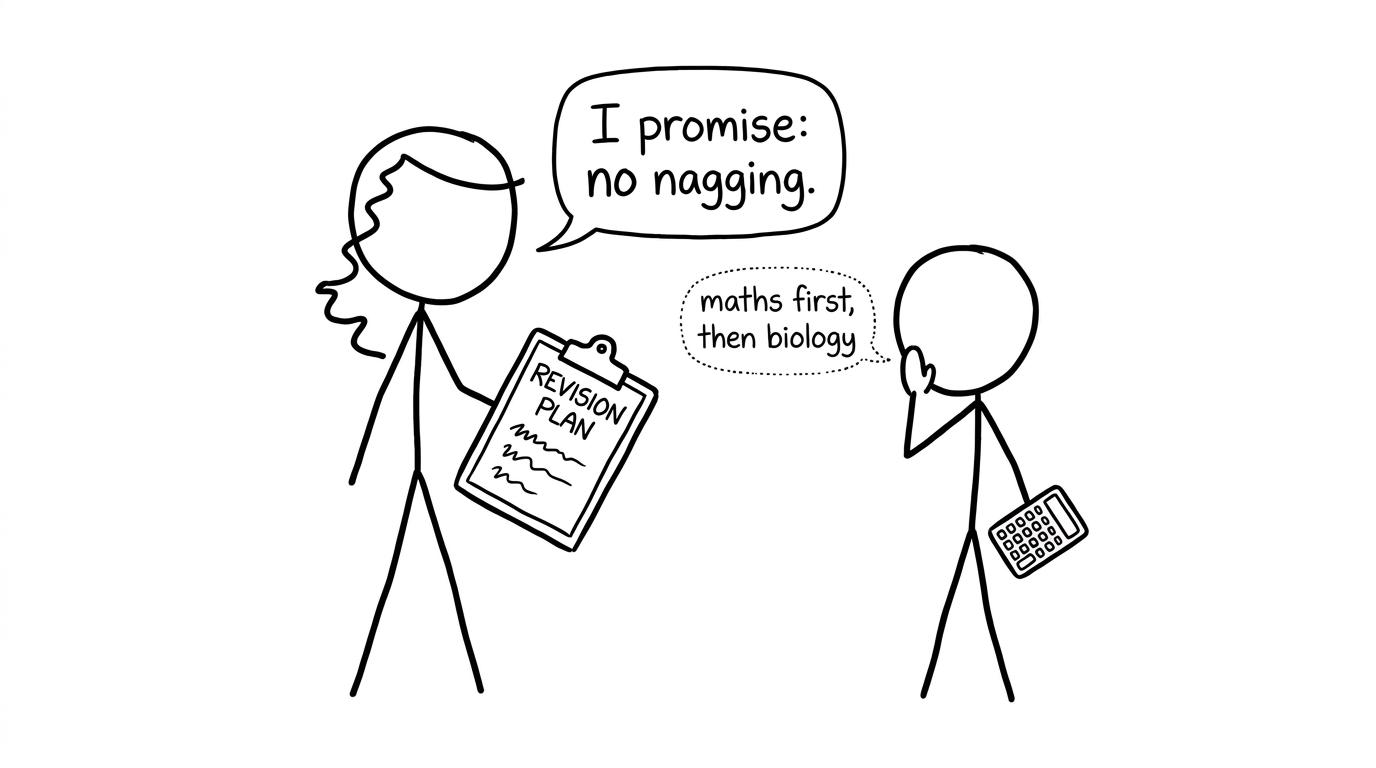 Parent with revision plan, no nagging
The no-nagging checklist (what actually helps)
Parents often ask for a “script”. Students often ask for “space”. The middle ground is a system.
- Agree a revision time and place (same as brushing teeth, boring, automatic, effective).
- Ask for a plan you can see (one page, not a life story).
- Swap reminders for choices: “Biology or maths first?”
- Make practice easy to start: laptop charged, logins saved, paper printed.
- Praise process, not personality: “You did 25 minutes” beats “You’re so smart.”
- Review once a week, not every hour.
If you only do one thing: help your child turn “I should revise” into “At 6pm I’ll do two exam questions.” That shift is where GCSE progress begins.
Why nagging backfires (and what to do instead)
Nagging is usually a love language in disguise. It’s a parent trying to reduce risk. The problem is that GCSE revision is a motivation game, not a lecturing game. When reminders become constant, your child stops hearing information and starts hearing threat: “You’re failing.” Even if you never say it.
A better approach is to make revision self-starting. You’re not the engine; you’re the mechanic.
Replace “Have you revised?” with three better questions
Try these, calmly, once a day at most:
- “What’s your next small task?”
- “What’s the easiest place to start?”
- “What do you want me to do: quiz you, time you, or just make tea?”
Those questions hand ownership back to the student, which is essential for GCSE confidence.
Build a two-subject rhythm: Biology memory + GCSE maths method
Biology revision is often about recall (key words, processes, definitions). Maths revision is often about method (steps, accuracy, exam technique). The rhythm that works for many students is:
- Biology: short, frequent active recall
- GCSE maths: fewer topics per session, but deeper practice with mark schemes
This matters because parents can support both without needing to know the content. You can support the structure.
A simple weekly structure that feels doable
- 4 evenings: 252525 minutes Biology recall + 252525 minutes GCSE maths practice
- 1 evening: a mixed “catch-up” slot
- Weekend: one longer paper-based session (maths past paper or mini test)
If your child is foundation tier, keep maths sessions shorter and more frequent. If higher tier, add more mixed-topic questions.
For maths, YesGenie makes the structure simple:
- Use GCSE Subjects to jump straight to maths.
- Start with Edexcel GCSE Maths Lessons (similar pathways exist for other boards).
- Add timed practice through Edexcel GCSE Maths Mini Tests.
- Then rotate in GCSE Past papers.
The “friction audit”: how parents quietly make revision easier
Students don’t usually avoid revision because they hate learning. They avoid the start. The start is where friction lives.
Do one ten-minute audit together:
- Where will revision happen?
- Is the chair comfortable?
- Is the phone away by default?
- Are pens, ruler, calculator ready?
- Are the right resources one click away?
Then, leave it alone. The goal is to create a place where GCSE revision begins with less negotiation.
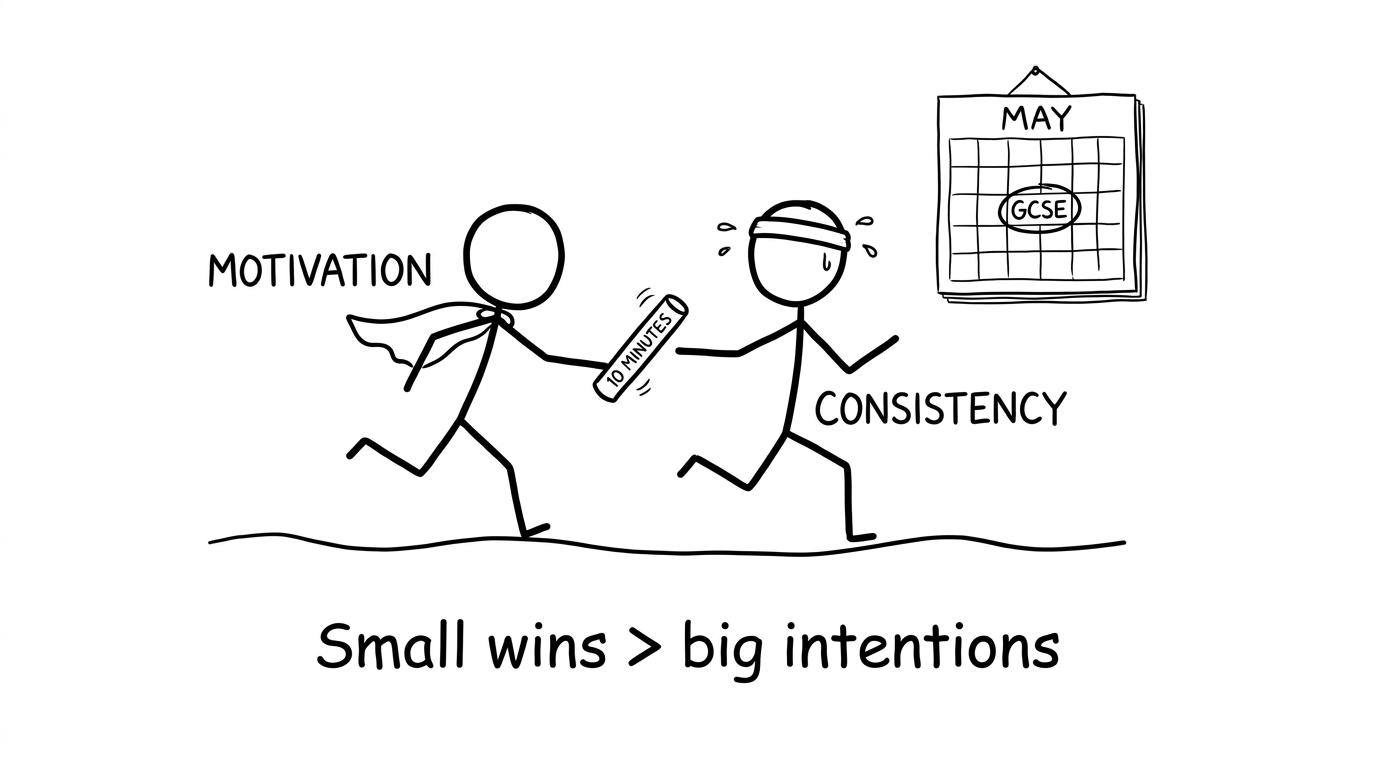 Motivation vs consistency relay
A parent-friendly way to “measure progress” without pressure
A lot of nagging is really a question: “Is this working?” You can measure progress gently using maths because it’s visible.
On GCSE maths, progress shows up as:
- fewer careless errors
- more method marks
- improved timing
- better topic coverage
YesGenie helps here because students can practise topic-by-topic and then confirm with papers and mark schemes.
Try a weekly check-in that sounds like coaching, not policing:
- “Which topic felt less scary this week?”
- “Which question type kept coming up?”
- “What will you repeat next week?”
If you want something concrete: ask them to show you one corrected mistake from a mark scheme. That single habit builds grades.
A worked GCSE maths example you can support (even if you “don’t do maths”)
Parents often worry they can’t help with GCSE maths because the syllabus changed. You don’t need to teach. You can support the method: show steps, check units, compare to the mark scheme.
Here’s a classic exam-style example where method matters.
Example: solving a quadratic by factorising
Solve x2−5x+6=0x^2 - 5x + 6 = 0x2−5x+6=0.
We look for two numbers that multiply to 666 and add to −5-5−5. Those are −2-2−2 and −3-3−3.
So:
x2−5x+6=(x−2)(x−3) x^2 - 5x + 6 = (x-2)(x-3) x2−5x+6=(x−2)(x−3)Set each bracket to zero:
x−2=0⇒x=2 x-2=0 \Rightarrow x=2 x−2=0⇒x=2 x−3=0⇒x=3 x-3=0 \Rightarrow x=3 x−3=0⇒x=3So the solutions are x=2x=2x=2 and x=3x=3x=3.
How a parent can help without teaching: ask, “What two numbers multiply to 666?” Then ask, “Do they add to −5-5−5?” That’s not nagging; it’s guiding the process.
For targeted practice, students can use topic pages and question banks on YesGenie, then confirm technique on papers with video solutions like June 2019 Paper 1 - Video Solutions.
Keeping Biology revision calm (without turning you into the teacher)
For Biology, your role is mostly to support retrieval practice and reduce procrastination.
Three non-naggy supports:
- Flashcard routine: You don’t need to know Biology. Your child reads the front, answers out loud, then checks the back.
- Blurting: They write everything they remember about a topic in two minutes, then fill gaps from notes.
- Exam questions: Short bursts, then mark with the mark scheme.
The same principle as GCSE maths applies: active recall beats passive rereading.
When your child is stuck: the “next smallest step” rule
A stuck student doesn’t need a motivational speech. They need a smaller task.
Try: “What’s the next smallest step you could do in 555 minutes?”
In maths, the next step might be “do one question on bounds.” In Biology, it might be “learn five key words for enzymes.” Small steps create movement, and movement creates confidence.
If you want a maths-focused landing page for short, doable chunks, Resources is useful for finding mini tests and other practice quickly.
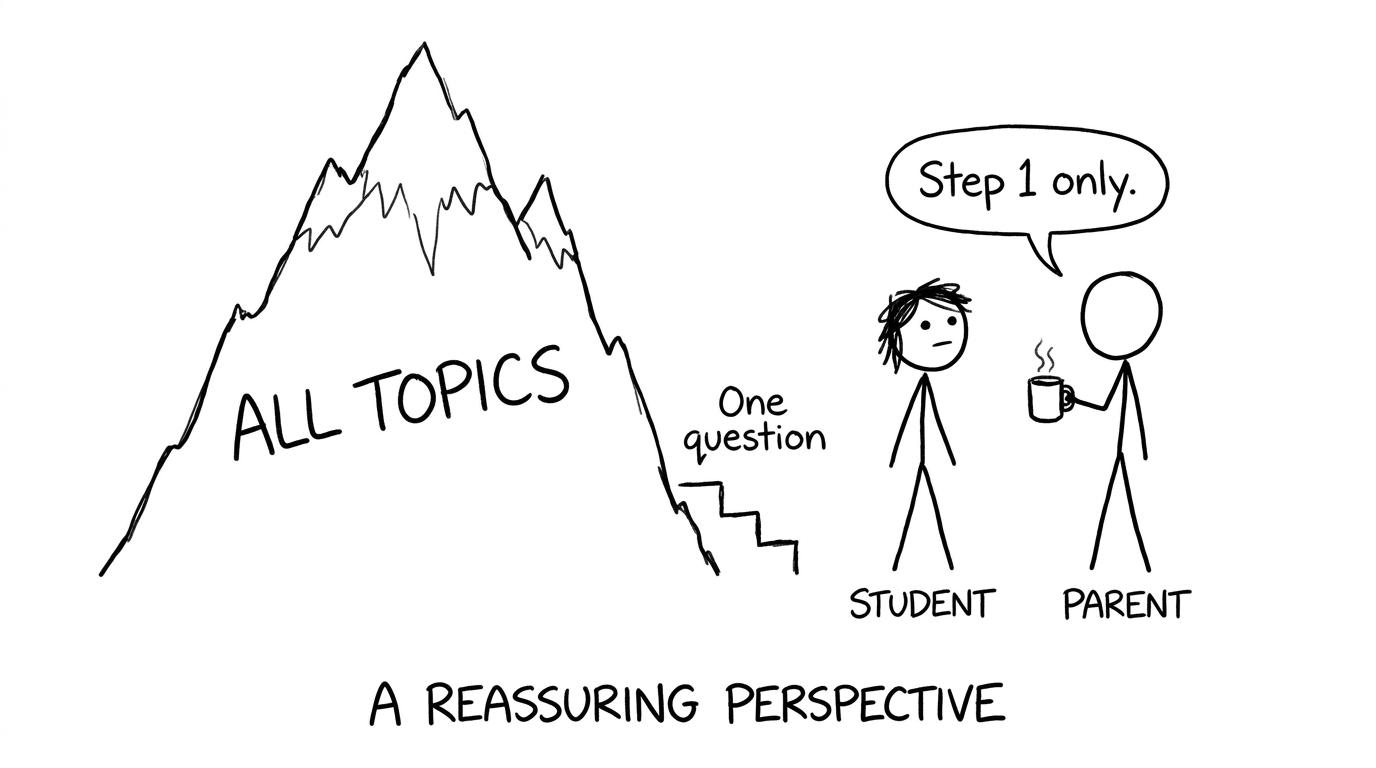 Mountain of topics, one question staircase
Common mistakes parents make (and what to do instead)
-
Mistake: asking for hours instead of outputs. Better: ask what they’ll complete (e.g. “two exam questions” or “one mini test”).
-
Mistake: comparing siblings or friends. Better: compare only to their past week, especially in GCSE maths where improvement is measurable.
-
Mistake: rescuing too fast. Better: let them sit with a hard question for 333 minutes, then prompt with, “What topic is this testing?”
-
Mistake: treating revision as punishment. Better: build it into the day, then protect rest. Sleep is part of revision.
-
Mistake: only doing papers at the end. Better: introduce papers earlier so exam technique grows steadily; use GCSE Past papers alongside topic practice.
A closing thought (and a practical next step)
The best kind of support doesn’t feel like pressure. It feels like someone quietly clearing a path. When parents stop trying to push GCSE revision and start trying to protect it: time, space, routine, and a calm weekly check-in; students usually do more, not less.
If your household needs a simple structure for GCSE maths alongside everything else (including Biology), use YesGenie as the backbone: revision lessons for understanding, practice questions and mini tests for retrieval, and past papers plus mark schemes and video solutions for exam technique. Start today by choosing one small task on YesGenie, then repeat it tomorrow. That’s how grades move.










