Is GCSE Religious Studies Harder Than Before?
GCSE Religious Studies harder than before? Explore what changed, why it feels tougher, and how to balance RS with effective GCSE maths revision.
A subject can feel different long before anyone proves that it is harder. The textbook looks thicker. The model answers seem longer. Every lesson introduces another quotation, belief or ethical argument to remember.
So, is GCSE Religious Studies harder than before? In England, the reformed GCSE introduced more demanding subject content, linear assessment and grades 999 to 111. That gives today's course a stronger emphasis on secure knowledge, explanation and evaluation. But it does not mean every modern student has a harder route to a particular grade. Exam boards set grade boundaries after reviewing how demanding each paper was and how students performed.
The fairest answer is this: the qualification has changed in ways that can make the workload and examinations feel tougher, but comparisons across different years are not simple. Your preparation matters more than the label attached to the course.
The short answer at a glance
Here is the practical picture for students balancing Religious Studies with GCSE maths:
- England's GCSE Religious Studies qualifications were reformed, with first teaching beginning in 201620162016 and the first examinations taking place in 201820182018.
- Reformed courses use linear assessment, so the qualification is examined at the end of the course rather than through modular examinations.
- Students generally need detailed knowledge of beliefs, teachings, practices and sources of authority, alongside the ability to analyse and evaluate arguments.
- Grades now run from 999 to 111 in England, replacing the former letter scale.
- Grade boundaries are not permanently fixed, so a more demanding paper can be reflected in the boundaries.
- Specifications differ between AQA, Edexcel, OCR and Eduqas, while arrangements outside England are not identical.
- Feeling under pressure may reflect the combined GCSE workload, not Religious Studies alone.
The best response is not to debate whether a previous generation had an easier paper. It is to understand the specification you will actually sit and build a revision system around it.
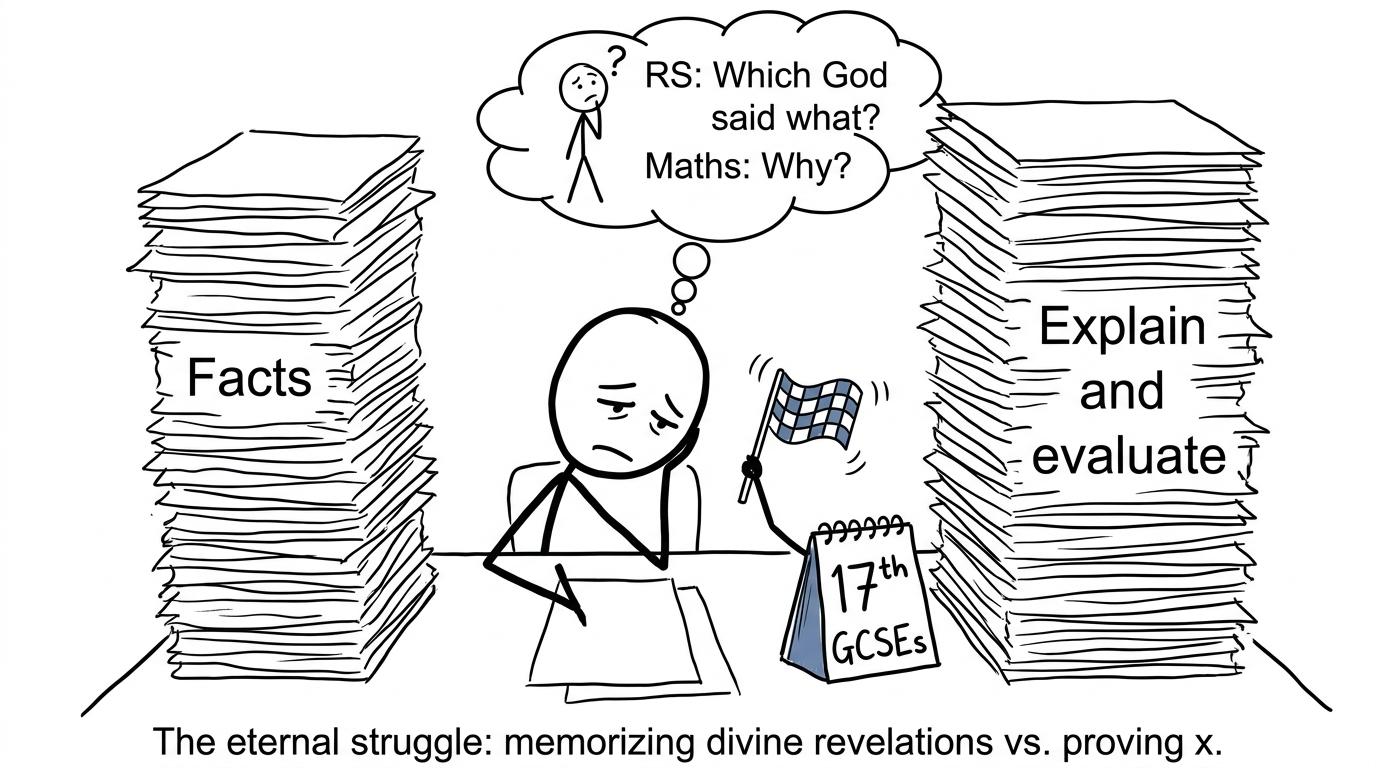 A student balancing Religious Studies knowledge and evaluation during GCSE revision
What changed in GCSE Religious Studies?
The current course in England was designed as part of the wider reform of GCSE qualifications. The reform affected more than the grade labels printed on results day.
Greater depth of subject knowledge
Religious Studies is not simply a collection of personal opinions. Students must know what particular religious traditions teach, how those teachings influence believers and how beliefs may be expressed through practices.
The exact content depends on the exam board and route selected by the school. It can include the study of two religions, religious practices, textual sources and thematic questions concerning matters such as peace, relationships, crime, human rights or life and death.
A successful response therefore needs more than a general statement such as “some religious people disagree”. It needs accurate, relevant knowledge connected to the question. This depth can make the modern qualification feel harder, especially when several themes and traditions must remain accessible at once.
More emphasis on explanation and evaluation
Current specifications reward both knowledge and the ability to use it. Students may need to explain beliefs, compare perspectives, analyse a statement and reach a justified conclusion.
That creates a particular kind of difficulty. Knowing a teaching is only the beginning; you must select it under time pressure and make it support an argument. In maths, a remembered method must be applied to the problem in front of you. In Religious Studies, remembered knowledge must be turned into precise reasoning.
The subjects look different on the page, but the revision principle is similar: retrieval without application is incomplete.
Linear examinations
Reformed GCSEs in England are linear. Assessment takes place at the end of the course, so students must retain a broad range of content for the final examination period.
This can feel more demanding than completing separate modules along the way. The challenge is partly intellectual and partly organisational. Forgotten material accumulates quietly, then becomes visible when a past paper asks for a topic last covered months earlier.
That is why spaced revision matters. A short return to a topic every few weeks is usually more useful than one enormous rereading session immediately before the examination.
Why GCSE Religious Studies may feel harder now
Qualification reform is only one part of the answer. The experience of difficulty also depends on what surrounds the subject.
The total GCSE workload is visible all at once
A student rarely revises Religious Studies in isolation. There may also be English literature quotations, science content, languages and several maths topics competing for attention.
When every subject approaches its final examinations together, each one can feel heavier. Religious Studies often creates additional pressure because its extended responses do not resemble quick factual questions. Planning, evidence, reasoning and judgement all consume time.
A realistic timetable should therefore divide revision by task rather than merely by subject. “Revise RS” is vague. “Recall teachings on one theme, plan two evaluation questions and check them against the mark scheme” is actionable.
Use the same specificity for maths. The free GCSE maths revision topics on MathsGenie let you identify the exact skill that needs attention rather than treating the whole course as one intimidating block.
Online model answers can distort expectations
Students often compare a timed response with a polished model answer written without the same pressure. That comparison is unfair. A model may show an ideal route through the question, but your goal is to produce a clear answer that satisfies the assessment criteria within the available time.
The same illusion appears in maths when a video solution looks effortless. The clean final method hides the decisions required to find it. Improvement comes from attempting the question first, checking the solution and then repairing the missing step.
Familiarity can be mistaken for simplicity
Older papers sometimes look easier because their terminology is familiar or because you are viewing them without the pressure of sitting the full examination. Conversely, a new specification can feel harder simply because teachers and students have fewer years of directly comparable materials.
Difficulty is not one measurable object. It includes content volume, question wording, time pressure, memory demands and the standard needed for a grade. Different versions of a qualification can be harder in different ways.
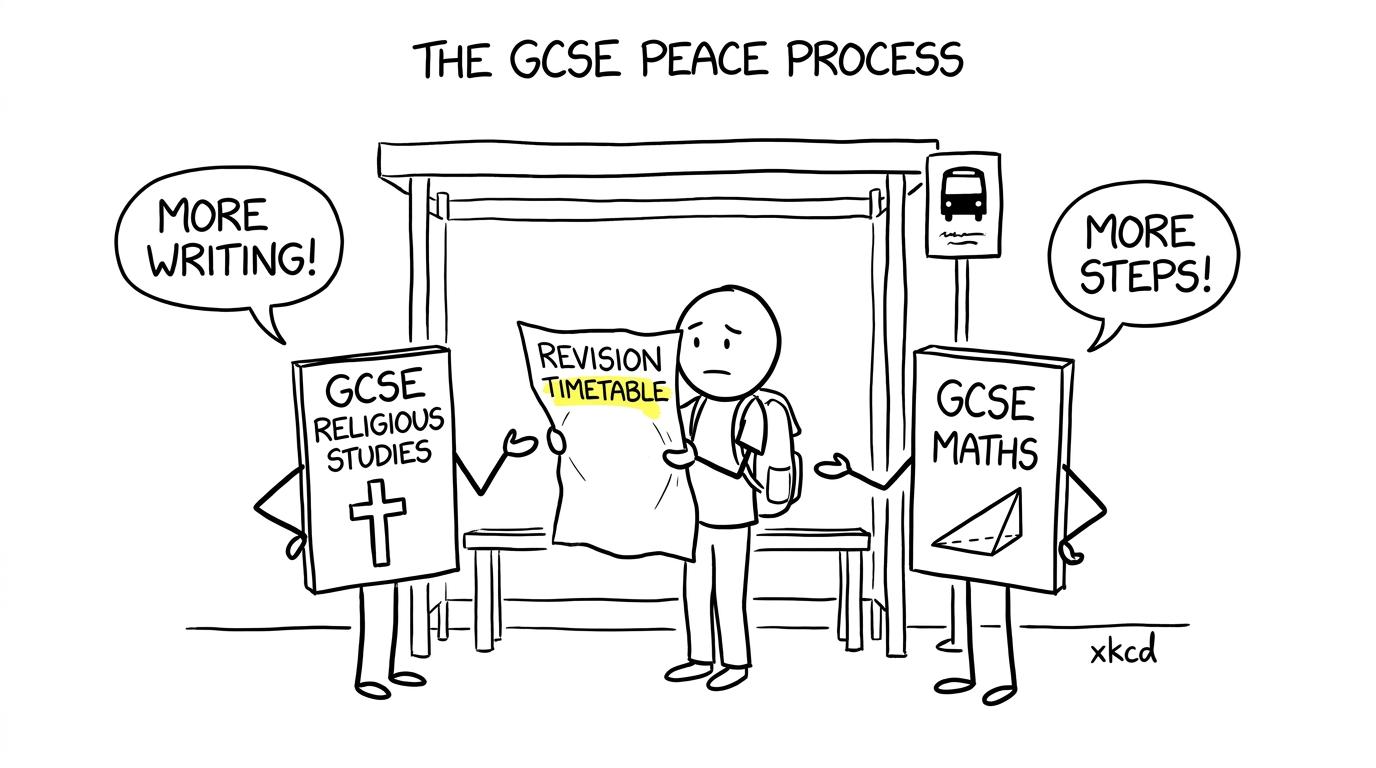 Religious Studies and maths negotiate over space in a GCSE revision timetable
Does a harder paper mean lower grades?
Not automatically. Grade boundaries are set for a specific exam board, qualification and examination series. They can change because papers are not identical in difficulty from one year to another.
This matters when people compare raw marks across time. A particular mark from one series does not necessarily represent exactly the same performance in another. Nor can the old letter grades be converted perfectly into grades 999 to 111 as though only the labels changed.
The broad standard-setting process is intended to prevent students from being unfairly rewarded or penalised simply because their paper was somewhat easier or harder than another year's paper. However, boundaries cannot remove every personal source of difficulty. A paper may still suit one student's strengths better than another's.
The useful conclusion is simple: do not build your target around a rumoured boundary. Build enough knowledge and exam technique to collect marks across the paper.
How maths students can balance both subjects
Religious Studies and maths place different demands on memory, but both improve through active practice.
Separate recall from performance
For Religious Studies, recall may include key beliefs, teachings, sources and contrasting perspectives. Performance means selecting those ideas and constructing an answer under timed conditions.
For maths, recall includes facts and methods; performance means recognising which method a question requires. MathsGenie's grade 555 revision resources, grade 777 topics and grade 999 material help you work at an appropriate level while still revisiting gaps from earlier grades.
Do not confuse recognising a page with being able to answer a question. Close the notes. Attempt the task. Then check.
Use mark schemes as feedback, not decoration
A mark scheme shows what the examiner can reward. In Religious Studies, use it alongside your specification and your teacher's guidance because acceptable examples and response structures depend on the board and question type.
In maths, GCSE past papers and mark schemes reveal whether an error came from knowledge, interpretation, algebraic accuracy or incomplete working. Recording the reason for each lost mark makes the next revision session far more focused.
Alternate demanding tasks
Two hours of continuous extended writing can become unproductive. So can a long run of difficult algebra when concentration has gone.
A better session might alternate an RS retrieval task, a timed paragraph, a focused maths lesson and a short set of practice questions. The change of mental demand provides a break without turning the session into passive revision.
Closer to the examination, MathsGenie's GCSE predicted papers can support timed maths practice. They should complement, not replace, official past papers and complete specification coverage.
Common mistakes when judging whether RS is harder
Comparing one question instead of whole qualifications
A difficult modern evaluation question and an easy question from an older paper do not prove that the entire qualification changed by the same amount. Fair comparison would need to consider content, assessment structure, time, mark schemes and grade standards.
Treating every exam board as identical
AQA, Edexcel, OCR and Eduqas specifications are not interchangeable. Paper structures, selected religions, themes and question styles can differ. Always check the specification named by your school and use board-specific materials.
GCSE arrangements also vary across the nations of the UK. Grades 999 to 111 and the reform timeline discussed here apply specifically to England; Wales and Northern Ireland have their own qualification arrangements.
Revising content without practising answers
Flashcards can build knowledge, but they do not automatically build timing, evaluation or judgement. Students need both retrieval and examination practice.
The maths equivalent is watching every revision video but attempting no questions. Use videos to learn, then practise independently through MathsGenie's GCSE revision lessons.
Letting one weak attempt define the subject
A poor timed answer is information, not a verdict. Work out what failed: missing knowledge, weak selection, unclear reasoning, insufficient development or poor timing. Each problem requires a different response.
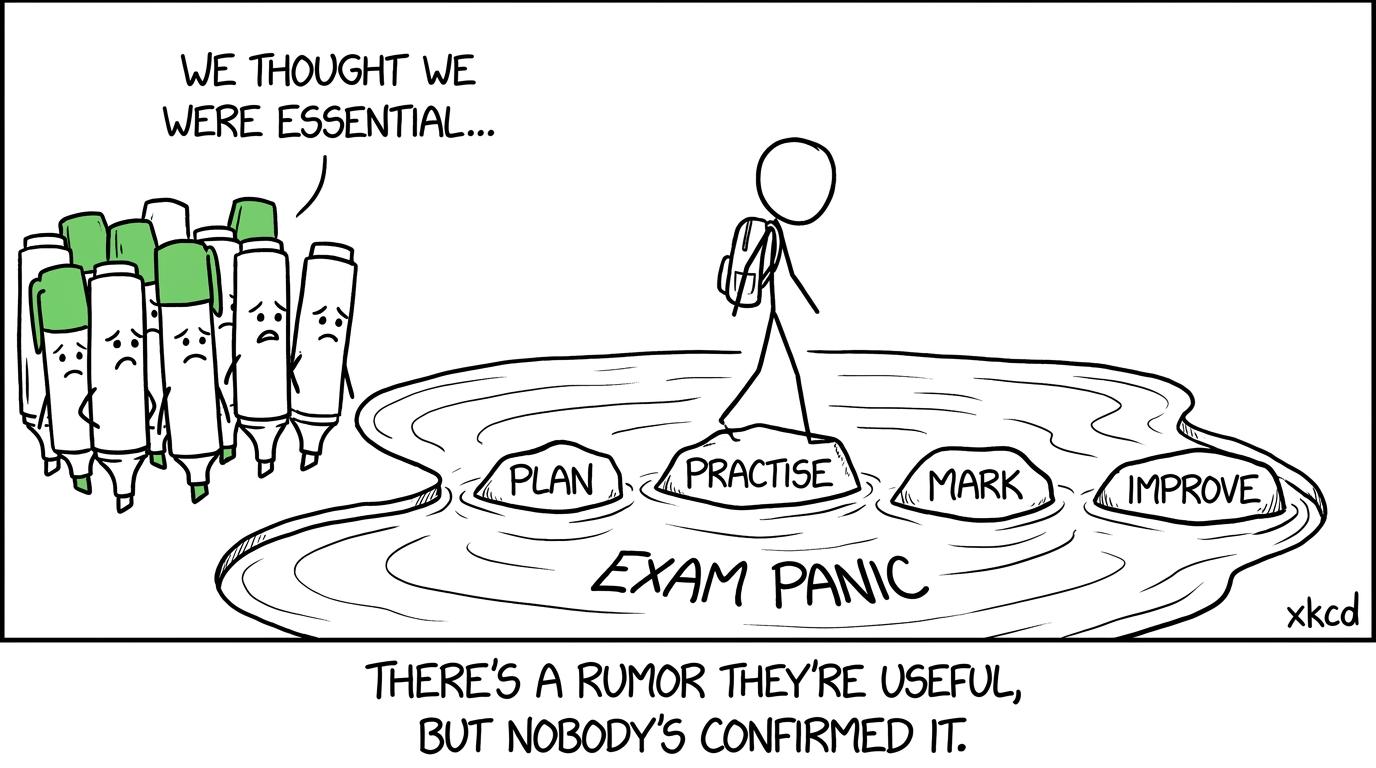 A student crosses from exam panic to improvement using plan, practise, mark and improve
A harder qualification still becomes manageable
GCSE Religious Studies has genuinely changed in England. Its reformed structure expects substantial knowledge and the disciplined use of that knowledge in explanation and evaluation. Those demands can make it feel harder than older versions of the course.
Yet “harder” is not the same as “unmanageable”, and it does not mean that previous raw marks can be compared directly with today's results. The examination board, specification, paper difficulty, grade boundaries and your wider GCSE workload all shape the experience.
Focus on the variables you can control: know your specification, retrieve content regularly, practise timed responses and learn from mark schemes. Then give maths the same structured attention. Start with MathsGenie's free GCSE maths revision hub, use targeted revision lessons and practice questions, complete past and predicted papers, and check every attempt with the available mark schemes and video solutions.
The argument about whether exams were once easier may continue. Your next useful revision session does not need to wait for the answer.