

GCSE: Find Your Weakest Topics for OCR Maths
GCSE OCR maths revision: learn how to spot your weakest topics using past papers, mark schemes and YesGenie question banks, then turn them into marks.

When you sit down with an OCR maths paper, the hardest part is rarely the algebra or the geometry. It’s the feeling that the paper is reading you back; finding the same soft spots you’ve been trying to ignore. If you’re revising for GCSE Maths, the fastest way to improve is not “do more questions”. It’s to find your weakest topics, name them clearly, and practise them until they stop being scary.
This post is a calm, practical plan for OCR students to diagnose weaknesses and convert them into marks, using YesGenie’s free GCSE revision lessons, question banks, past papers, mini tests and mark schemes.
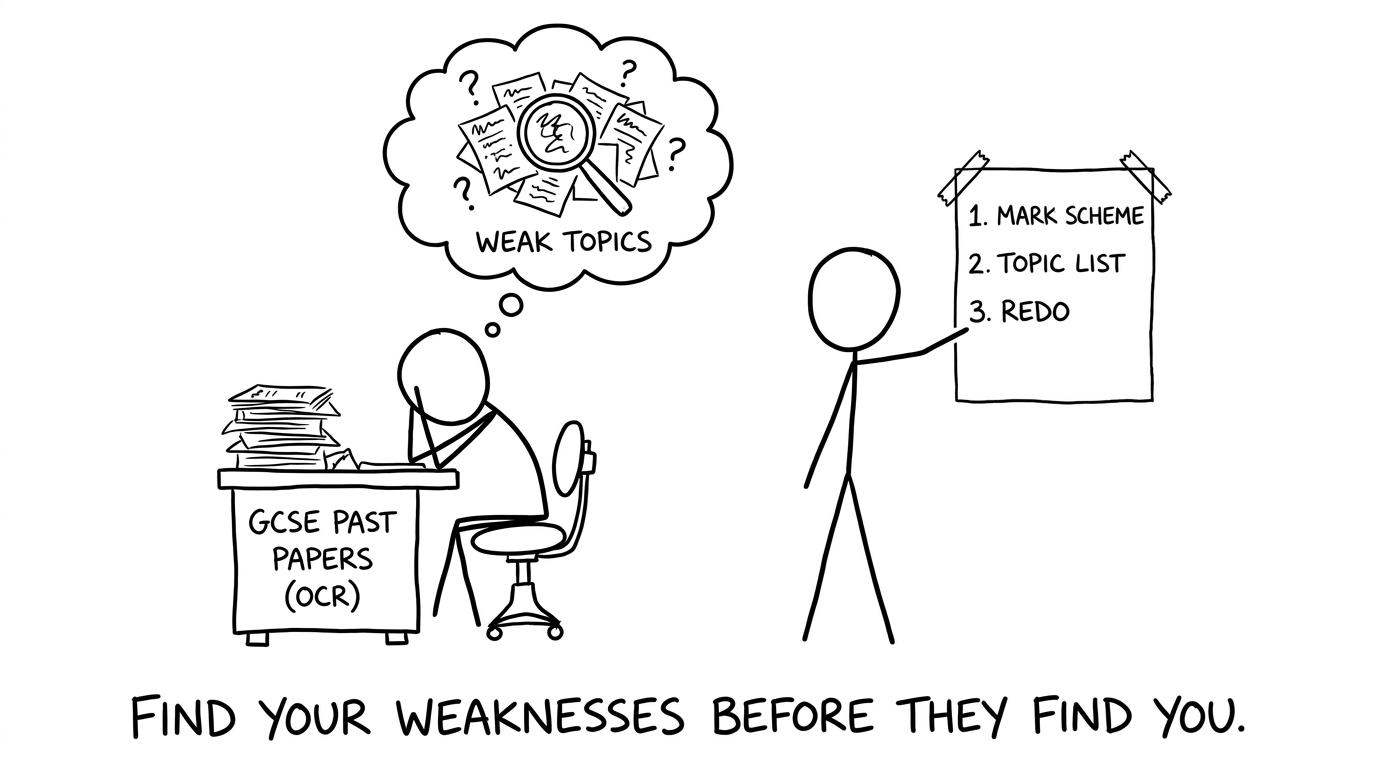 A stick-figure student hunting weak topics with a magnifying glass
The simple idea: you don’t rise to the occasion, you fall to your habits
Most students revise what feels familiar because it gives quick comfort. But OCR GCSE Maths rewards the opposite habit: returning to what you avoid, and making it ordinary.
Weak topics are usually not “things you don’t know at all”. They’re topics you half-know; you can start, but you leak marks on method, on accuracy, or on exam wording.
So the goal is not to build a longer revision list. The goal is to build a truer list.
A quick checklist to find your weakest topics (OCR GCSE Maths)
Use this as your diagnostic loop:
- Do one paper section under timed conditions.
- Mark it using the mark scheme.
- For every lost mark, write a topic label (not “careless”).
- Sort your lost marks into a short “Top 5 weakest topics” list.
- Practise those topics using topic questions and revision guides.
- Re-attempt similar questions after 48 hours.
On YesGenie, you can run this loop using:
- GCSE Maths OCR home (all OCR resources in one place)
- GCSE Past papers (papers by exam board)
- Resources hub (predicted papers, mini tests and more)
Start with OCR-specific practice papers, but mark like a detective
The best diagnostic tool is still a paper, because it shows you what you do under pressure.
Go to GCSE Maths OCR and choose a past paper or exam-style set. If you’re not ready for a full paper, do 20-30 minutes on a section.
The marking rule that changes everything
When you mark, don’t just write the score. Write why that mark was lost.
Use three labels:
- Topic gap: you didn’t know what to do.
- Method gap: you knew the topic, but used the wrong process.
- Accuracy gap: you used a sensible method but slipped.
All three matter for GCSE, but they need different fixes.
Turn “lost marks” into a topic heatmap (in 10 minutes)
Here’s a simple way to make weakness visible.
- Create three columns: Number, Algebra, Geometry/Measures/Stats.
- As you mark, put a tally in the right column with a topic label.
- At the end, circle the top 5 topic labels with the most tallies.
Example labels that are actually useful:
- “Reverse percentages” (not “percentages”)
- “Angles in parallel lines” (not “angles”)
- “Forming equations from worded problems” (not “algebra”)
Then pick the matching YesGenie topic resources. For example, if your tallies scream fractions/percentages, use:
- Fractions, Decimals and Percentages (OCR flashcards)
- Fractions, Decimals and Percentages (revision guide) (same maths skill, exam-board neutral)
A worked example: diagnosing the real weakness (percentages)
Suppose you lost marks on a question like this:
A jacket costs £80 after a 20%20\%20% discount. What was the original price?
Many students label this “percentages”. But the true label is reverse percentages.
Let the original price be xxx.
After a 20%20\%20% discount, you pay 80%80\%80% of the original, so:
0.8x=80 0.8x = 80 0.8x=80Divide both sides by 0.80.80.8:
x=800.8=100 x = \frac{80}{0.8} = 100 x=0.880=100So the original price was £100.
Diagnosis tip: if you multiplied by 0.80.80.8 and got £64, that’s not “careless”; it’s a method gap. Your fix is doing 10-15 reverse percentage questions until the equation feels automatic.
Use topic question banks to rebuild the missing method
Once you have your “Top 5 weakest topics”, don’t return straight to full papers. Build the method first.
A good pattern is:
- Read a short revision guide.
- Do topic questions.
- Check worked solutions.
- Redo the ones you missed the next day.
If you’re on Eduqas or have access to wider topic sets, the question-bank style is ideal for drilling weaknesses:
Even if you’re OCR, maths skills transfer. The exam wording changes a little, but the method doesn’t.
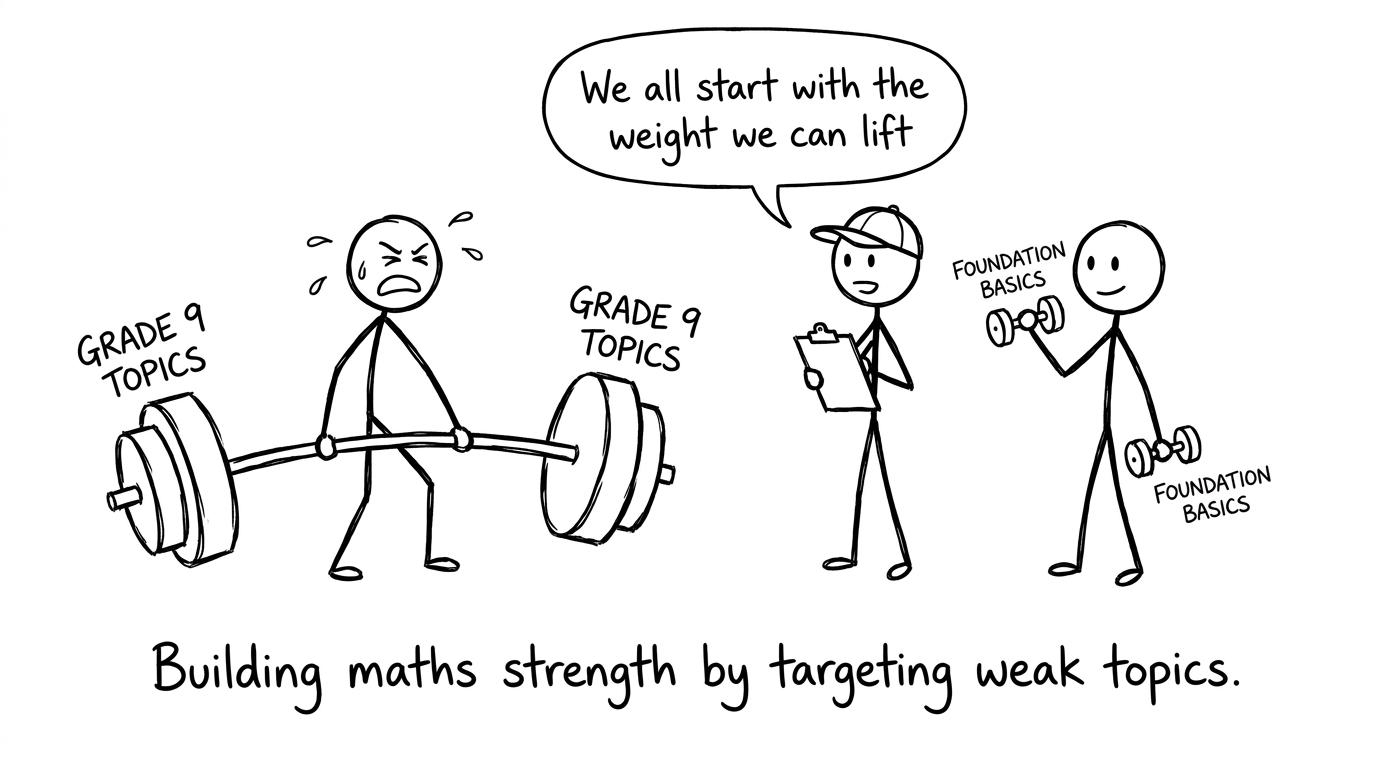 Two stick figures training weak-topic “muscles”
A worked example: algebra weakness that looks like “I hate worded problems”
Worded problems often hide a cleaner weakness: forming an equation.
Example:
The perimeter of a rectangle is 34 cm34\text{ cm}34 cm. The length is 3 cm3\text{ cm}3 cm more than the width. Find the width.
Let the width be www cm. Then the length is w+3w+3w+3.
Perimeter of a rectangle: P=2(length+width)P = 2(\text{length} + \text{width})P=2(length+width).
So:
2((w+3)+w)=34 2\big((w+3)+w\big) = 34 2((w+3)+w)=34Simplify:
2(2w+3)=34 2(2w+3)=34 2(2w+3)=34 4w+6=34 4w+6=34 4w+6=34 4w=28 4w=28 4w=28 w=7 w=7 w=7So the width is 7 cm7\text{ cm}7 cm.
Diagnosis tip: if you wrote 2w+3=342w+3=342w+3=34, you didn’t make an algebra mistake; you missed the structure of perimeter. That’s a topic gap in “perimeter and forming equations”, which is fixable with targeted practice.
Use mini tests when you need feedback fast
If you’re short on time, mini tests are the quickest way to reveal weak topics because they compress the skill.
Even if you’re OCR, these are useful for GCSE method practice:
Use them like this:
- Do one mini test.
- Mark it carefully.
- Extract 2 weakest topics.
- Practise those topics for 25 minutes.
- Redo the mini test a few days later.
This loop is how you turn revision into improvement, rather than just activity.
When you’re ready, return to papers and track “marks per topic”
Papers matter because they teach pacing, stamina, and OCR-style phrasing. But now, you’ll use papers differently.
Instead of aiming for a higher score immediately, aim for fewer repeated mistakes.
A good metric is:
- “How many marks did I lose on my Top 5 weakest topics this time?”
That number should fall faster than your total score rises, and that’s fine. It means the foundations are shifting.
Useful paper hubs:
Common mistakes OCR GCSE students make when trying to find weak topics
- Calling everything ‘careless’. Careless is a symptom; the cause is usually an accuracy gap (rounding, arithmetic, negative numbers, copying values). Label the cause, then practise that cause.
- Doing full papers too early. Papers are great, but if you don’t know the method, you’ll just rehearse panic. Build method with topic practice first.
- Not using the mark scheme properly. Many GCSE marks are method marks. If your method is nearly right, learn what the examiner rewards and write it every time.
- Mixing tiers in a random way. Foundation and higher tier overlap, but the demand differs. Make sure your weak-topic list reflects your tier.
- Never redoing questions you got wrong. The learning happens on the second attempt. If you only ever do new questions, you never prove the method has stuck.
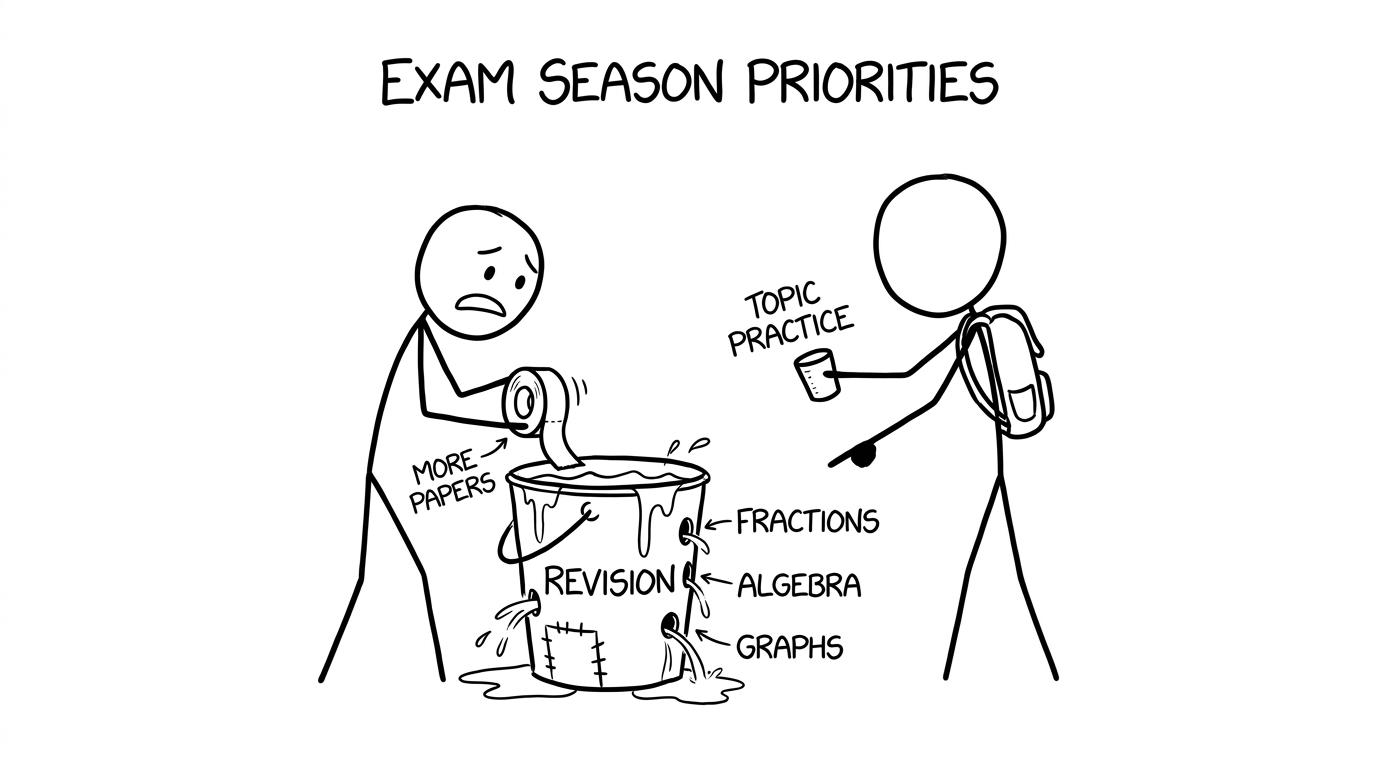 A leaky revision bucket patched with “more papers”
Bringing it together: the quiet confidence of knowing what to fix
A GCSE Maths paper feels brutal when it surprises you. It feels manageable when it confirms what you’ve already seen in your revision.
So take the pressure off: don’t try to become good at everything at once. Find your weakest topics like a detective, practise them like a craft, then return to OCR-style questions and watch the marks come back.
If you want a clean place to run the whole process, use YesGenie as your base:
- Start at GCSE Maths OCR for OCR-specific revision resources.
- Use GCSE Past papers to practise exam technique with mark schemes.
- Use the Resources hub for mini tests and predicted-paper style practice.
Your weakest topics aren’t a verdict. They’re a map. And once you can see them clearly, you can finally start moving in the right direction: one method, one mark, one GCSE paper at a time.










