

GCSE OCR Chemistry Revision Without Wasting Time
GCSE OCR Chemistry revision without wasting time: build a smart plan, practise exam questions, and use maths methods that win marks quickly.
If you’re an OCR student revising GCSE Chemistry, the biggest danger isn’t that the content is “too hard”. It’s that revision quietly turns into activity: rereading, highlighting, watching videos on 1.5×1.5\times1.5× speed, and feeling busy without moving your mark. And because you’re also a maths student, you already know a painful truth: time is limited, and marks are specific. Good GCSE Chemistry revision is less about doing more and more about doing what the mark scheme actually rewards.
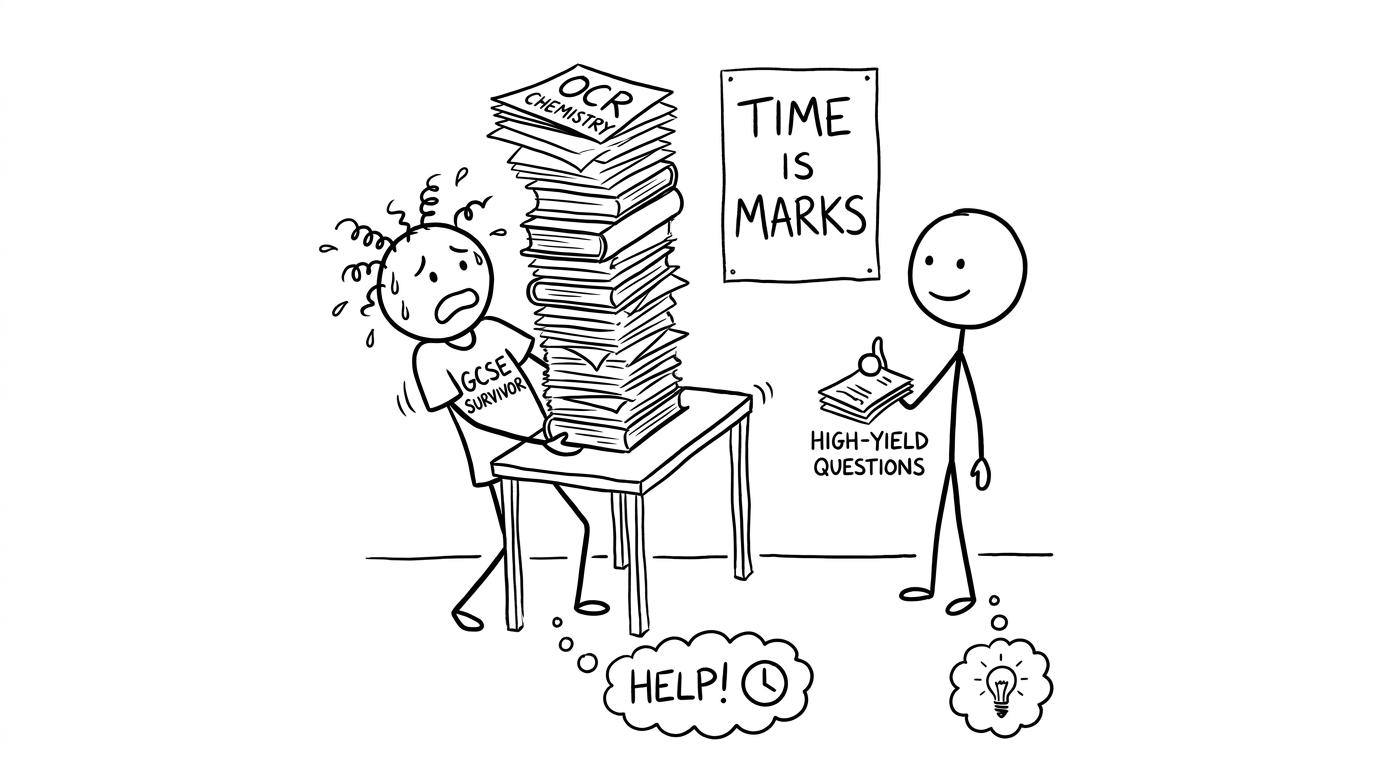 Two stacks: OCR Chemistry vs high-yield questions
This post is written for UK GCSE (and A Level) maths students who want a calm, efficient way to revise OCR Chemistry, without wasting evenings that could be used for maths past papers, mini tests, and predicted papers. You’ll see a tight checklist, a few worked examples (including the maths behind the chemistry), common mistakes, and an FAQ.
The no-waste OCR Chemistry revision checklist
Use this as your “minimum effective dose” for GCSE OCR Chemistry.
- Know what OCR asks: prioritise exam questions and mark schemes over notes.
- Revise in cycles: learn →\rightarrow→ practise →\rightarrow→ mark →\rightarrow→ fix.
- Make your maths do the heavy lifting: moles, concentration, rates, percentage yield.
- Use timed practice early: speed is a skill, not a personality trait.
- Keep a mistake log: one page that grows, not fifty pages that repeat.
If you’re also revising maths, build your week around high-quality practice on YesGenie: GCSE Past papers, board-specific maths hubs like GCSE Maths - OCR, and short, focused tests like Edexcel GCSE Maths Mini Tests (use the format even if your board differs).
Why OCR Chemistry revision wastes time (and how to stop it)
Most wasted GCSE Chemistry revision happens for a simple reason: students confuse familiarity with retrieval. When you reread a page on the periodic table, your brain recognises it and whispers, “You know this.” But OCR doesn’t award marks for recognition. It awards marks for specific statements, correct units, and linked reasoning.
A better approach is to treat revision like maths: you wouldn’t revise simultaneous equations by reading solutions. You’d do questions, check methods, and fix the exact step where you went wrong. The same mindset saves hours in GCSE Chemistry.
The “mark scheme first” habit
For OCR Chemistry, you should become lightly obsessed with wording. Not because you need to write essays, but because the same ideas are tested in the same shapes.
A practical rule:
- If a topic is mostly definitions and explanations (e.g. bonding, structure and properties), you practise short written questions and mark ruthlessly.
- If a topic is calculation-heavy (e.g. moles, concentration, gas volumes), you practise until the method is automatic.
On the maths side, use structured revision pages when you need the method re-taught clearly. For example, if chemistry calculations expose a weakness in powers or standard form, a quick reset with Powers and Roots (GCSE Revision Guide) can stop you losing easy marks across both subjects.
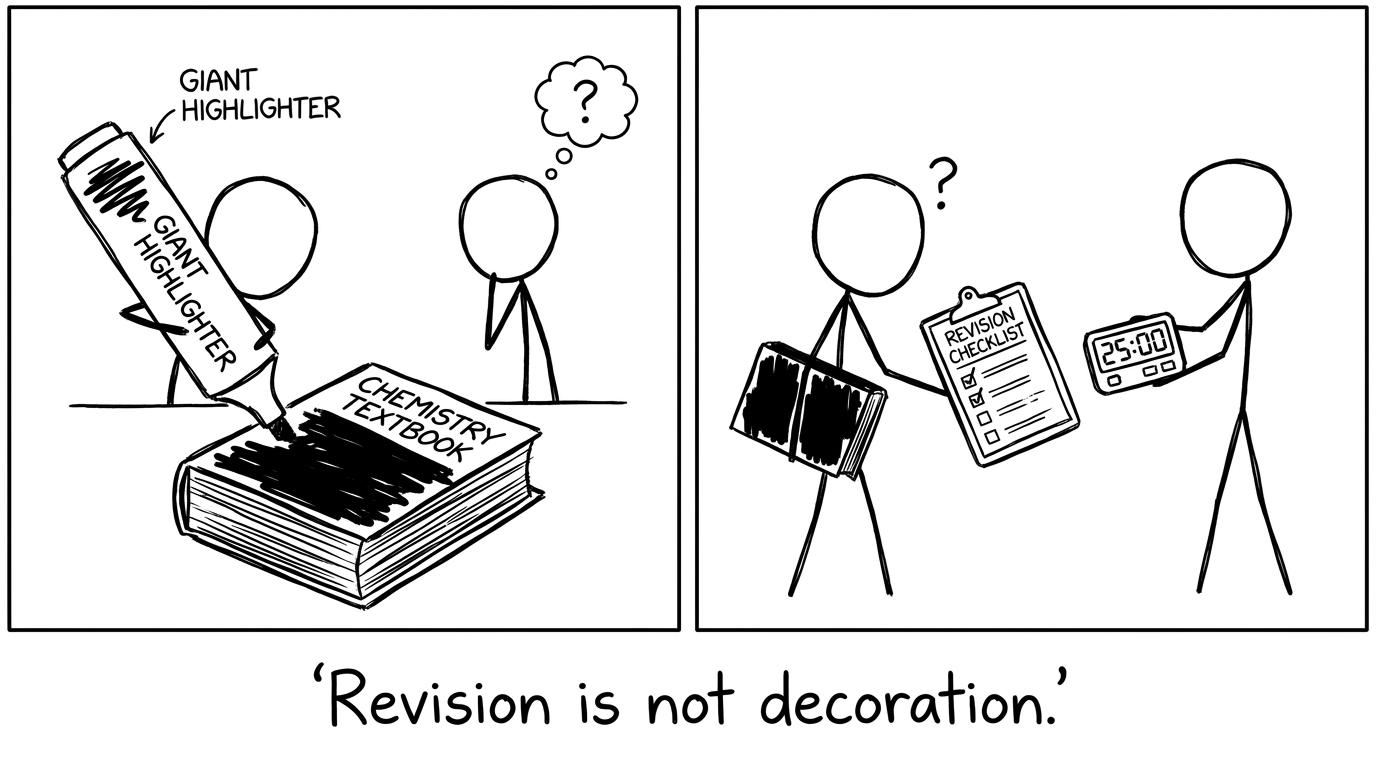 Highlighting the whole book vs a checklist
The 4-step loop that makes GCSE Chemistry stick
This loop is boring in the best way. It’s the fastest path to better GCSE grades.
Learn
Pick one small chunk (e.g. “limiting reactants” or “electrolysis of molten compounds”). Use brief notes, a lesson, or a video. The aim is not beauty; it’s clarity.
Practise
Do exam-style questions immediately. If you don’t have many OCR-specific ones to hand, still do mixed exam questions and mark with a mark scheme. The skill is answering like an examiner.
Mark
Be strict. In GCSE science, “nearly” often gets 000.
Fix
Rewrite only what you missed, in the form you need next time: a sentence stem, a definition, a unit reminder, or a one-line method.
To keep your maths ticking over in the same week, use YesGenie’s built-in exam practice structure: GCSE Past papers for full runs, and the Resources page to find bite-sized formats when you’re tired but still want meaningful practice.
Worked examples: the maths inside OCR GCSE Chemistry
You’re a maths student. That’s an advantage in GCSE Chemistry because many marks are simply method marks in disguise. Here are three high-yield calculations that come up again and again.
Moles and mass
Question style: Calculate the amount (in moles) of CO2\text{CO}_2CO2 in 11 g11\text{ g}11 g.
Method: n=mMrn = \frac{m}{M_r}n=Mrm.
Molar mass of CO2\text{CO}_2CO2 is:
Mr=12+2×16=44M_r = 12 + 2\times 16 = 44Mr=12+2×16=44So:
n=1144=0.25 moln = \frac{11}{44} = 0.25\text{ mol}n=4411=0.25 molWhy this saves time: it’s always the same structure. If you write n=mMrn = \frac{m}{M_r}n=Mrm at the top of the page in practice, you train your hand to do it in the exam without thinking.
Concentration (required practical energy)
Question style: 2 g2\text{ g}2 g of sodium chloride is dissolved and made up to 100 cm3100\text{ cm}^3100 cm3. Find concentration in g/dm3\text{g/dm}^3g/dm3.
Convert volume: 100 cm3=0.1 dm3100\text{ cm}^3 = 0.1\text{ dm}^3100 cm3=0.1 dm3.
Then:
concentration=20.1=20 g/dm3\text{concentration} = \frac{2}{0.1} = 20\text{ g/dm}^3concentration=0.12=20 g/dm3Examiner habit: OCR frequently rewards unit accuracy. If you’re careless with cm3\text{cm}^3cm3 and dm3\text{dm}^3dm3, you lose marks you actually understand.
Percentage yield
Question style: Actual yield =18 g= 18\text{ g}=18 g, theoretical yield =24 g= 24\text{ g}=24 g. Calculate percentage yield.
% yield=actualtheoretical×100=1824×100\%\text{ yield} = \frac{\text{actual}}{\text{theoretical}}\times 100 = \frac{18}{24}\times 100% yield=theoreticalactual×100=2418×100Simplify 1824=34=0.75\frac{18}{24} = \frac{3}{4} = 0.752418=43=0.75.
So:
% yield=0.75×100=75%\%\text{ yield} = 0.75\times 100 = 75\%% yield=0.75×100=75%Time-saving insight: if you practise this until it feels like a ratio question in maths, you stop spending mental energy on it in the exam.
If you notice these calculations feel slow because the arithmetic is shaky (fractions, rearranging, standard form), plug that gap with targeted maths revision on YesGenie rather than hoping it fixes itself. Your chemistry marks often rise with your maths fluency.
How to balance OCR Chemistry with GCSE maths (without burnout)
A lot of students try to “be fair” to each subject. Fairness is comforting. It’s also not what grades respond to.
Instead, be strategic:
- Use your highest-energy time (often after school but before dinner) for the subject that needs the most thinking.
- Use low-energy time (later evening) for short retrieval and marking.
- Use weekends for timed papers.
For maths, that structure is easy to build around papers and mark schemes. YesGenie makes it simple to rotate resources: practise a set of topics from Edexcel GCSE Maths Revision Guides, then switch into exam mode with GCSE Past papers. Even if you’re OCR for maths, the revision-guide explanations are still useful for method, and you can keep your exam practice board-specific.
Common mistakes OCR GCSE Chemistry students make (that waste time)
- Rewriting notes instead of retrieving: copying feels productive, but it doesn’t train recall under pressure.
- Not using the command word: “describe” is not “explain”; “calculate” needs working and units.
- Forgetting required practical structure: method, variables, safety, reliability. OCR loves these predictable marks.
- Dropping units in calculations: g\text{g}g, mol\text{mol}mol, dm3\text{dm}^3dm3, mol/dm3\text{mol/dm}^3mol/dm3 are not optional.
- Mixing up state symbols and equations: you can know the reaction and still lose marks if the representation is wrong.
- Leaving timing too late: if you only do timed papers a week before, you’re not revising: you’re gambling.
Bringing it together: stop being busy, start getting marks
OCR GCSE Chemistry doesn’t reward the student who does the prettiest revision. It rewards the student who can retrieve facts, apply methods, and write what the mark scheme is looking for, under time pressure. If you’re also revising maths, you don’t need a perfect plan. You need a plan that protects your time and turns it into marks.
Keep Chemistry revision question-led. Keep a short mistake log. Practise the core calculations until they feel like routine GCSE maths. Then use your saved time to build paper confidence in maths; the subject where practice is most directly convertible into grades.
When you’re ready to make your maths revision feel organised rather than chaotic, lean on YesGenie as your free home base: structured topic support through Edexcel GCSE Maths Revision Guides, board-specific practice through GCSE Maths - OCR, and proper exam preparation through GCSE Past papers. Add mini tests when you’re short on time, and keep pushing towards full timed papers with mark schemes. That’s how you revise for GCSE results without wasting the evenings you’ll never get back.










