GCSE Night-Before Plan for Physics (No Panic)
GCSE night-before plan for Physics that avoids panic: a calm checklist, quick maths methods, and smart practice using YesGenie past papers and mini tests.
If you’re reading this the night before a GCSE Physics exam, you’re probably not short of effort. You’re short of certainty. That’s the real fuel of panic: not knowing what to do next, so you do everything at once. The good news is that a night-before plan doesn’t need to be heroic. It needs to be specific, calm, and built around the way exams actually award marks.
This guide is a GCSE night-before plan for Physics that avoids panic, written for students who revise maths on YesGenie and want that same clarity when Physics turns into calculations. We’ll keep it practical, time-boxed, and focused on the parts you can still improve in one evening: method marks, unit confidence, and the ability to stay steady under timed pressure.
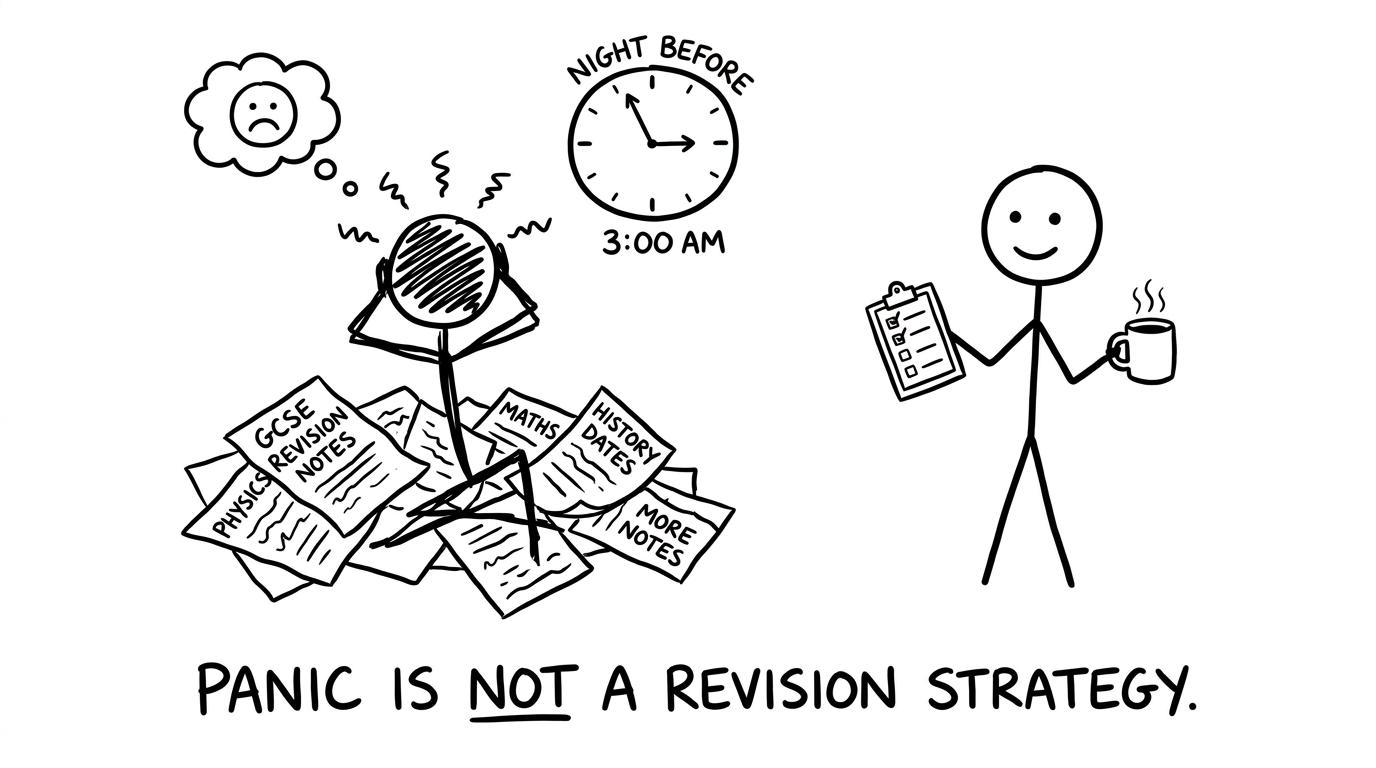 Panic is not a revision strategy
The calm checklist (what tonight is for)
Tonight isn’t for learning an entire specification. Tonight is for four things that move your GCSE mark quickly:
- Lock in the core equations and units you’re most likely to need.
- Practise the method on a small number of high-value calculation types.
- Train exam behaviour: showing working, rearranging formulae, rounding properly.
- Protect sleep so your brain can retrieve what you already know.
A quiet truth of GCSE exams: most lost marks aren’t from not knowing anything. They’re from rushing, skipping steps, or mixing up units.
The night-before timetable (2.5 hours that actually works)
Aim for about 150150150 minutes total, split into simple blocks. If you have less time, shorten each block but keep the order.
Set up (10 minutes)
- Put your calculator, pens, ruler, and required equipment in one place.
- Decide your stop time (ideally at least 60-90 minutes before sleep).
- Open a single page for maths support: GCSE Past papers so you can do quick, timed accuracy work without hunting.
Block 1: Equations and units that actually appear (30 minutes)
Physics equations are often easy; the hard bit is using them under pressure. Spend this block on:
- Writing the equation you need.
- Rearranging it correctly.
- Converting units consistently.
Use a short list of formulas you keep seeing (across AQA, Edexcel, OCR, Eduqas). For example:
- v=stv = \frac{s}{t}v=ts
- ρ=mV\rho = \frac{m}{V}ρ=Vm
- P=IVP = IVP=IV
- E=PtE = PtE=Pt
- F=maF = maF=ma
If rearranging is where you wobble, do it deliberately and slowly.
Example: rearranging P=IVP = IVP=IV
Find III:
P=IV⇒I=PVP = IV \Rightarrow I = \frac{P}{V}P=IV⇒I=VPFind VVV:
P=IV⇒V=PIP = IV \Rightarrow V = \frac{P}{I}P=IV⇒V=IPThat looks trivial now. Under GCSE time pressure it’s the difference between full marks and a blank line.
Block 2: Three high-frequency calculation types (60 minutes)
Pick three types and do a few examples of each. Don’t do twenty topics badly. Do three topics cleanly.
If you’re a maths student, you’ll recognise the pattern: questions reward method, not vibes. Use the habit you built on YesGenie topic practice and apply it here.
Speed, distance, time (and unit traps)
Worked example A car travels 3.6 km3.6\text{ km}3.6 km in 240 s240\text{ s}240 s. Find the speed in m/s\text{m/s}m/s.
Convert distance: 3.6 km=3600 m3.6\text{ km} = 3600\text{ m}3.6 km=3600 m.
v=st=3600240=15 m/s v = \frac{s}{t} = \frac{3600}{240} = 15\text{ m/s}v=ts=2403600=15 m/sThis is classic GCSE marks: conversion + substitution + correct unit.
Density (and volume conversions)
Worked example A metal block has mass 540 g540\text{ g}540 g and volume 200 cm3200\text{ cm}^3200 cm3. Find density in g/cm3\text{g/cm}^3g/cm3.
ρ=mV=540200=2.7 g/cm3\rho = \frac{m}{V} = \frac{540}{200} = 2.7\text{ g/cm}^3ρ=Vm=200540=2.7 g/cm3If the question asks for kg/m3\text{kg/m}^3kg/m3, that’s a separate step, and it’s where GCSE students often haemorrhage marks.
Electricity: power and energy
Worked example A device runs at 12 V12\text{ V}12 V and draws 0.8 A0.8\text{ A}0.8 A. It runs for 5 minutes5\text{ minutes}5 minutes. Find the energy transferred.
First power:
P=IV=0.8×12=9.6 WP = IV = 0.8 \times 12 = 9.6\text{ W}P=IV=0.8×12=9.6 WConvert time: 5 minutes=300 s5\text{ minutes} = 300\text{ s}5 minutes=300 s.
Energy:
E=Pt=9.6×300=2880 JE = Pt = 9.6 \times 300 = 2880\text{ J}E=Pt=9.6×300=2880 JWhat examiners like: units, conversions, and steps shown. What they don’t like: jumping straight to a final number with no trail.
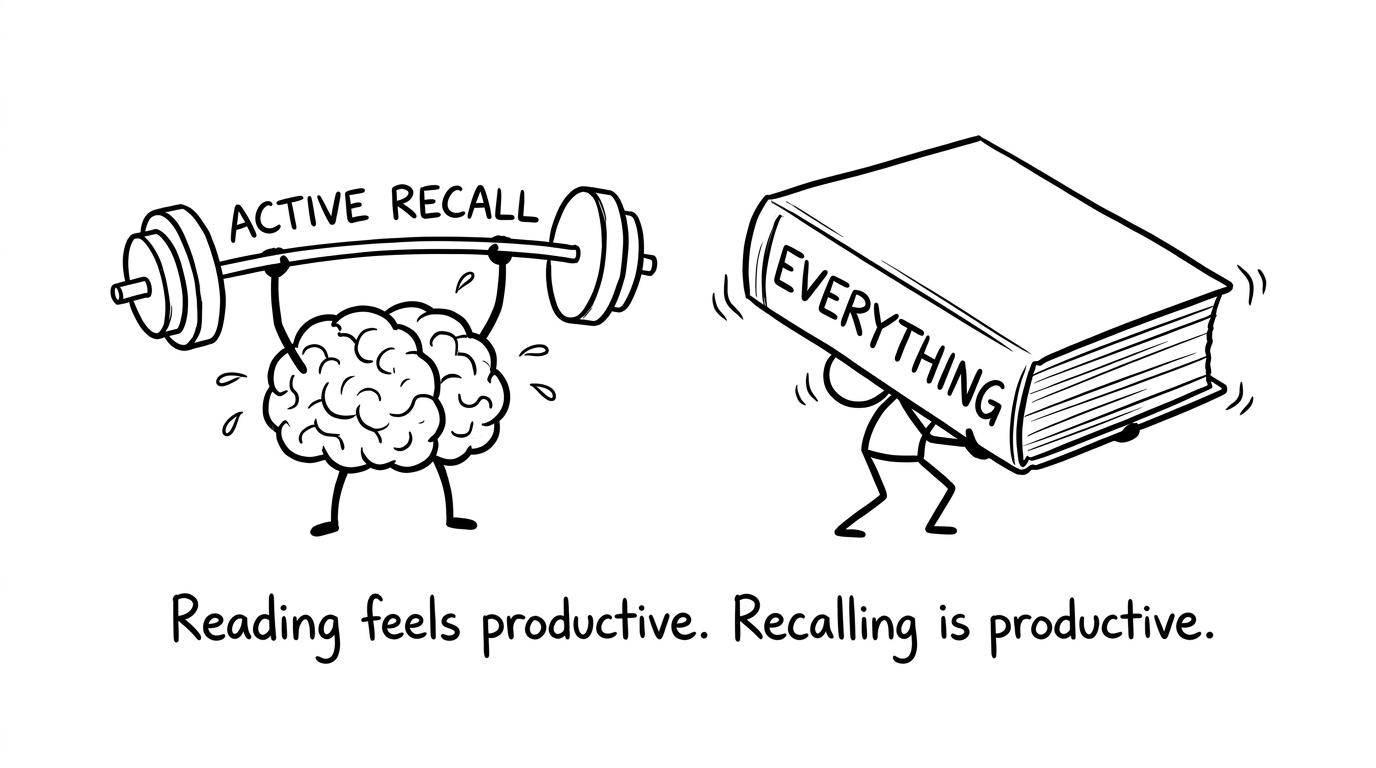 Reading feels productive. Recalling is productive.
Block 3: Timed accuracy (30 minutes)
Panic shrinks your working memory. The antidote is doing a small amount of timed work to make tomorrow feel familiar.
On YesGenie, use one of these formats to build calm exam rhythm:
- Edexcel GCSE Maths Mini Tests for short, focused timing practice.
- GCSE Past papers if you prefer full-paper pacing.
- Resources if you want a quick menu of predicted papers, mini tests, and more.
Even though this is a GCSE Physics night-before plan, the point is the skill: stay accurate while the clock is running.
Block 4: Mark-scheme thinking (20 minutes)
This is the most underrated night-before move: look at how marks are awarded.
- Did you write the equation?
- Did you substitute with correct units?
- Did you show a rearrangement step?
- Did you round at the end?
YesGenie’s video solutions are a perfect reminder of what “exam-ready working” looks like. Try one paper walkthrough like: November 2020 Paper 2 - Video Solutions. You’re not learning new content here; you’re copying a reliable standard.
Stop, reset, sleep (at least 30 minutes before bed)
Write a tiny plan for the morning on paper (not your phone): breakfast, travel time, and the three formulae you want to remember. Then stop.
The boring choice is the strong choice.
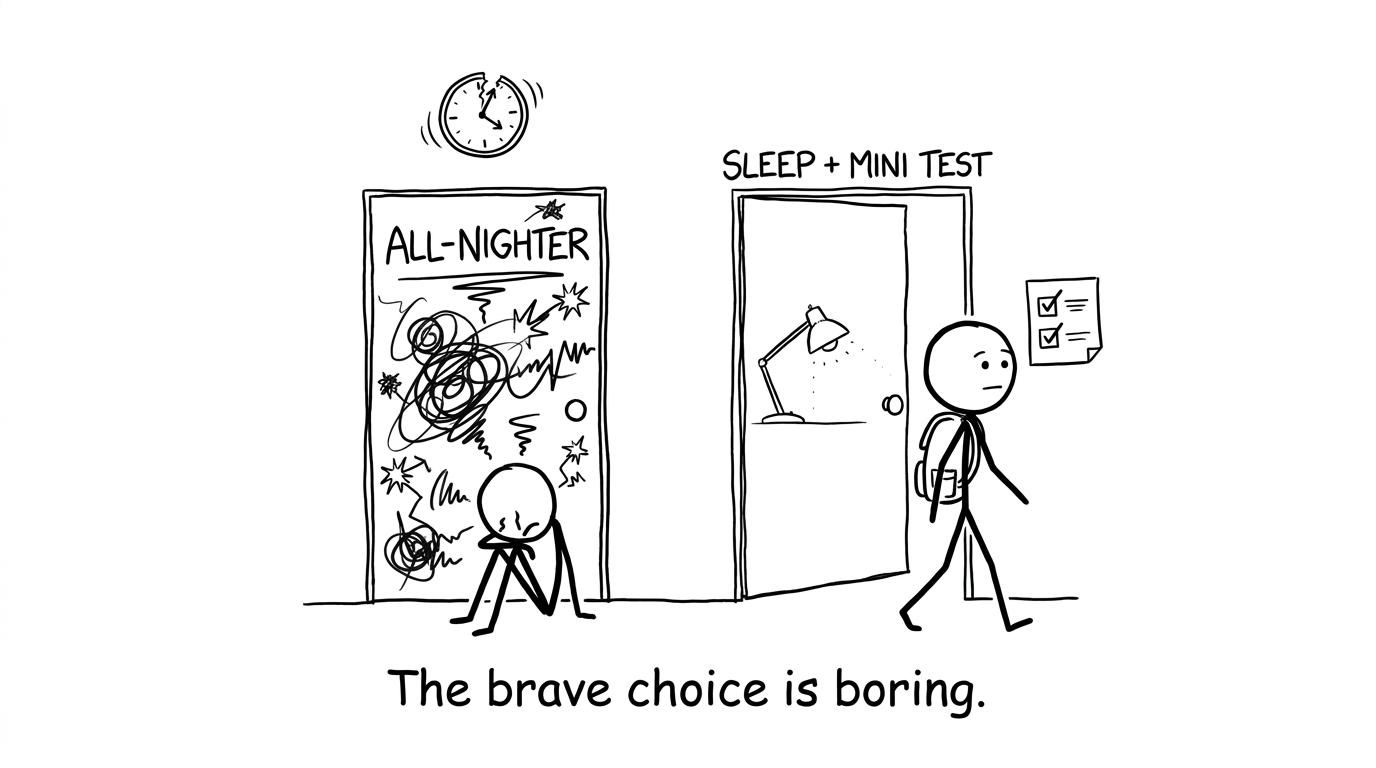 The brave choice is boring.
The maths habits that rescue GCSE Physics marks
GCSE Physics calculations often feel harder than they are because they mix three things at once: algebra, numbers, and units. If you treat it like a maths problem first, your confidence rises fast.
Write the structure before the numbers
A reliable template:
- Equation
- Rearrange (if needed)
- Substitute
- Calculate
- Unit
This is exactly the same discipline that gets marks in GCSE maths.
Rearranging without fear: one clean method
If you struggle to rearrange, use the “undo” mindset.
Example: E=PtE = PtE=Pt. Solve for ttt.
You’re multiplying by ttt, so undo it by dividing by PPP:
E=Pt⇒t=EPE = Pt \Rightarrow t = \frac{E}{P}E=Pt⇒t=PEMake this your default. It keeps you calm, which keeps you accurate.
Rounding: don’t sabotage yourself
A classic GCSE mistake is rounding too early.
If your calculator gives 288012=240\frac{2880}{12} = 240122880=240, great. But if you get a long decimal, keep it until the end, then round to the required significant figures.
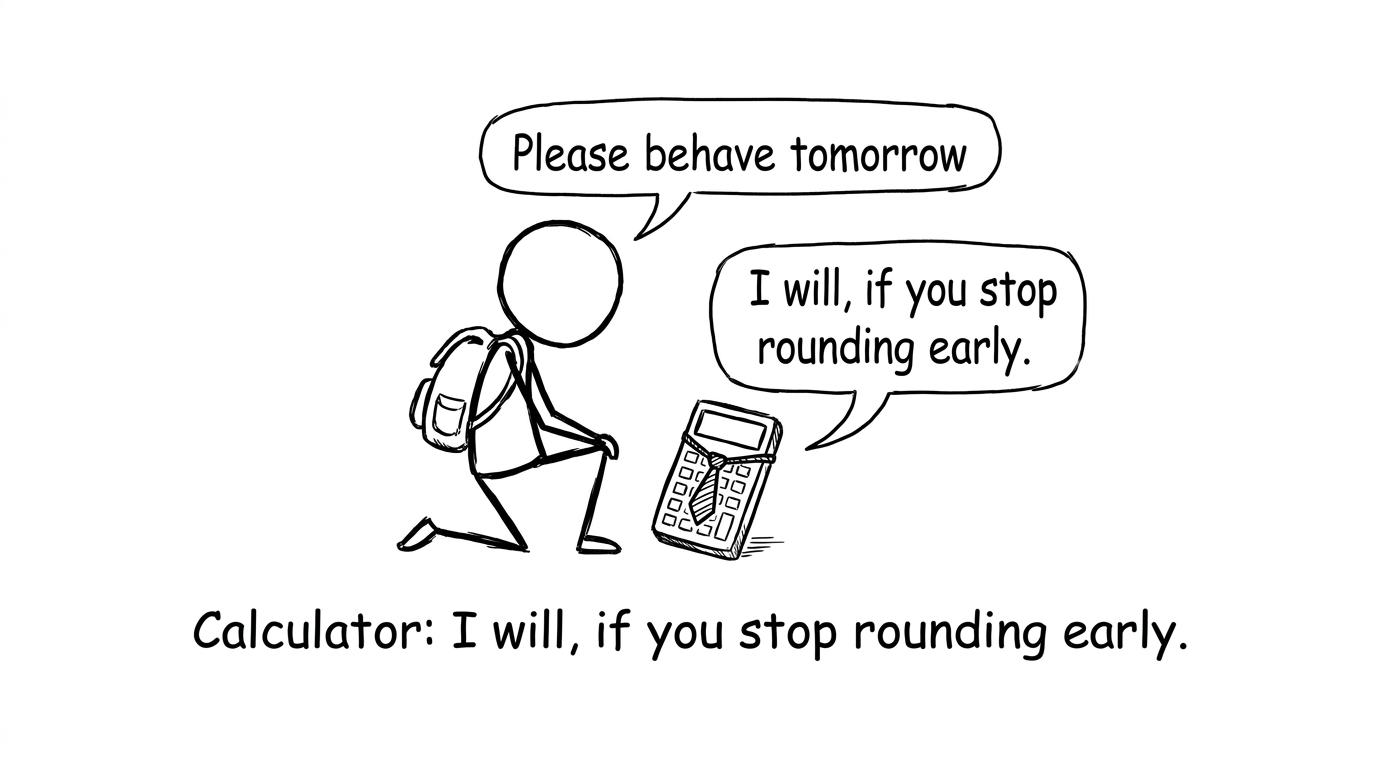 Calculator: I will, if you stop rounding early.
Common mistakes (and how to dodge them tomorrow)
These are the marks that vanish quietly in GCSE Physics:
- Forgetting unit conversions (minutes to seconds, km to m, g to kg, cm3\text{cm}^3cm3 to m3\text{m}^3m3).
- Rearranging incorrectly (especially when the unknown is in the denominator).
- Writing the wrong unit even with the right number (a painful way to lose an easy mark).
- Rounding mid-calculation and drifting away from the correct answer.
- Not showing the equation so you lose method marks when your arithmetic slips.
- Answering a “describe” question like it’s a calculation (or vice versa) because you’re rushing.
A night-before plan for GCSE success is really a plan to remove avoidable errors.
A final night-before reminder (GCSE calm is a strategy)
A good GCSE night-before plan isn’t about cramming harder. It’s about removing chaos. You write the key equations, you practise a few calculation types properly, you do a short timed block, and you stop in time to sleep.
And if you want a revision home base that makes the whole process simpler, keep YesGenie open: revision lessons when you’re unsure, practice questions when you need repetition, video solutions when you need a model answer, and past papers and predicted papers when you need exam rhythm. That combination is how GCSE confidence is built: quietly, deliberately, one method at a time.