GCSE Night-Before Plan for Chemistry (No Panic)
GCSE night-before plan for Chemistry that avoids panic: a calm timetable, key equations, quick maths methods, and how YesGenie supports your revision.
The night before a GCSE Chemistry exam often feels like standing in a kitchen while every cupboard flies open at once. Flashcards. Equations. Required practicals. “What if they ask me the one thing I didn’t revise?”
The truth is that the night before a GCSE exam isn’t for learning new content. It’s for reducing uncertainty. And if you’re also a GCSE maths or A Level student, you’ve got a quiet advantage: Chemistry rewards the same habits maths does: clear steps, units, proportional reasoning, and calm checking.
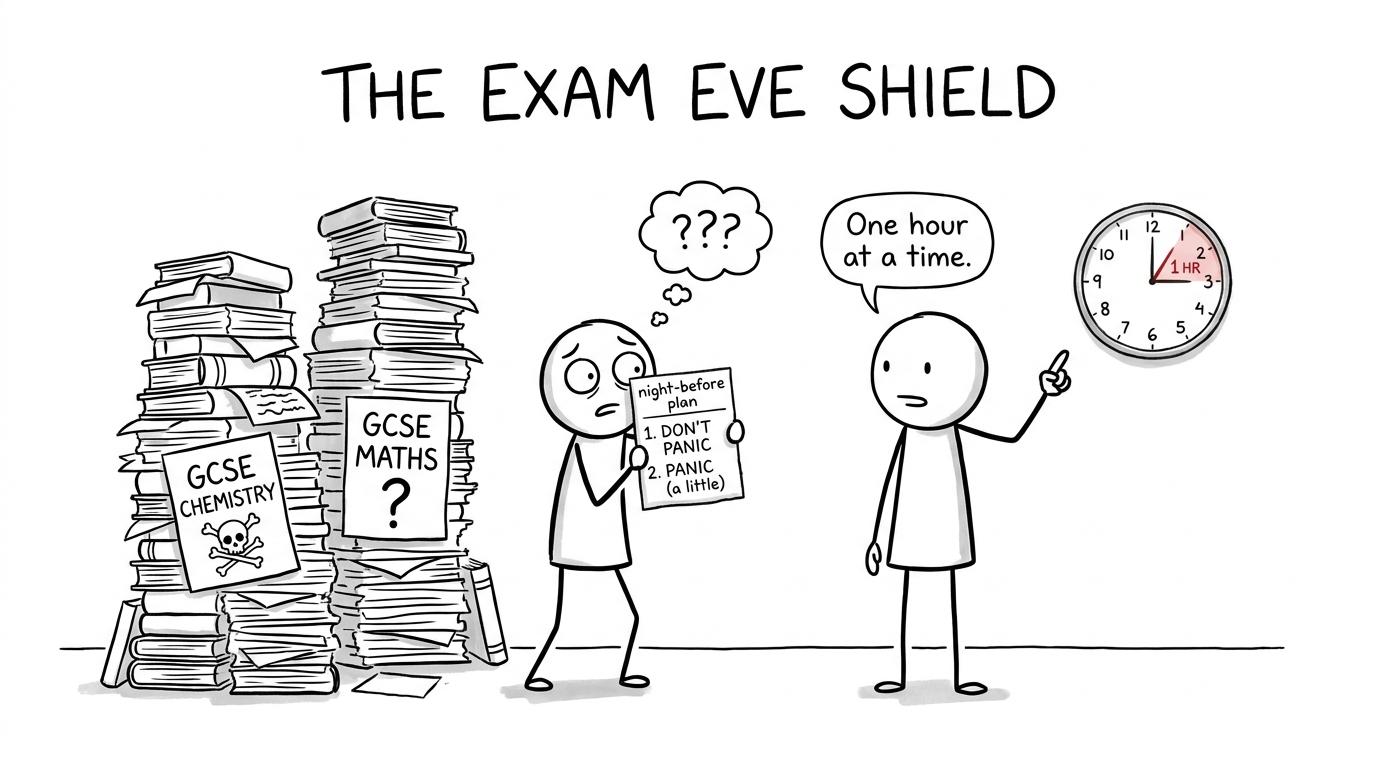 A student holding a night-before plan like a shield
The night-before checklist (save this)
Keep this GCSE night-before plan simple. Your job is to arrive tomorrow with a steady head, not a heroic all-nighter.
- Pick your exam board focus (AQA, Edexcel, OCR, Eduqas) and identify the big-ticket topics.
- Do one short timed set (not a full paper) to wake up exam technique.
- Rehearse the equations and units you’re most likely to use.
- Practise three high-frequency calculation types (worked below).
- Fix two weak spots only (maximum).
- Pack your kit and protect your sleep.
While you do the Chemistry plan, keep your maths ticking over with short, confidence-building practice on YesGenie: GCSE Past papers, Resources, and your board hub like Edexcel GCSE Maths Revision.
Why the night-before plan works for GCSE Chemistry
Panic comes from trying to hold the whole course in your head at once. A good GCSE night-before plan shrinks the problem.
Chemistry marks aren’t awarded for “knowing” in a fuzzy way. They’re awarded for doing specific things: selecting an equation, substituting correctly, showing steps, giving units, and using key terms. That’s comforting, because it means you can earn marks even when your memory feels wobbly.
A maths student recognises this immediately: you don’t “feel” the answer to simultaneous equations you follow a method. Chemistry is the same.
Build a two-hour GCSE Chemistry session (that doesn’t spiral)
Here’s a structure that fits almost anyone, foundation or higher tier, across AQA/Edexcel/OCR/Eduqas.
First 10 minutes: decide what “done” looks like
Write one sentence:
- “Tonight I will secure calculations and required practicals, then sleep.”
That sentence matters. It stops you from opening a new topic at 11:45 pm because anxiety demanded it.
Next 35 minutes: equations, units, and definitions (fast recall)
Chemistry loves a small set of tools. Rehearse them like you rehearse times tables.
Make a one-page “must know” list, including:
- mass=moles×Mr\text{mass} = \text{moles} \times \text{Mr}mass=moles×Mr
- moles=massMr\text{moles} = \frac{\text{mass}}{\text{Mr}}moles=Mrmass
- concentration=molesvolume\text{concentration} = \frac{\text{moles}}{\text{volume}}concentration=volumemoles (usually mol dm−3\text{mol dm}^{-3}mol dm−3)
- percentage yield=actual yieldtheoretical yield×100\text{percentage yield} = \frac{\text{actual yield}}{\text{theoretical yield}} \times 100percentage yield=theoretical yieldactual yield×100
- atom economy=Mr of desired productsMr of all products×100\text{atom economy} = \frac{\text{Mr of desired products}}{\text{Mr of all products}} \times 100atom economy=Mr of all productsMr of desired products×100
Then do one small thing that feels almost too easy: check your calculator habits. Chemistry errors are often arithmetic errors in disguise.
If you want to sharpen those calculator habits quickly, YesGenie’s short, timed format is perfect the night before: Edexcel GCSE Maths Mini Tests or the calmer middle ground of Edexcel GCSE Maths 45 Min Tests.
Next 45 minutes: one targeted timed set
Do a short burst, not a marathon. You’re training judgement.
- Pick 10-15 calculation and data questions (moles, concentration, gas volumes, rates, graphs).
- Time yourself strictly.
- Mark it honestly.
For maths exam technique (because many of the same habits carry over), use board-specific practice: Edexcel GCSE Maths Past Papers or Edexcel GCSE Maths Predicted Papers. The point isn’t “more content”. It’s practising calm under a clock: a core GCSE skill.
Final 30 minutes: fix two things only
Choose two issues from your marking.
- One content issue (e.g. confusing ionic vs covalent, or what a catalyst does).
- One technique issue (e.g. missing units, rounding, significant figures).
Then stop. Stopping is part of the plan.
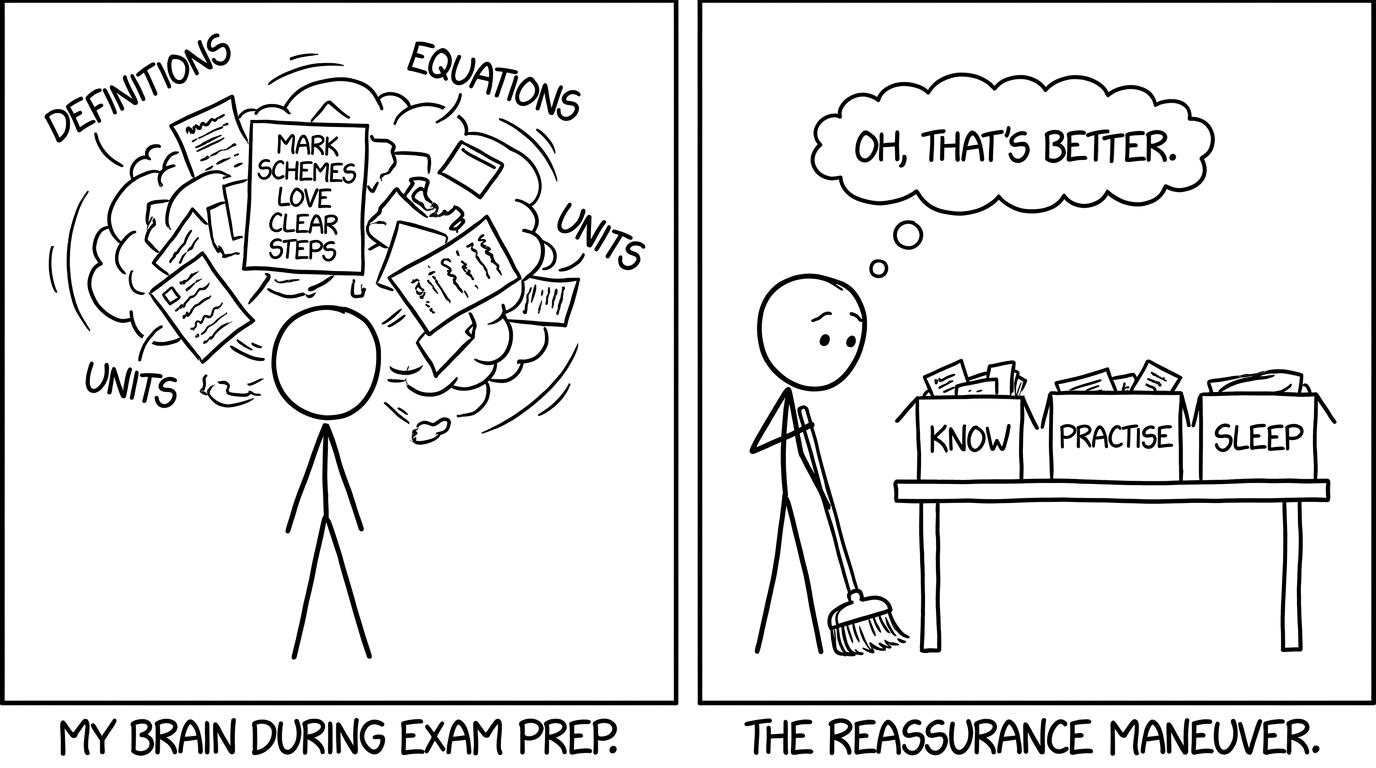 A messy brain desk tidied into Know, Practise, Sleep
Three GCSE Chemistry calculations (with maths methods you already know)
These are common across AQA, Edexcel, OCR and Eduqas. The chemistry content is important, but tonight we’re focusing on method because method earns marks.
Moles from mass (and back again)
Example: You have 10 g10\text{ g}10 g of calcium carbonate, CaCO3\text{CaCO}_3CaCO3. Calculate the number of moles.
- Find Mr\text{Mr}Mr:
- Use moles=massMr\text{moles}=\frac{\text{mass}}{\text{Mr}}moles=Mrmass:
So there are 0.1 mol0.1\text{ mol}0.1 mol.
Maths habit to steal: write the equation first, then substitute. This is exactly the discipline you use in algebra.
Concentration (unit control matters)
Example: 0.2 mol0.2\text{ mol}0.2 mol of sodium chloride is dissolved to make 500 cm3500\text{ cm}^3500 cm3 of solution. Find the concentration in mol dm−3\text{mol dm}^{-3}mol dm−3.
- Convert volume: 1000 cm3=1 dm31000\text{ cm}^3 = 1\text{ dm}^31000 cm3=1 dm3.
- Use concentration=molesvolume\text{concentration}=\frac{\text{moles}}{\text{volume}}concentration=volumemoles:
So the concentration is 0.4 mol dm−30.4\text{ mol dm}^{-3}0.4 mol dm−3.
Maths habit to steal: treat unit conversion as a ratio problem. If you can handle scale factors in GCSE maths, you can handle this.
Percentage yield (a fractions question wearing a lab coat)
Example: The theoretical yield is 8 g8\text{ g}8 g but you actually collect 6.4 g6.4\text{ g}6.4 g. Calculate the percentage yield.
percentage yield=6.48×100=0.8×100=80 \text{percentage yield}=\frac{6.4}{8}\times 100=0.8\times 100=80 percentage yield=86.4×100=0.8×100=80So the percentage yield is 80%80\%80%.
Maths habit to steal: simplify before multiplying. It reduces errors and makes your working clearer for the mark scheme.
 A calculator in a lab coat and a beaker doing maths
How to use a mark scheme mindset (even without the mark scheme)
A GCSE mark scheme is basically a checklist of “did you show the method?”. That’s why tidy working matters in Chemistry calculations.
Use this routine for every calculation question:
- Write the equation.
- Substitute with units.
- Show one clean line of arithmetic.
- Give the final answer with units.
- If it’s a practical or explanation question, use the key words the specification expects.
This mindset transfers directly to maths, where method marks are everything. If you want to reinforce that habit tonight, do one short set with video walkthroughs: for example, a single paper’s Video Solutions can be enough to remind you how clear steps feel.
Common mistakes students make the night before GCSE Chemistry
- Trying to relearn the whole course. Your brain interprets that as danger and speeds up. Stick to the plan and keep the scope small.
- Ignoring units. Many lost marks are really unit mistakes: cm3\text{cm}^3cm3 vs dm3\text{dm}^3dm3, g\text{g}g vs kg\text{kg}kg, or forgetting %\%%.
- Memorising without practising. Reading notes feels productive, but exam performance comes from retrieval and application.
- Doing a full paper too late. A 90-minute paper at 9 pm often ends with stress, not learning.
- Not reviewing errors. The value is in the correction, not the attempt.
- Sacrificing sleep for “one more topic”. An extra hour tired can cost more marks than an extra hour revised gains.
 Choosing 7 hours sleep over an all-nighter monster
A calm closing plan for GCSE exam day
Tonight, the win is not “knowing everything”. The win is walking into your GCSE Chemistry exam with a brain that’s steady enough to use what you already know.
So keep the plan small: equations, units, one timed set, two fixes, then sleep. If you want a final confidence boost in the skills Chemistry quietly depends on, use YesGenie to practise the maths that protects marks: Edexcel GCSE Maths Revision, GCSE Past papers, and Edexcel GCSE Maths Predicted Papers for exam-style rhythm. Then close the laptop, pack your pens, and let tomorrow be the day you collect the marks you’ve been building towards.