

GCSE Night-Before Plan That Avoids Panic
GCSE night-before plan to avoid panic: a calm, time-boxed routine, quick maths confidence boosts, and smart resources so you sleep and score well.
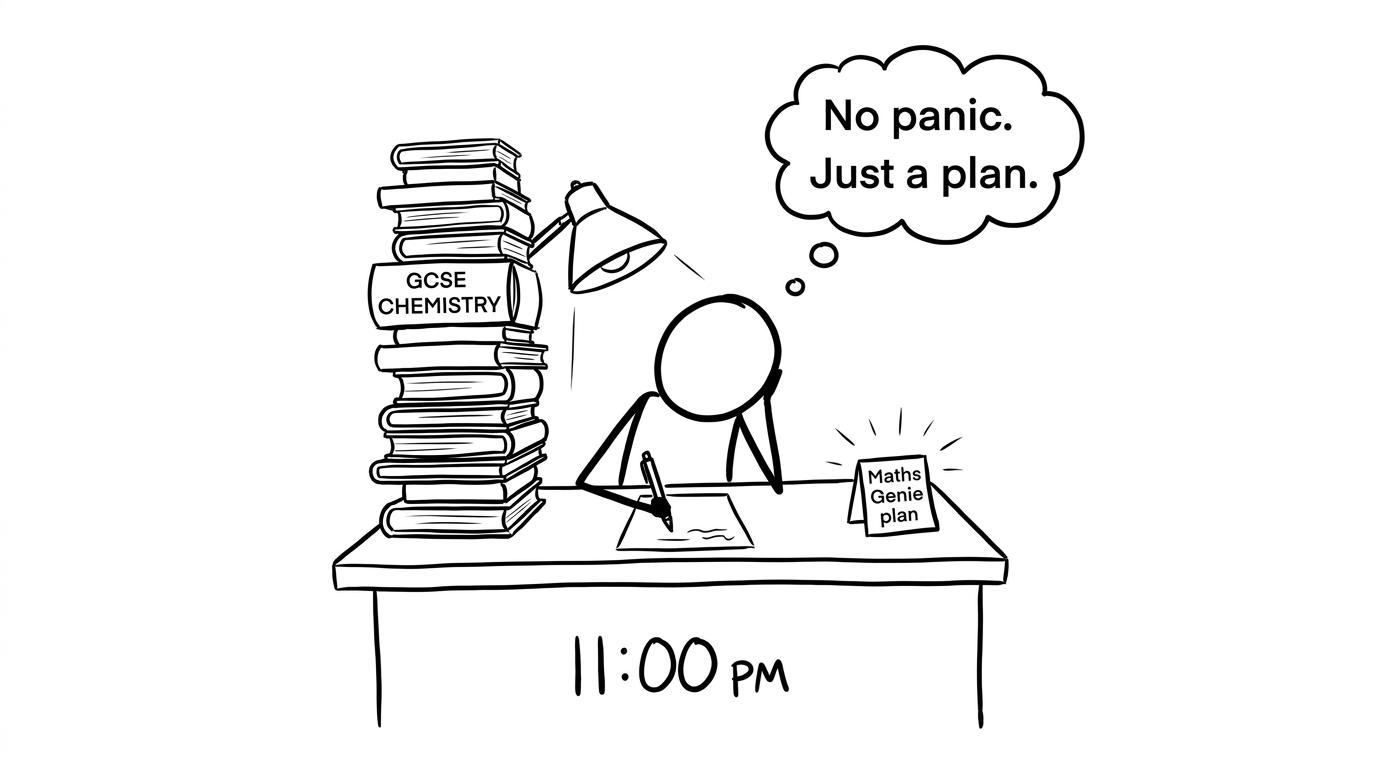 A calm night-before plan, not a panic spiral
There’s a particular kind of silence the night before an exam. Your desk is suddenly too small for your worries, and every page you didn’t revise starts shouting louder than the ones you did. If your exam is GCSE Chemistry tomorrow, it’s easy to mistake panic for productivity. But your brain isn’t a sponge tonight. it’s a spotlight. Your job is to aim it.
This is a night-before plan for GCSE Chemistry that avoids panic, protects sleep, and still moves your grade. And because you’re a UK GCSE or A Level maths student (the kind of student who knows that method matters), we’ll also use a few quick maths routines to stabilise your confidence. Not because tomorrow is a maths exam, but because maths is the fastest way to remind yourself: I can follow steps, I can earn marks, and I can stay calm.
The night-before checklist (print this in your head)
Keep it simple. Tonight is about control, not heroics.
- Pick three Chemistry topics you’re most likely to lose marks on.
- Do one short burst of recall for facts (not rereading).
- Do one set of exam-style questions with a mark scheme.
- Fix two repeated mistakes only.
- Pack your kit and plan your morning.
- Stop at a set time so you get sleep.
If you want structure for the short-question part of your night, use a timed resource like GCSE Maths Mini Tests (Edexcel) as your template for pace: short, focused, marked. The subject might differ, but the discipline is the same.
Why panic feels useful (and why it isn’t)
Panic gives you a false sense of motion. You flip pages, highlight headings, watch a video at 1.5×1.5\times1.5× speed, and feel like you’re “covering content”. The problem is that exams don’t reward coverage. Exams reward retrieval and application: the ability to pull the right idea out of your head under time pressure and use it in a methodical way.
In GCSE Chemistry, that means you need:
- a small set of high-frequency facts (tests, trends, definitions)
- a small set of high-frequency calculations (moles, concentrations, atom economy)
- the habit of writing clear steps
That last bullet is where maths students quietly have an advantage. If you can write a clean solution to a quadratic, you can write a clean solution to a moles question. Same mindset: define, substitute, calculate, check.
The two-hour night-before plan (calm, not crammed)
You can do this in 222 hours. If it’s already late, compress it to 606060 minutes by halving the times.
Set up (10 minutes)
- Clear desk. One drink. Phone on charge away from you.
- Write down the three Chemistry topics you’re most worried about.
- Decide your stop time (non-negotiable). A sensible target is to be in bed with lights out at least 888 hours before you must wake.
To keep yourself honest, use a timer and treat each block like a mini exam. You can practise this style of timing with any short assessment, for example the YesGenie Resources page (it’s a hub for mini tests, predicted papers, and other timed formats).
Block 1: Retrieval, not rereading (25 minutes)
Pick one topic and do “blank page recall”:
- Write the heading.
- Write everything you can remember for 555 minutes.
- Then check your notes for gaps.
For GCSE Chemistry, good targets are:
- required practicals (method + variables + hazards)
- bonding and structure (ionic vs covalent vs metallic)
- chemical tests (ions, gases)
Aim for clarity. You’re building cues for tomorrow.
Block 2: One calculation topic, fully worked (30 minutes)
Choose one calculation area and do a small set of questions with full working. If you only do one “proper” thing tonight, do this.
Here are three GCSE Chemistry calculations where students often drop marks, with worked examples using the same step-by-step style you use in maths.
Worked example: Moles from mass
Question: Calculate the amount of substance (in moles) in 9.8 g9.8\text{ g}9.8 g of sulfuric acid, H2SO4\text{H}_2\text{SO}_4H2SO4.
- Find relative formula mass:
- Use n=mMrn=\frac{m}{M_r}n=Mrm:
Mark-winning habit: write the formula and substitute before you calculate.
Worked example: Concentration (g/dm3^33)
Question: 2.5 g2.5\text{ g}2.5 g of sodium chloride is dissolved to make 250 cm3250\text{ cm}^3250 cm3 of solution. Find the concentration in g/dm3\text{g/dm}^3g/dm3.
-
Convert volume: 250 cm3=0.25 dm3250\text{ cm}^3=0.25\text{ dm}^3250 cm3=0.25 dm3.
-
Use c=mVc=\frac{m}{V}c=Vm:
Check: dividing by 0.250.250.25 should make the answer bigger. It does.
Worked example: Atom economy
Question: In the reaction
CaCO3→CaO+CO2 \text{CaCO}_3\rightarrow \text{CaO}+\text{CO}_2 CaCO3→CaO+CO2calculate the atom economy for producing CaO\text{CaO}CaO.
- Find MrM_rMr values:
- Atom economy:
Mark-winning habit: show the fraction before multiplying by 100100100.
If you want to rebuild calculation fluency quickly, borrow maths momentum: do 111 short paper from GCSE Past Papers after Chemistry. Not because it’s the same subject, but because it trains the exam muscle: timed work, checking, mark schemes.
Block 3: Exam-style questions with a mark scheme (35 minutes)
Choose one set of Chemistry questions (a mixed page, or a past-paper section) and do it properly:
- time it
- write full answers
- mark it honestly
In maths, you wouldn’t “half-answer” a question and hope the examiner fills in the rest. Chemistry is the same. Marks live in steps, units, and key terms.
After you mark:
- circle the two biggest mistakes
- write the correct method in your own words
- do one similar question if you have one
For maths-style marking practice, YesGenie’s exam resources are built around mark schemes and clear solutions. Explore the broader YesGenie Resources section to see formats like predicted papers and shorter timed tests that mimic real exam pressure.
Block 4: The confidence close (10 minutes)
This is not fluff. It’s strategy.
- Write a short “tomorrow plan”: wake time, breakfast, travel, what you’ll skim.
- Pack equipment.
- Put your Chemistry spec/notes away.
Then do a tiny maths win: 555 minutes of a familiar topic from a revision guide list like Edexcel GCSE Maths Revision Guides. Pick something you usually get right (percentages, rearranging, angles). You’re teaching your nervous system that you can still perform under a clock.
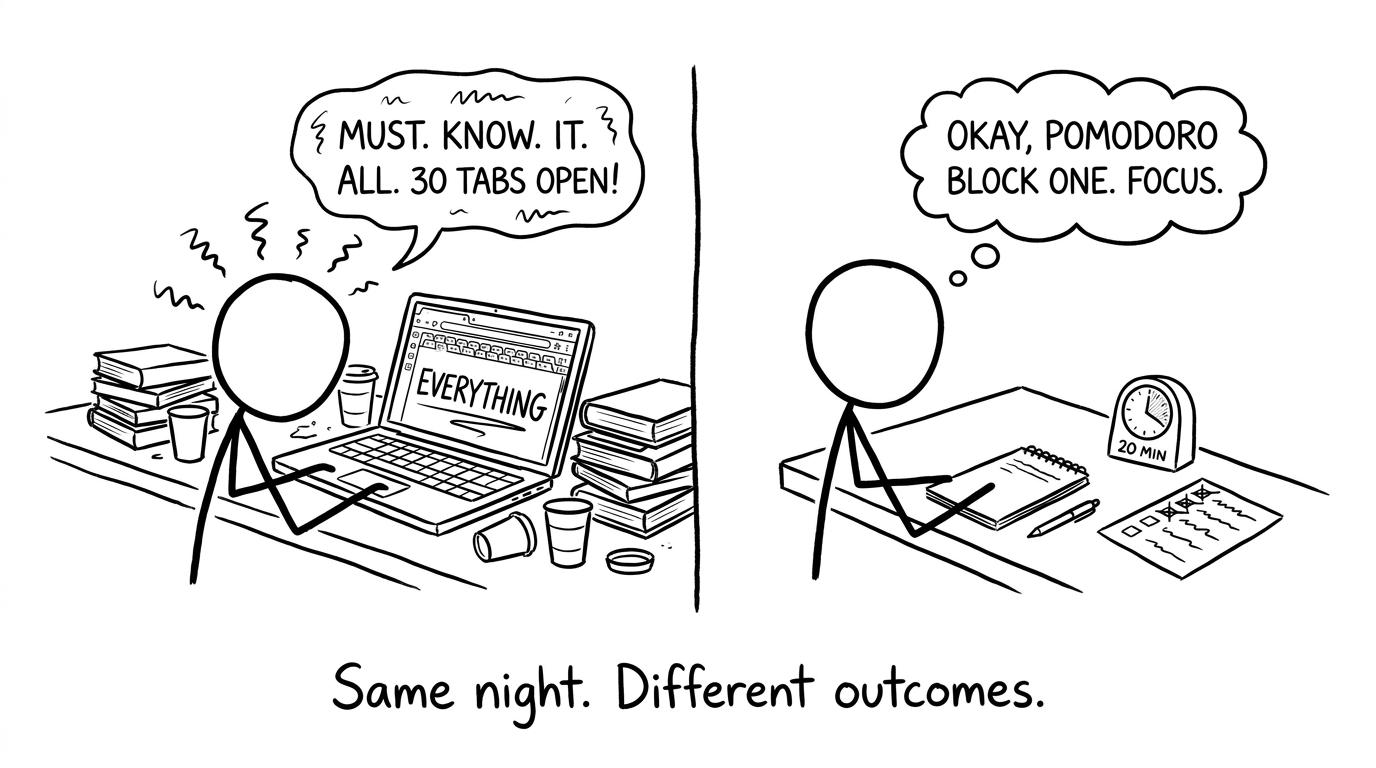 Two ways to spend the same night
A-level students: why this still matters
If you’re in Year 12 or 13, you already know the trap: you’re used to big topics and long problem sets, so you assume the night-before should be long too. But GCSE exams reward clean recall and high-frequency patterns. The best preparation the night before is to reduce noise.
Also, if you’re helping a younger sibling or tutoring someone, the plan above is a useful template. In fact, it’s the same philosophy that makes maths revision efficient: fewer resources, more marking, more corrections.
Common mistakes the night before GCSE Chemistry
Trying to relearn entire topics
You cannot rebuild a whole unit tonight. You can rescue marks by learning a handful of definitions, practising one calculation method, and tightening exam technique. Choose depth over breadth.
Confusing “familiar” with “known”
Reading notes feels comforting because it looks like progress. But the exam asks you to produce answers from memory. If you can’t write it without looking, you don’t know it yet.
Ignoring units and conversions
Many Chemistry calculations are lost to unit slips: cm3\text{cm}^3cm3 to dm3\text{dm}^3dm3, grams to kilograms, minutes to seconds. Treat conversions like a first step, not an afterthought.
Marking softly
If you only “sort of” check your answers, you carry the same mistakes into tomorrow. In maths, the mark scheme is a teacher. Use it like one.
Sacrificing sleep for anxiety
You don’t get extra marks for being awake at 2 am2\text{ am}2 am. Sleep improves recall and reduces careless errors. The goal is to arrive calm enough to read the question properly.
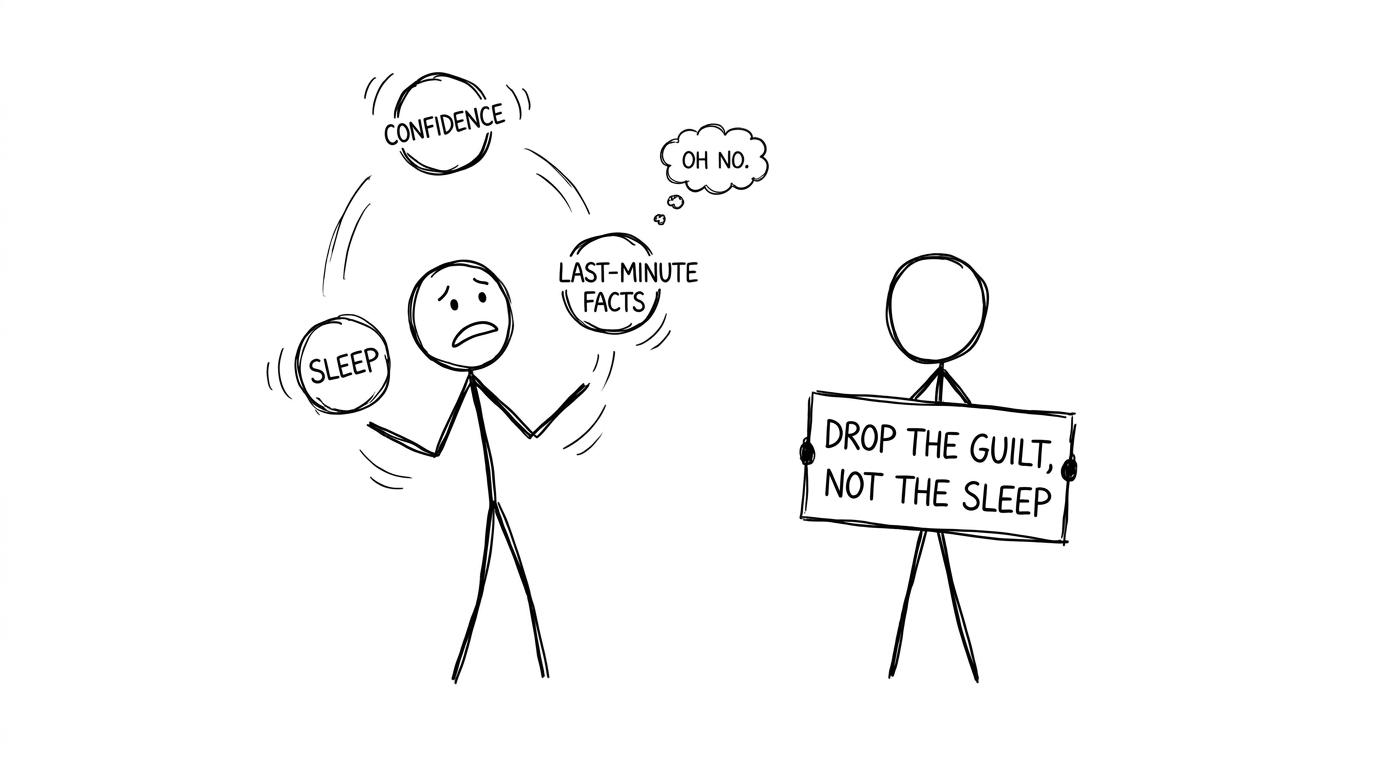 Juggling sleep, confidence, and last-minute facts
The calm ending: your GCSE night-before promise
Tomorrow’s GCSE Chemistry paper doesn’t require you to know everything. It requires you to stay present, read carefully, and collect marks in the places you do know. Tonight, your plan is to tighten methods, fix repeated mistakes, and go to sleep with a clear morning routine.
If you want your revision to feel less like guesswork and more like a system, use YesGenie as your structure. Build confidence with GCSE Past Papers, practise under time pressure using GCSE Maths Mini Tests (Edexcel), and steady your fundamentals with topic lists like Edexcel GCSE Maths Revision Guides. The night before a GCSE exam is not the time to do everything. It’s the time to do the right few things, mark them properly, and sleep like someone who has a plan.










