GCSE Mark Schemes: A CCEA Student’s Secret Weapon
GCSE mark schemes can transform CCEA revision. Learn how to read them, spot patterns, and turn feedback into higher marks, with YesGenie practice.
GCSE revision rarely fails because you “don’t know enough”. More often, it fails because you don’t know what the examiner is looking for. That’s why GCSE mark schemes are so powerful: they are the closest thing you’ll ever get to the examiner’s checklist. If you’re a CCEA student revising GCSE Biology, the mark scheme can feel like a cold judgement afterwards. But used before and during revision, it becomes a map. And if you’re also revising GCSE maths, you’ll notice something reassuring: across subjects, marks reward method, keywords, and clarity.
On YesGenie, GCSE maths students use mark schemes daily through past papers and worked solutions. The habit transfers beautifully to CCEA Biology: practise, check, refine, repeat. That loop is how grades move.
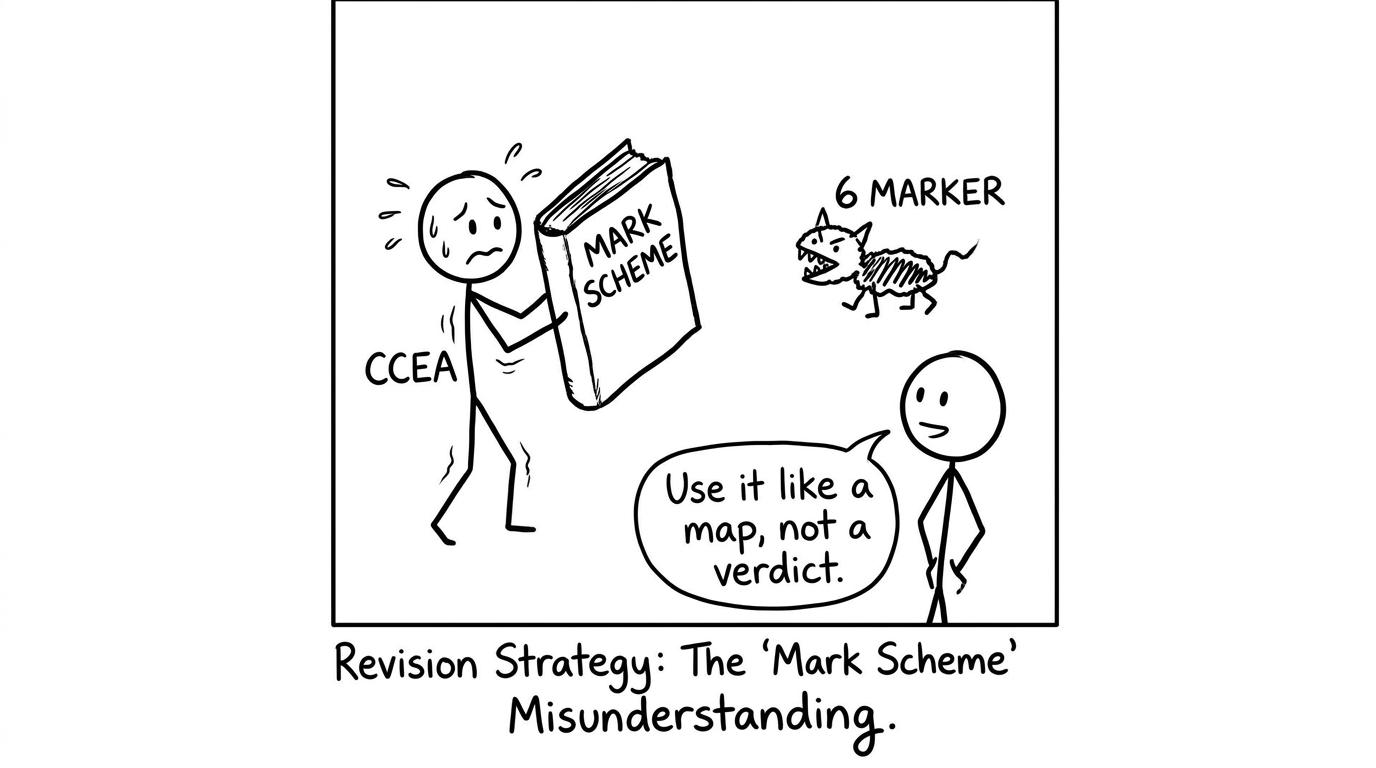 A CCEA student uses a mark scheme like a shield
A quick checklist for using GCSE mark schemes (CCEA Biology edition)
- Read the question like an examiner: underline command words (describe, explain, evaluate).
- Predict the marking points first: write 3-6 bullet points you expect to see.
- Mark with the scheme in two passes: first for content, second for precision (keywords, units, definitions).
- Turn the scheme into a rewrite: improve one answer immediately while it’s fresh.
- Create a “mark scheme phrase bank”: the recurring wording that keeps appearing.
- Practise the same skill in maths: method marks, follow-through, clear working.
If you want that “mark scheme loop” for maths, start with GCSE Past papers and make it a daily ritual.
What GCSE mark schemes are really telling you
A mark scheme isn’t a model answer. It’s a shopping list of marking points. In GCSE Biology (including CCEA-style questions), marks are often split between:
- Core science statements (facts and processes)
- Keywords (precise terms like “diffusion”, “osmosis”, “active transport”)
- Linking words (because, therefore, so that)
- Application (using the context in the question)
In maths, students discover early that you can lose marks for skipping steps. Biology has the same problem, just in sentences. A perfect idea written vaguely can score less than a decent idea written precisely.
To see how explicit mark schemes get in maths, open any YesGenie paper and click the mark scheme tab, for example: Example GCSE maths mark scheme view. The principle is identical in Biology: marks are designed to be awarded when you show the right points.
How CCEA Biology students should read a mark scheme
Start by identifying the “shape” of the question
CCEA GCSE Biology includes short recall questions and longer explanations. Before looking at the mark scheme, ask:
- Is this definition (1-2 marks)?
- Is this process explanation (3-6 marks)?
- Is this data/graph interpretation (often structured marks)?
Then look at the scheme and notice the pattern: longer questions typically want a chain.
A useful habit is to write your answer as a chain of cause and effect:
- Statement: what happens
- Reason: why it happens
- Consequence: what that leads to
This mirrors what high-mark maths working looks like: statement, reason, conclusion.
Use the “allowable” language, not just your own
Mark schemes often accept multiple phrasings. But they nearly always have non-negotiable keywords. Your job is to learn which words are flexible and which are fixed.
In maths, “method marks” reward process. For example, if you’re finding a mean, the method is:
mean=sum of valuesnumber of values \text{mean} = \frac{\text{sum of values}}{\text{number of values}} mean=number of valuessum of valuesIf you show the structure, you can earn marks even if arithmetic slips. Biology mark schemes work similarly: you can earn marks for the correct steps in an explanation even if one detail is off.
For maths method practice (and seeing what examiners reward), the Resources page is a strong starting point because it links you to mini tests, predicted papers, and more.
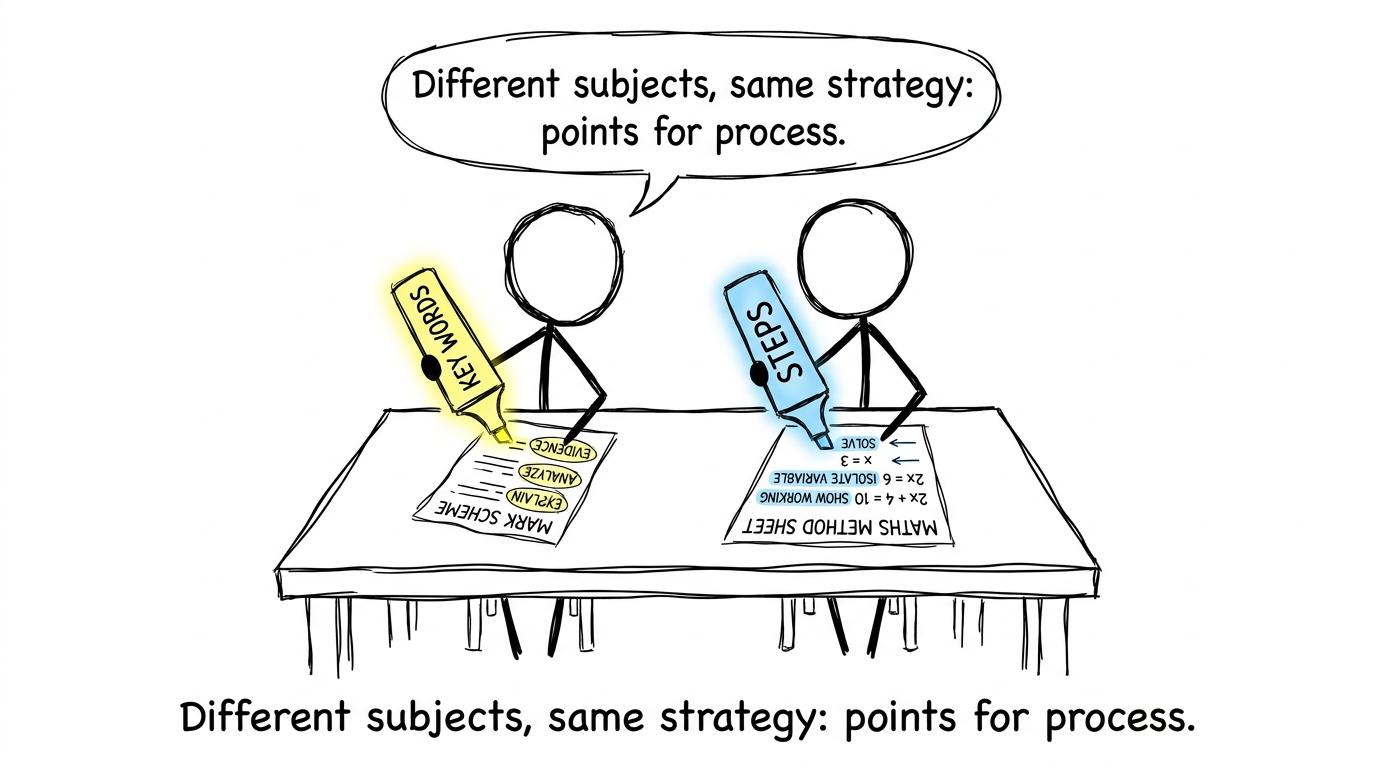 Two students highlight “key words” and “steps”
Turn a mark scheme into a repeatable revision method
The 3-pass method (works for GCSE Biology and GCSE maths)
Pass 1: Attempt without help. Write your best answer. No mark scheme. No notes.
Pass 2: Mark honestly with the scheme. Use a different colour. Award marks only when your point matches a marking point.
Pass 3: Upgrade immediately. Rewrite the answer aiming to hit every point. Then create a short “trigger list” you could recall next time.
This is exactly how you should use maths papers on YesGenie: attempt, mark, then re-attempt. Try it with a short paper format like Edexcel GCSE Maths Mini Tests (even if you’re not Edexcel, the skills transfer), because they’re small enough to repeat.
Build a “mark scheme notebook”
Split a page into two columns:
- Examiner wording (the phrase that appears)
- My version (how you would remember it)
In Biology you’ll see repeated patterns like “increase in surface area increases rate of diffusion”. In maths you’ll see repeated patterns like “factorise then solve”. The repetition is the point. Your notebook becomes a personal mark scheme translator.
For topic-by-topic maths repetition, the CCEA route on YesGenie is a great hub: CCEA GCSE Maths.
Worked examples: using mark schemes like an examiner (maths skill that boosts Biology too)
You’re revising maths on YesGenie, but the thinking style is what helps you in Biology: write what earns marks.
Worked example 1 (maths): method marks and follow-through
A student calculates 34\frac{3}{4}43 of 484848.
A mark scheme usually gives credit for a correct method such as:
34×48=3×12=36 \frac{3}{4} \times 48 = 3 \times 12 = 36 43×48=3×12=36Notice the structure: convert “fraction of” into multiplication, simplify, finish.
Biology transfer: in a 6-marker, you want the same visible structure: definition, steps, conclusion. You don’t just “know it”; you show it.
Worked example 2 (maths): clear communication wins easy marks
A typical “best buy” structure is:
unit cost=total costquantity \text{unit cost} = \frac{\text{total cost}}{\text{quantity}} unit cost=quantitytotal costSuppose option A costs £3.603.603.60 for 121212 items.
unit cost=3.6012=0.30 \text{unit cost} = \frac{3.60}{12} = 0.30 unit cost=123.60=0.30So it’s £0.300.300.30 per item.
Biology transfer: when a mark scheme wants “use data to support conclusion”, the skill is the same: quote the number, interpret it, then decide.
If you want a maths page that models this “explain as you go” style, see: Best Buy Questions (Revision Guide).
Worked example 3 (maths): proof teaches you how to write for marks
In GCSE maths proof questions, marks are awarded for logically connected statements. For example, if you show that the sum of two odd numbers is even, you might write:
Let the odd numbers be 2a+12a+12a+1 and 2b+12b+12b+1.
(2a+1)+(2b+1)=2a+2b+2=2(a+b+1)(2a+1) + (2b+1) = 2a + 2b + 2 = 2(a+b+1)(2a+1)+(2b+1)=2a+2b+2=2(a+b+1)Since 2(a+b+1)2(a+b+1)2(a+b+1) is divisible by 222, the sum is even.
Biology transfer: a strong explanation is also a chain that “locks” at the end. If your final sentence is just a repeat, you often miss the last marking point. Finish with the consequence.
For high-grade communication practice in maths, use: Proof (Grade 8-9).
Common mistakes when using GCSE mark schemes
- Only reading the mark scheme, never rewriting. Improvement happens in the rewrite, not the reading.
- Treating the scheme like a single perfect paragraph. It’s a list of points, sometimes in any order.
- Ignoring command words. “Describe” is not “explain”; CCEA examiners mark them differently.
- Missing the context. Many Biology marks are for applying science to the scenario given.
- Learning vague synonyms instead of the keyword. If the scheme wants “diffusion”, “moving around” rarely scores.
- In maths: skipping working. Even if your final answer is right, a mark scheme can award method marks you’re throwing away.
If your revision tends to drift, anchor it with ready-made structures: Edexcel GCSE Maths Revision Guides and the Resources hub make it easier to practise in short, repeatable sessions.
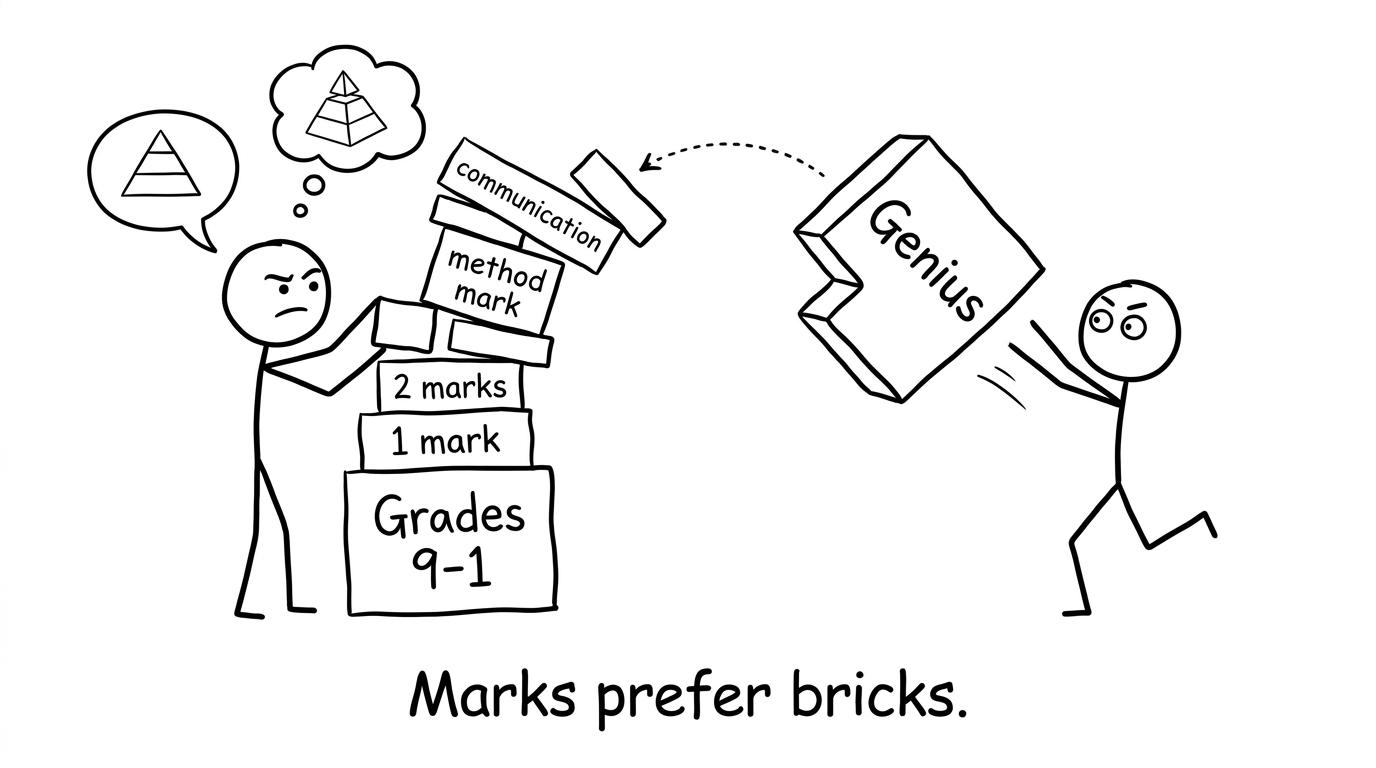 A tower built from small marks beats “genius”
Bringing it together: make GCSE mark schemes your daily feedback
If you’re a CCEA student revising GCSE Biology, using GCSE mark schemes isn’t about being harsh on yourself. It’s about getting accurate feedback while there’s still time to improve. The students who climb grades 9-1 aren’t always the ones who do the most revision; they’re the ones who close the loop fastest: attempt, mark, rewrite, repeat.
For your maths revision, you can build that loop for free on YesGenie using GCSE Past papers, the Resources hub, and focused practice like Edexcel GCSE Maths Mini Tests. Add in revision lessons, topic notes, and video solutions from the CCEA pathway at CCEA GCSE Maths, and you’ve got a system that makes mark schemes feel less like judgement and more like direction.
Use GCSE mark schemes the way they were meant to be used: as a map. Then practise until the map becomes familiar enough that the exam feels like walking a route you’ve already done.