

GCSE Grades A Star to 9: Old vs New
GCSE grades A star to 9 explained for students and parents, including equivalents, passes, maths boundaries, tiers and practical revision advice.
A GCSE report can feel unfamiliar when your own results were letters. What does a numerical grade mean, and how does it compare with an old A or A*?
GCSE grades A star to 9 are not an exact conversion. In England, numerical grading replaced the old letter scale, starting with English language, English literature and maths in 2017. Grade 999 is the highest, grade 111 is the lowest graded result, and U means ungraded. The clearest reference points are the bottoms of grade 777 and the old A, and grade 444 and the old C.
Old and new GCSE grades at a glance
These comparisons are approximate, particularly between the main alignment points.
| New GCSE grade | Approximate old grade comparison |
|---|---|
| 999 | Above the old A* threshold |
| 888 | Overlaps the old A and A* range |
| 777 | Bottom aligned with the old A threshold |
| 666 | Roughly a high B |
| 555 | Roughly a high C to low B |
| 444 | Bottom aligned with the old C threshold |
| 333 | Roughly between D and E |
| 222 | Roughly between E and F |
| 111 | Bottom aligned with the old G threshold |
| U | Ungraded |
The numerical scale gives greater differentiation among higher-attaining students. Grades 777, 888 and 999 cover achievement previously represented by A and A*. This explains why grade 999 is not simply another name for A*.
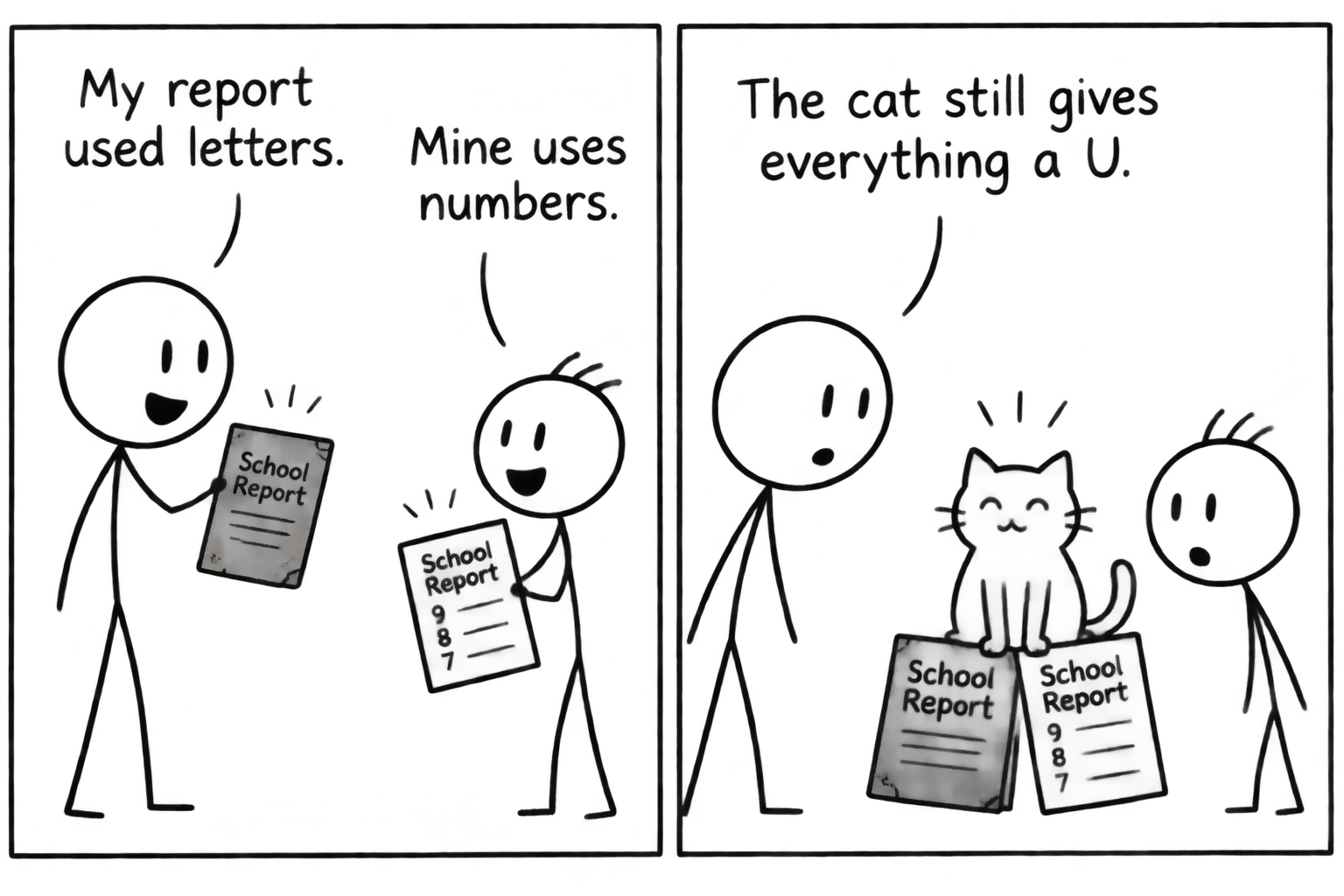 A parent and student discover that cats remain unimpressed by both letter and number GCSE grades
A quick checklist for GCSE maths results
When reading a result or setting a target, remember:
- Grade 444 is a standard pass.
- Grade 555 is a strong pass.
- Foundation and Higher tier offer different grade ranges.
- Boundaries vary between exam boards and exam series.
- Course entry requirements may be higher than a standard pass.
The GCSE Maths revision hub helps students find lessons, practice questions and past papers for their exam board.
What counts as a pass?
In England, grade 444 is described as a standard pass, while grade 555 is a strong pass. These labels do not determine every course entry requirement.
Sixth forms, colleges, apprenticeships and employers can set their own conditions. A course might require grade 555 or 666 in maths, even though grade 444 is a standard pass. Check the requirements for your intended destination, especially before choosing A Level subjects.
That makes revision more purposeful. A student securing a pass and a student preparing for A Level Maths may need different priorities. MathsGenie's revision planner can help turn a target into a manageable routine.
Foundation and Higher tier grades
Foundation GCSE maths offers grades 111 to 555. Higher tier targets grades 444 to 999, with a grade 333 available for candidates who narrowly miss grade 444, subject to awarding arrangements.
Students aiming above grade 555 need Higher tier. Students targeting grade 444 or 555 may take either tier, depending on their school's assessment of their understanding and likely performance.
Higher is not automatically the best choice. It includes more demanding content, while Foundation can provide a suitable route to a standard or strong pass. Discuss tier entry with your teacher using evidence from lessons and mocks.
For focused preparation, the Edexcel GCSE Maths revision page organises topics by grade. Treat these groupings as revision guidance: exam questions can combine several skills.
How GCSE maths grade boundaries work
A grade boundary is the minimum mark needed for a particular grade in an exam series. It is not a percentage guaranteed to stay the same every year.
Exam boards set boundaries after marking, taking account of evidence about paper difficulty and standards. Boundaries can therefore change between series. They also differ between Edexcel, AQA, OCR and other boards, whose papers and total marks may differ.
Use a past paper's matching boundaries when reviewing your performance. Check the board, tier and series carefully. A boundary from one year cannot guarantee the marks needed in a future exam.
Short GCSE maths mini tests can reveal recurring gaps before you attempt full timed papers. Mark the working as well as the final answers.
Turning a target grade into revision
A target helps most when it changes what you practise. After marking a paper, identify whether lost marks came from missing knowledge, an incorrect method, arithmetic errors or unfinished questions.
Choose a small number of recurring weaknesses. Revisiting fractions, decimals and percentages can support several other topics. Focused practice on Pythagoras can strengthen both method selection and calculator accuracy.
Watch the revision lesson, attempt questions independently, then check the mark scheme or video solution. Return to similar questions later to test whether the method has stayed with you. Students targeting the highest grades still benefit from this cycle: difficult questions often combine familiar skills.
Common mistakes when comparing grades
Treating every letter as one number
The scales have different numbers of grades. Use the main alignment points and treat other comparisons as approximate, rather than assigning every old letter an exact numerical replacement.
Assuming grade five replaced grade C
Grade 444 aligns with the bottom of the old C. Grade 555 is a strong pass, broadly covering achievement around the upper C and lower B range.
Comparing percentages across tiers
The same percentage on Foundation and Higher papers need not produce the same grade. The papers assess different ranges of attainment and have separate boundaries.
Trusting predicted boundaries
Predicted papers support exam practice; they cannot promise future questions or grade thresholds. Build secure methods rather than planning around an unconfirmed cut-off.
Focus on the next useful step
Understanding the scale makes a report easier to read. Improvement comes from what happens afterwards: choosing a gap, practising carefully and checking progress.
Start with MathsGenie's GCSE Maths resources, select your exam board and choose a topic that needs attention. Use revision lessons and practice questions first, then mini tests, past papers and mark schemes to see what is secure. Let your target guide the work, one corrected mistake at a time.















