

GCSE Food and Nutrition Predicted Grade Process
GCSE food and nutrition predicted grade process explained: learn how teachers use mocks, NEA, class evidence and exam standards to estimate your grade.

A predicted grade can feel strangely final. It appears on a report as one small number, yet it seems to carry the weight of every practical lesson, written test and mock exam you have completed.
The GCSE food and nutrition predicted grade process is less mysterious than it looks. Teachers normally estimate the grade you are most likely to achieve by reviewing evidence such as mock results, non-exam assessment, class tests and practical performance. They compare that evidence with the specification, mark schemes and suitable grade-boundary information, then apply their professional judgement and the school's assessment policy.
There is no single national formula that every school must use for routine predicted grades. Your prediction is also not your final GCSE result. It is an informed estimate based on the evidence available at that moment.
The predicted grade process at a glance
A teacher will usually consider:
- your performance in mock examinations and timed assessments
- marks from topic tests and other specification-based tasks
- completed or developing non-exam assessment, known as NEA
- practical food preparation skills and the evidence recorded for them
- your ability to apply, analyse and evaluate, not merely recall facts
- whether recent results represent a consistent standard
- relevant grade boundaries or exam-board exemplars
- departmental moderation and the school's reporting policy
The important phrase is range of evidence. One disappointing test may matter, but it should not automatically define the entire prediction.
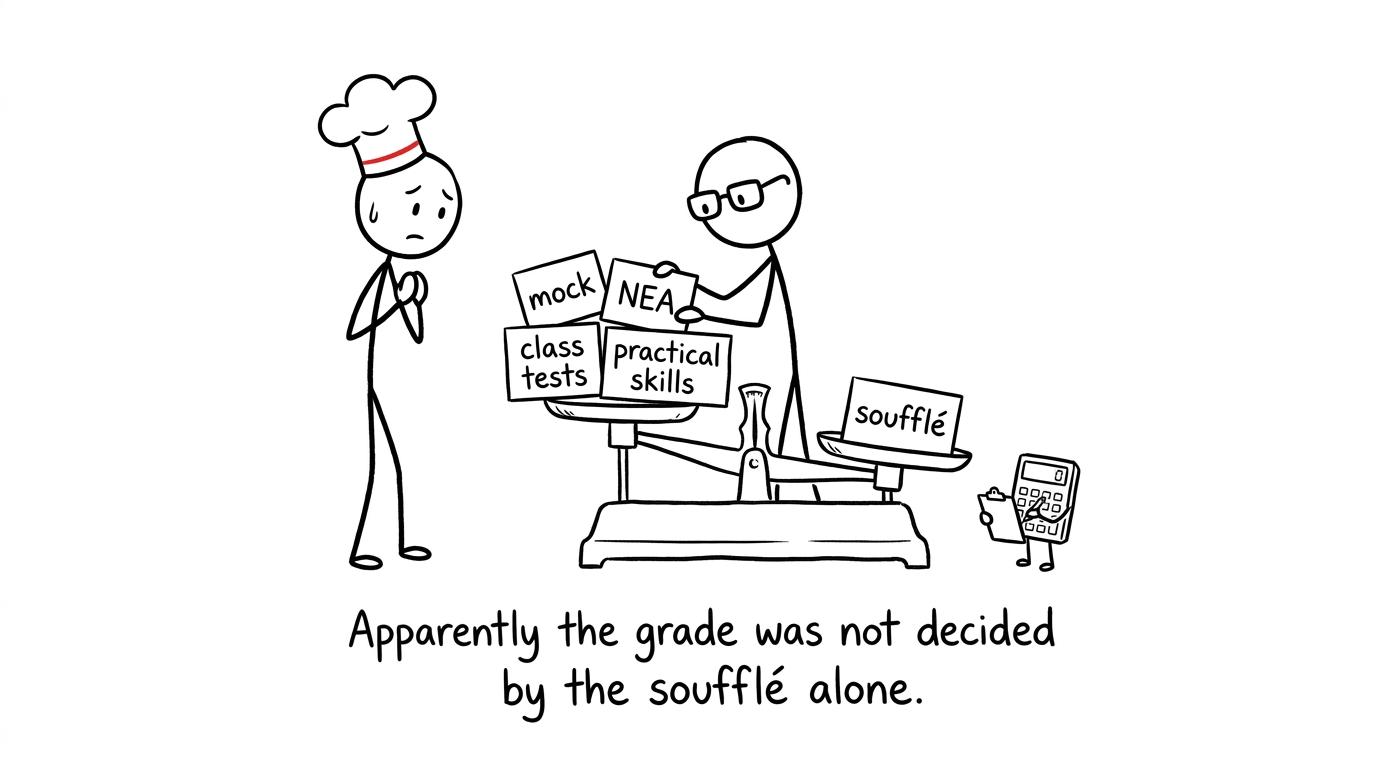 A teacher balances mock, NEA and practical evidence while deciding a predicted grade
What is actually assessed in GCSE Food Preparation and Nutrition?
The qualification's formal title is usually GCSE Food Preparation and Nutrition, although students and schools often shorten it to food and nutrition.
In England, current specifications are offered by AQA, OCR and Eduqas. Pearson Edexcel does not currently offer this reformed GCSE, so check the name and code printed on your school's assessment materials rather than assuming your board.
Ofqual requires the qualification to be divided equally between:
- a written examination worth 50%50\%50%
- non-exam assessment worth 50%50\%50%
The regulated assessment objectives are also consistent across the specifications:
- AO1: knowledge and understanding, worth 20%20\%20%
- AO2: application of knowledge and understanding, worth 30%30\%30%
- AO3: planning, preparing, cooking and presenting dishes, worth 30%30\%30%
- AO4: analysis and evaluation, worth 20%20\%20%
The precise paper length, raw marks and administration arrangements vary by board. For example, AQA's written paper is worth 100100100 raw marks and lasts 111 hour 454545 minutes, while OCR's written examination lasts 111 hour 303030 minutes. All three boards retain the overall 50%50\%50% examination and 50%50\%50% NEA split.
The NEA generally consists of a food investigation worth 15%15\%15% of the qualification and a food preparation assessment worth 35%35\%35%. It is internally assessed using exam-board criteria and externally moderated. That means the teacher marks the work, but the awarding organisation checks whether the centre has applied the standard appropriately.
The evidence teachers are likely to use
Mock examinations
Mocks often provide strong evidence because they can cover a broad part of the specification under timed, supervised conditions. A mock can reveal whether you can retrieve knowledge independently, interpret unfamiliar information and sustain your performance across a full paper.
However, a raw mark is not automatically a prediction. Teachers must consider the paper's difficulty, the content taught before the mock and the grade boundaries being used. A boundary from another series may provide a useful reference, but it is not a guaranteed boundary for your eventual examination.
If timed papers expose gaps in your own maths preparation, the GCSE Maths revision hub brings together board-specific lessons, questions and papers.
Non-exam assessment
NEA is particularly important because it contributes half of the actual qualification. Teachers may look at the marks already awarded, the sections completed and the standard demonstrated against the published criteria.
This evidence can include:
- investigation planning and research
- practical investigation evidence
- interpretation of findings
- technical food preparation skills
- menu planning and time management
- presentation of the final dishes
- nutritional, sensory and practical evaluation
Teachers should assess what the evidence demonstrates, not simply how attractive the finished food looks. A polished dish cannot replace weak planning, limited analysis or missing evaluation.
If the NEA is incomplete when predictions are required, the teacher may need to estimate its likely contribution from completed sections and comparable supervised work. How this is handled depends on the school's policy. Asking which sections have already been included is more useful than guessing.
Class tests and specification-based tasks
Topic assessments can show whether your knowledge is secure across nutrition, food science, food safety, provenance and preparation methods. They are especially useful when several tests reveal the same pattern.
Teachers may give more weight to controlled, recent and comprehensive assessments than to a short homework task. Work completed at home can still inform teaching, but supervised evidence is normally easier to authenticate as your independent performance.
Practical performance
Practical skill is relevant, but it is judged through the assessment criteria rather than general impressions. Teachers may record how independently and safely you select techniques, organise your work, control processes and respond when something does not go to plan.
Effort and improvement are valuable, but a predicted grade should principally represent likely attainment. Behaviour, personality and the grade somebody wants should not replace evidence of the required knowledge and skills.
How marks become an estimated grade
A department may first create an estimated overall mark from the available components. Where components carry different weightings, the general calculation is:
estimated overall percentage=∑(component percentage×component weighting)\text{estimated overall percentage} = \sum \left(\text{component percentage} \times \text{component weighting}\right)estimated overall percentage=∑(component percentage×component weighting)This is a model, not a universal school formula. Some departments use assessment databases, notional grade boundaries or professional judgement instead. They may also adjust the importance given to an assessment if it covered only a narrow part of the course.
A teacher then considers whether the numerical estimate reflects the student's broader evidence. Questions may include:
- Was the mock completed under realistic conditions?
- Does it cover enough of the specification?
- Is the NEA mark secure and internally standardised?
- Are recent results consistently stronger or weaker?
- Is one unusually high or low result distorting the picture?
- Has the same standard appeared across several assessment objectives?
This is why two students with the same mock mark might not necessarily receive the same prediction. One may have secure NEA evidence across all criteria; another may have substantial gaps or incomplete evidence. The judgement should still be explainable and grounded in assessed work.
Why moderation matters
Predicted grades are rarely meant to be an unchecked decision made by one person. Departments commonly compare marking, discuss borderline cases and review whether teachers have applied standards consistently.
For the actual NEA, internal standardisation is required, and exam boards externally moderate the centre's marking. Moderation can lead to adjustments if a centre's marking is found to be too generous or too severe.
Routine school predictions are different from final awarding. The final GCSE grade is produced from your assessed examination performance and moderated NEA marks using the exam board's official grade boundaries for that series. A school prediction does not instruct the exam board what grade to award.
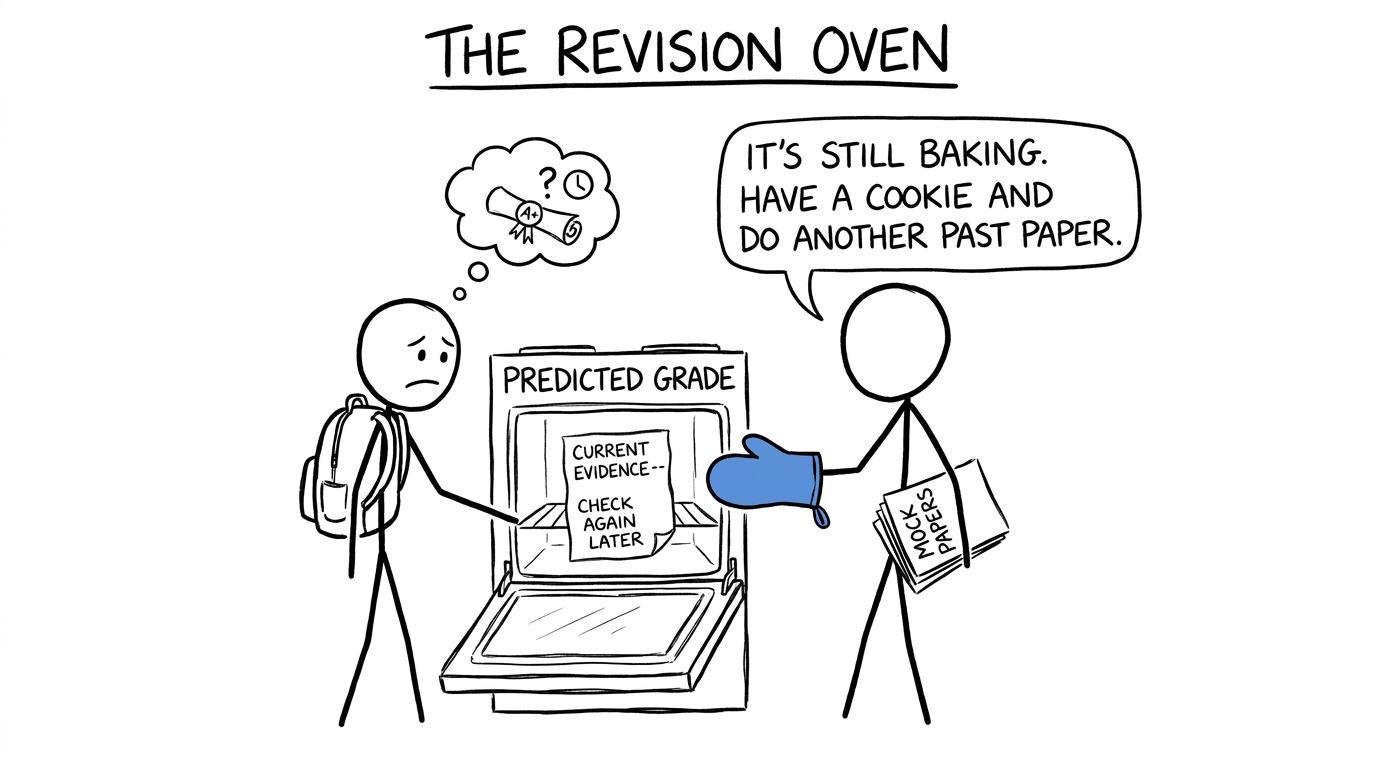 A predicted-grade oven contains a note explaining that the evidence may change
Predicted grade, target grade and final grade
These three terms are easy to confuse:
- A target grade is an aim or benchmark, sometimes informed by prior attainment.
- A predicted grade estimates the outcome you are currently likely to achieve.
- A final grade is awarded after the examination and NEA process is complete.
A prediction can change as new evidence appears. It is not a promise, a ceiling or an official early result. Nor is a higher target proof that a lower prediction is incorrect. They answer different questions: the target describes an aim; the prediction describes the outcome suggested by current evidence.
How to respond if your prediction is lower than expected
Begin with evidence rather than argument. Ask your teacher:
- Which assessments contributed most to the prediction?
- How much completed NEA evidence was available?
- Which assessment objectives are weakest?
- Is the issue knowledge, application, practical skill or evaluation?
- When will the grade next be reviewed?
- What would stronger evidence look like?
This changes the conversation from “Why did I get this number?” to “What performance do I need to demonstrate next?” The second question gives you something you can act on.
For the mathematical and data-handling demands within food investigations, strengthen your understanding of percentages, ratio and GCSE statistics. These skills support recipe scaling, nutritional comparisons, data presentation and interpretation.
Common mistakes when interpreting predicted grades
Treating one mock as the entire decision
A mock can be influential, but teachers usually have other evidence. Find out whether the prediction also includes NEA marks, topic tests and practical assessment.
Assuming hard work automatically changes the grade
Effort creates the conditions for improvement, but a prediction must ultimately be supported by stronger assessed performance. Turn revision time into visible evidence by completing timed tasks and responding to feedback.
Comparing raw marks from unrelated papers
Papers differ in difficulty and total marks. Grade boundaries also change between examination series. Compare like with like and use boundaries only in the context for which they were published.
Ignoring the assessment objectives
Remembering nutritional facts supports AO1, but higher overall performance also requires application, practical execution, analysis and evaluation. Revision that concentrates on recall alone leaves much of the qualification uncovered.
Confusing predicted papers with predicted grades
A predicted paper is revision material designed to resemble likely examination content and style. A predicted grade is a teacher's estimate of your likely result. Neither can guarantee what will happen in the final examination.
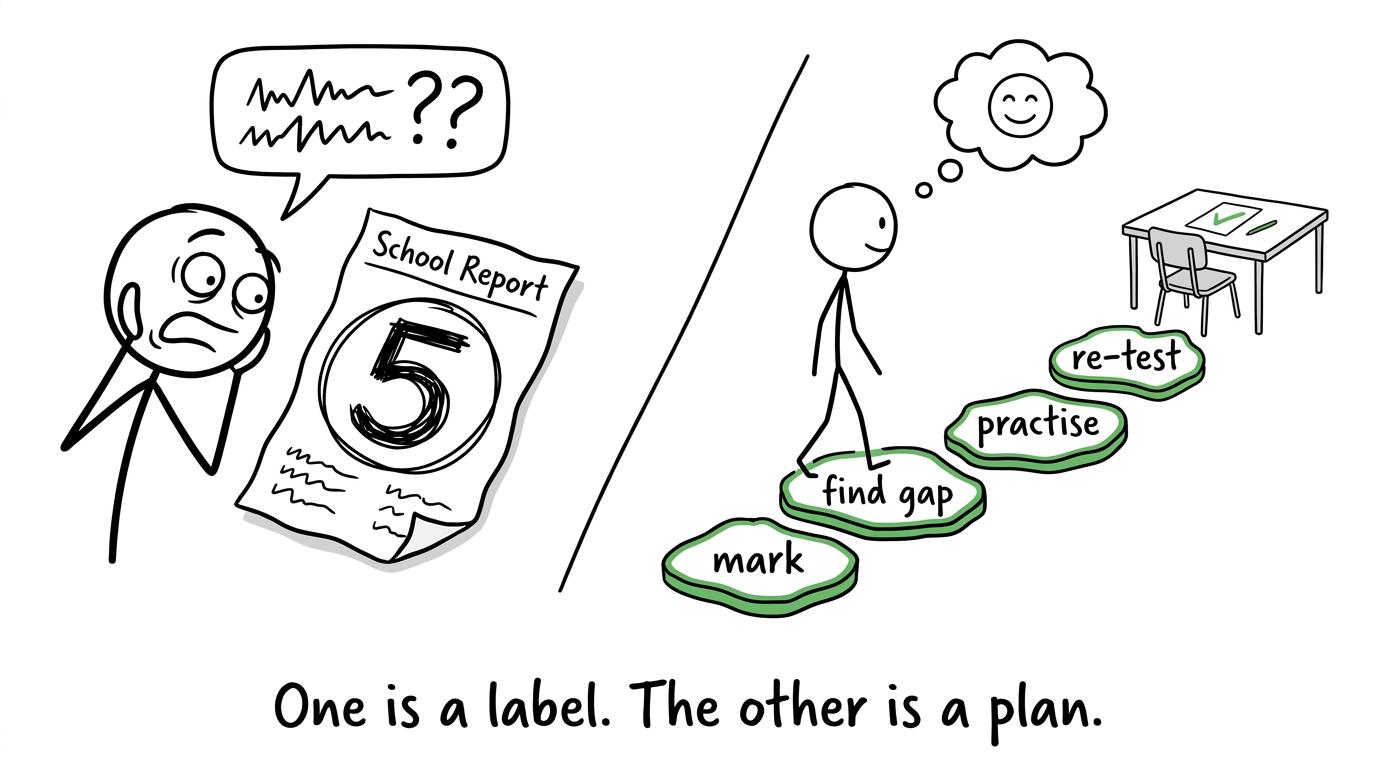 One student stares at a grade while another follows a mark, practise and re-test plan
Turn the prediction into a revision plan
The most useful grade is not necessarily the highest one written on a report. It is the one that helps you identify the next action.
Use the same evidence-led cycle for maths revision:
- complete a timed assessment
- mark it strictly
- record why each mark was lost
- revise the smallest relevant topic
- practise fresh questions
- re-test without notes
Start with AQA GCSE Maths past papers or the OCR GCSE Maths revision hub, depending on your board. Edexcel students can use GCSE Maths predicted papers after topic practice to test unfamiliar questions under timed conditions.
A predicted grade is a snapshot. Your revision habits determine what evidence exists when the next snapshot is taken.
Make the next piece of evidence stronger
The GCSE food and nutrition predicted grade process is not a hidden calculation carried out behind a closed door. It is usually a structured judgement based on mocks, class assessments, practical work, NEA evidence and the standards described by the specification.
You cannot control every reporting policy or future grade boundary. You can control the quality of the next piece of work.
Use MathsGenie as your free maths revision base: learn through revision lessons and videos, practise with topic questions and mini tests, then check progress using past papers, predicted papers, mark schemes and video solutions. Choose one weak skill today, complete a short assessment and let evidence, rather than anxiety, decide your next step.










