GCSE English Literature Easter Holiday Revision
GCSE English Literature Easter holiday revision: create a balanced plan for quotes, essay practice, maths revision and rest without losing your break.

The Easter holiday can make revision feel strangely urgent. There is enough time to improve, but also enough time to waste by trying to do everything. Effective GCSE English Literature Easter holiday revision is not about surrendering the entire break. It is about choosing a small number of useful tasks, returning to them regularly and protecting time for maths, other subjects and genuine rest.
A balanced plan should include quotation retrieval, knowledge of themes and characters, timed writing and reflection on feedback. It should also leave space for the subjects that require frequent practice. If maths is competing for attention, MathsGenie's GCSE revision resources can give that part of your timetable a clear structure.
Your Easter revision checklist
Before filling a timetable, decide what successful revision will look like. By the end of the holiday, aim to have:
- identified your weakest Literature text, character or theme;
- created a manageable bank of flexible quotations;
- practised planning and writing exam responses;
- checked the requirements of your exam board;
- completed regular maths practice rather than leaving it until the end;
- kept several blocks of the holiday completely free;
- recorded what needs attention when school resumes.
This is deliberately short. A revision plan works best when it makes choices on your behalf. A list containing every possible task simply moves the stress from your head onto a page.
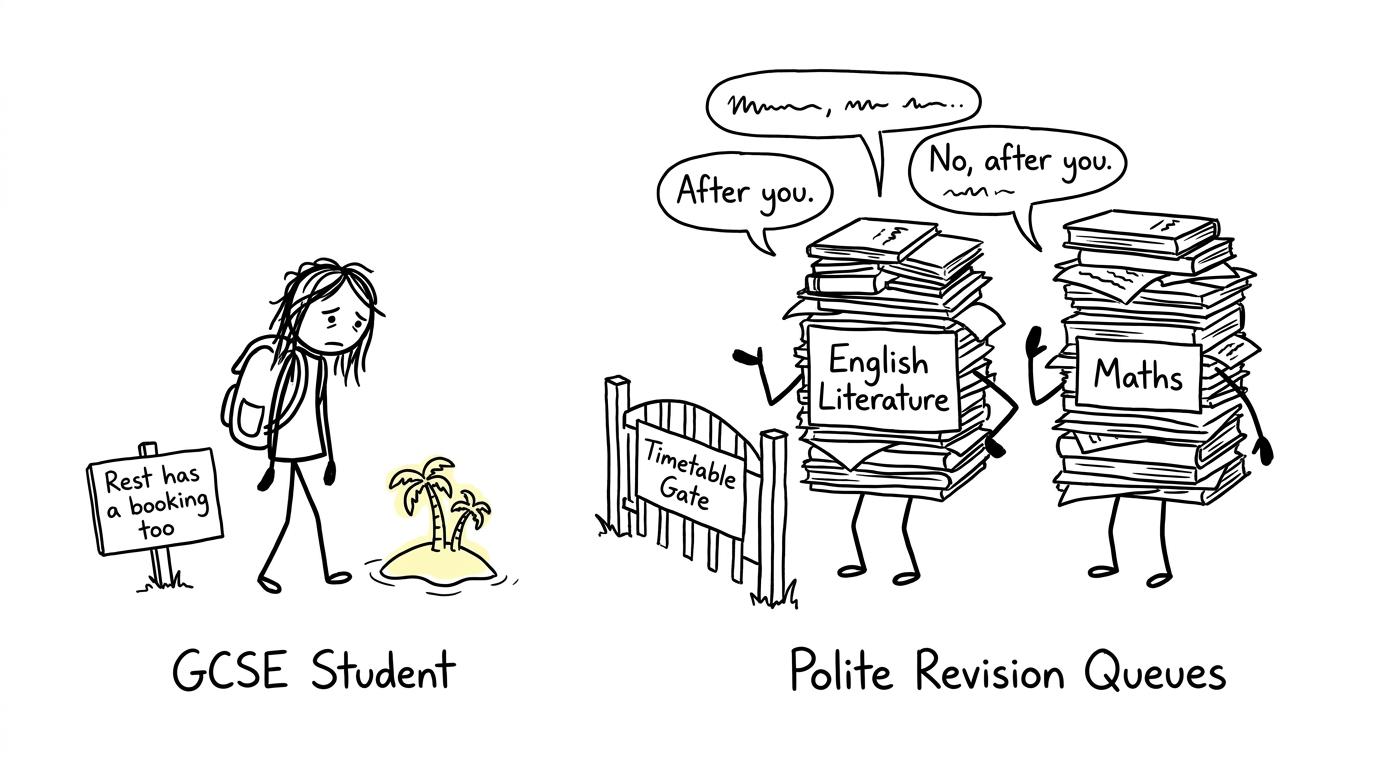 A student protects rest time while English Literature and maths wait at a timetable gate
Start with the exam you will actually sit
AQA, Edexcel, OCR and Eduqas do not use identical papers, texts, timings or assessment arrangements. Before revising, check your exam board, set texts and current specification with your school. Your teacher's guidance should take priority because optional text choices vary between centres.
Broadly, GCSE English Literature rewards a clear response to the task, relevant references to the text and analysis of how writers create meaning. Context also matters where the paper and assessment objectives require it. However, the wording and weighting of assessment objectives differ, so avoid building your plan around generic advice alone.
Write down the following for each paper:
- the texts and sections being assessed;
- the question format;
- which questions are compulsory;
- the time available;
- whether an extract is provided;
- the assessment objectives being tested.
This turns a vague subject into a defined set of demands. Revision becomes easier when you know what the exam is asking you to produce.
Divide the holiday into three phases
A useful Easter plan has a beginning, middle and end. Without those stages, students often spend too long making resources and too little time recalling or applying knowledge.
Diagnose before you revise
Use the first part of the break to identify gaps. Without looking at notes, list the important characters, themes, relationships, turning points and quotations for each text. Then compare your recall with your class materials.
Label each area as secure, uncertain or weak. Your timetable should be led by the weak and uncertain areas, not by the topics that feel comfortable. Familiarity is reassuring, but it can disguise the fact that little new learning is taking place.
Do the same for maths. A short set of mixed questions can reveal whether algebra, number, geometry, ratio or statistics needs attention. MathsGenie's topic resources are organised by grade, including grade 444 revision, grade 555 revision and grade 777 revision. Use the grade appropriate to your course and current targets rather than automatically choosing the hardest page.
Build and retrieve knowledge
The middle of the holiday should contain most of your knowledge work. For Literature, this might involve:
- recalling quotations from memory;
- linking each quotation to several themes;
- explaining why a writer may have chosen a particular word or image;
- creating character and theme maps;
- sequencing major events without consulting the text;
- comparing your recall with accurate class notes.
Keep quotation banks selective. A smaller collection of quotations that you can remember, analyse and adapt is more useful than pages of copied lines. Choose references that connect to several ideas and moments in a text.
Retrieval matters here. Close the book, attempt to remember, check the answer and revisit what you missed. Rereading can help you reconnect with a text, but it does not show reliably what you can produce without support.
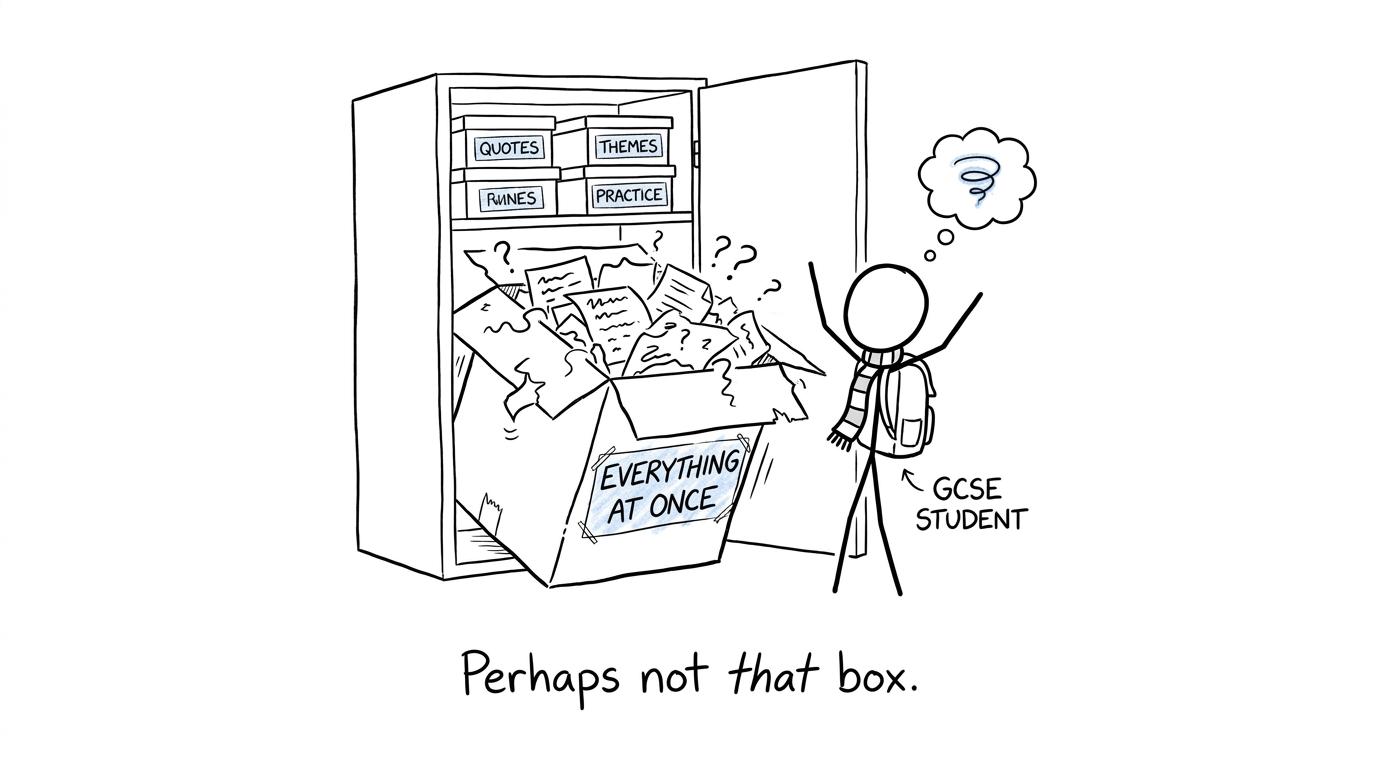 A revision cupboard contains useful small boxes and one disastrous everything-at-once box
Apply knowledge under exam conditions
Towards the end of the break, shift from collecting knowledge to using it. Practise unpacking questions, selecting evidence and organising an argument. Complete some plans and some timed responses rather than writing every answer in full.
After each task, ask:
- Did I answer the precise question?
- Was my argument clear from the beginning?
- Did I choose relevant textual references?
- Did I analyse the writer's choices rather than retell the plot?
- Did context illuminate the interpretation, or was it added mechanically?
- What is the single most important improvement for next time?
A full essay followed by no reflection is less useful than an imperfect response that reveals a specific weakness. Practice becomes revision only when it changes the next attempt.
Build a timetable that leaves room to breathe
Start by blocking out commitments, meals, family time and rest. Revision should fit around a real holiday rather than an imaginary week in which you have unlimited concentration.
Next, choose one or two focused sessions for each revision day. A session of roughly 252525 to 454545 minutes may be enough for one defined task, although the right length depends on your concentration and the activity. Timed essays naturally require longer. Quote retrieval may require less.
Give every session an outcome. “Revise Macbeth” is too broad. Better tasks include:
- retrieve quotations about ambition;
- plan one response about responsibility;
- compare two interpretations of a character;
- complete one timed poetry comparison;
- answer a targeted set of maths questions.
Build in lighter days and days off. Rest is not a reward earned only after every topic is secure. It is part of a sustainable plan, particularly when revision will continue after Easter.
Balance English Literature with maths
Literature and maths place different demands on you. Literature revision involves recalling evidence, shaping interpretations and writing coherent arguments. Maths improvement depends heavily on solving questions, checking methods and correcting errors. Giving both subjects identical sessions is not necessarily balanced.
A practical pattern is to alternate the type of thinking. You might complete a Literature retrieval task, take a proper break and then answer a focused set of maths questions. On another day, a timed Literature response could be paired with a shorter maths mini test.
For maths, begin with GCSE revision lessons and questions, then move towards GCSE exam papers when you need broader practice. Students working on earlier foundations can use the grade 222 revision page or grade 333 revision page, while more demanding higher-tier topics can be selected from the grade 666 revision page.
The principle is simple: Literature needs regular recall and writing; maths needs regular problem-solving. Short, repeated contact with both is usually more manageable than assigning an entire week to one subject and hoping the other will wait.
Use resources without spending the holiday making them
Resource-making can feel productive because it creates something tidy. Yet beautiful notes are not the same as retrievable knowledge.
Use flashcards when they prompt a genuine question. Use mind maps when they require you to reconstruct connections from memory. Use videos or revision notes to repair a specific gap, not to avoid attempting a task.
For Literature, keep one error and improvement log. Record forgotten quotations, weak interpretations, unclear paragraph openings and feedback that recurs. For maths, record the topic, the nature of the mistake and the correction needed. Then revisit those entries later in the break.
As exams approach, MathsGenie predicted papers can supplement topic practice. They should not replace official past papers or complete coverage of your specification, but they can provide further exam-style questions once core weaknesses have been addressed.
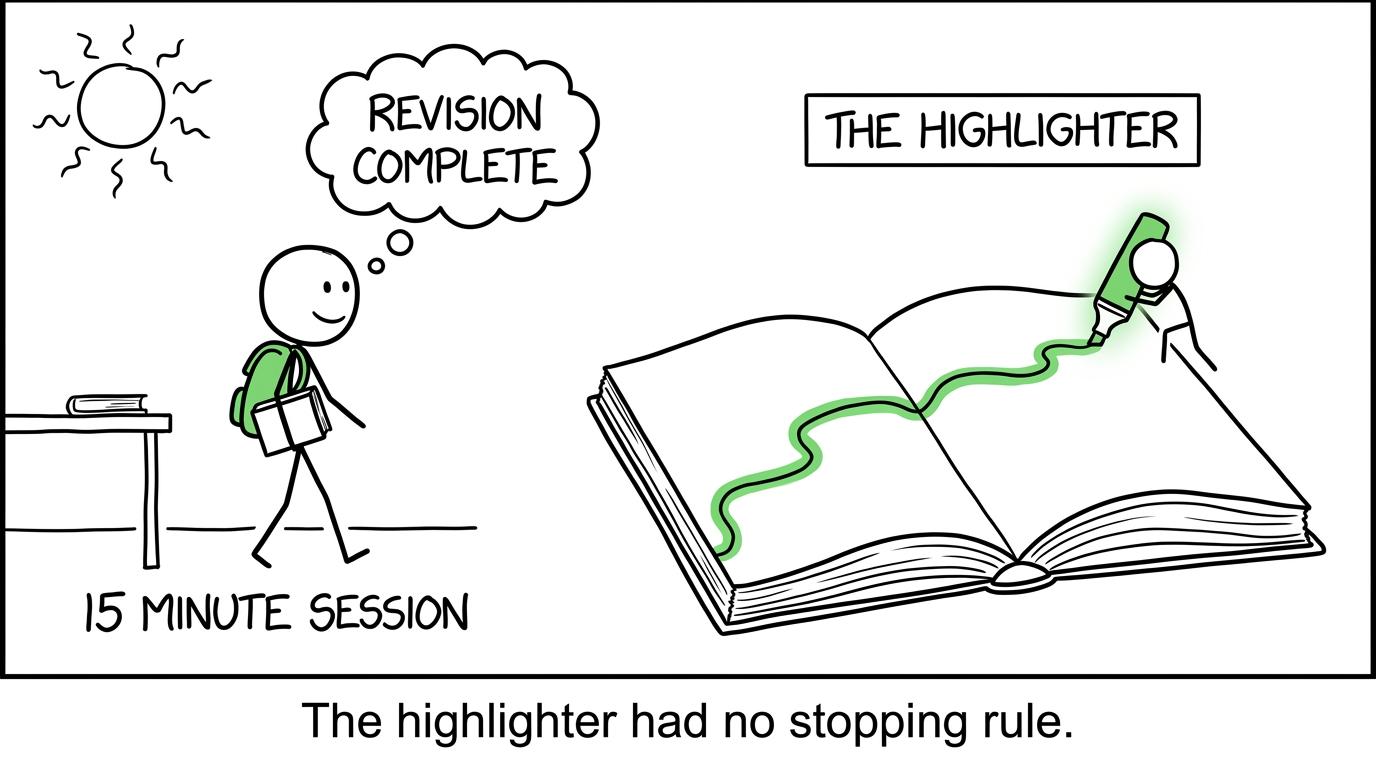 A student leaves after a focused session while an overenthusiastic highlighter carries on alone
Common Easter revision mistakes
Planning every hour
An overfilled timetable has no room for tiredness, unexpected plans or a difficult task taking longer than expected. Schedule outcomes and leave spare capacity.
Memorising quotations without understanding them
Knowing a line is only the beginning. You also need to connect it to the question, analyse the writer's choices and explain its significance within the text.
Writing essays without reviewing them
Volume alone does not guarantee improvement. Compare each response with your teacher's feedback, the assessment objectives and an appropriate mark scheme. Identify one change to carry into the next task.
Revising only favourite texts and topics
Confidence can pull you towards material you already know. Begin with a diagnosis and give more time to weaknesses while continuing brief retrieval of secure content.
Treating rest as failure
A plan that consumes the whole holiday is difficult to sustain. Decide when revision finishes each day and protect some days from academic work altogether.
Forgetting maths until the final weekend
Maths skills can become rusty without use. Maintain regular contact through topic questions before progressing to complete papers. When you do attempt a paper, use the mark scheme and video solutions to understand errors rather than merely recording a mark.
Finish Easter with a clear next step
The best Easter holiday does not end with everything completed. It ends with greater clarity: you know your texts better, you have practised turning knowledge into arguments, and you understand what still needs work.
Use the final day of revision to review your error logs and choose the first tasks for the return to school. Keep the list short. Momentum is easier to preserve when the next action is obvious.
For the maths part of your plan, make MathsGenie your free revision base. Choose targeted revision lessons and practice questions, check your work with mark schemes and video solutions, and progress to past papers and predicted papers when you are ready. Easter revision should make the weeks ahead calmer, not make the holiday disappear.