GCSE English Language: a calm night-before plan
GCSE night-before plan for English Language that avoids panic. A calm checklist, timing tips, and a maths-style method so you sleep and perform.
If you have a GCSE English Language exam tomorrow, you can probably feel the tug-of-war already: one part of you wants to do “one last thing”, and another part is quietly begging for sleep. The panic usually arrives when revision stops being a plan and becomes a blur. Tonight’s aim is simpler than it sounds: reduce uncertainty. And because you’re a maths student too, we’ll borrow what maths does best at GCSE: a clear method, a few reliable checks, and no dramatic leaps.
This is a night-before plan for GCSE English Language that avoids panic, protects your energy, and still improves what you do under pressure.
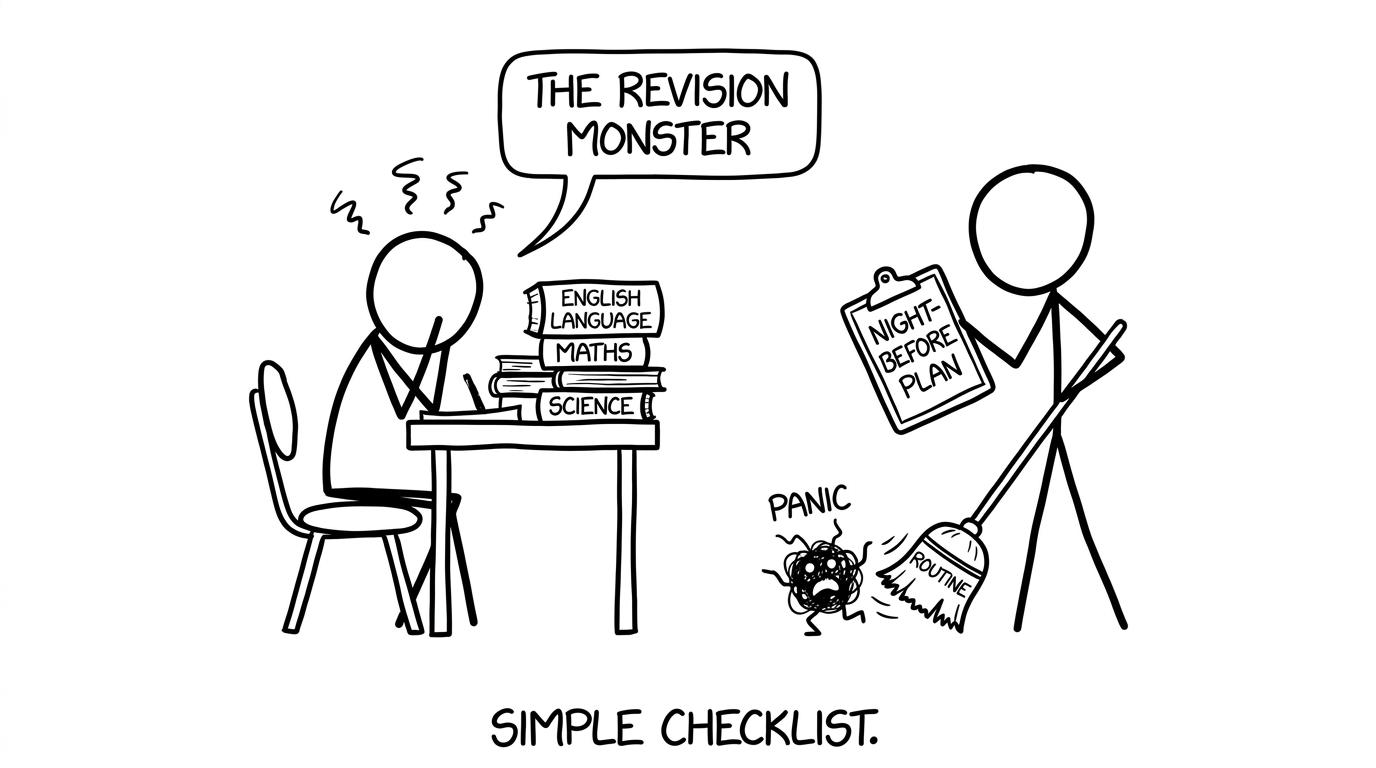 A calm checklist shooing away panic
The night-before checklist (keep it boring on purpose)
A calm night works because it limits decisions. Here’s the checklist you’re aiming to complete; then stop.
- Choose your exam board route (AQA, Edexcel, OCR, Eduqas/WJEC) and open the right past paper.
- Rehearse two question routines (one reading, one writing) with a mark scheme.
- Build a micro-plan for timing.
- Pack your kit and prep your morning.
- Finish with a short, confidence-boosting maths warm-down so your brain believes in methods again.
You can do all of this in about 909090 minutes of focused effort. That number matters because it creates a finish line.
Why panic happens the night before (and how maths helps)
Panic isn’t proof you’re unprepared. It’s usually a signal that your brain can’t see the path from “now” to “tomorrow’s paper”. English Language feels especially slippery because you can’t memorise it the way you might memorise a trig exact value or a circle theorem.
Maths revision at GCSE works because:
- questions repeat in structure,
- methods are reusable,
- marks are earned in steps.
English Language is the same in disguise. The texts change, but the moves don’t. The night before is for practising those moves, not re-learning the whole subject.
If you want a reminder of how powerful “method marks” thinking is, it’s worth dipping into a mark-scheme-friendly maths topic on YesGenie, like BIDMAS Revision Guide, not because you need BIDMAS for English, but because it reconnects you with structured thinking.
Step 1: Pick the right paper and reduce noise
Before you do anything else, decide which route you’re on.
- AQA GCSE English Language has familiar reading and writing sections that reward clear inference and organised responses.
- OCR GCSE English Language past papers can feel different in wording, so practising with the right prompts matters.
On YesGenie you can go straight to the correct board hub: AQA GCSE English Language Revision. If you’re OCR, use OCR’s past paper route: OCR GCSE English Language Past Papers.
Your goal tonight: open one paper and commit. Multiple papers create the illusion of productivity and the reality of panic.
Step 2: Do a “two-routine rehearsal” (one reading, one writing)
Think like a GCSE maths student: you don’t practise every topic the night before, you practise the ones that anchor your confidence.
Choose:
- one reading question type you often drop marks on,
- one writing task type you want to feel steady with.
Then practise each for a short, controlled burst.
Reading routine: build an “evidence ladder”
A lot of students lose GCSE marks in reading because they:
- paraphrase without analysing,
- pick weak quotations,
- jump from quote to conclusion with no bridge.
Use this simple routine (write it as a mini template):
- Point: one sentence answering the question.
- Evidence: a short quote.
- Inference: what the quote suggests.
- Method: zoom in on a word or technique.
- Effect: what it makes the reader think/feel.
You’re essentially doing “show your working”, which is why it suits GCSE maths thinkers.
To make this feel concrete, treat your answer like a chain of statements. In maths you might write:
(2x+3)2=(2x+3)(2x+3)=4x2+12x+9(2x+3)^2 = (2x+3)(2x+3)=4x^2+12x+9(2x+3)2=(2x+3)(2x+3)=4x2+12x+9In English, your “working” is the explanation chain from quote to meaning. The quote is not the answer; it’s the start of the method.
Writing routine: plan first, then write with a simple structure
For the writing task, your night-before aim is not to produce your best ever creative piece. It’s to produce a piece that reliably scores.
Use a plan that takes 555 minutes and saves you 202020 minutes.
- Purpose and audience: who are you writing for and why?
- Tone: persuasive, descriptive, reflective, etc.
- Paragraph map: 444 to 555 paragraphs with one clear job each.
- Two crafted sentences: one opening line and one closing line you can be proud of.
That’s it. The plan is the panic-killer.
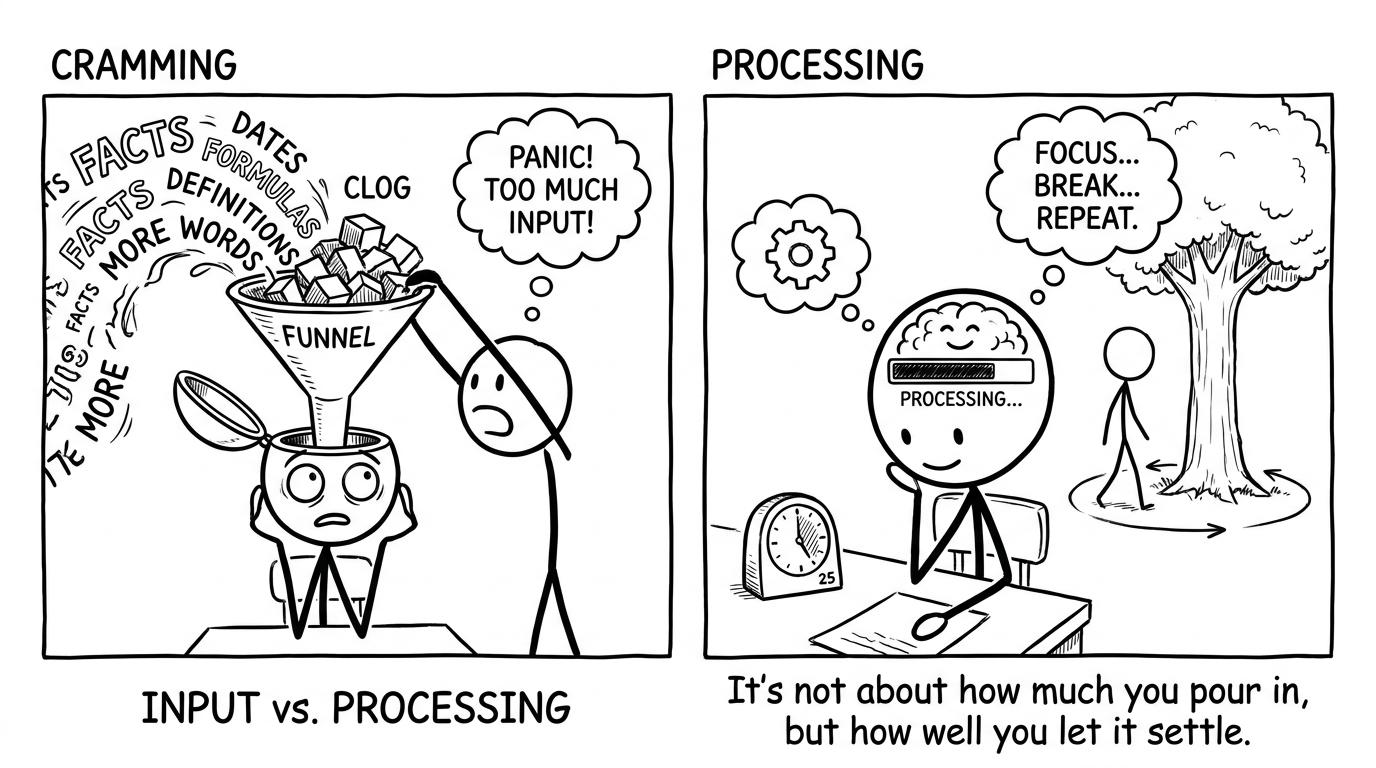 Input vs processing comic
Step 3: Use a timing model (so you don’t “run out of everything”)
Most GCSE English Language disasters aren’t about ability; they’re about time.
A timing model is like a calculator check in maths: it stops you trusting vibes.
Here’s a simple method you can adapt to your paper:
- Divide the paper time into chunks per section.
- For each chunk, decide a finish time, not just a start time.
A practical maths-style way to do it:
If your paper is 105105105 minutes and you have two main sections, you might allocate 555555 minutes and 505050 minutes. Then within the 555555 minutes, split across questions in proportion to marks.
For example, if a section has 404040 marks and one question is 101010 marks, then the time for that question is:
time=55×1040=55×14=13.75 minutes\text{time} = 55 \times \frac{10}{40} = 55 \times \frac{1}{4} = 13.75 \text{ minutes}time=55×4010=55×41=13.75 minutesRound to a usable rule: 141414 minutes. Now you have a finish time you can obey.
That’s the GCSE maths advantage: when emotions rise, numbers keep you honest.
Step 4: Mark-scheme thinking (hunt the easy marks)
The fastest way to improve the night before is to see how marks are actually awarded.
In maths, you look for method marks and follow the structure. In English Language, examiners reward:
- clear, focused points,
- relevant evidence,
- development (explaining how and why),
- accuracy and control.
So when you check your practice responses tonight, don’t just ask “is it good?” Ask “where are the marks?”
A good habit: underline where each bullet point of the mark scheme is met. If you can’t underline it, it probably isn’t there.
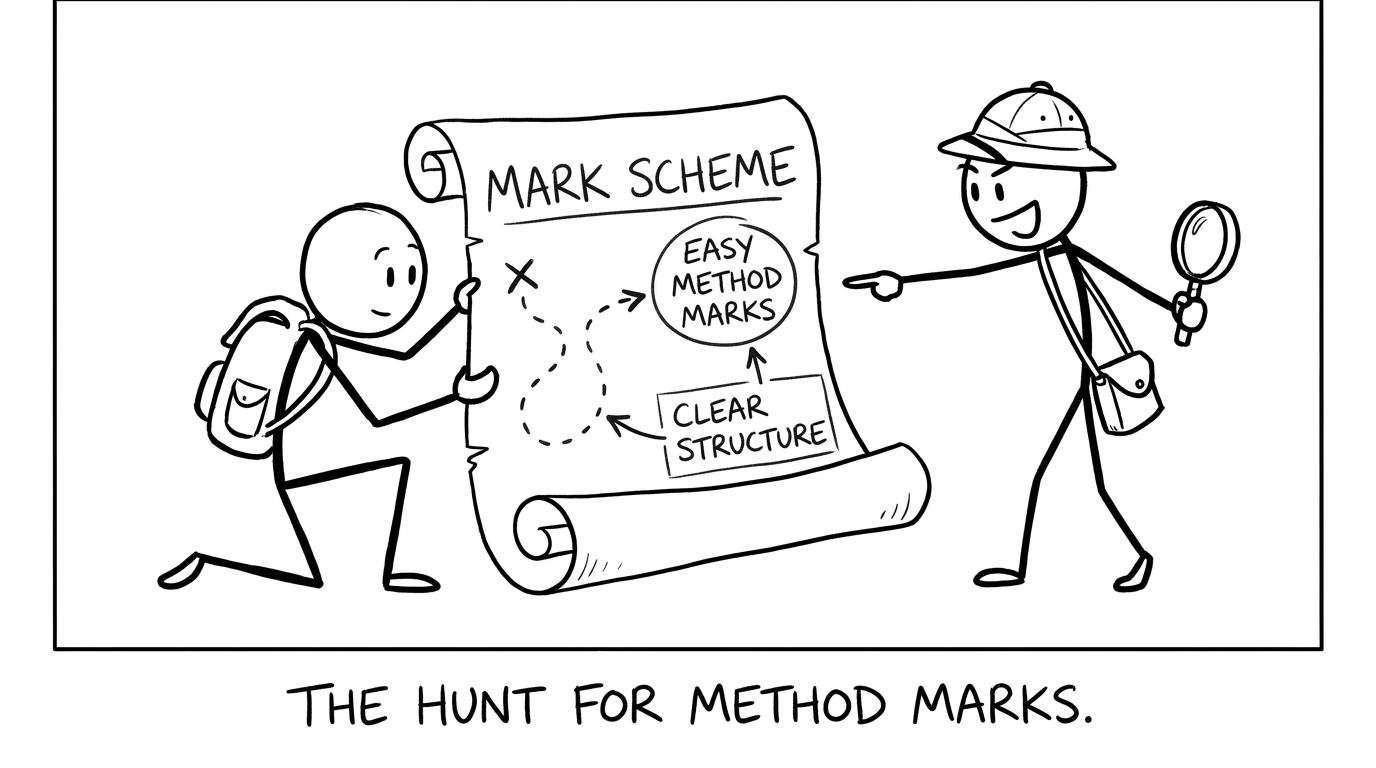 Hunting method marks like treasure
If you want a quick reminder of what “mark scheme clarity” feels like, do a short maths resource where the marking is crisp and immediate, such as Edexcel GCSE Maths Mini Tests. It’s not about switching subjects; it’s about switching your brain back to structured output.
Step 5: Pack your kit and remove morning decisions
This part feels too simple to matter, which is why it matters.
- pens (at least 222), highlighter (if allowed/needed), ruler,
- water,
- a watch (if your centre allows it),
- your candidate details if required.
Then set a morning plan:
- what time you wake,
- what you eat,
- how you travel.
Panic loves the morning because the morning contains surprises. Remove the surprises.
A maths-style “confidence warm-down” for English (10 minutes)
Once you finish your English rehearsal, do a short maths warm-down that reminds you you’re competent.
Pick one small topic you can complete cleanly in 101010 minutes:
Worked example (quick and tidy):
Evaluate 144+32\sqrt{144}+3^2144+32.
144=12\sqrt{144}=12144=12 32=93^2=932=9 144+32=12+9=21\sqrt{144}+3^2=12+9=21144+32=12+9=21You’re not doing this to “revise maths” properly. You’re doing it to end the night with a completed method and a correct answer. That feeling carries into your GCSE English Language paper more than you’d expect.
Common mistakes that cause night-before panic
- Trying to do a full paper at full speed at 101010pm. You want rehearsal, not exhaustion.
- Consuming advice instead of practising. Watching ten videos feels safe; writing two paragraphs is what improves marks.
- Ignoring timing until the exam. Timing is a skill, and you can practise it in miniature tonight.
- Over-editing writing. In the exam you need controlled, clear writing, not perfection.
- Switching resources constantly. One board, one paper, one plan.
- Doing nothing for maths because English feels urgent. If you’re a GCSE or A Level maths student, a short structured task can calm you and protect tomorrow’s performance.
A calm finish: your GCSE plan ends with action, not adrenaline
The night before a GCSE English Language exam is not when you become a new person. It’s when you become a slightly calmer version of yourself, the one who can see a path from question to marks.
Follow the plan: one board, two rehearsals, a timing model, mark-scheme thinking, then stop. If you want your revision to feel even more structured, keep YesGenie open as your home base: use AQA GCSE English Language Revision or OCR GCSE English Language Past Papers, then return to maths resources like GCSE Past Papers, Edexcel GCSE Maths Predicted Papers, and the wider Resources section for mini tests and focused practice.
Tomorrow, you don’t need to feel fearless. You just need a method you trust. That’s what good GCSE revision really is, and it’s exactly what YesGenie helps you build.