GCSE English Language Exam-Day Kit Checklist
GCSE English Language exam day kit checklist: pack the right pens, clear pencil case and water bottle, and know what to leave outside the exam room.
There is a peculiar kind of panic that arrives the night before an exam. You may have revised persuasive writing, practised language analysis and planned your timings, yet suddenly the urgent question is whether you own a working black pen.
The good news is that a GCSE English Language exam day kit should be simple. Pack at least two reliable black pens in a transparent pencil case, prepare a clear unlabelled water bottle if your centre allows one, and have any candidate card or identification requested by your school or college. Leave your phone, watch, notes and dictionary outside the exam room as directed by the centre.
That is the short answer. The rest of this guide will help you check the details, avoid preventable mistakes and build a routine you can reuse for your maths exams.
Your night-before GCSE English Language checklist
Put everything together before you go to bed. Morning decisions feel surprisingly difficult when an exam is waiting.
Pack in a transparent pencil case
- At least two reliable black ballpoint pens
- One additional spare black pen if possible
- A highlighter only if your centre permits it, for use on the question paper rather than in your written answers
- Any candidate card or identification your school or college has specifically asked you to bring
Prepare separately
- A transparent water bottle with its label removed, if drinks are permitted by your centre
- Comfortable clothing that follows your school’s uniform rules
- Any approved access-arrangement equipment organised by your centre
- Your journey plan and the time at which you need to arrive
- A suitable breakfast or snack for before the exam, not for the examination room
Leave out of the exam room
- Mobile phones and other communication devices
- Smartwatches, analogue watches and fitness trackers
- Earphones or wireless earbuds
- Revision notes, prompt cards and textbooks
- Dictionaries unless the examination instructions expressly permit one
- Correction fluid, correction pens and erasable pens
- An English anthology or set text unless your centre has explicitly told you it is required
Your school or college’s instructions take priority. Examination arrangements can vary between centres, while approved access arrangements are individual. If anything is unclear, ask the exams officer or your English teacher before exam morning.
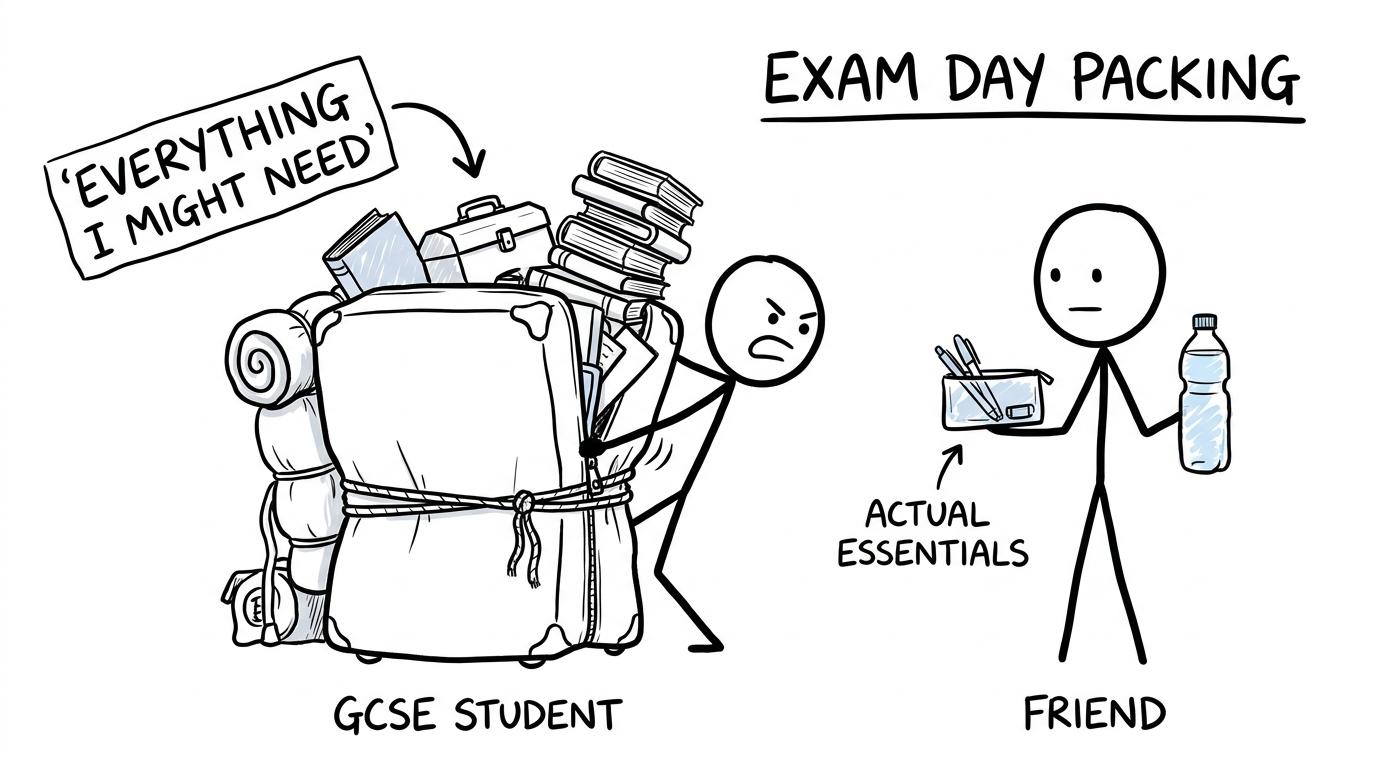 A student comparing an enormous exam suitcase with a sensible clear pencil case
The essential items explained
A useful exam kit is not the one containing the most stationery. It is the one that removes small uncertainties without introducing new problems.
Two or three dependable black pens
GCSE answers are commonly scanned so that examiners can mark them electronically. Current examination instructions require candidates to write in black ink unless a paper says otherwise. A straightforward black ballpoint pen is therefore the safest choice.
Test each pen the night before. Write several lines rather than making a quick scribble. A pen that produces broken or faint writing is not ready for an examination.
Pack more than one. Pens run out, stop working or roll onto the floor. A spare costs almost no space but prevents a distracting interruption. Avoid relying on erasable pens because heat, friction and scanning can make the writing unreliable.
Your handwriting does not need to be decorative. It does need to be dark, legible and large enough to read comfortably. If an examiner cannot understand a word, they cannot infer what you intended.
A transparent pencil case
Examination rules generally require pencil cases to be see-through. A transparent case allows invigilators to check its contents quickly and avoids questions about hidden notes or unauthorised material.
Do not fill it with every item from your school bag. English Language normally requires much less equipment than GCSE Maths. You will not ordinarily need a calculator, compass, protractor or ruler for an English paper.
Keeping the case uncluttered also makes spare pens easier to find. In a silent room, thirty seconds spent searching can feel much longer than it is.
A clear water bottle
If your centre permits water, use a transparent bottle and remove its label. Avoid coloured bottles, printed sleeves and opaque flasks. Put the bottle beside your bag the night before, but fill it in the morning so it remains fresh.
Water is optional, not a reason to delay entering the room. Check the lid properly and keep the bottle away from your answer booklet where possible. A leaking bottle is an avoidable complication.
Candidate information requested by your centre
Some centres give students a candidate card containing details such as their candidate number and seat. Others place this information on the desk. Bring identification only when your school or college has told you to do so.
You do not need to memorise administrative details if the centre provides them. You should, however, listen carefully to the invigilator and copy any required information accurately onto the answer booklet.
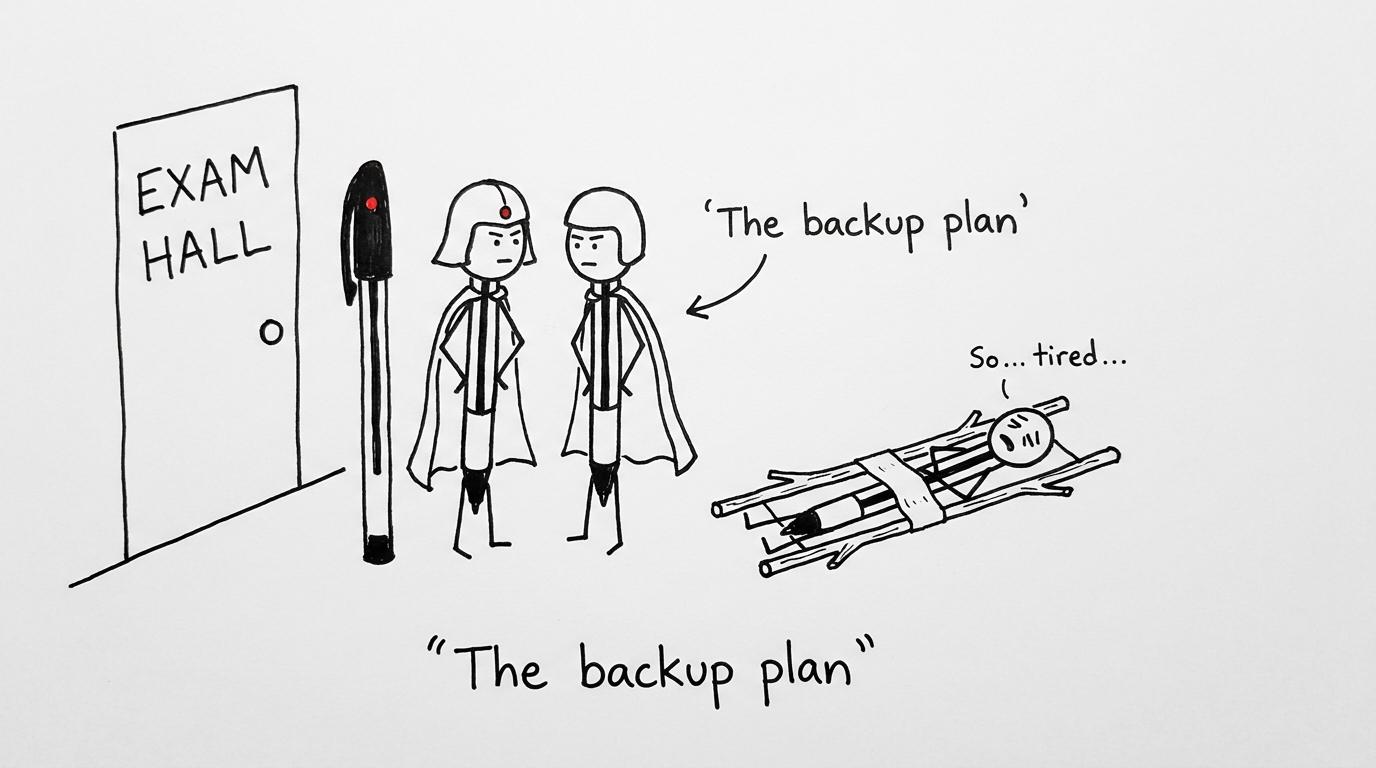 Two heroic spare pens waiting to rescue an exhausted exam pen
Useful extras that require care
Not every permitted item belongs in the essential kit. Some are useful only when handled correctly.
Highlighters
A highlighter can help you locate key words in a source or command word in a question. However, highlighter should not be used in your written answers. Scanning may not reproduce the colour reliably, and highlighting is not a substitute for explaining your interpretation.
Ask whether your centre permits highlighters and keep one in the transparent case only if it genuinely supports your reading. Do not turn the source into a wall of colour. Selective annotation is useful; highlighting almost every sentence is not.
Tissues and medical items
Centres may have their own procedures for tissues, medication and medical equipment. Speak to the exams officer in advance rather than assuming that an item can sit on your desk.
If you have approved access arrangements, such as supervised rest breaks, a word processor or extra time, these are organised by the centre. They are not items you need to improvise on the morning of the paper. Raise any concern early enough for staff to check the agreed arrangements.
What not to bring into the examination room
The easiest object to forget is often the most serious one: a phone in a pocket.
Phones, smartwatches, ordinary watches, earbuds and other unauthorised electronic devices must not be in your possession during the examination. Turning a phone to silent is not enough. Follow your centre’s procedure for switching it off and storing it securely outside the room.
Do not carry revision cards or notes in a blazer pocket, even if you have no intention of reading them. Check every pocket before entering. Unauthorised material can create a malpractice issue simply because it is in your possession.
A dictionary is not part of a normal GCSE English Language kit unless the specific examination instructions allow it. The same principle applies to anthologies, prepared plans and model answers. English Language papers from Edexcel, AQA, OCR and Eduqas provide the material candidates are meant to use according to the relevant specification and paper instructions.
Never bring correction fluid or correction tape. If you make an error, put a neat line through it and continue. Examiners are accustomed to crossings-out; they are interested in the answer you want marked.
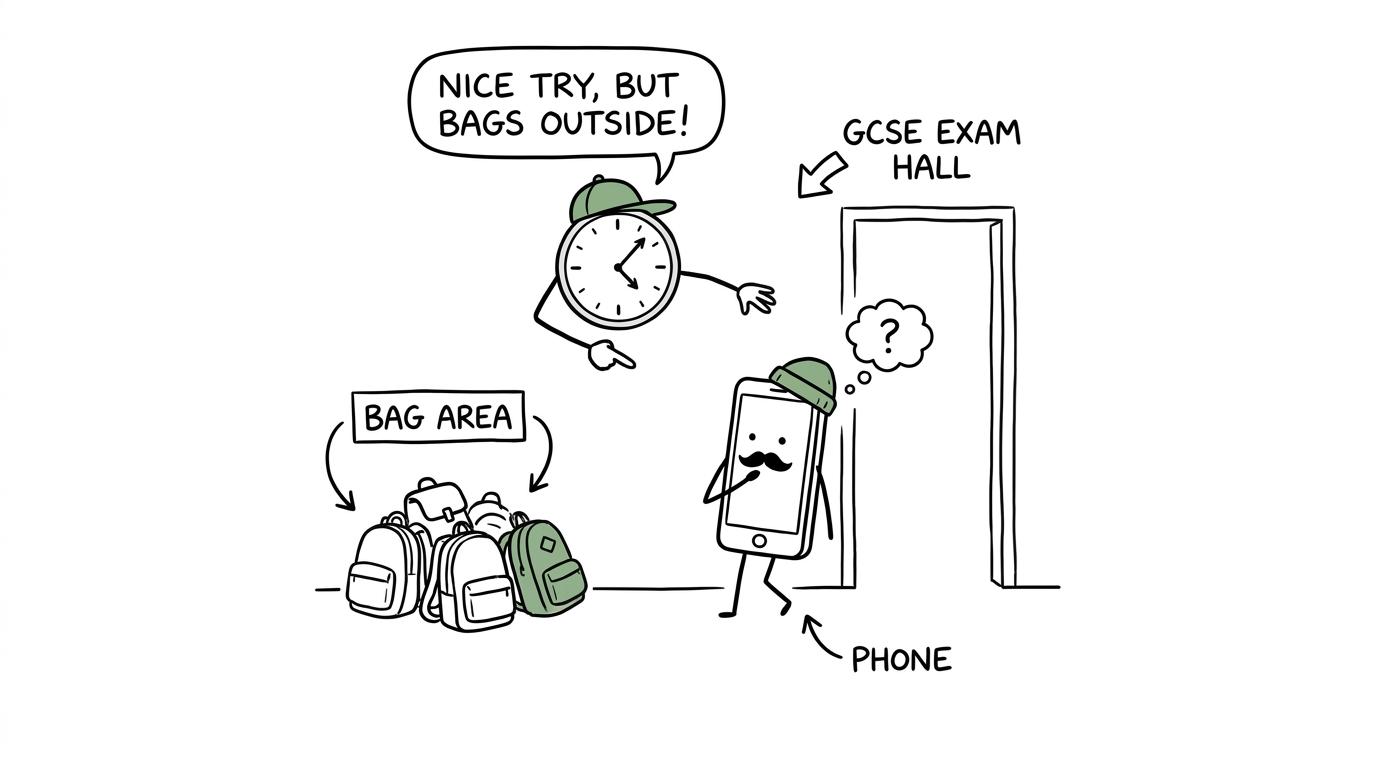 A disguised mobile phone being directed away from the exam hall
Build an exam-morning routine
Packing is valuable because it reduces the number of decisions left for the morning. The aim is not to create a complicated ritual. It is to make the ordinary things automatic.
Check your arrival time and route the evening before. Set an alarm with enough space for breakfast, washing, dressing and travel. If someone else is taking you, confirm when you are leaving rather than assuming they know.
Arrive at the time specified by your centre. This gives staff time to direct you to the correct room and resolve practical problems. If a genuine emergency causes a delay, contact the school or college immediately and follow its instructions. Do not decide for yourself that it is too late to attend.
Once seated, place only permitted items on the desk. Read the front of the paper, check that you have the correct examination and listen to every announcement. If something is wrong, raise your hand. Quietly worrying about it does not solve it.
Use the same system for GCSE Maths
Although the equipment changes, the planning habit transfers directly to maths. A maths kit may need black pens, pencils, an eraser, a ruler, geometrical instruments and an approved calculator for calculator papers. The paper instructions and your centre determine exactly what is permitted.
Equipment is only the final layer of preparation. For the knowledge underneath it, use the free GCSE Maths revision lessons to identify gaps, then practise retrieving methods without notes. Students taking Edexcel can become familiar with paper layouts through Edexcel GCSE Maths past papers, while separate collections are available for AQA GCSE Maths past papers and OCR GCSE Maths past papers.
The connection is simple: familiarity protects attention. When you already know where your pens are, what equipment is permitted and how a paper is structured, more of your concentration remains available for the questions.
This matters beyond GCSE. Students progressing to sixth form can use the same preparation cycle alongside A Level Maths revision resources: learn the content, answer practice questions, check the mark scheme and prepare the practical details before the assessment.
Common exam-kit mistakes
Packing only one pen
One pen may be enough in theory, but there is little benefit in taking the risk. Bring at least one tested spare.
Bringing a non-transparent case or bottle
A patterned pencil case or labelled bottle may not meet examination-room requirements. Choose transparent versions and remove the bottle label before leaving home.
Keeping a phone or watch in a pocket
Do a deliberate pocket check before entering. Store all electronic devices exactly where your centre instructs you to store them.
Assuming English requires an anthology or dictionary
English Language is not the same as English Literature. Bring only the materials listed by your centre for that particular paper.
Using highlighter in an answer
If permitted, use highlighter sparingly on the question paper. Write the answer itself clearly in black ink.
Packing without checking the pens
Owning three pens is not useful if none writes properly. Test them on ordinary paper the night before and replace faint or unreliable ones.
Revising so late that the morning becomes harder
A final check can be calming. Hours of tired rereading usually are not. Pack the kit, check the alarm and give yourself the best realistic chance of arriving rested and attentive.
Walk in with fewer things to think about
An exam-day kit cannot write an analysis or choose the best quotation. Its value is quieter than that. It prevents a dry pen, hidden phone or missing bottle from taking attention away from the work you have prepared to do.
Tonight, keep the process small: test your black pens, place them in a transparent case, prepare your clear bottle, empty your pockets and confirm when you need to arrive. Then stop packing.
For your maths papers, bring the same calm structure to revision. Start at MathsGenie’s free maths revision hub, work through revision lessons and practice questions, complete past and predicted papers under timed conditions, and use mark schemes, video solutions, mini tests and the revision planner to decide what to practise next. Preparation cannot remove every exam-day nerve, but it can make sure those nerves are not about the pen in your hand.