GCSE English Language Discord Server: Is It Worth It?
GCSE English Language Discord server advice: discover the benefits, risks and practical ways to use online revision communities safely and effectively.
A revision server can feel like the perfect answer to a difficult evening. Someone is awake, someone has attempted the same question, and someone seems certain about what the examiner wants. Yet certainty in a chat is not the same as accuracy.
A GCSE English Language Discord server can be worth joining for motivation, discussion and peer feedback, but it should support rather than direct your revision. The best communities help you think more carefully. They cannot replace your teacher, your exam board's current specification, authenticated past papers or official mark schemes.
That distinction matters particularly if you are balancing English with GCSE maths. Both subjects reward practice, but neither improves simply because revision content is passing across your screen.
A quick checklist before you join
A useful GCSE revision community should:
- have visible rules and active moderation;
- organise channels by exam board or paper;
- distinguish personal suggestions from official guidance;
- discourage leaked papers, cheating and fabricated grade claims;
- protect students' privacy;
- help you return to independent practice;
- allow you to mute notifications without missing essential material.
If a server creates more anxiety than understanding, leaving is not a failure. It is sensible revision management.
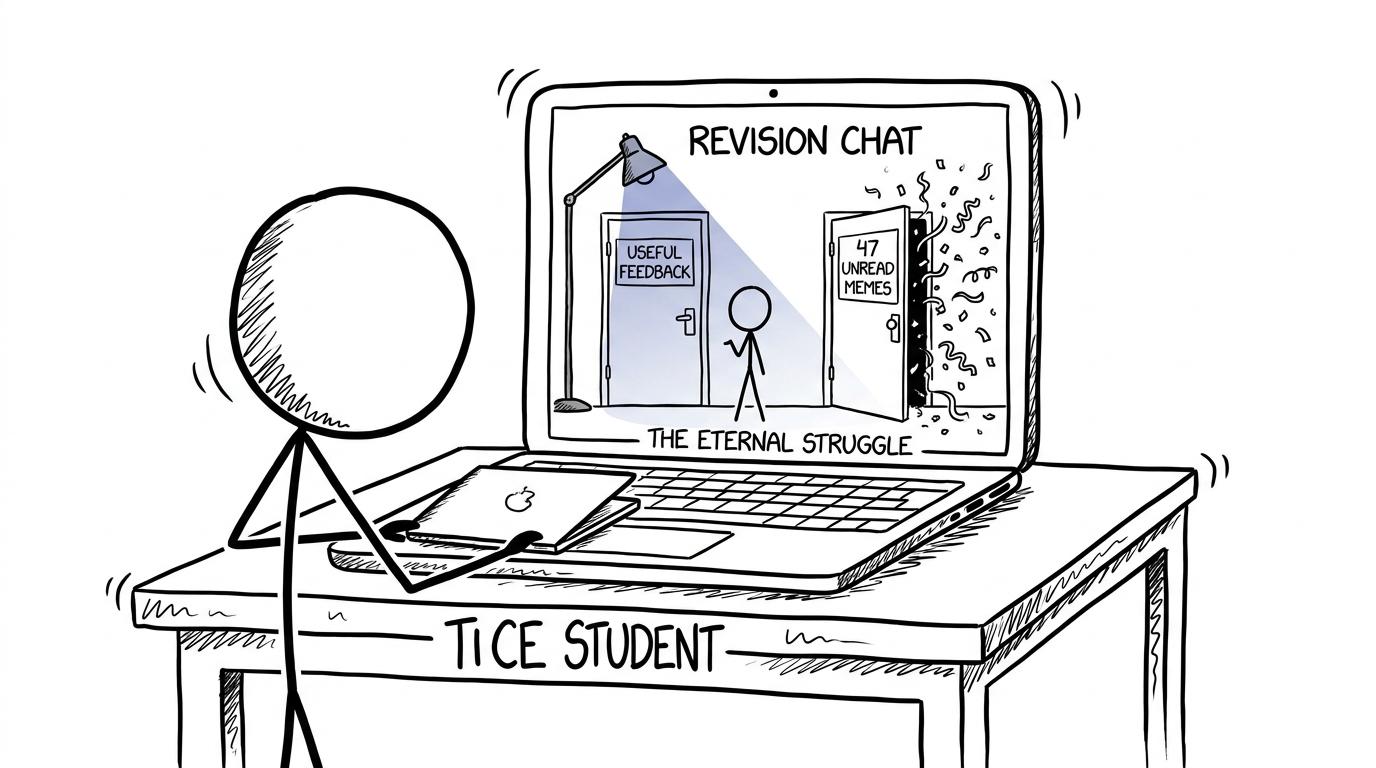 A student choosing between useful feedback and unread revision memes
What an English Language Discord community can offer
The useful part of an online community is rarely a secret resource. It is usually the presence of other people who are wrestling with similar decisions.
A place to discuss interpretations
English Language questions often ask you to explain how a writer creates an effect, compare perspectives or shape your own writing for a purpose and audience. Discussion can expose you to interpretations you had not considered.
This does not mean the most unusual interpretation is automatically the best. A convincing response still needs relevant evidence, precise analysis and a clear connection to the question. A server can generate possibilities; you must decide which possibilities the text genuinely supports.
Peer feedback on writing
Another student may notice that your paragraph loses focus, repeats one idea or makes a claim without analysing the writer's choices. That can be valuable, particularly when feedback is specific.
Good feedback sounds like this: identify the sentence that is unclear, explain why it is unclear and suggest what the writer should reconsider. Weak feedback merely assigns an imagined grade or says that a response is “good”. Unless a qualified teacher is applying the correct assessment criteria in the proper context, an online grade estimate should be treated cautiously.
Accountability and shared routines
A quiet revision channel, scheduled writing session or small study group can make starting easier. The important word is starting. Being present in a revision voice channel is not itself revision.
A useful session ends with something tangible: a completed response, an annotated extract, a self-assessed paper or a list of weaknesses to address. This principle transfers directly to maths. Watching other people discuss algebra is less valuable than completing questions and checking your method.
For structured maths practice, use the GCSE maths revision resources to choose a topic, watch the lesson and attempt the accompanying questions. The community can provide encouragement, but the work must still happen on the page.
What a GCSE English Language Discord server cannot reliably provide
The greatest risk is not that every answer will be wrong. It is that accurate, inaccurate and partly accurate advice can look identical in a fast-moving chat.
Guaranteed exam predictions
Students naturally want to know which question, theme or writing form will appear. Confident predictions can spread quickly because they reduce uncertainty, not because they are well founded.
Do not reorganise your entire revision plan around a screenshot, anonymous message or supposed leak. Unauthorised exam material may also involve malpractice. Report suspicious content to a moderator, teacher or appropriate adult rather than downloading or sharing it.
MathsGenie's GCSE predicted papers are designed as extra practice in an exam-style format. Even legitimate predicted papers are not promises about the live examination. Their value comes from practising unfamiliar questions under realistic conditions.
Authoritative marking
Peer assessment can help you improve clarity, but community members do not become examiners by adopting examiner-like language. GCSE English Language specifications and paper structures differ across AQA, Edexcel, OCR and Eduqas. Advice for one exam board may not fit another.
Before accepting a claim, check:
- whether the person knows your exam board;
- whether the advice matches the current specification;
- whether it can be supported by an official question paper or mark scheme;
- whether your teacher has given different guidance;
- whether the feedback explains a decision rather than declaring a grade.
The same discipline is useful in maths. Complete GCSE maths past papers, compare your work with the relevant mark scheme and use video solutions to understand methods you missed. Evidence is more dependable than chat-room confidence.
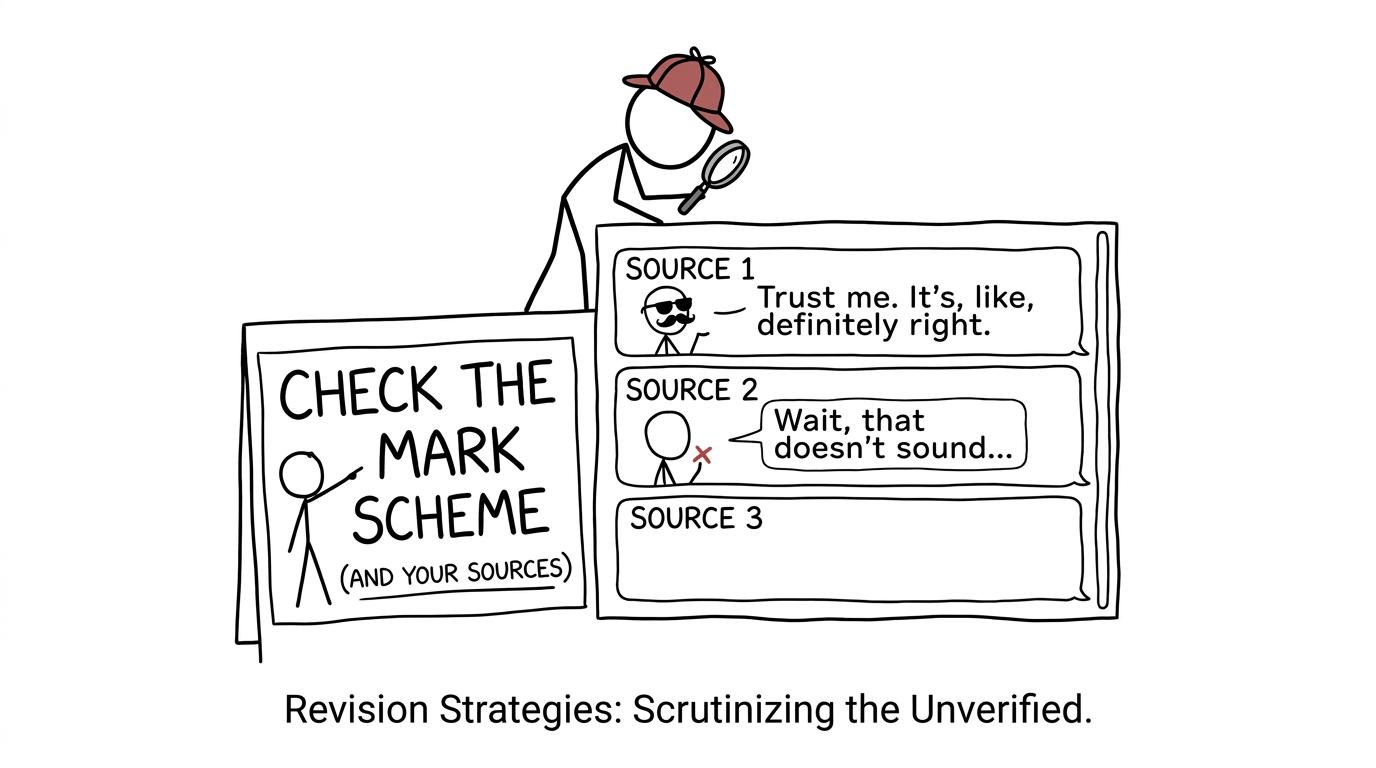 A student detective checking revision claims against a mark scheme
How to use an online revision server well
Joining is easy. Setting boundaries is the part that creates value.
Enter with a specific purpose
Do not open the server merely because revision feels uncomfortable. Decide what you need first. You might want feedback on whether a paragraph remains relevant, clarification of an exam instruction or company during a timed task.
Post a focused question, read the responses and then return to your work. A server should be a tool you visit, not a room in which your entire evening disappears.
Separate discussion from deliberate practice
Discussion feels productive because it is mentally busy. Deliberate practice is quieter. It requires you to retrieve knowledge, make decisions and finish a task without seeing everyone else's answers first.
Try a simple sequence:
- attempt the task independently;
- compare your response with reliable criteria;
- ask one precise question;
- improve the response;
- record what you will do differently next time.
For maths, you can apply the same routine through MathsGenie's topic pathways. Start with Grade 4 maths topics, Grade 5 maths topics or Grade 7 maths topics, depending on your course and current needs. Topic grades are useful navigation guides, not guarantees of a final examination grade.
Verify before you memorise
Treat every unsupported claim as a suggestion to investigate. The strongest source depends on the question:
- use the current exam-board specification for course requirements;
- use official question papers and mark schemes for assessment evidence;
- use your teacher for advice connected to your class and exam board;
- use peers for discussion, alternative perspectives and encouragement.
This hierarchy prevents a persuasive message from quietly becoming a revision rule.
Protect your privacy and wellbeing
A public or semi-public revision server still contains strangers. Use a non-identifying display name and avoid sharing your school, location, timetable, personal accounts or private documents containing identifying information.
Be cautious with direct messages, files and external links. Block and report harassment, sexual content, threats, requests for personal information or pressure to move into a private conversation. Tell a trusted adult if an interaction makes you uncomfortable. Platform tools help, but moderation is not a guarantee that every member is safe or honest.
Control notifications
A server can turn revision into permanent interruption. Mute channels that do not serve your goals and check the community at planned times. During timed practice, close it completely.
This is especially important when preparing for papers that demand sustained concentration. MathsGenie's A Level maths revision resources and A Level past papers can support students progressing beyond GCSE, but even excellent resources only work when attention stays with the question.
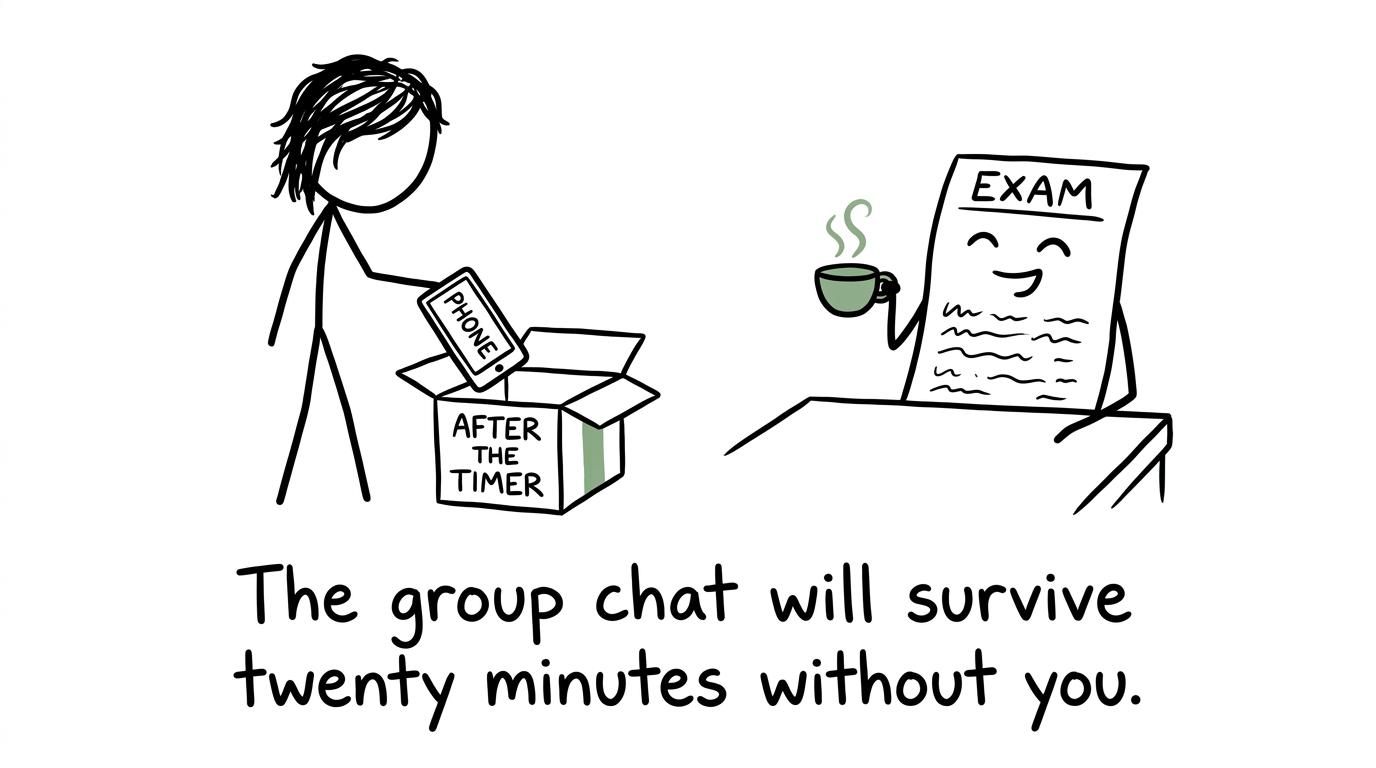 A phone waiting patiently while a student completes focused revision
A balanced revision routine
A useful online community should occupy a small, defined place within a wider plan. Your routine might include:
- learning or reviewing one skill;
- completing practice without chat assistance;
- marking the work honestly;
- identifying one weakness;
- asking for help if the mark scheme or lesson does not resolve it;
- returning later to test whether the improvement has lasted.
Notice where the community appears: after an independent attempt, not instead of one.
For maths, MathsGenie brings the structured parts together through free revision lessons, practice questions, mini tests, past papers, predicted papers, mark schemes and video solutions. A revision planner can then help you decide what deserves attention next rather than following whichever topic happens to be active in a group chat.
Common mistakes when using revision communities
Collecting resources instead of completing them
A folder containing hundreds of documents can create the feeling of preparation. One carefully attempted and reviewed paper usually tells you more about your current weaknesses.
Trusting confident language
An answer does not become official because it contains phrases such as “the examiner wants”. Ask what source supports the claim and whether it applies to your exam board.
Posting work without context
State the exam board, paper, question and kind of feedback you want. Remove your name, school and any other identifying information before uploading an image or document.
Comparing revision hours or predicted grades
Public progress reports are incomplete. You rarely know the quality of another person's practice, their starting point or whether their claim is accurate. Compare today's work with your own previous attempt instead.
Letting chat replace retrieval
Reading a discussion can make an idea look familiar. Exams require you to produce a response independently. Close the server regularly and find out what you can actually recall and apply.
Is joining worth it?
Yes, potentially, if the community is well moderated, relevant to your exam board and used with clear boundaries. It may provide motivation, thoughtful peer comments and a reminder that difficult revision is difficult for other students too.
But no server can carry the responsibility for your result. The dependable foundations remain the current specification, teaching from your school, independent practice and careful use of mark schemes. Leave any community that spreads unsafe content, encourages malpractice or makes concentration harder.
Use conversation to solve a specific problem, then return to the work that earns marks. For maths, begin with MathsGenie's free GCSE revision hub, choose the lesson or paper that matches your next priority, and use the practice questions, predicted papers, mark schemes and video solutions to turn advice into measurable progress.