GCSE Engineering Note Taking That Works
GCSE engineering note taking that turns classwork into useful revision. Build concise notes, formula cards and retrieval prompts for stronger maths recall.
A page can look productive without being useful. Neat headings, careful highlighting and copied diagrams may show that you were busy in class, but the real test comes several weeks later: can those notes help you answer a question?
Effective GCSE engineering note taking is built for that later moment. Record the essential engineering idea, connect it to the maths you need, then turn it into a prompt that makes you retrieve the knowledge. Your notes should be less like a transcript and more like a compact set of tools.
This matters because engineering questions rarely reward isolated facts. You may need to choose a formula, convert units, interpret a drawing and explain a design decision within the same task. Notes organised around those actions are far easier to revise from.
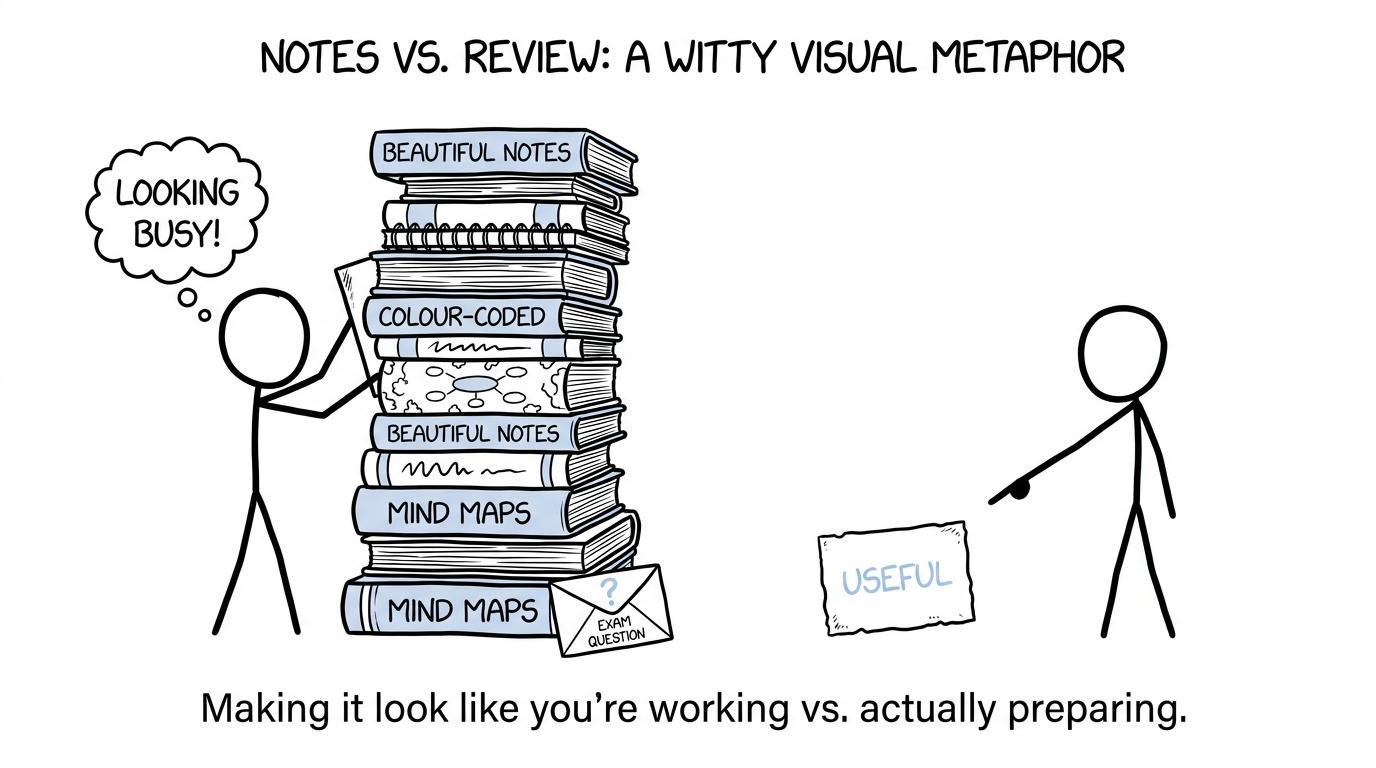 A student discovers that one useful revision card beats a tower of decorative notebooks
Your GCSE engineering note-taking checklist
A useful set of notes should contain:
- the topic and specification point;
- a short definition in your own words;
- labelled diagrams only where they clarify structure or process;
- relevant equations, symbols and units;
- conditions or limitations attached to each rule;
- one or two retrieval questions;
- links to related maths topics;
- mistakes found through practice;
- a date for reviewing the page again.
The exact engineering qualification depends on your school. Some students take GCSE Engineering, while others follow a Level 111/222 engineering or engineering design course. Content and assessment arrangements vary, so use your current specification and teacher guidance as the final authority. The note-taking system below works across these routes because it focuses on recall, application and mathematical accuracy.
Build notes for retrieval, not transcription
Copying feels safe because the information is visible. Unfortunately, visibility can create a false sense of familiarity. When the book closes, the knowledge may disappear with it.
Retrieval reverses that process. Instead of looking at an answer repeatedly, you try to bring it back from memory. Research on learning consistently supports combining retrieval practice with spaced review rather than relying on rereading alone.
Divide each topic page into three working areas:
| Area | What to record |
|---|---|
| Core knowledge | Definitions, principles, processes and essential diagrams |
| Maths toolkit | Equations, units, conversions and graph skills |
| Retrieval prompts | Questions you must answer with the page covered |
For a materials topic, the core knowledge might distinguish properties such as toughness, hardness and ductility. The maths area might contain density or percentage-change relationships. The prompt area could ask you to identify which property matters under a particular loading condition.
The prompt is what makes the page reusable. Without it, notes are mostly a storage system. With it, they become a revision activity.
Keep each page centred on one idea
Engineering topics connect naturally, but putting everything on one page makes later review slow. Give each sheet or digital note a clear purpose such as materials selection, manufacturing processes, forces, tolerances, energy, mechanisms or quality control.
At the top, write a question rather than a decorative title. For example:
- How do material properties affect product design?
- Which manufacturing process suits this shape and production volume?
- How do I read dimensions and tolerances correctly?
- Which quantities must use consistent units before calculation?
A question tells your future self what the page helps you do. It also gives you an immediate retrieval test: cover the page and attempt to answer its heading.
Use consistent tags to show connections. A small MATHS label can mark content requiring calculation; DESIGN can indicate justification; PROCESS can flag sequencing. This is faster and more meaningful than colouring whole paragraphs.
Create a compact engineering maths toolkit
Maths is not a separate appendix to engineering. It is often the language used to describe size, force, efficiency, cost and performance. Your notes should therefore include a compact formula bank, but never a list of equations without meaning.
For every relationship, record:
- what each symbol represents;
- the unit expected for each quantity;
- whether units must be converted first;
- when the relationship applies;
- the rearrangements you are likely to need.
Common relationships may include:
density=massvolume\text{density}=\frac{\text{mass}}{\text{volume}}density=volumemass speed=distancetime\text{speed}=\frac{\text{distance}}{\text{time}}speed=timedistance efficiency=useful outputtotal input×100%\text{efficiency}=\frac{\text{useful output}}{\text{total input}}\times 100\%efficiency=total inputuseful output×100%Do not assume that the formula is the difficult part. Many lost marks come from selecting inconsistent units, substituting into the wrong relationship or reporting an answer without a suitable unit.
Use the MathsGenie GCSE revision topics to strengthen weak mathematical links. Engineering calculations frequently draw on ratio and proportion revision, compound measures, area and perimeter, volume and interpreting graphs.
Make units impossible to ignore
Place units beside the quantity name, not only at the end of a formula. Keep a small conversion strip on relevant pages, covering relationships such as:
1 m=1000 mm1\text{ m}=1000\text{ mm}1 m=1000 mmand
1 cm3=1000 mm3.1\text{ cm}^3=1000\text{ mm}^3.1 cm3=1000 mm3.Notice that length and volume do not scale in the same way. This is exactly the sort of detail that attractive but passive notes often hide. A useful note should expose the decision you need to make.
Use diagrams as thinking tools
Engineering is visual, so diagrams matter. Yet copying a detailed image line by line can consume time without improving understanding.
Draw only what helps you recall a component, process, force, mechanism or relationship. Use arrows deliberately. Label the feature and explain why it matters. If a part is under tension, compression, bending or torsion, make that information visible rather than leaving the drawing to stand alone.
For scale drawings, dimensions and geometric reasoning, connect your engineering page to the relevant lesson on the MathsGenie GCSE revision hub. The goal is not to duplicate an entire maths lesson. It is to leave a clear route back when practice reveals a gap.
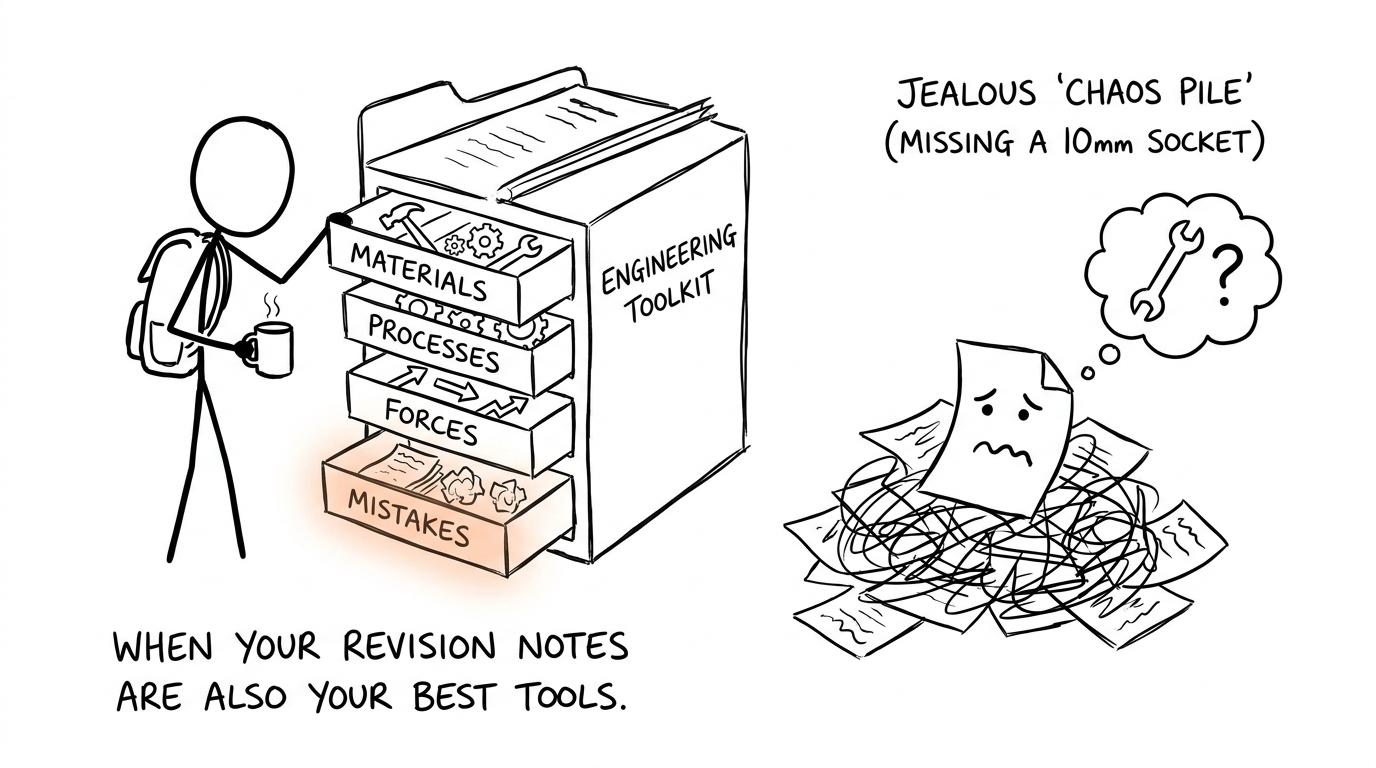 An organised engineering revision folder behaves like a useful tool cabinet
Turn lesson notes into revision notes
Notes taken during a lesson are a first draft. They contain explanations written at speed, reminders that made sense in the moment and perhaps a diagram you did not quite finish. Do not expect that draft to carry your revision months later.
Use a short conversion routine after the lesson:
- remove duplicated wording;
- complete unclear labels;
- check formulas and units;
- add one link to prior knowledge;
- write two retrieval questions;
- flag anything you still cannot explain.
This need not become a rewriting project. Five focused minutes can be more useful than producing a perfect second copy. If a page needs extensive repair, summarise it onto one retrieval card instead.
A strong card has a prompt on one side and a concise answer on the other. Prompts should require thought: compare two processes, justify a material choice, name the unit needed, rearrange a relationship or interpret a graph trend. Questions that merely ask you to recognise a highlighted word are too weak.
Review notes on a spaced schedule
The best notes still fail if they remain closed. Review them after increasing intervals rather than waiting until the night before an assessment.
A simple cycle is:
- first review shortly after the lesson;
- second review a few days later;
- third review the following week;
- later reviews during mixed-topic practice.
Begin every review with the page covered. Answer the heading question, sketch the key diagram from memory or write the equation with its units. Then open the notes, check accuracy and add only what was missing.
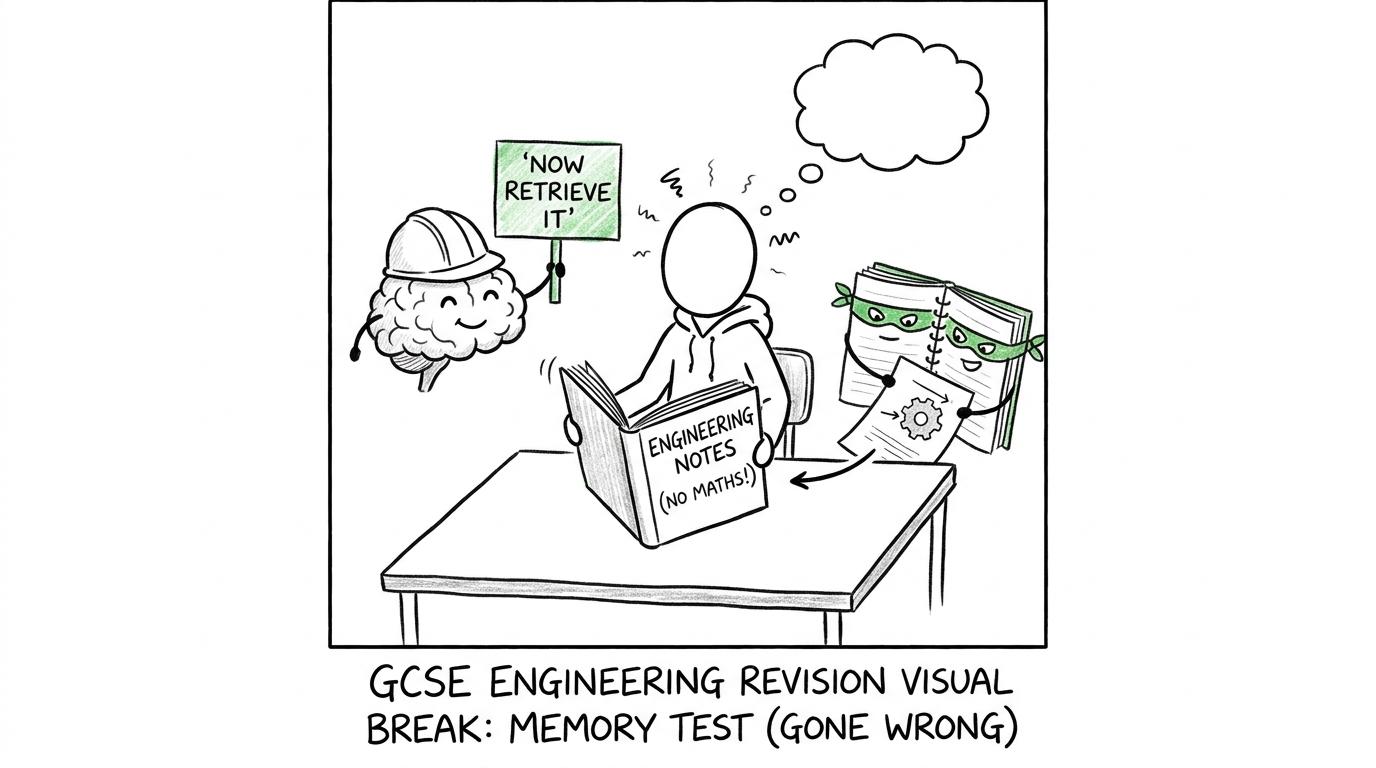 A hard-hat-wearing brain asks a student to retrieve the answer before opening the notebook
Let questions improve your notes
The most valuable note may be the one added after getting something wrong. Practice reveals distinctions that seemed obvious during a lesson: radius versus diameter, mass versus weight, area units versus volume units, or total input versus useful output.
Use GCSE maths past papers to test the mathematical parts of engineering topics under exam-style conditions. When you mark your work, do not simply write the correct answer. Add a brief diagnosis to the relevant note:
- wrong relationship chosen;
- units not converted;
- diagram information missed;
- premature rounding;
- explanation lacked engineering context.
This turns a mark scheme into feedback you can act on. Later, MathsGenie predicted papers can support timed maths practice, while the topic lessons, practice questions, mini tests and video solutions help you repair individual gaps.
Common GCSE engineering note-taking mistakes
Copying every sentence
A transcript records what was said but does not identify what matters. Compress explanations into keywords, relationships and decisions. Keep detail only where removing it would change the meaning.
Highlighting without a system
If most of the page is coloured, nothing is prioritised. Assign a limited purpose to each mark, such as formulas, units, warnings or specification language.
Recording formulas without context
An equation alone does not tell you when to use it. Add symbol meanings, units, conditions and a retrieval prompt beside every important relationship.
Making notes but never testing them
Reading is not the same as recalling. Cover the answer, attempt the prompt and check honestly. The moment of uncertainty is not failure; it is where useful revision begins.
Rewriting everything neatly
Neatness helps only when it improves navigation or clarity. Do not spend an hour reproducing information you already understand. Direct that time towards questions, marking and targeted corrections.
Keeping engineering and maths completely separate
An engineering problem may depend on geometry, ratio, percentages, graphs or compound measures. Add direct links between the two subjects so that a maths weakness does not remain hidden until the assessment.
Build notes that earn their place
Good notes are not judged by how impressive they look on the day they are written. Their value appears later, when a prompt helps you recover an equation, a unit warning prevents an error or a mistake log tells you exactly what to practise.
Start with one topic. Reduce it to core knowledge, its maths toolkit and a small set of retrieval questions. Test the page. Improve it after practice. Then repeat.
MathsGenie can provide the other half of that system. Use the free GCSE revision lessons to rebuild understanding, then move to practice questions, mini tests, past papers, mark schemes and video solutions. As exams approach, use predicted papers and a revision plan to combine topics under time pressure. Your engineering notes will then do what notes are supposed to do: help you think when the answer is no longer sitting in front of you.