GCSE Mark Schemes: Eduqas Students’ Secret Weapon
GCSE mark schemes can transform Eduqas Maths revision. Learn how to spot method marks, use follow-through, and turn mistakes into higher grades.

The quiet power of a mark scheme
Most GCSE Maths revision advice sounds loud: “Do more papers”, “Practise every day”, “Learn the formulae”. But the biggest improvements often come from something quieter: the mark scheme.
If you’re an Eduqas student, you’ve probably had this experience. You finish a past paper, turn to the mark scheme, and it feels like reading someone else’s language. Codes, ticks, short phrases, and an answer that looks nothing like what you wrote. It’s tempting to treat the mark scheme as a verdict: right or wrong.
Used properly, a mark scheme isn’t a verdict. It’s a map. And for GCSE Maths, where method marks matter as much as final answers, learning to read that map is one of the fastest ways to move up grades 9-1.
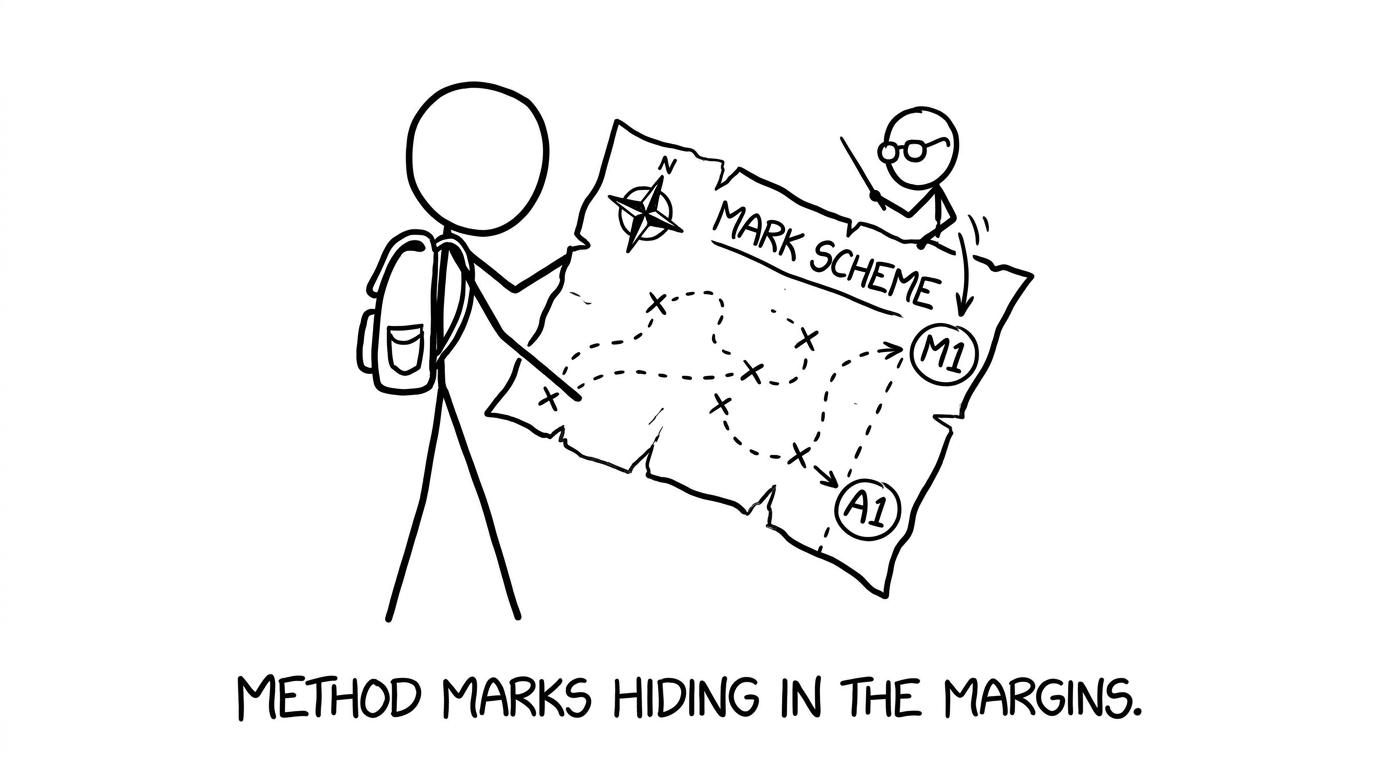 Student opens mark scheme like a treasure map
A quick checklist for using a mark scheme (the “don’t waste the pain” method)
When you mark a GCSE paper, do this every time:
- Circle the marks for the question before you look at solutions.
- Identify what the marks are paying for: method, accuracy, reasoning.
- Compare structure, not just numbers: what did they write that you didn’t?
- Write a one-line fix: “Next time I must…”.
- Redo the question 24-48 hours later without looking.
To practise this with real exam-style questions, start with YesGenie’s GCSE Past papers and combine it with topic help from the Eduqas GCSE Maths Revision Guides.
What mark schemes are really testing in GCSE Maths
A mark scheme isn’t just checking whether you can do maths. It’s checking whether you can do maths in an exam, under time pressure, with limited space, and with marks split across steps.
Method marks vs accuracy marks
Most GCSE Maths questions reward process.
- A method mark is earned for a correct approach, even if you make a slip later.
- An accuracy mark is earned for getting the correct result, usually dependent on the method.
That’s why “I knew how to do it but I got the wrong answer” can still be worth marks, if you showed enough working.
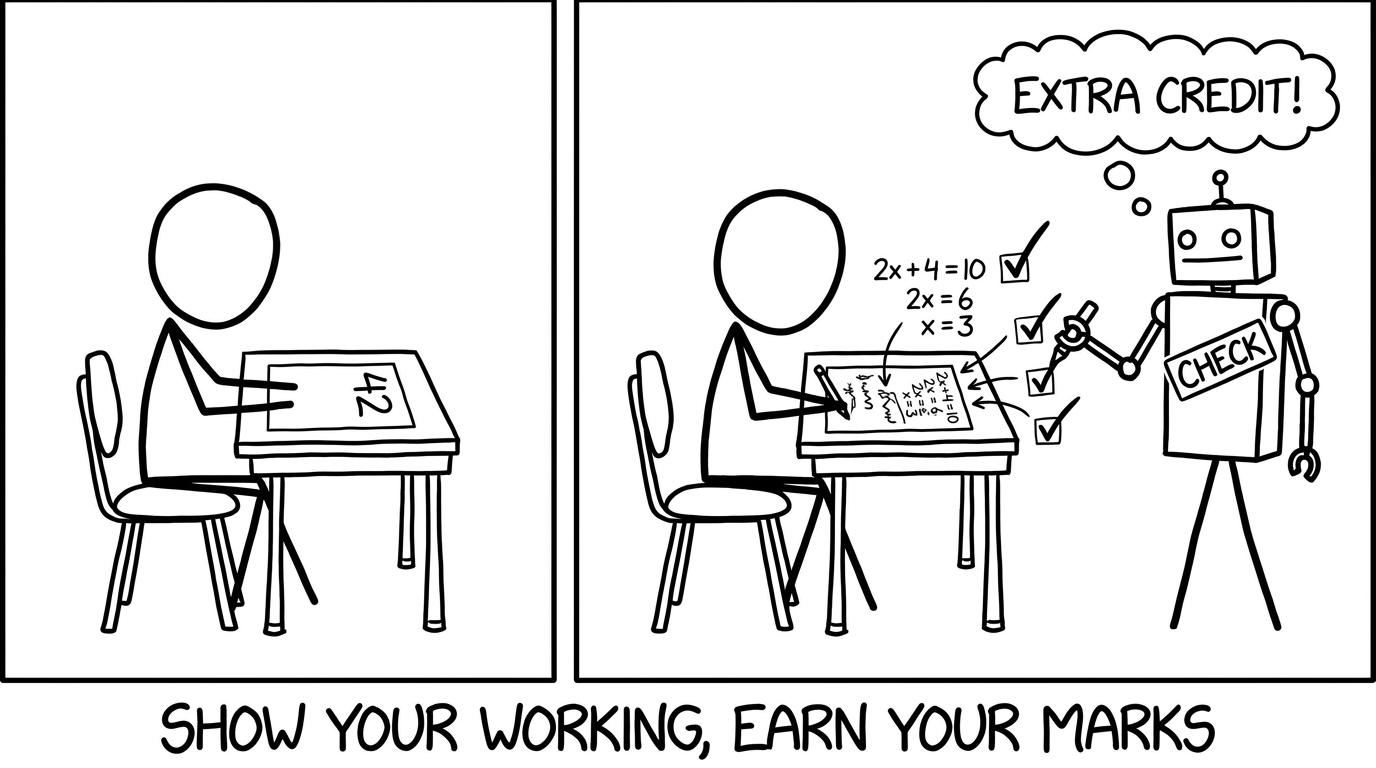 Two students: answers-only vs working-out
Follow-through marks (the exam board’s small act of mercy)
Mark schemes often allow follow-through: if you make one mistake early but then use your incorrect value consistently and correctly, you can still gain later marks.
This matters for Eduqas GCSE papers because multi-step questions are common, and a single arithmetic error shouldn’t wipe out your whole solution.
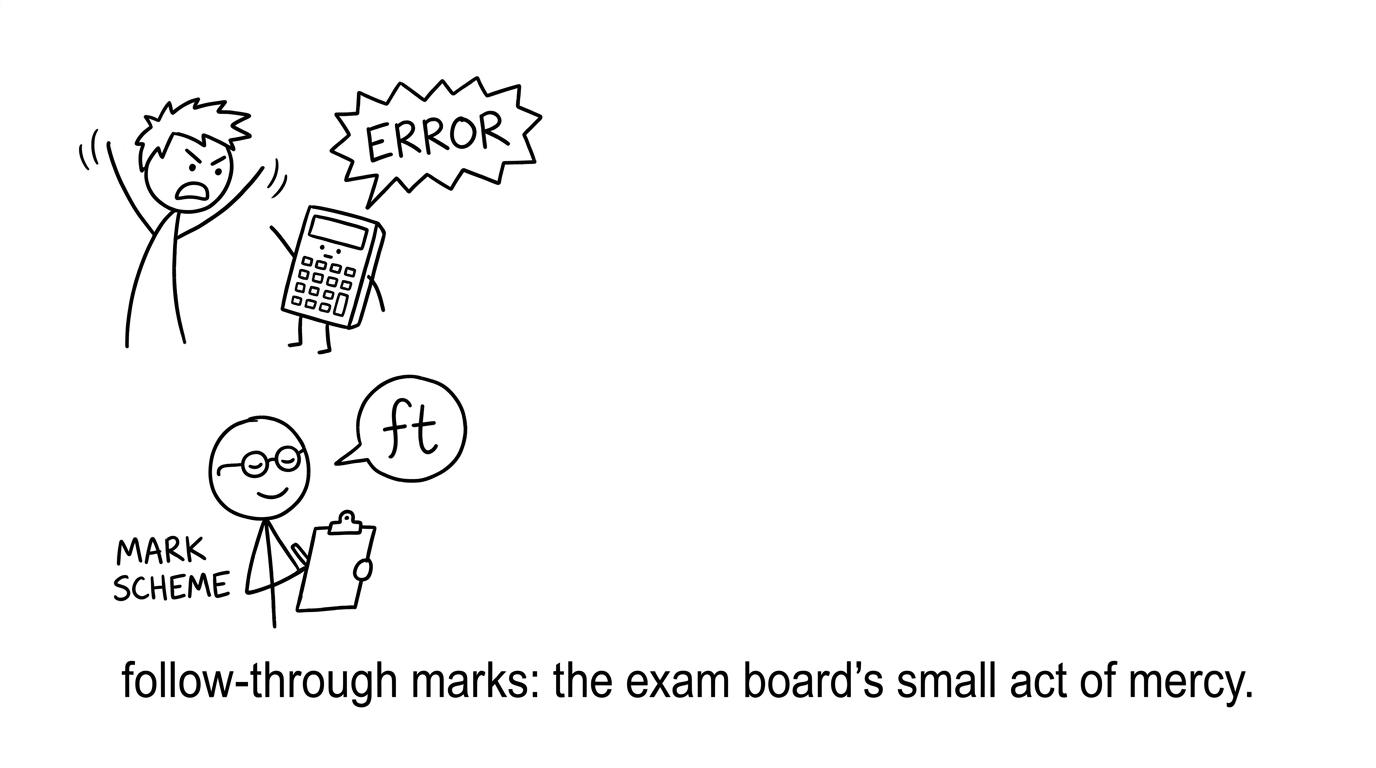 Calculator says ERROR, mark scheme says ft
How Eduqas students should “read” a mark scheme
Your job is not to memorise solutions. Your job is to reverse-engineer what the examiner needed to see.
Start with the mark total, then split it into “chunks”
If a question is worth 4 marks, it usually isn’t “4 marks for the answer”. It’s more like:
- 1 mark for setting it up
- 1 mark for a key transformation
- 1 mark for a correct intermediate value
- 1 mark for the final answer (often with units, rounding, or justification)
When you mark, ask: Which chunk did I miss?
Notice acceptable alternatives
Good GCSE mark schemes often include “or equivalent” routes. That’s a hint: the exam board rewards correct maths, not one sacred method.
But there’s a catch. Even if multiple methods are allowed, your working still needs to be legible, directed, and checkable.
Extract “exam language” for reasoning marks
Eduqas GCSE Maths also rewards clear reasoning. When the mark scheme uses phrases like “because”, “therefore”, “so”, or points out a conclusion, it’s showing you the minimum reasoning that earns the mark.
If you’re losing marks in “show that” or “prove” style questions, spend time on the higher-grade topics and how solutions are communicated. A useful starting point for tricky, mark-scheme-heavy topics is Bounds.
Worked example: turn a 4-mark loss into a repeatable method
Here’s a classic GCSE algebra skill where mark schemes reveal what earns marks.
Example 1: solving a quadratic (method marks live in the setup)
Solve x2−5x+6=0x^2 - 5x + 6 = 0x2−5x+6=0.
A mark scheme typically expects factorising (or the quadratic formula). Factorising:
x2−5x+6=(x−2)(x−3) x^2 - 5x + 6 = (x-2)(x-3) x2−5x+6=(x−2)(x−3)Then use the zero-product rule:
x−2=0 or x−3=0 x-2=0 \;\text{or}\; x-3=0 x−2=0orx−3=0So:
x=2 or x=3 x=2 \;\text{or}\; x=3 x=2orx=3How the mark scheme helps you improve:
- If you wrote only x=2,3x=2,3x=2,3 with no working and made a slip, you likely lose everything.
- If you showed (x−2)(x−3)=0(x-2)(x-3)=0(x−2)(x−3)=0 but wrote x=2x=2x=2 only, you usually gain method marks.
- If you expanded incorrectly but still used a correct solving method afterwards, you might get follow-through.
If you need to rebuild the basics behind this kind of question, you can practise algebra structure using topic pages like Simplifying Algebra (the skills transfer directly across exam boards, even if the URL shows Edexcel).
Worked example: using the mark scheme to rescue “lost” marks in ratio
Example 2: ratio with a method mark for the setup
A recipe uses flour and sugar in the ratio 5:25:25:2.
If the recipe uses 350 g350\text{ g}350 g of flour, how much sugar is needed?
A clear method that mark schemes reward:
- 555 parts correspond to 350350350.
- So 111 part is 3505=70\frac{350}{5}=705350=70.
- Sugar is 222 parts, so 2×70=1402 \times 70 = 1402×70=140.
Answer: 140 g140\text{ g}140 g.
Why this matters for Eduqas GCSE marking: the method marks often sit in the “1 part” line. If you jump straight to 350×25350 \times \frac{2}{5}350×52 and slip, you might lose more marks than if you wrote the parts method clearly.
To get more questions like this and see consistent structure, use YesGenie’s GCSE Past papers and then funnel your weak topics into revision from the Eduqas GCSE Maths Revision Guides.
How to turn mark schemes into a personal revision plan
A mark scheme is most powerful when it changes what you do next, not what you think about what you did.
Build a “mark scheme error log” (small, specific, repeatable)
After each GCSE paper or mini test, write mistakes in three columns:
- Topic (e.g. bounds, trig, linear graphs)
- What the mark scheme wanted (one sentence)
- My fix (one action)
Example:
- Topic: bounds
- Wanted: lower and upper bounds written correctly with units
- Fix: always write LB=…\text{LB}=\ldotsLB=… and UB=…\text{UB}=\ldotsUB=… before calculating
Use short retakes, not long guilt
Most students re-read mark schemes and feel productive, but don’t actually change performance. The change happens when you redo.
A strong pattern for GCSE Maths:
- Do one paper section.
- Mark it carefully.
- Redo only the questions you lost marks on, 48 hours later.
If you want structure, YesGenie’s Resources page is a good hub for predicted papers and timed practice options.
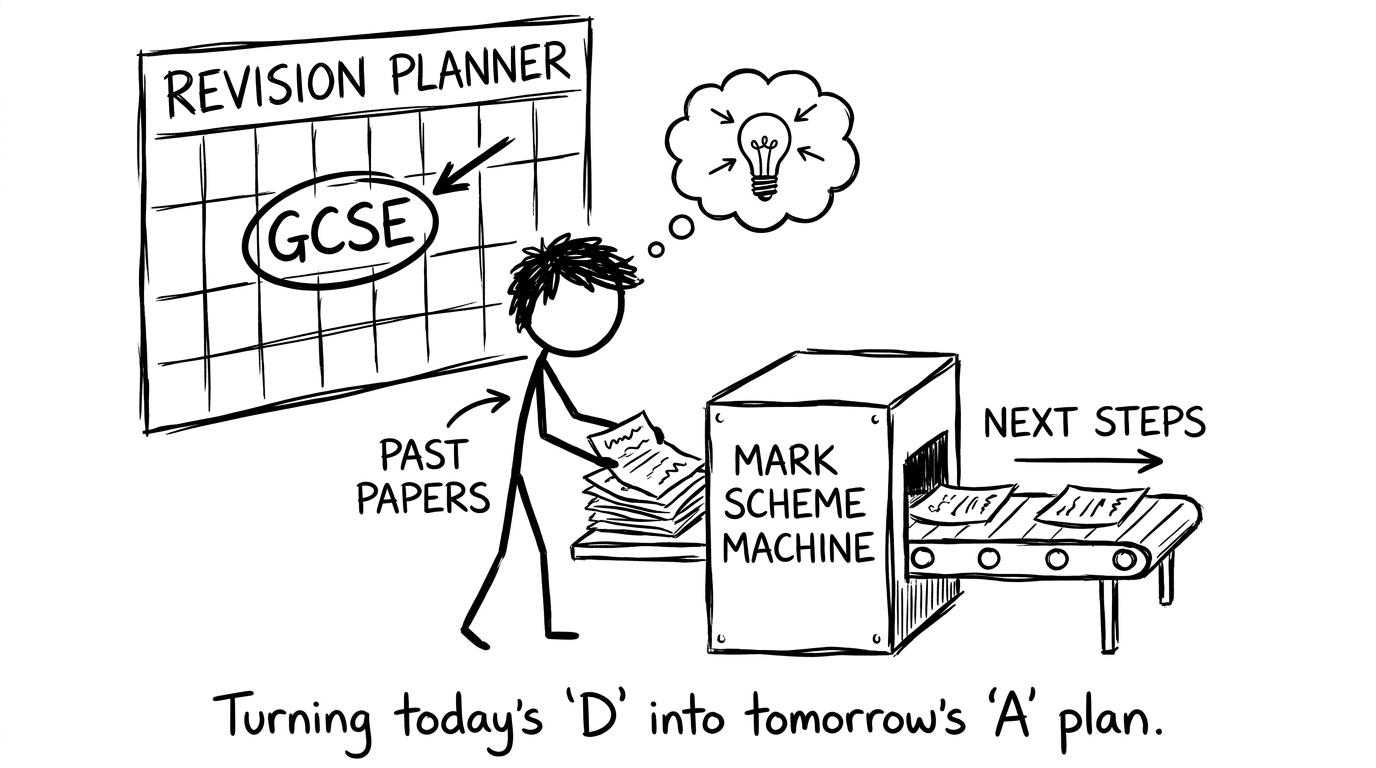 Revision planner turns past papers into next steps
Common mistakes Eduqas GCSE students make with mark schemes
- Marking by answers only: you tell yourself you were “basically right”, but the mark scheme rewards visible steps.
- Copying the solution without diagnosing the gap: you end up recognising it, not being able to reproduce it.
- Ignoring units and rounding: many GCSE marks are quietly sitting next to cm2\text{cm}^2cm2, m/s\text{m/s}m/s, or “to 333 s.f.”.
- Not learning from follow-through: if you see follow-through allowed, it’s a sign you should keep going in the exam even after a mistake.
- Treating “show that” as optional: the mark scheme is looking for a chain of equalities and a clear conclusion.
Bringing it together: make the mark scheme your coach
A GCSE mark scheme is one of the few revision tools that tells the truth with no drama. It shows what the examiner pays for: structure, method, clarity, accuracy, and sometimes a single unit you forgot to write.
For Eduqas students, the goal isn’t to “do more”. It’s to do fewer questions, more intelligently, so each paper leaves behind a trail of upgrades you can actually repeat.
Use YesGenie to make that easy: start with GCSE Past papers, plug gaps using the Eduqas GCSE Maths Revision Guides, and build momentum with targeted topic practice and worked solutions. If you’re revising close to exams, check Resources for predicted papers and extra practice.
Your next grade jump probably isn’t hiding in a new topic. It’s hiding in the margin of a mark scheme, waiting for you to notice what it was trying to teach you all along: how to earn marks on purpose.