

GCSE Drama 5 to 7: How to Raise Your Grade
GCSE drama 5 to 7: discover how precise performance choices, stronger analysis and mark-scheme-led revision can help you reach a higher grade with confidence.
Moving from a grade 555 to a grade 777 in GCSE Drama is rarely about becoming louder, writing more or suddenly discovering a talent for emotional monologues. It is about making clearer choices and explaining them with greater precision.
The central difference in a GCSE drama 555 to 777 journey is control. Grade 555 work often communicates a sensible idea but develops it unevenly. Grade 777 work is more deliberate: performance decisions support an interpretation, written answers connect evidence to meaning, and evaluation explains why something was effective.
This guide shows you the specific changes that can move your work towards a higher grade band. Exact component names, assessment weightings and marking language vary across AQA, Edexcel, OCR and Eduqas, so keep your own specification and teacher's guidance beside you.
Your grade 555 to 777 checklist
Focus on these five improvements:
- turn general performance ideas into precise physical and vocal choices;
- sustain your character and intentions throughout a performance;
- explain the effect of each choice on the audience;
- use detailed evidence when analysing live theatre or a set text;
- revise according to assessment objectives and mark schemes, not instinct alone.
There is no universal mark that guarantees a grade 777. GCSE grades are awarded from your overall assessed work, and grade boundaries can change between exam series and exam boards. Your real target is therefore to produce work that consistently matches the higher-level language in your board's mark scheme.
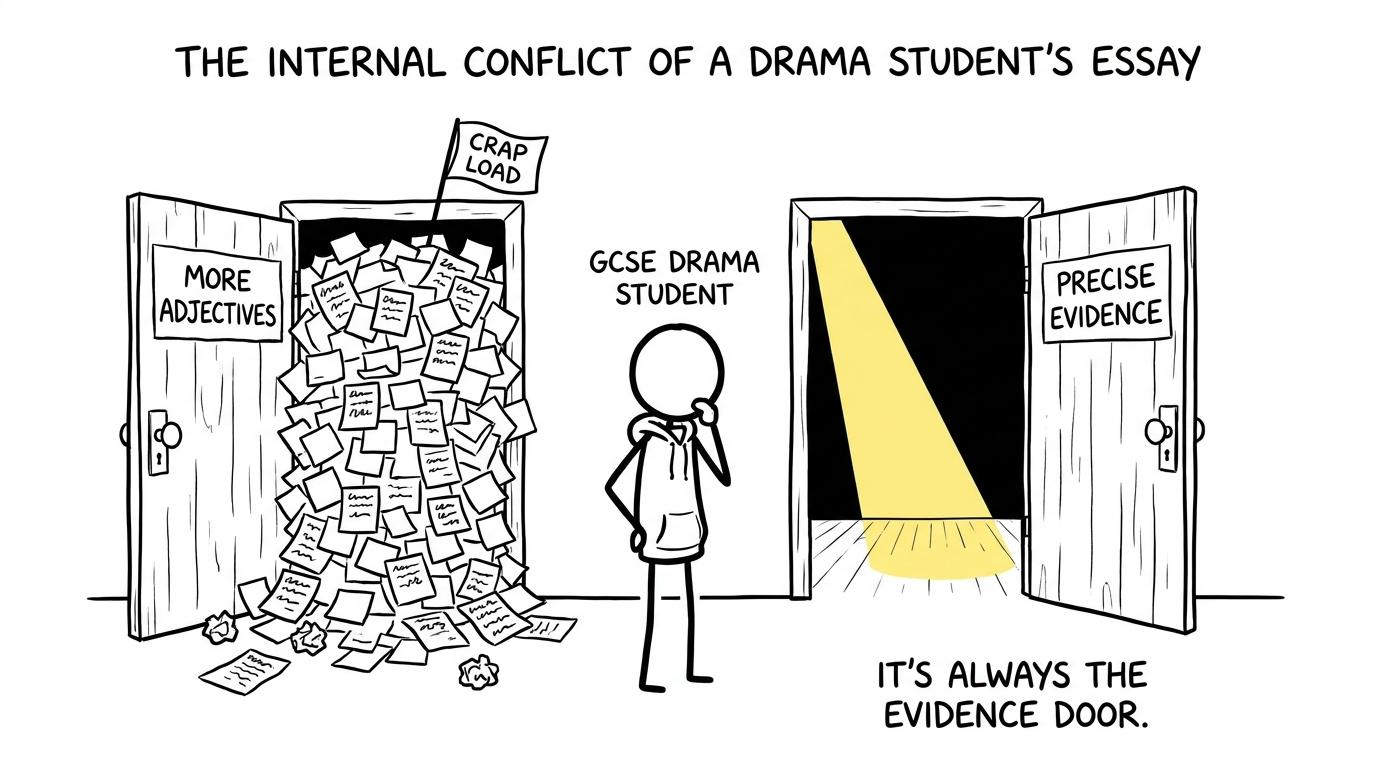 A Drama student choosing precise evidence over a mountain of adjectives
What separates a grade 555 from a grade 777 in GCSE Drama?
A grade 555 student normally demonstrates secure knowledge and some effective skills. The performance makes sense. The written answer contains relevant ideas. The evaluation identifies strengths and weaknesses.
At grade 777, those same elements become connected and purposeful.
| Grade 555 tendency | Grade 777 direction |
|---|---|
| A clear but occasionally inconsistent character | A sustained, controlled and convincing interpretation |
| Appropriate vocal or physical skills | Carefully selected skills that communicate a specific intention |
| Relevant comments about a performance | Detailed analysis supported by precise moments from the performance |
| Explanation of what happened | Explanation of how and why choices created meaning |
| Some evaluation of success | Balanced judgement linked to intentions and audience response |
| Ideas taken from the script or stimulus | A developed interpretation shaped through rehearsal and refinement |
These are not official universal grade descriptors. Each board uses its own levels and terminology. They are practical distinctions drawn from the qualities GCSE Drama assessments generally reward: knowledge, application, analysis, evaluation, creative development and performance or design skill.
The important shift is from identifying a choice to justifying it.
Make every performance choice intentional
A student working around grade 555 might say that a character should appear nervous. A stronger student decides how that nervousness will be communicated, when it will intensify and what the audience should understand from it.
That requires control over details such as:
- pitch, pace, pause, tone, volume and emphasis;
- posture, gesture, facial expression, gait and stillness;
- positioning, proximity, eye contact and use of levels;
- reactions while another character is speaking;
- changes that reveal a turning point in the scene.
More techniques do not automatically mean more marks. A single pause placed at the right moment may communicate more than continuous movement and exaggerated expression. The question is always: what does this choice reveal?
Sustain the interpretation
A convincing opening is not enough if concentration fades halfway through the scene. Higher-band performance is sustained, including during transitions, moments of silence and other actors' dialogue.
Rehearse short sections and give each run a narrow purpose. One run might focus only on pace. Another might test physical distance between characters. Record the section, review it against your intention and change one element at a time.
This resembles effective maths revision. Rather than completing random questions, you isolate one weakness, practise it and check the result. MathsGenie's GCSE revision lessons and practice questions use that focused structure across grades 999-111.
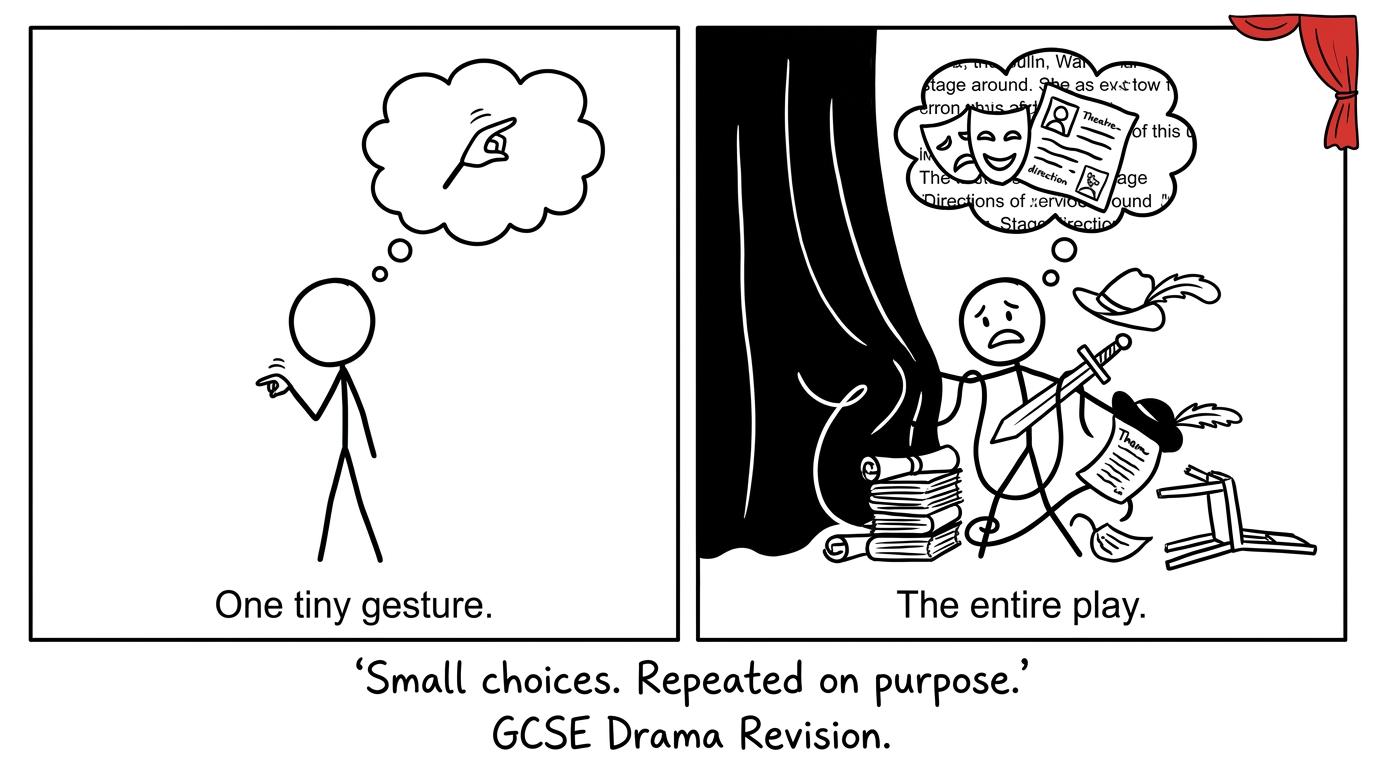 One student refining a gesture while another becomes tangled in an entire production
Develop ideas instead of collecting them
Devising can feel productive when the rehearsal room is full of ideas. But marks are not awarded for the size of the pile. Development matters.
For each significant idea, record:
- where it came from;
- what you wanted the audience to think or feel;
- how you explored it practically;
- what feedback or observation revealed;
- what you changed and why;
- how the final decision supported the overall intention.
A grade 555 portfolio may describe a rehearsal chronologically: first the group tried one scene, then another. Grade 777 evidence is more selective. It identifies meaningful decisions and shows a chain of creative reasoning.
Your log should not become a diary of everything that happened. It should preserve evidence of development.
Use feedback as evidence of refinement
Writing that your teacher or group gave feedback is not enough. State what the feedback revealed and how your practical work changed because of it.
If a scene was confusing, for instance, the valuable part is not the word "confusing". It is the decision that followed: perhaps simplifying the staging, clarifying the character relationship or changing the rhythm of an exchange. The revision becomes evidence that you can evaluate and refine your work independently.
Write precise analysis rather than longer answers
In written Drama, vague language creates a ceiling. Comments such as "the acting was powerful" or "the lighting created tension" identify an effect without analysing how it was produced.
A stronger paragraph follows a clear reasoning chain:
- make a judgement that answers the question;
- identify a precise performance or design detail;
- explain what that detail communicated;
- analyse its effect on the audience;
- connect it to character, context, theme or dramatic intention.
Use subject terminology where it makes the explanation more exact. Do not add terminology simply to sound sophisticated. "Proxemics" earns no special credit if you never explain what the distance between characters revealed.
Select evidence you can reconstruct accurately
For live theatre, prepare a bank of memorable moments rather than attempting to memorise the whole production. Include moments involving acting, staging and relevant design elements such as lighting, sound, costume or set.
For each moment, know what happened, how it was achieved and why it mattered. Check your exam board's rules and current question wording because requirements differ.
Timed writing is essential. The same principle applies when using GCSE maths past papers: answering under time pressure exposes gaps that ordinary note-reading can hide. Afterwards, compare your response with the level descriptors, mark scheme and teacher feedback.
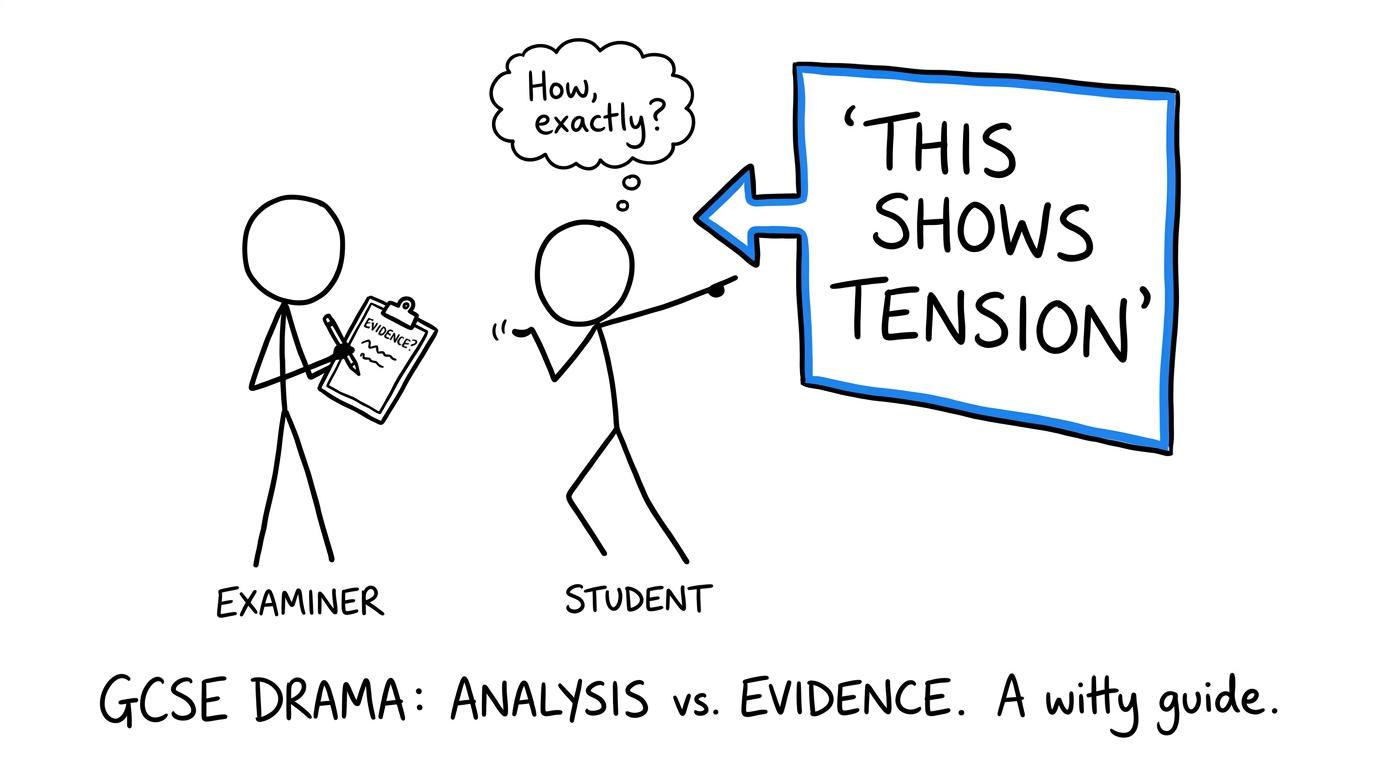 An examiner asks how a dramatic choice creates tension
Evaluate with evidence and judgement
Evaluation is not the same as praise. Nor is it a list of mistakes.
A useful evaluation considers how successfully the final work achieved its intention. It should acknowledge limitations, but every judgement needs evidence. Explain which moment you are discussing, what you intended, how the audience appeared likely to interpret it and what could have made the communication clearer.
Avoid claiming to know every audience member's feelings. It is safer and more analytical to write that a choice was intended to create an effect, or that it was likely to encourage a particular interpretation, before supporting that judgement with evidence.
The strongest evaluation often discusses change. It recognises that an early idea may have been interesting but unsuitable, and that removing or adapting it improved the final piece. Creative maturity includes knowing what not to keep.
Build a revision system around the mark scheme
Drama contains practical work, written preparation and content knowledge. Treating all three as one enormous task makes revision difficult to measure.
Divide your week into short, visible jobs:
- rehearse and review one practical extract;
- plan one timed paragraph;
- retrieve quotations or key moments from the set text;
- revisit one live-theatre example;
- compare one response with a mark scheme;
- update a vocabulary or evidence bank.
Use your specification to confirm exactly what is assessed. Then translate assessment language into questions you can ask yourself: Have I analysed rather than described? Have I justified this decision? Is my interpretation sustained? Is my evidence precise?
Students balancing Drama with maths can use the structure of the MathsGenie GCSE revision page to organise maths by topic and grade while reserving focused sessions for Drama. Past papers and mark schemes help make maths practice measurable, while MathsGenie predicted papers provide further exam-style practice when available for the relevant series.
The subjects are different, but the productive cycle is the same: attempt, check, diagnose, improve and attempt again.
Common mistakes that keep students near grade 555
Describing instead of analysing
Retelling a scene does not explain how dramatic meaning was created. Reduce plot summary and spend more time on methods, intentions and effects.
Using ambitious vocabulary without precision
Several technical terms cannot replace one exact observation. Use terminology only when it helps you explain a particular moment.
Treating volume as the main sign of emotion
Emotion can also be communicated through pace, breath, stillness, posture, focus and reaction. Constant intensity leaves a performance with nowhere to develop.
Making audience claims without evidence
Do not state that an audience "definitely felt shocked" unless you have valid evidence. Explain how the choice was designed to produce that response and why it was likely to do so.
Writing rehearsal diaries
A chronological account records activity but may not demonstrate development. Select decisions that reveal experimentation, feedback, refinement and intention.
Ignoring command words
"Describe", "explain", "analyse" and "evaluate" require different kinds of response. Read the whole question, identify its focus and keep returning to it.
Revising only by reading notes
Recognition feels comfortable but does not test recall or performance under pressure. Rehearse from memory, plan without notes and complete timed questions. For your maths timetable, combine MathsGenie video explanations and practice resources with full exam-paper practice.
Move upwards through small, deliberate changes
The distance between grades 555 and 777 can look large when viewed as one leap. In practice, it is usually a collection of smaller changes: one performance choice made more precise, one paragraph supported with better evidence, one rehearsal evaluated more honestly.
Begin by comparing your latest work with your exam board's level descriptors. Choose the single weakness that appears most often and make it the focus of your next rehearsal or written response. Once the improvement becomes consistent, move to the next weakness.
MathsGenie can keep the rest of your exam preparation equally focused. Use the free GCSE maths revision resources, practice questions, video solutions and mini tests to strengthen individual topics, then test your progress with past papers and mark schemes. Add predicted papers where appropriate and organise the work through your revision planner.
A higher grade is rarely produced by one heroic revision session. It comes from learning to notice what better work looks like, and then making that quality repeatable.











