GCSE Chemistry Revision for CCEA: Stuck at a Pass?
GCSE Chemistry CCEA revision when you’re stuck at a pass grade: use maths-led methods, past-paper habits and a simple plan to lift your marks.
If you’re a CCEA student revising GCSE Chemistry and you feel stuck at a pass grade, it can feel strangely personal. You’re doing “revision”, you’re showing up, and yet every test seems to land in the same place. The truth is usually less dramatic: you’re not failing Chemistry; you’re leaking marks in the parts where Chemistry quietly becomes maths. And because GCSE exam papers are built from mark schemes, small numerical habits can make a big difference.
This post is written for UK GCSE and A Level maths students who want a practical way to lift Chemistry marks (especially calculations) without turning revision into a panic. You’ll use maths revision techniques, the same ones that move grades in GCSE maths, and aim them at the CCEA GCSE Chemistry pass boundary.
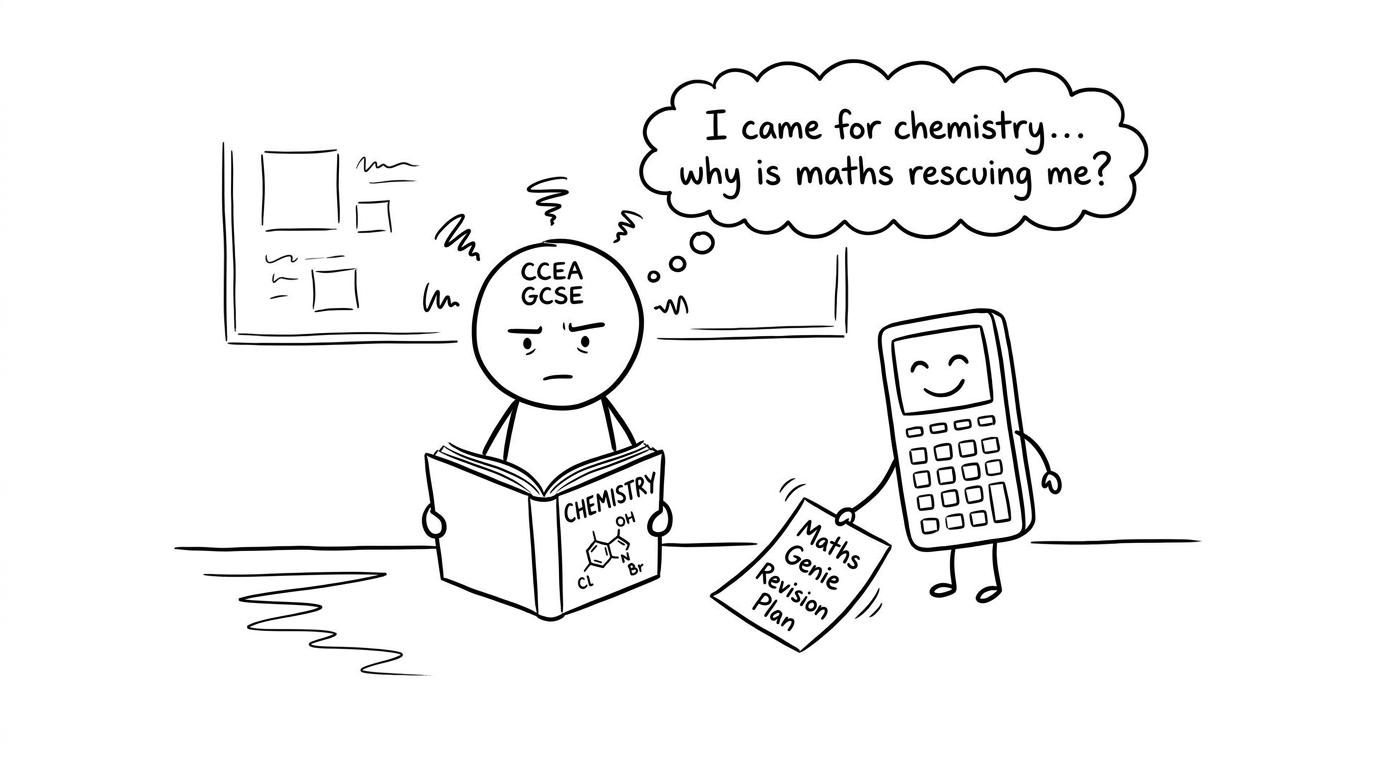 Student came for chemistry, maths rescues them
The quick checklist (what to do when you’re stuck at a pass grade)
If you want a pass to become a safer pass (and ideally a higher grade), you need a routine that produces marks, not just familiarity.
- Find your “maths leak” topics: percentage change, rearranging formulae, ratio/proportion, unit conversion, graphs.
- Practise with a mark scheme mindset: method marks first, accuracy marks second.
- Do short, repeated cycles: learn, practise, check, fix, repeat.
- Keep a one-page “error log”: every lost mark becomes a future saved mark.
- Use maths mini-tests for speed and confidence, then return to Chemistry questions.
YesGenie is a maths site, but that’s a feature here, not a limitation: if your Chemistry grade is stuck, a clean lift often comes from getting calmer and sharper at GCSE calculations.
Why CCEA GCSE Chemistry feels harder when you’re near a pass
Near a pass grade, most students can recall some content. The difference is that they can’t reliably turn that recall into marks under time pressure. CCEA GCSE Chemistry papers (like AQA, Edexcel, OCR and Eduqas equivalents) reward:
- choosing the correct relationship (often a formula),
- substituting values with correct units,
- rearranging safely,
- rounding to a sensible number of significant figures,
- writing a conclusion that matches the command word.
That’s maths behaviour. And the annoying part is that it’s usually not “hard maths”; it’s GCSE maths done carefully.
To train that, build your habits using maths resources you can trust:
- GCSE Past papers for realistic timing and mark schemes
- Edexcel GCSE Maths Revision (skills practise that transfers directly)
- WJEC GCSE Maths Revision and Eduqas GCSE Maths Revision Guides for topic-by-topic explanations
- Edexcel GCSE Maths Mini Tests for short bursts of retrieval and speed
- Resources when you want a quick bank of practice formats
The pass-grade strategy: stop revising everything, start revising what pays
A student stuck at a pass grade usually revises in a wide, comforting way: re-reading notes, highlighting, watching videos, “going over” topics. It feels responsible, but it doesn’t force precision.
A better GCSE strategy is narrower and sharper:
Choose three “high-return” calculation skills
For CCEA GCSE Chemistry, these usually include:
- Percentages (percentage yield, percentage error, concentration changes)
- Ratio and proportion (reacting masses, particle models, dilutions)
- Rearranging formulae + units (density, rate, energy, gas volume)
These are also core GCSE maths skills. When you improve them, you don’t just improve one topic; you improve your ability to collect method marks across the paper.
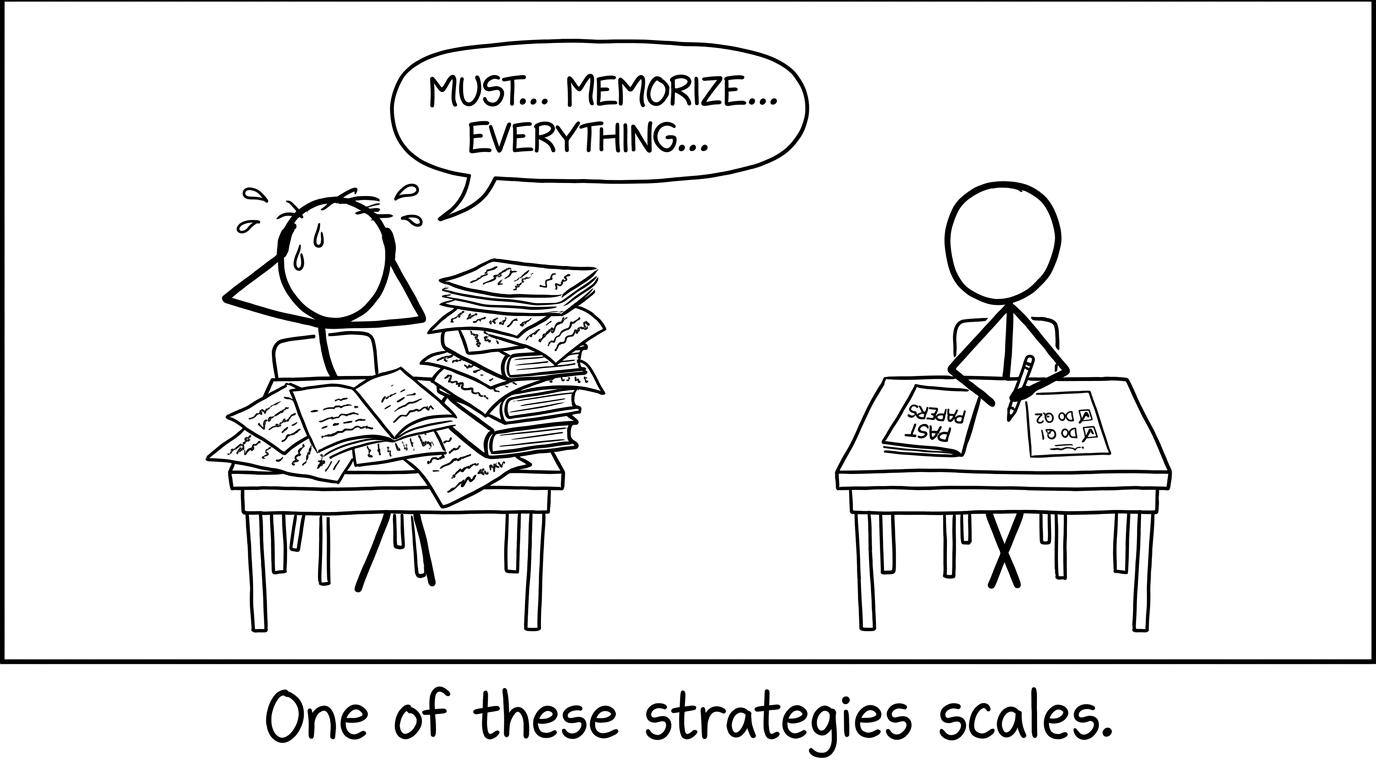 Two strategies: memorising vs past-paper practise
Worked examples: the Chemistry that is secretly GCSE maths
You don’t need dozens of examples. You need a few, done slowly, with a mark scheme mindset.
Percentage yield (the “easy marks” topic students rush)
Example: Theoretical yield is 12 g12\text{ g}12 g. Actual yield is 9 g9\text{ g}9 g. Find the percentage yield.
Use the structure:
percentage yield=actualtheoretical×100 \text{percentage yield} = \frac{\text{actual}}{\text{theoretical}} \times 100 percentage yield=theoreticalactual×100Substitute:
percentage yield=912×100=0.75×100=75% \text{percentage yield} = \frac{9}{12} \times 100 = 0.75 \times 100 = 75\% percentage yield=129×100=0.75×100=75%Why this lifts a pass grade: even if your Chemistry memory is shaky, this is a reliable 2-3 marks if you write the method clearly.
To practise this skill quickly, use percentage change and fraction confidence from GCSE maths revision, then return to Chemistry questions. A good home base is any structured topic system like Edexcel GCSE Maths Revision, because the practise is designed to build method security.
Concentration from mass and volume (unit discipline wins marks)
A common school definition is:
concentration=mass of solutevolume of solution \text{concentration} = \frac{\text{mass of solute}}{\text{volume of solution}} concentration=volume of solutionmass of soluteExample: 2.5 g2.5\text{ g}2.5 g of solute is dissolved to make 500 cm3500\text{ cm}^3500 cm3 of solution. Find concentration in g dm−3\text{g dm}^{-3}g dm−3.
Step 1: convert cm3\text{cm}^3cm3 to dm3\text{dm}^3dm3.
1000 cm3=1 dm3⇒500 cm3=0.5 dm3 1000\text{ cm}^3 = 1\text{ dm}^3 \Rightarrow 500\text{ cm}^3 = 0.5\text{ dm}^3 1000 cm3=1 dm3⇒500 cm3=0.5 dm3Step 2: substitute.
concentration=2.50.5=5 g dm−3 \text{concentration} = \frac{2.5}{0.5} = 5\text{ g dm}^{-3} concentration=0.52.5=5 g dm−3Pass-grade lesson: you can know the formula and still lose marks if you ignore units. Write the conversion line every time until it becomes automatic.
If unit conversions are a weak point, revise the underpinning skill in GCSE maths: conversion factors and place value. Topic practice and mini-tests help here: Edexcel GCSE Maths Mini Tests.
Density (rearranging a formula without fear)
Density questions are classic “marks you can bank” if you rearrange cleanly.
ρ=mV \rho = \frac{m}{V} ρ=VmExample: A solid has mass 120 g120\text{ g}120 g and density 2.4 g cm−32.4\text{ g cm}^{-3}2.4 g cm−3. Find its volume.
Rearrange:
ρ=mV⇒V=mρ \rho = \frac{m}{V} \Rightarrow V = \frac{m}{\rho} ρ=Vm⇒V=ρmSubstitute:
V=1202.4=50 cm3 V = \frac{120}{2.4} = 50\text{ cm}^3 V=2.4120=50 cm3What this teaches: rearranging is not a “higher tier trick”; it’s a pass-grade skill that wins method marks. If you can do this reliably, you stop dropping the easy questions.
To strengthen rearranging, practise the pure maths version first, then return to Chemistry. Any systematic GCSE maths topic list helps, for example Eduqas GCSE Maths Revision Guides.
Drawing a straight-line graph and reading gradients
Even when the science context changes, the maths is steady: plot accurately, choose sensible scales, draw a best-fit line, then interpret.
Example: A line passes through (2,5)(2, 5)(2,5) and (8,17)(8, 17)(8,17). Find the gradient.
gradient=ΔyΔx=17−58−2=126=2 \text{gradient} = \frac{\Delta y}{\Delta x} = \frac{17 - 5}{8 - 2} = \frac{12}{6} = 2 gradient=ΔxΔy=8−217−5=612=2Why it matters in GCSE Chemistry: rate graphs and “relationship” questions often ask for proportionality or trends. If your graph skills are calm, you don’t bleed marks on presentation.
How to use mark schemes to escape the pass-grade plateau
Most students use mark schemes like a judge. High scorers use them like a coach.
When you finish a question, don’t only ask “what’s the answer?” Ask:
- Where were the method marks? (a formula line, a rearrangement, a substitution)
- Where were the accuracy marks? (final value, rounding, units)
- What would have earned a follow-through mark?
YesGenie past papers are built to encourage this behaviour: GCSE Past papers let you practise under exam conditions, then compare your working to the mark scheme style.
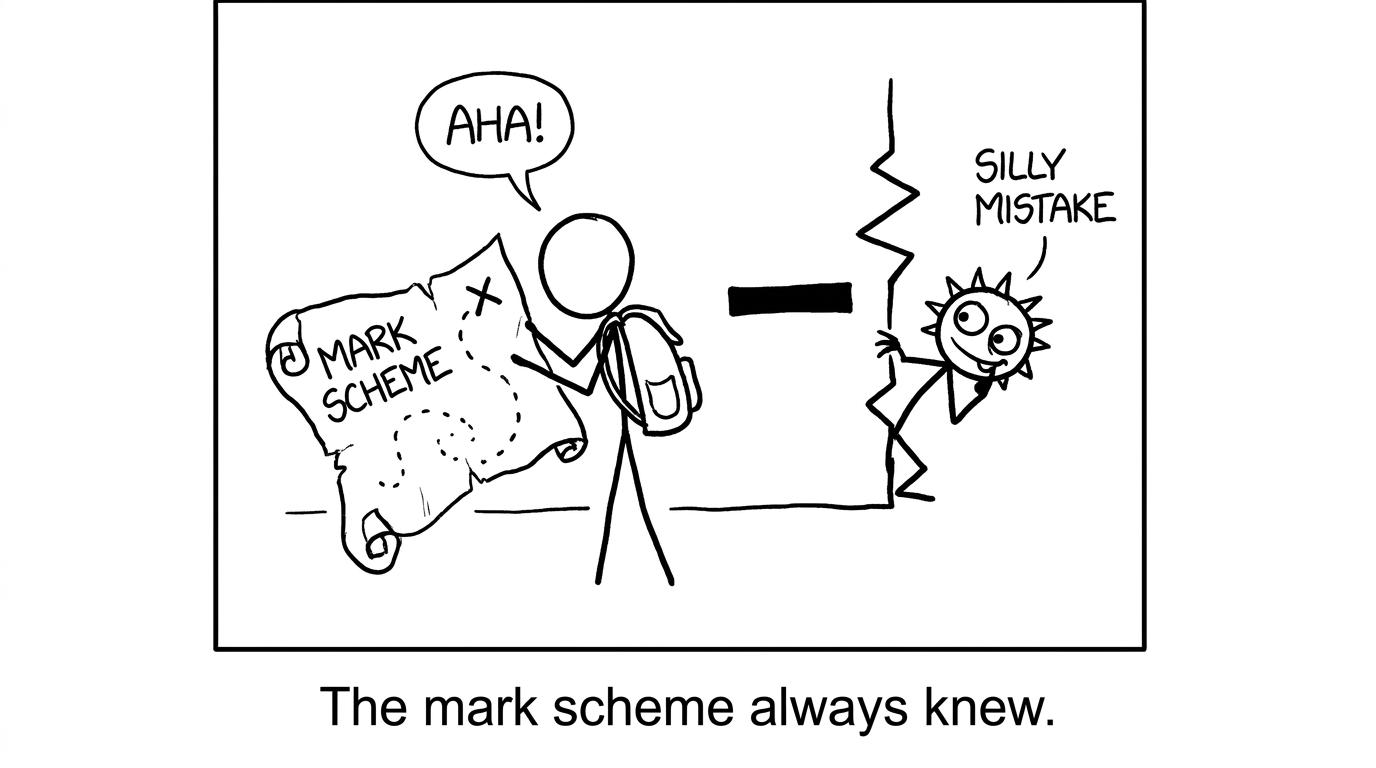 Mark scheme as treasure map, silly mistake gremlin
A two-week revision plan for CCEA GCSE Chemistry (maths-led)
This is designed for students stuck at a pass grade who need a quick, realistic lift.
Week 1: build the calculation engine
- Day 1-2: percentage change and fractions (maths practice) then one Chemistry percentage-yield set.
- Day 3-4: ratio/proportion and unit conversions, then concentration and reacting mass questions.
- Day 5: rearranging formulae (density-style), then mixed calculations.
- Day 6: graphs and gradients, then one full graph question set.
- Day 7: one timed paper section, then mark scheme analysis and error log.
Week 2: turn it into exam marks
- Day 8-10: two short timed sets (15-20 minutes each), focusing on your three leak areas.
- Day 11: one longer timed session (45-60 minutes) and strict marking.
- Day 12: re-do only the questions you got wrong (same style, new numbers if possible).
- Day 13: final mixed calculation practise, then summary sheet of formulae, units, and pitfalls.
- Day 14: rest, light recap, early night.
This is exactly how GCSE maths grades move: short cycles, lots of checking, and targeted repetition. Use maths pages like Edexcel GCSE Maths Revision alongside timed practice from GCSE Past papers.
Common mistakes that keep CCEA students stuck at a pass grade
- Skipping units and then wondering why the final value is “off”. If you write units at each step, you catch errors early.
- Rounding too soon. Keep exact values until the end unless the question instructs otherwise.
- Not writing the formula. Even if you can do it in your head, writing the formula often secures a method mark.
- Misreading cm3\text{cm}^3cm3 and dm3\text{dm}^3dm3 conversions. Learn the key equivalence 1000 cm3=1 dm31000\text{ cm}^3 = 1\text{ dm}^31000 cm3=1 dm3 and use it every time.
- Guessing the trend on graphs without calculating a gradient or describing the relationship precisely.
- Practising only easy questions. If you’re stuck, you need the uncomfortable middle: exam-style questions that force method.
 Beaker and graph arguing about doing each other’s jobs
Bringing it together: use GCSE maths habits to lift GCSE Chemistry marks
If you’re a CCEA student stuck at a pass grade, your goal isn’t to “revise harder”. It’s to revise in a way that turns into marks under pressure. For most students, that means treating GCSE Chemistry calculations like GCSE maths: write the method, control the units, practise with mark schemes, and repeat until it’s automatic.
Use YesGenie as your free training ground for the skills that keep leaking marks: start with structured topic practice on Edexcel GCSE Maths Revision or WJEC GCSE Maths Revision, build speed with Edexcel GCSE Maths Mini Tests, and then simulate the real pressure using GCSE Past papers. Add in the wider Resources when you need a different practice format.
When you’re ready, make it simple: practise, mark, fix, repeat. That’s how a pass becomes secure, and how a secure pass becomes a better GCSE grade.