GCSE CCEA Physics: Use Mark Schemes to Gain Marks
GCSE CCEA students can use mark schemes to spot exam patterns, fix weak maths, and write high-mark answers. A practical step-by-step guide.

If you’ve ever walked out of a CCEA GCSE Physics paper thinking, “I knew that”, and then opened the mark scheme and lost faith in your own brain; you’re not alone. The frustrating truth is that in GCSE exams, knowing the physics isn’t always the same as earning the marks. Mark schemes aren’t just a post-mortem. Used properly, they’re a training plan: they tell you what examiners reward, what they ignore, and which tiny details quietly decide your grade.
This is a maths student’s advantage. Physics is full of calculations, units, rearranging formulae, and proportional reasoning. If you treat the mark scheme like feedback on your method, you can build a repeatable approach that lifts your marks quickly.
 A student holding a mark scheme like a treasure map
A quick checklist for using a mark scheme properly
Use this after every timed question set or past paper section:
- Mark in two passes: first for method, then for accuracy.
- Circle command words in the question (state, calculate, explain, describe).
- Underline what the mark scheme repeats (key phrases, units, rounding, substitutions).
- Record a “mark-loss reason” (units, rounding, no working, wrong formula, weak explanation).
- Re-do the question without looking, 24-48 hours later.
To practise with plenty of exam-style maths (the part that often limits Physics grades), use YesGenie’s GCSE Past Papers alongside maths topic practice like Speed and Density questions (scroll to the “Speed and Density” row) and revision resources from Resources.
Why mark schemes feel “picky” (and why that’s good)
A mark scheme is basically a list of evidence. Examiners can’t award marks for thoughts you didn’t write down. That’s why mark schemes often:
- reward a formula even before any numbers,
- reward a substitution even if the final answer is wrong,
- insist on units even when the number is correct,
- accept multiple wordings, but only if the meaning matches.
In CCEA GCSE Physics, this matters because lots of questions are “half maths, half communication”. Students lose marks not because they can’t do the topic, but because they don’t show the exact pieces of working that prove it.
The mark scheme codes you should actually care about
Different exam boards (AQA, Edexcel, OCR, Eduqas, CCEA) have slightly different styles, but most mark schemes boil down to a few ideas:
- Method marks: you can earn these for the correct approach even if the arithmetic slips.
- Accuracy marks: usually dependent on the method being visible.
- Communication marks: clear statements, correct units, correct rounding, correct significant figures.
- Follow-through: sometimes you can carry forward an earlier wrong value and still gain later marks if the method is consistent.
Even though YesGenie is primarily a maths revision site, you can see how examiners think by looking at real mark schemes in the GCSE Past Papers area. That habit transfers beautifully into Physics: show your steps, label your units, and make your reasoning legible.
A mark-scheme-first method for calculation questions
When you review a Physics calculation with the mark scheme, don’t just check the final number. Instead, ask: “What evidence were they looking for?”
A strong GCSE calculation answer usually contains these four lines:
- Write the formula
- Rearrange if needed
- Substitute with units
- Final answer with correct rounding and units
Worked example: speed (classic Physics maths)
A student runs 150 m150\text{ m}150 m in 25 s25\text{ s}25 s. Calculate their speed.
Step 1: formula
v=dt v = \frac{d}{t} v=tdStep 2: substitute
v=15025 v = \frac{150}{25} v=25150Step 3: calculate
v=6 v = 6 v=6Step 4: units
v=6 m s−1 v = 6\text{ m s}^{-1} v=6 m s−1Why this earns marks in a mark scheme: even if you made a slip like 150÷25=5150\div 25 = 5150÷25=5, the written formula and substitution can still secure method marks. This is the same reason showing working matters in GCSE maths, especially on multi-mark questions.
For more practice on this style of calculation, build consistency using YesGenie’s GCSE Maths Edexcel revision hub (methods transfer across boards) and short timed practice from Edexcel GCSE Maths Mini Tests.
Using mark schemes to upgrade your written explanations
Some of the most “unfair-feeling” GCSE Physics marks are in 3-6 mark explanations: students write a lot, but the mark scheme wanted three specific points.
A mark-scheme-first approach is to turn explanations into a point bank:
- Read the mark scheme and highlight the distinct marking points.
- Rewrite them in your own words as short bullet points.
- Practise producing only those bullets in 45-60 seconds.
The goal isn’t to sound clever. It’s to sound markable.
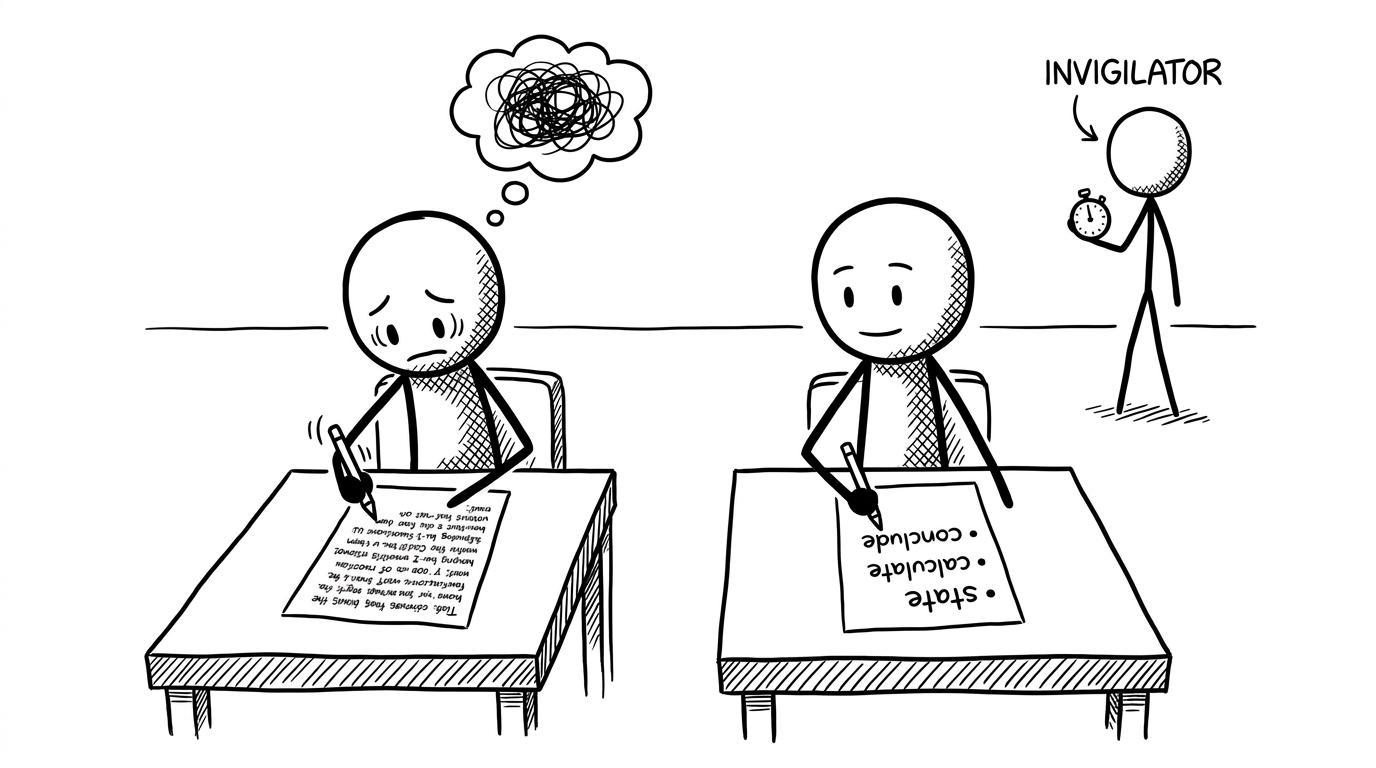 Exam hall with one student writing paragraphs and another writing bullet points
Mini worked example: turning waffle into marks
Question: “Explain why a parachutist reaches terminal velocity.”
A mark scheme often rewards ideas like:
- weight acts downwards, drag acts upwards,
- drag increases with speed,
- eventually drag equals weight,
- resultant force becomes zero,
- acceleration becomes zero so speed becomes constant.
A mark-winning answer can be short:
- As the parachutist speeds up, drag increases.
- Eventually drag equals weight, so resultant force is 000.
- With zero resultant force, acceleration is 000, so the speed stays constant (terminal velocity).
Notice the structure: cause (drag increases); condition (forces balance); consequence (no acceleration). That’s exactly how mark schemes are built.
The “maths marks” CCEA Physics students lose most often
CCEA GCSE Physics calculations rarely require advanced algebra, but they punish small habits. Mark schemes make these habits obvious.
Units and conversions
If the mark scheme expects m s−1\text{m s}^{-1}m s−1 and you give m/s\text{m/s}m/s you’ll usually be fine, but if you forget units entirely you often lose a mark. Conversions are worse: cm\text{cm}cm to m\text{m}m, g\text{g}g to kg\text{kg}kg, minutes to seconds.
Example conversion you should do automatically:
3.5 km=3.5×1000=3500 m 3.5\text{ km} = 3.5\times 1000 = 3500\text{ m} 3.5 km=3.5×1000=3500 mRounding and significant figures
If values are given to 222 s.f., aim for 222 or 333 s.f. unless the question says otherwise. Mark schemes often accept a small range, but they won’t accept inconsistent rounding that changes the value meaningfully.
Rearranging formulae
This is the quiet divider between “I understand it” and “I can score on it”. Physics rearrangement is GCSE algebra.
Worked rearrangement:
Given
V=IR V = IR V=IRfind III.
Divide both sides by RRR:
I=VR I = \frac{V}{R} I=RVThat’s a single algebra step, but it’s frequently a full method mark in a mark scheme.
To strengthen rearranging (vital for Physics), practise the GCSE topic Changing the Subject of a Formula (scroll to that row) and revise methods using a full course hub like GCSE Maths CCEA.
A simple routine: “mark scheme reflection” in 10 minutes
After you finish a Physics past paper section, do this:
- Spend 2 minutes circling every lost mark.
- Spend 3 minutes categorising each loss: method missing, unit missing, conversion, explanation point missing, rounding, read question wrong.
- Spend 3 minutes rewriting one perfect model answer for the worst question.
- Spend 2 minutes setting a micro-goal for the next attempt (e.g. “units on every line”).
This is how mark schemes turn into progress. Not by reading them once, but by building a feedback loop.
Common mistakes (and how the mark scheme exposes them)
- Writing the correct final answer with no working: you risk losing all method marks if the number is wrong. Mark schemes reward evidence.
- Forgetting units or using the wrong unit: especially when converting cm\text{cm}cm to m\text{m}m or g\text{g}g to kg\text{kg}kg. The mark scheme usually has a dedicated unit mark.
- Rounding too early: if you round mid-calculation, you can drift outside acceptable tolerance. Keep full calculator values, round at the end.
- Using a formula that doesn’t match the quantity asked: e.g. using v=dtv=\frac{d}{t}v=td when the question expects acceleration from a speed change. Mark schemes are unforgiving because they’re signalling the correct physics relationship.
- Answering “explain” questions like “describe” questions: explain needs a cause-and-effect chain, and the mark scheme lists those links.
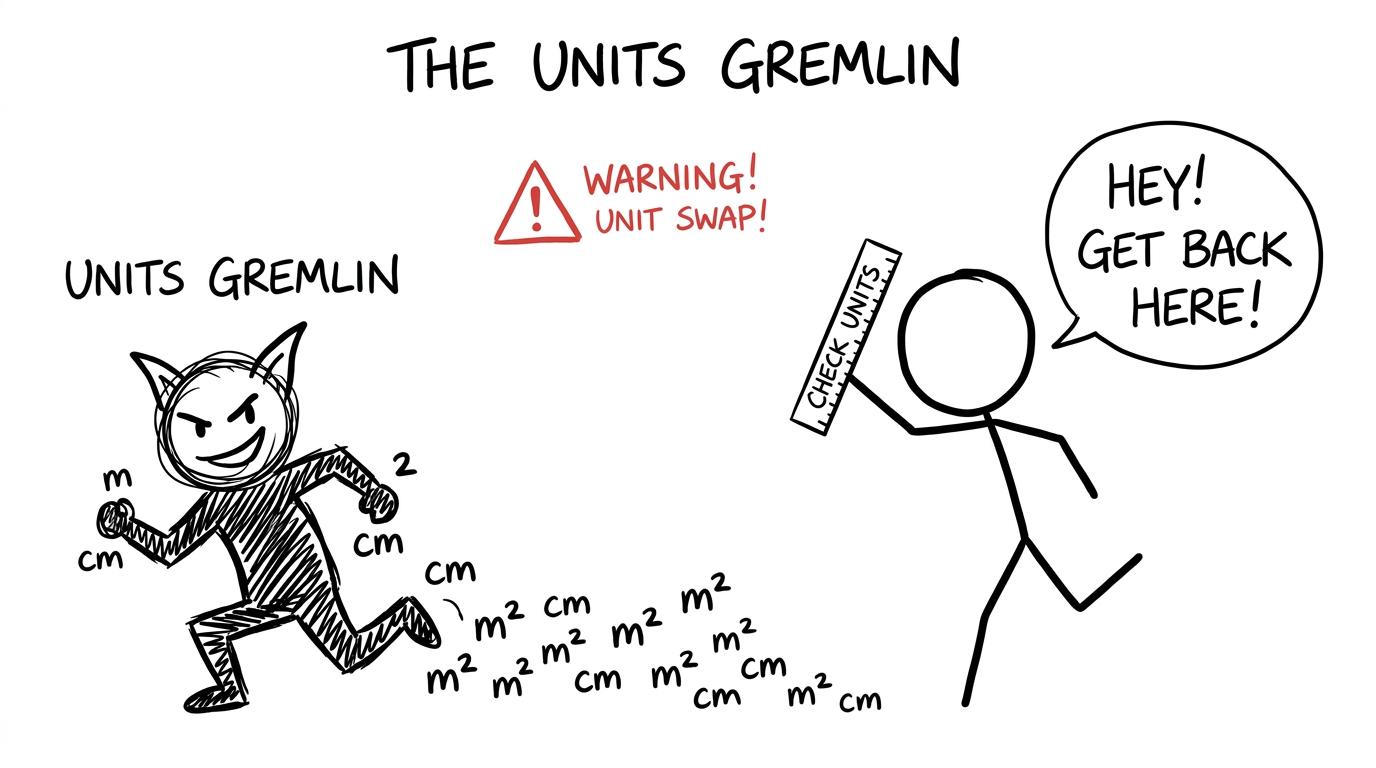 A units gremlin stealing marks by swapping cm and m
Bringing it back to GCSE success (and using YesGenie properly)
CCEA GCSE Physics can feel like it’s testing two things at once: the science, and your ability to communicate it in the examiner’s language. Mark schemes are the translator. They show you how marks are built from small, repeatable decisions: formula first, steps shown, units included, explanation points stated.
If you’re a GCSE or A Level maths student, lean into what you already do well. Use YesGenie to strengthen the maths that powers Physics: algebra, rearranging formulae, proportional reasoning, and careful calculation. Start with GCSE Maths CCEA, practise under time pressure with GCSE Past Papers, and keep momentum with Mini Tests and Predicted Papers.
Do that, and the next time you open a mark scheme, it won’t feel like a list of things you didn’t do. It’ll feel like a map, and you’ll know exactly where the marks are.