GCSE CCEA guide: Help with Physics revision without nagging
GCSE CCEA guide for parents: support Physics revision without nagging. Use routines, past papers and calm check-ins to build confidence and marks.
The quiet moment before the argument
Every household has a version of it. Your child is at the table, the Physics book is open, and the air feels tense in that familiar way it does in spring. You want them to do well in their GCSE, because you can see what it would mean: less panic, more confidence, better options later. But the more you ask, the less they do. The more you remind, the more they resist.
Here’s the truth most families learn the hard way: revision rarely fails because of laziness. It fails because of friction. Parents can reduce that friction massively, without turning the house into an exam hall.
This CCEA-focused guide is written for the reality of Northern Ireland homes, but it’s also designed to help UK GCSE and A Level maths students who are revising alongside Physics. Because in Physics, the maths isn’t a side quest; it’s the engine.
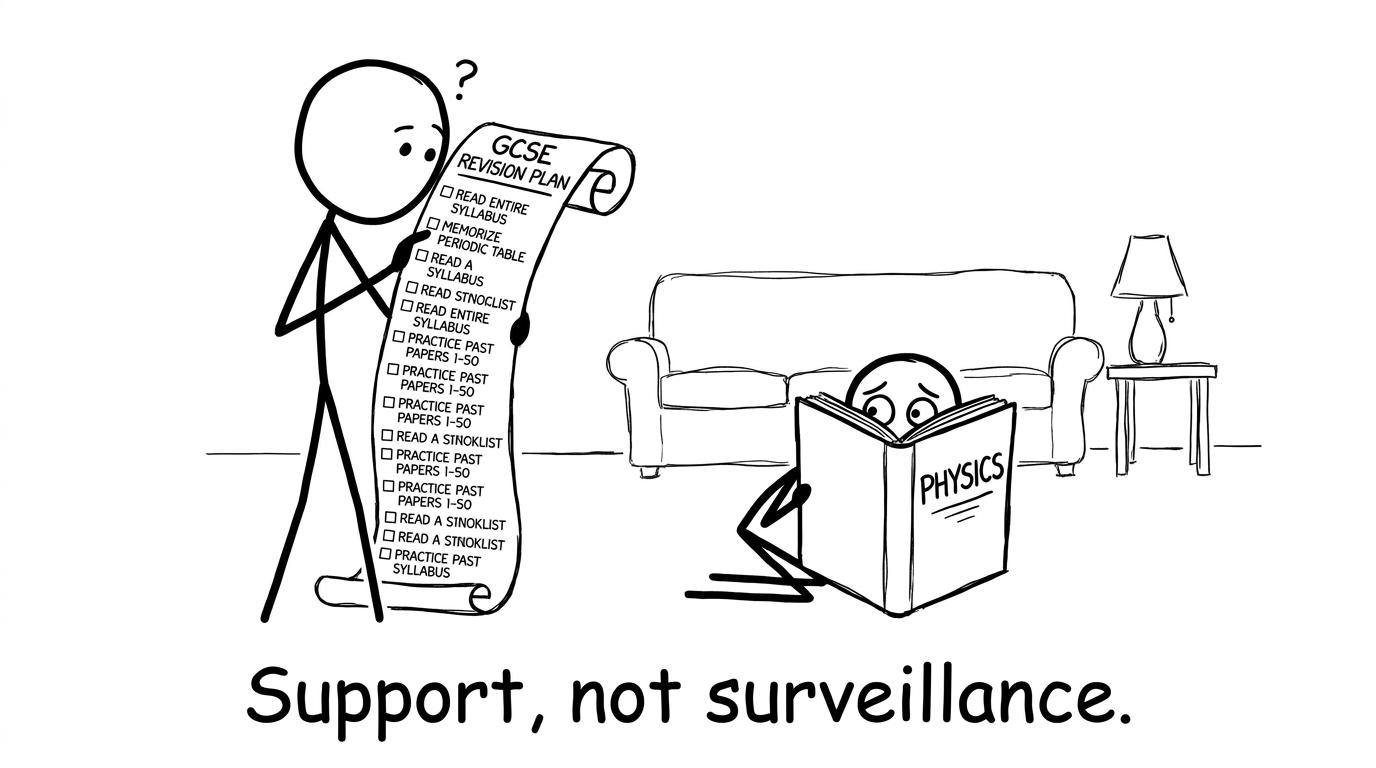 A parent with a giant revision checklist while a student hides behind a physics textbook
A parent’s checklist for supporting GCSE revision (without nagging)
Use this as a “support plan”, not a surveillance plan:
- Agree a simple weekly routine (same time, same place) for GCSE revision.
- Ask about inputs (time, focus, resources), not outputs (grades, rank, pressure).
- Make practice visible and easy: past papers, mark schemes, and short timed sections.
- Encourage “maths-first” thinking for Physics calculations.
- Use calm check-ins: one scheduled conversation beats ten reminders.
- Replace “Have you revised?” with “What’s your next question?”
If you want a single home base for the maths side, bookmark GCSE Maths (CCEA) on YesGenie and keep it open on a family device.
Why nagging backfires (and what to do instead)
Nagging is usually a signal that you care, but students experience it as a message: You don’t trust me to handle this. That triggers defensiveness, and defensiveness kills momentum.
A better approach is to make revision feel like something your child is choosing, not something they are being chased into.
Swap reminders for rituals
A ritual is small, repeatable, and low-emotion. For example:
- 6:00pm: snack and 10 minutes to settle
- 6:10pm to 6:35pm: one focused block
- 6:35pm to 6:40pm: quick check (what did you learn?)
- 6:40pm: stop (ending matters)
If you want a resource that naturally supports this, YesGenie’s Resources page makes it easy to pick a short task (mini tests, predicted papers, topic practice) without a long setup.
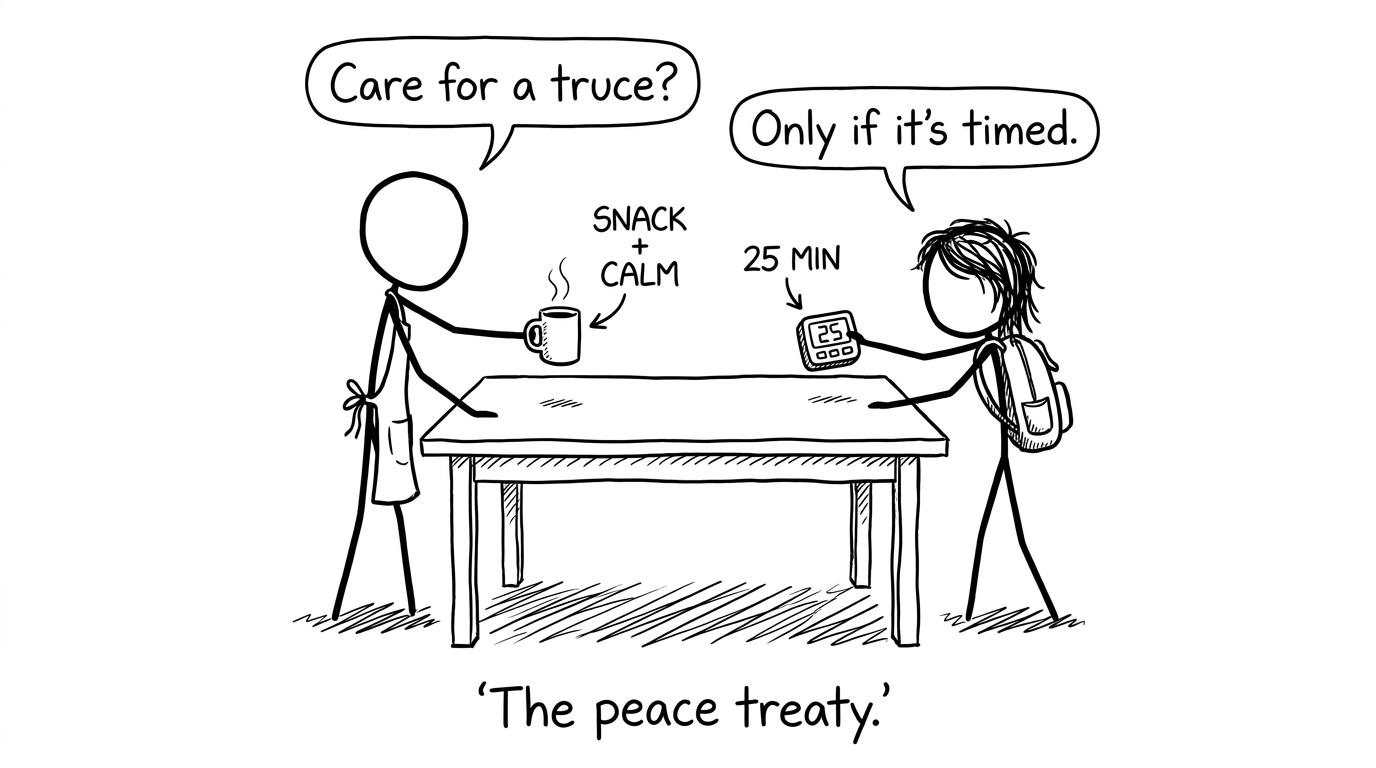 Parent offers tea labelled “snack + calm”, student offers a timer labelled “25 min”
CCEA GCSE Physics revision: where maths actually decides marks
Even though this is a CCEA guide, many students sit Edexcel, AQA, OCR or Eduqas. Across boards, the pattern is similar: a large chunk of Physics marks come from calculations, rearranging formulae, and sensible rounding.
If your child is revising Physics and also doing GCSE maths, you can help by making the maths side feel familiar.
The “maths-first” script (parents can say this)
When your child gets stuck, try:
- “Let’s ignore the Physics words for a moment. What quantities do we have?”
- “What formula links them?”
- “What are the units? Do they make sense?”
- “Can we do a rough estimate before calculating?”
That last line is powerful because estimation catches silly errors before they cost marks.
Worked example: rearranging a formula (the skill behind half of Physics)
A typical Physics relationship is V=IRV = IRV=IR.
If you need RRR, rearrange by dividing both sides by III:
V=IR⇒VI=RV = IR \quad \Rightarrow \quad \frac{V}{I} = RV=IR⇒IV=RSo R=VIR = \frac{V}{I}R=IV.
If V=12 VV = 12\text{ V}V=12 V and I=0.5 AI = 0.5\text{ A}I=0.5 A, then:
R=120.5=24 ΩR = \frac{12}{0.5} = 24\,\OmegaR=0.512=24ΩThat’s pure GCSE algebra. If your child’s algebra confidence is shaky, practising “collect like terms” and tidy manipulation helps across subjects. A gentle place to start is a short revision guide like Simplifying Algebra.
Worked example: using standard form in Physics
Physics loves very large and very small numbers. Standard form is a classic GCSE skill.
Suppose the speed of light is approximately 3.0×10⁸ m/s3.0 \times 10^8\text{ m/s}3.0×108 m/s and a signal travels for 2.0×10⁻⁶ s2.0 \times 10^{-6}\text{ s}2.0×10⁻⁶ s.
Distance is d=vtd = vtd=vt:
d=(3.0×10⁸)(2.0×10⁻⁶)=6.0×10² m=600 md = (3.0 \times 10^8)(2.0 \times 10^{-6}) = 6.0 \times 10^{2}\text{ m} = 600\text{ m}d=(3.0×10⁸)(2.0×10⁻⁶)=6.0×10² m=600 mA parent doesn’t need to teach this. They can just encourage the habit: “Write the powers of ten, then multiply the front numbers.”
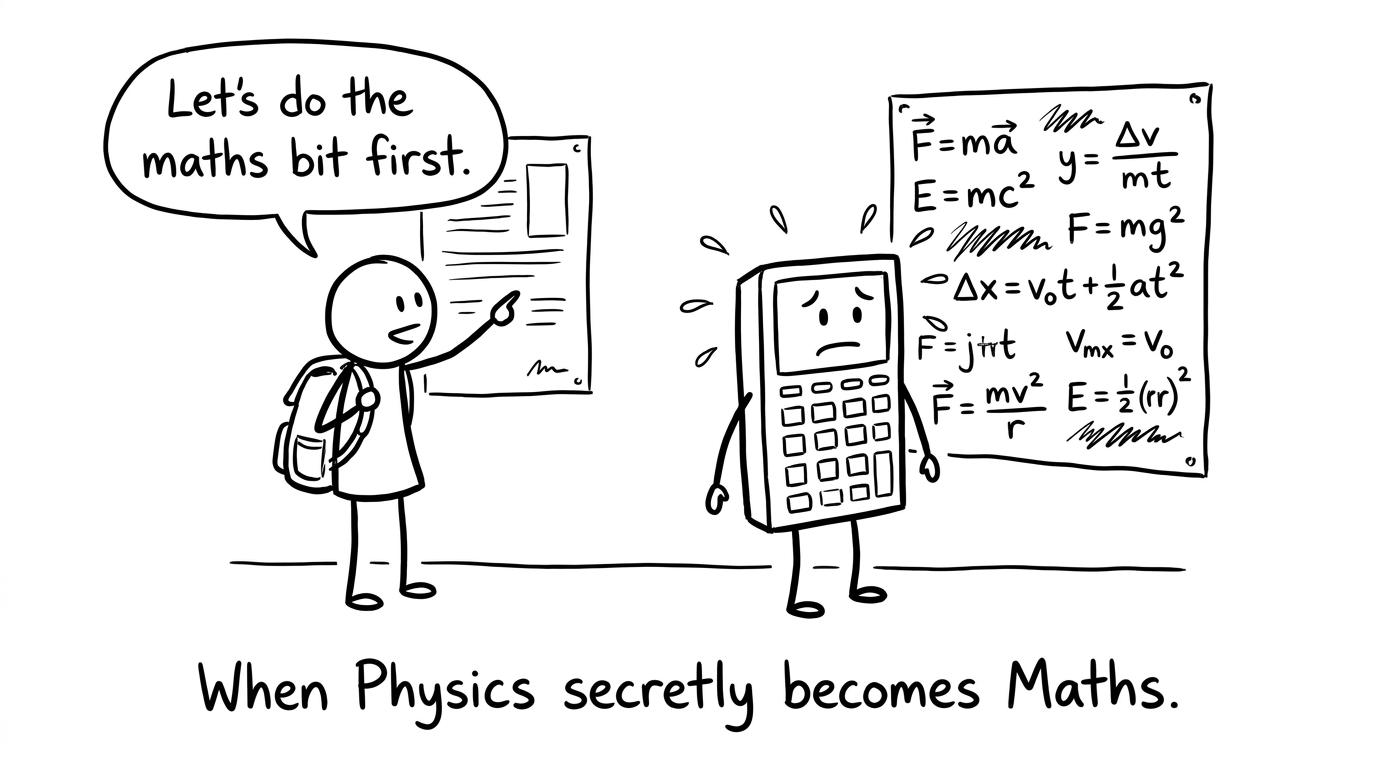 A sweating calculator facing a physics formula poster
The easiest way to help: make practice papers normal
Students often revise by reading. Parents often assume that looks like work. But GCSE marks are earned by doing questions under time pressure, then fixing mistakes using mark schemes.
YesGenie makes this simple:
- Use GCSE Past papers for routine exam practice.
- If your child is on Edexcel for maths, use Edexcel GCSE Maths Past Papers.
- Use predicted materials strategically with Edexcel GCSE Maths Predicted Papers.
A parent-friendly “paper routine” (30-40 minutes)
- Pick a section (not necessarily a full paper).
- Set a timer.
- Let them struggle a bit (that’s learning).
- Mark with the mark scheme or use video solutions.
- Write a tiny “fix list”: 2 things to practise next.
If your child panics at full papers, breaking them down is not lowering standards; it’s building stamina.
How to check progress without becoming the revision police
Instead of asking “Have you revised?”, try questions that respect independence and still create structure:
- “What topic are you doing today?”
- “What’s one thing that felt easier than last week?”
- “What’s your ‘sticky’ topic at the moment?”
Then follow up with an offer, not an order:
- “Do you want me to print a past paper?”
- “Should we set up a 25-minute timer?”
- “Want a quick walk after that block?”
For students juggling multiple subjects, it can also help to centralise their maths revision by exam board. For example, Edexcel GCSE Maths Revision keeps lessons, revision guides, and practice in one place.
Common mistakes parents make (with better alternatives)
Turning revision into a daily interrogation
If every conversation becomes “How much did you do?”, revision starts to feel like a courtroom. Replace constant reminders with one scheduled weekly check-in where your child chooses what to show you.
Over-focusing on grades too early
Talking about a grade target can be motivating, but repeated grade pressure usually creates avoidance. Instead, focus on controllables: number of practice questions, time spent, and error patterns.
Solving the question for them
It’s tempting to rescue them from struggle. But productive struggle is where memory forms. If they’re stuck, ask them to show you the line they are confident about, then help them find the next step.
Treating Maths and Physics as separate worlds
In reality, Physics calculations often depend on GCSE maths fluency: rearranging, fractions, percentages, standard form, and graphs. Strengthening maths skills makes Physics revision calmer.
Assuming longer revision is always better
An exhausted 2-hour session can be less effective than two focused 25-minute blocks. Help them stop on time so they can start again tomorrow without dread.
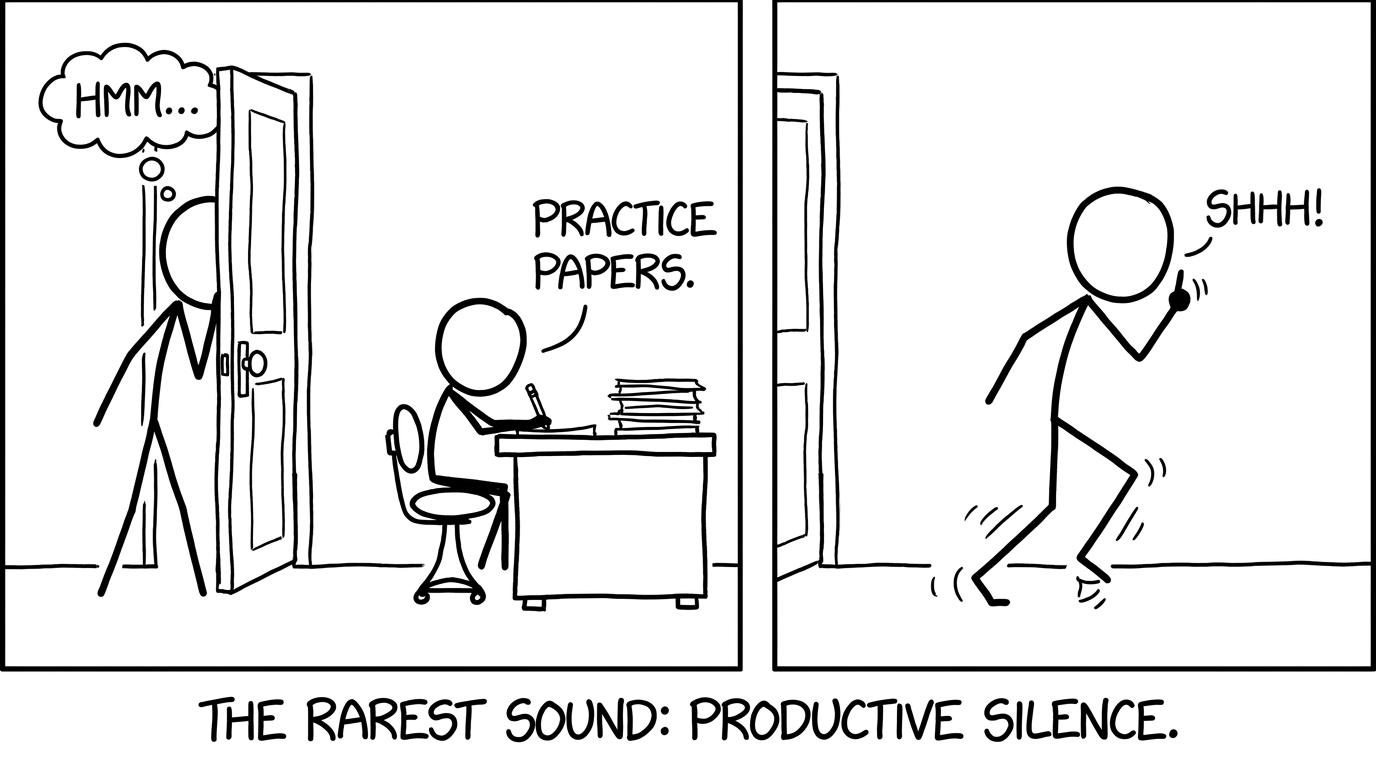 A parent peeks in, sees practice papers happening, quietly tiptoes away
Bringing it together: support that feels like trust
The best kind of help is the kind your child can accept without losing face. A calm routine. A quick timer. A printed paper. A cup of tea at the right moment. And a gentle shift from “Have you revised?” to “What are you practising for your GCSE this week?”
If you want to make the maths side of Physics revision easier, keep YesGenie open as the family home base. Start with GCSE Maths (CCEA), use GCSE Past papers to normalise exam practice, and dip into Edexcel GCSE Maths Revision (or your child’s exam board) for lessons, revision guides, practice questions, and mark schemes. Add predicted papers when exam season is close, and use video solutions to turn mistakes into method.
Support, not surveillance. Structure, not shouting. That’s how GCSE revision becomes something a student can actually sustain, and succeed at.