

GCSE CCEA guide: parents supporting revision without nagging
GCSE CCEA guide for parents: support Biology revision without nagging, using calm routines, check-ins and YesGenie maths tools to reduce stress.
The quiet moment before the argument
The hardest part of GCSE revision at home is rarely the content. It is the tone.
A parent asks, “Have you revised?” A student hears, “You’re behind.” The room tightens. Everyone wants the same thing: decent GCSE grades, less panic in May/June, and a home that doesn’t feel like an exam hall.
This CCEA guide is for parents who want to support GCSE Biology revision without nagging, and for students who secretly want help but hate being chased. YesGenie is a maths site, but the habits that lift GCSE maths marks are the same habits that make GCSE Biology stick: short sessions, active recall, and feedback you can trust.
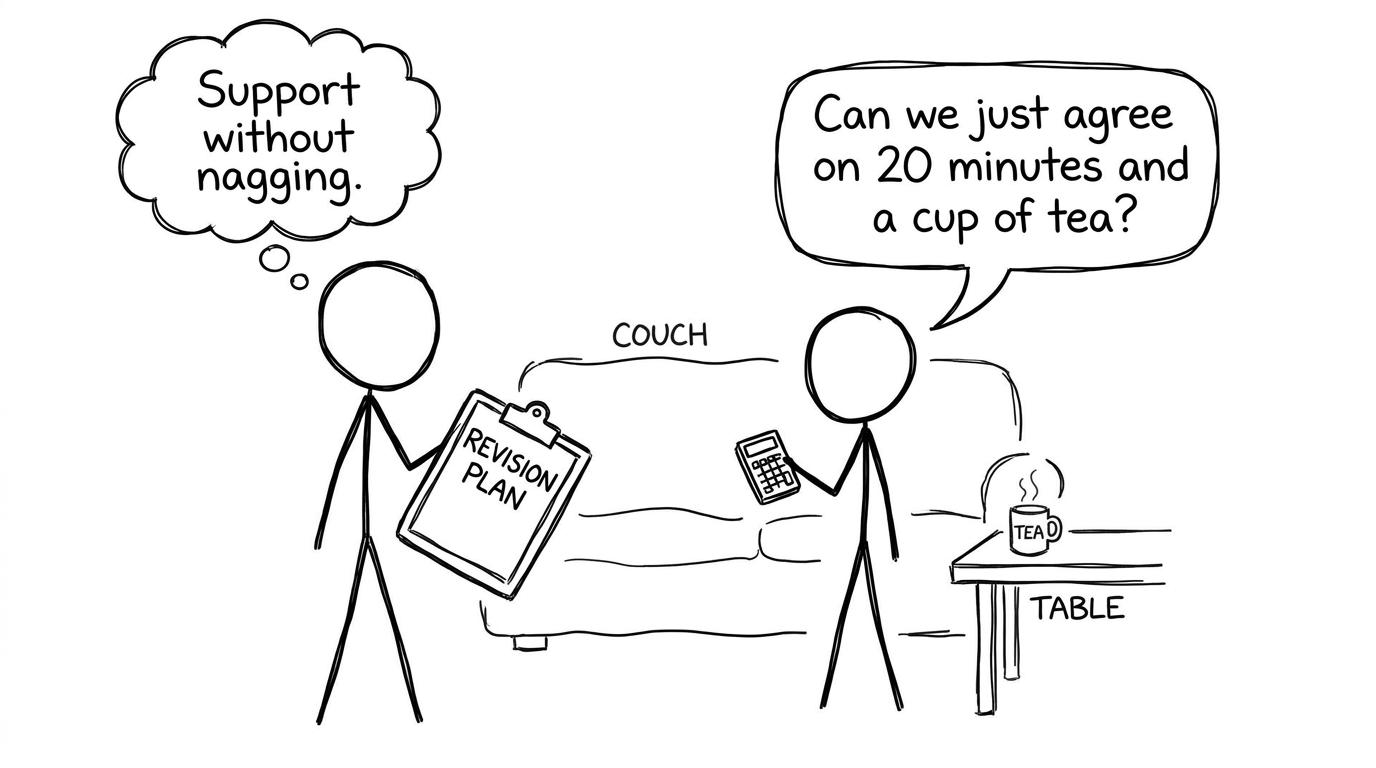 Parent and student negotiating revision calmly
A practical checklist for supporting GCSE revision (without friction)
Here is the simplest way to keep GCSE revision moving while keeping the relationship intact.
- Agree a small daily “minimum” (even 202020 minutes counts)
- Swap “Have you revised?” for “What’s your plan today?”
- Make the next step obvious (one topic, one paper, one review)
- Use mark schemes to remove emotion from feedback
- Track effort lightly (time, topics, mistakes) not personality (“lazy”, “unmotivated”)
- Build in recovery: sleep, food, movement, and a cut-off time
If you only do one thing, make it this: let the plan do the nagging, not you.
Why nagging fails (and what to do instead)
Nagging is an attempt to manufacture motivation with pressure. It works for about 303030 seconds, then collapses into avoidance.
The better lever is clarity. GCSE students procrastinate less when they can answer three questions:
- What exactly am I doing?
- How long will it take?
- How will I know it worked?
Parents can help with all three without teaching the subject.
The “coach voice” script (CCEA-friendly)
Try these swaps for GCSE season:
- “Have you revised Biology?” -> “Which Biology topic are you focusing on today?”
- “You should be doing maths as well.” -> “Do you want a 252525-minute maths slot before dinner?”
- “That’s not good enough.” -> “Let’s look at what the mark scheme wanted.”
Notice what changes: the focus moves from judgement to process. That is how you reduce nagging while still raising GCSE performance.
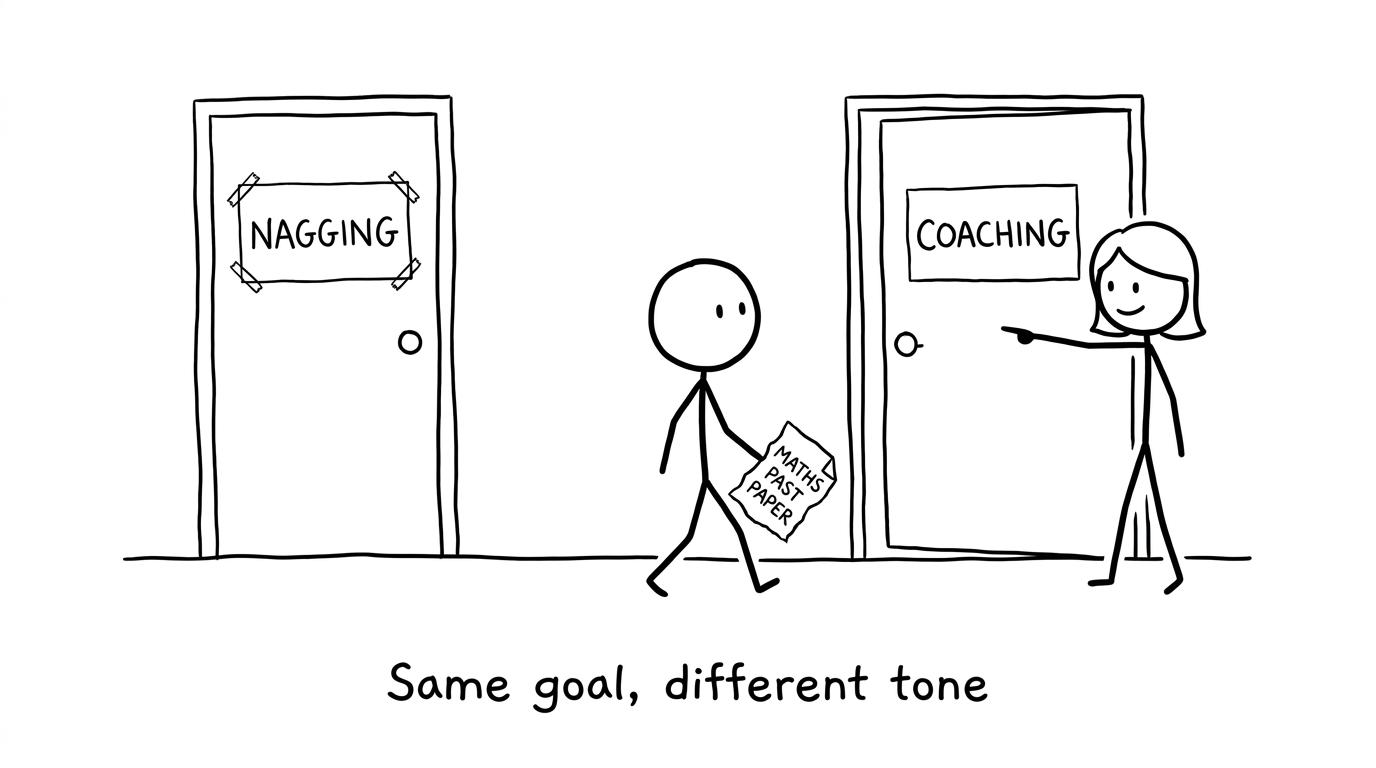 Two doors: Nagging vs Coaching
The CCEA angle: make revision feel like the exam
CCEA GCSEs still reward the same fundamentals: accurate recall, clear working, and exam timing. Parents don’t need to know the specification line-by-line; they can help students practise exam-shaped habits.
A simple home routine that fits CCEA and any board (AQA, Edexcel, OCR, Eduqas) looks like this:
- 252525 minutes: learn/review a single micro-topic
- 252525 minutes: exam-style questions (timed)
- 101010 minutes: mark with a mark scheme and write a short “fix list”
YesGenie is built for that loop in maths: revision lessons, practice questions, video solutions, and past papers.
Useful starting points for the GCSE maths side (because maths is the subject that quietly boosts overall confidence):
- GCSE Maths Revision
- Edexcel GCSE Maths Revision Guides
- Edexcel GCSE Maths Past Papers
- GCSE Past papers (all subjects)
- Resources hub (including predicted papers and mini tests)
How parents can “support” without becoming the teacher
Support is mostly environment design. It is making the right thing easier to start.
Set up the room to reduce decision fatigue
When a student sits down, they should not have to decide what “counts” as GCSE revision.
Parents can help by:
- keeping a consistent spot (same chair, same table, same charger)
- making materials frictionless (calculator, ruler, pens, paper)
- agreeing a start trigger (“After tea, one session”)
Then let the student choose the content. Autonomy matters.
Use “micro-check-ins”, not monitoring
A check-in is 606060 seconds, once per day:
- What did you do yesterday?
- What are you doing today?
- What’s one thing you’ll fix?
You are not checking worth. You are checking direction.
A worked maths example parents can use (even if they “hate maths”)
Parents often ask how to help with GCSE maths without teaching methods incorrectly. The trick is: ask them to teach you.
Here is a perfect “teach me” example, using percentages (which also supports GCSE Biology skills such as percentage change, data interpretation, and required practical calculations).
Worked example: percentage change
A student scored 424242 out of 808080 on a GCSE paper, then 545454 out of 808080 on the next.
- Find the increase in marks:
- Percentage increase relative to the original score:
So the score increased by about 28.6%28.6\%28.6%.
A parent does not need to lead those steps. They can simply ask:
- “What are you taking as the original?”
- “Why are you dividing by 424242 and not 808080?”
- “Can you estimate first: should it be closer to 10%10\%10% or 50%50\%50%?”
That style of questioning supports GCSE reasoning without nagging.
For targeted practice and fully worked solutions, a student can use topic pages like:
When Biology revision stalls, use maths to restart momentum
This sounds odd, but it works. When GCSE Biology feels heavy (too much content, too many terms), switching to a crisp maths topic can restart momentum and lower stress.
Maths is clean feedback: right or wrong, fixable, trackable. A short burst can make the student feel competent again, and that competence carries back into Biology.
Parents can suggest a “reset block”:
- 151515 minutes maths mini-topic
- 555 minutes break
- return to Biology with one specific task
In the final weeks of GCSEs, this can be the difference between “I can’t” and “I started.”
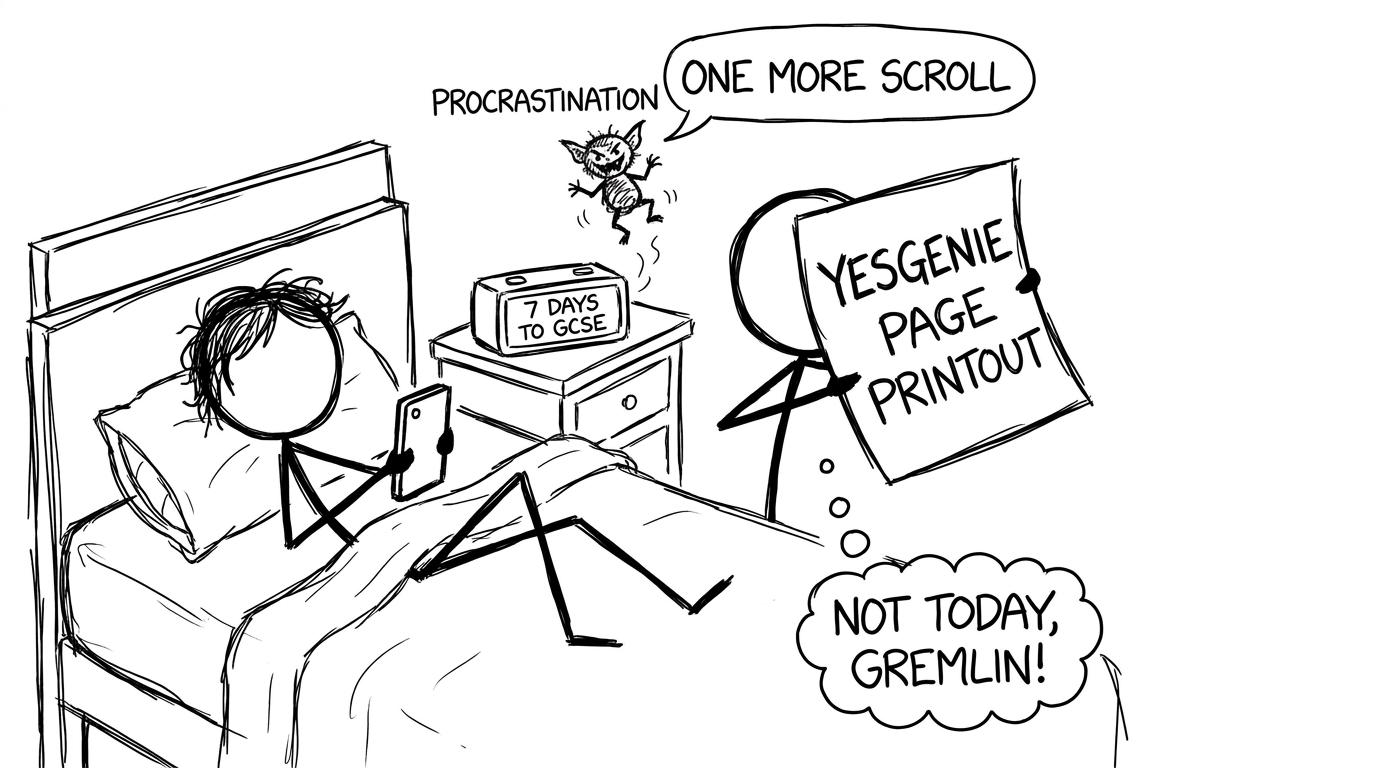 Procrastination gremlin vs revision plan
Using papers and mark schemes to remove conflict
Many arguments happen because feedback feels personal. Papers make it impersonal.
A calm parent routine is:
- student does 303030 minutes of questions
- student marks with the mark scheme
- parent asks: “What pattern do you see in the mistakes?”
That’s it. No lecture.
For students, a strong GCSE strategy is to mix real papers with predicted papers when you need fresh practice. YesGenie makes this easy:
Even if you’re not Edexcel, the habit transfers: timed attempt, mark, fix list, repeat.
Common mistakes (for parents and students)
Turning every conversation into GCSE talk
If every car journey becomes “What grade are you on?”, students start hiding. Pick one daily check-in and protect the rest of life.
Confusing time spent with progress
Two hours of passive reading can be less effective than 252525 minutes of exam questions. Progress is shown by fewer repeated mistakes and better timing.
Helping by giving answers
In GCSE maths, giving answers robs students of retrieval practice. In GCSE Biology, it does the same. Ask questions that force the student to explain.
Waiting until the student is “motivated”
Motivation often arrives after starting, not before. Make starting tiny: open the page, do two questions, stop if needed. The habit is the win.
Ignoring foundation vs higher reality
A foundation-tier student needs mastery of core skills and accuracy under pressure. A higher-tier student needs that plus breadth and problem-solving. Support looks different: foundation needs consistency; higher needs challenge and past-paper variety.
Closing: let the system do the reminding
The best support for GCSE revision is not a louder voice. It is a quieter system.
If you are a parent, aim to be the person who protects time, reduces friction, and keeps feedback factual. If you are a student, aim to be the person who starts small, marks honestly, and repeats what works. Either way, GCSE success is built less from heroic last-minute marathons and more from ordinary days that don’t fall apart.
When you want a structure that does not nag, use YesGenie as the external brain: revision lessons, practice questions, past papers, predicted papers, mini tests, mark schemes and video solutions. Start with GCSE Maths Revision, pick one topic, and let the next 252525 minutes be enough. The GCSEs will still be demanding, but they won’t have to be lonely, or loud.










