

GCSE Biblical Hebrew vs Modern Hebrew: Employer View
GCSE Biblical Hebrew vs Modern Hebrew employers: discover what recruiters and colleges notice, the skills each subject shows and how to choose wisely.
A GCSE subject can feel as though it carries a hidden message about you. One language might sound practical. Another might sound unusual enough to make an application memorable. It is easy to imagine an employer studying the difference closely.
For students searching GCSE Biblical Hebrew vs Modern Hebrew employers, the short answer is reassuring: most employers and colleges do not have a general preference between the two. They are more likely to notice your grade, your overall GCSE profile and whether you can explain the skills you developed. Modern Hebrew may be more directly relevant where present-day communication matters, while Biblical Hebrew can demonstrate linguistic analysis, precision and engagement with historical texts.
The better choice is usually the subject that fits your interests, future plans and realistic chance of achieving a strong result, without weakening essential subjects such as GCSE Maths and English.
The quick comparison
| Question | GCSE Biblical Hebrew | GCSE Modern Hebrew |
|---|---|---|
| Main focus | Reading and analysing Biblical Hebrew language and prescribed literature | Understanding and communicating in present-day Hebrew |
| Skills most visible | Translation, grammar, close textual analysis and interpretation | Listening, speaking, reading, writing and practical communication |
| Likely employer reaction | Distinctive, academically interesting, but may need explanation | More immediately recognisable as a current language skill |
| Particularly relevant to | Theology, ancient languages, history, textual study and related interests | Communication, travel, community work and roles involving Hebrew speakers |
| General college value | A recognised GCSE contributing to your academic profile | A recognised GCSE contributing to your academic profile |
| Best reason to choose it | You enjoy the texts, language structure and analytical demands | You want to communicate in a living language and enjoy practical language learning |
A sensible decision checklist is:
- Check which qualification your school actually offers and which exam board specification you will follow.
- Look at the assessment style, not just the subject name.
- Consider which course matches your current language experience.
- Ask whether either subject is relevant to a genuine future plan.
- Protect the revision time needed for GCSE Maths, English and your other subjects.
- Choose the course in which you are most likely to remain engaged and perform well.
What the two GCSEs actually assess
The names sound similar, but the learning experience is different.
GCSE Biblical Hebrew
OCR offers GCSE Biblical Hebrew under specification J625. It is an ancient-language qualification built around knowledge of Biblical Hebrew and the study of prescribed literature. Students need to understand vocabulary and grammar, translate accurately and engage carefully with texts.
This makes the qualification closer in character to the disciplined study of an ancient language than to a modern conversational course. Its transferable strengths include careful reading, pattern recognition, attention to detail and the ability to justify an interpretation using evidence.
An employer may not know the specification. That does not make the GCSE unhelpful; it means the student may need to explain what it involved.
GCSE Modern Hebrew
The current Pearson Edexcel qualification is officially titled GCSE Hebrew, although schools and students commonly use “Modern Hebrew” to distinguish it from Biblical Hebrew. Like other modern-language GCSEs, it assesses practical language skills across listening, speaking, reading and writing.
That purpose is easier for many recruiters to recognise immediately. If a role involves Hebrew-speaking colleagues, customers or communities, practical communication may have direct relevance. However, a GCSE does not by itself prove professional fluency. Students should describe their ability accurately rather than presenting the qualification as evidence of complete command of the language.
 A student asks an employer what really matters about two language GCSEs
Which GCSE do employers actually notice?
Most employers are unlikely to use a standard rule that ranks Biblical Hebrew above Modern Hebrew, or the reverse. GCSE requirements vary by job, but recruiters commonly pay particular attention to required grades in English and maths, alongside qualifications or experience relevant to the role.
The language subject can still help in three ways.
First, it adds evidence of academic breadth. Completing a language GCSE shows sustained learning over time.
Second, it can provide evidence for skills. Biblical Hebrew can support claims about precision, textual analysis and handling complex grammatical systems. Modern Hebrew can support claims about communication, listening and adapting language for different situations.
Third, either subject can create a useful interview conversation. But distinctiveness only helps when you explain it. “I took Biblical Hebrew” is a fact. “It trained me to analyse unfamiliar text carefully and check small details before reaching a conclusion” communicates value.
Modern Hebrew has the clearer advantage only when contemporary Hebrew is relevant to the role. Biblical Hebrew has the clearer connection where the application concerns theology, ancient languages, scriptural study or historical texts. For an unrelated apprenticeship, weekend job or graduate career, the distinction will usually matter much less than your attainment, experience and wider evidence.
Do sixth forms and colleges care which one you choose?
Sixth forms and colleges normally publish entry requirements based on an overall GCSE profile and grades in particular subjects. A student hoping to take A Level Maths, for example, may need a specified GCSE Maths grade. Choosing one form of Hebrew over another does not replace that requirement.
For most courses, either Hebrew GCSE can contribute to a broad set of recognised qualifications. A college is more likely to ask whether you meet its stated entry requirements than to operate an unpublished preference between the two subjects.
There are exceptions where relevance becomes important. A course involving modern-language communication may find Modern Hebrew more directly aligned. A pathway involving theology or ancient-language study may regard Biblical Hebrew as useful preparation. Requirements vary, so students should read the current admissions information for each institution rather than relying on a general comparison.
If maths is part of your next step, use the free GCSE Maths revision lessons to identify topics that need attention before sixth-form applications and final exams.
The grade often matters more than the label
Subject names attract attention because they are easy to compare. Performance is harder to ignore.
A demanding subject that you dislike, rarely practise and cannot fit into your timetable may not be the strategic choice merely because it sounds distinctive. Equally, choosing a subject only because it appears easier can lead to poor motivation. The useful question is not “Which title looks best?” but “Which course can I approach seriously, and what evidence will the final result provide?”
This is especially important during GCSE exam season. Language learning benefits from regular contact, while maths improves through repeated practice, correction and revisiting weak topics. Both require time. A realistic MathsGenie GCSE revision programme can help you avoid giving every subject equal time when they do not have equal needs.
Use GCSE Maths past papers to test whether your core knowledge survives under exam conditions. The result may reveal that one neglected maths topic has more immediate consequences for your next step than the precise wording of an additional GCSE on your application.
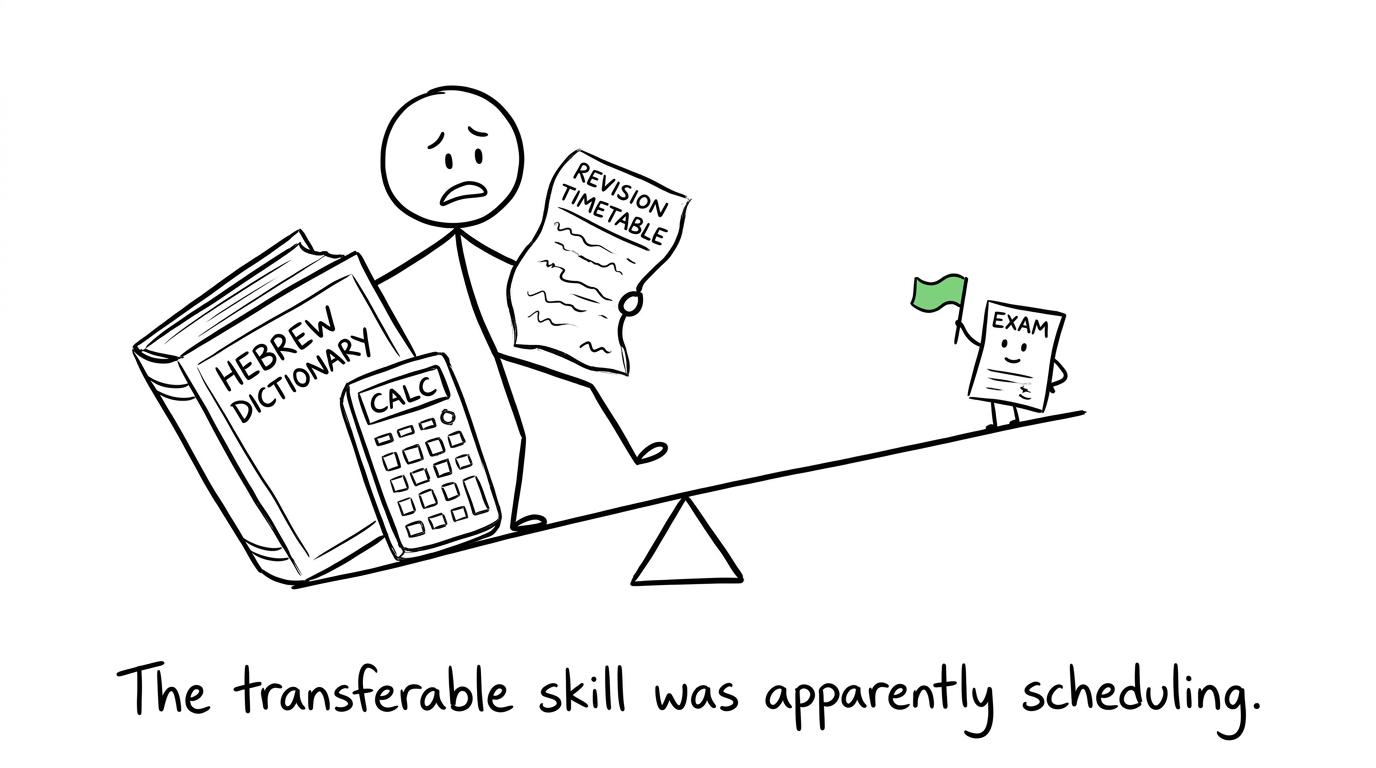 A student balances language learning, maths and a revision timetable
How to present either GCSE on an application
A qualification becomes more meaningful when it is connected to evidence. On a CV, application or in an interview, use the correct official qualification title and exam board where appropriate. Then explain the relevant skill briefly.
For Biblical Hebrew, useful evidence might include:
- translating unfamiliar or demanding passages accurately;
- recognising grammatical patterns;
- comparing interpretations of a text;
- supporting conclusions with precise textual evidence; or
- maintaining concentration when small details change meaning.
For Modern Hebrew, useful evidence might include:
- communicating ideas in speech and writing;
- listening for key information;
- adapting language to audience and context;
- learning vocabulary consistently; or
- responding when communication is imperfect.
Do not force the GCSE into every application. Select the evidence that matches the opportunity. A customer-facing role may value communication. A research-related course may respond better to analysis and accuracy.
The same principle applies to maths. Saying that you are “good with numbers” is vague. Completing timed papers, reviewing mark schemes and acting on errors gives you evidence of methodical improvement. MathsGenie provides predicted GCSE Maths papers alongside topic practice, helping students turn revision intentions into something measurable.
Choosing without trying to predict every employer
At GCSE age, it is tempting to optimise every decision for an employer you have not met and a career you may later change. That is usually impossible.
A stronger approach is to keep important routes open. Check the entry requirements for courses you may want, prioritise core qualifications and choose additional subjects that you can study with genuine commitment. If you have a specific reason to use present-day Hebrew, Modern Hebrew is likely to be the more practical choice. If your interest lies in original Biblical texts, ancient language or textual analysis, Biblical Hebrew may offer the better intellectual fit.
Neither choice guarantees that an application will stand out. Neither normally damages an application simply because the other form of Hebrew exists. Your explanation, grade and wider profile provide the context.
Students considering future quantitative courses can also explore the free A Level Maths resources to see what follows GCSE. Looking ahead can make today’s revision priorities clearer.
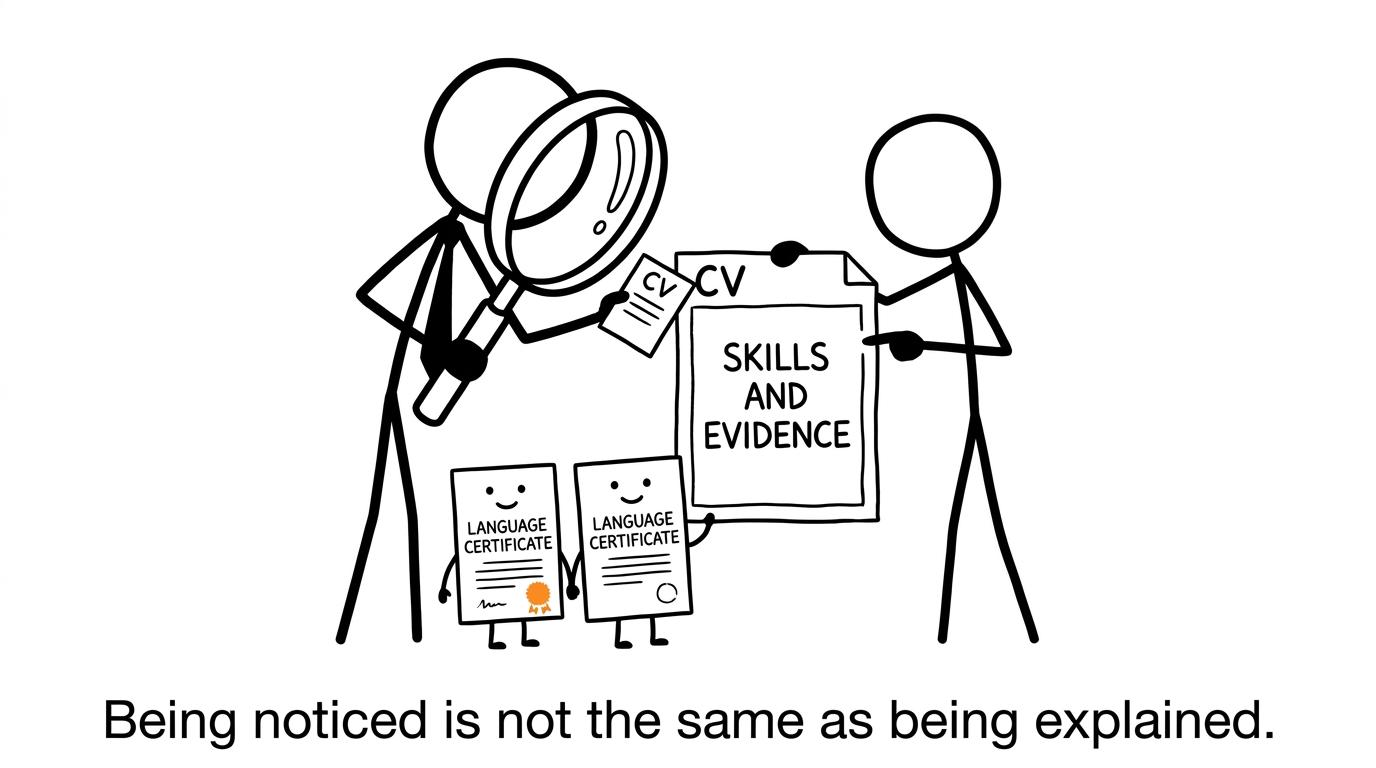 An employer looks for explained skills rather than an unexplained subject title
Common mistakes when comparing the qualifications
Assuming employers have a universal preference
There is no general employer ranking that places one Hebrew GCSE above the other. Relevance depends on the role, while many recruiters will focus more closely on required subjects, grades and experience.
Treating Biblical and Modern Hebrew as interchangeable
They share linguistic connections, but their assessment purposes differ. One centres on Biblical language and literature; the other develops present-day communication across several skills.
Claiming fluency from a GCSE alone
A language GCSE is a valuable achievement, but fluency is a separate claim. Describe what you can currently do and provide evidence if language ability is relevant to the application.
Ignoring official course details
Qualification availability, prescribed content and assessment arrangements can change. Check the current OCR or Pearson Edexcel specification and confirm what your school offers before deciding.
Neglecting core GCSE requirements
An unusual language GCSE can enrich an application, but it will not compensate for missing a stated Maths or English requirement. Use revision lessons, mini tests, practice questions, video solutions and mark schemes to deal with weak areas early rather than hoping another subject will distract from them.
Make the choice that gives you useful evidence
Employers and colleges rarely care more about GCSE Biblical Hebrew or GCSE Modern Hebrew in the abstract. They care about relevance, attainment and what the qualification reveals about how you work. Modern Hebrew communicates practical language use more immediately. Biblical Hebrew can show unusual analytical depth. Both can be valuable when chosen for a clear reason and explained honestly.
Once the choice is made, the useful work becomes less dramatic: practise consistently, learn from errors and protect time for the subjects that determine your next step. Start with MathsGenie’s GCSE revision resources, build a revision planner around your weakest topics, and use past papers, predicted papers, practice questions, mark schemes and video solutions to turn preparation into stronger exam performance.










