GCSE Bengali Predicted Grade Process Explained
GCSE Bengali predicted grade process explained: see how teachers use mocks, speaking evidence, classwork, mark schemes and progress to estimate grades.
A predicted grade can feel strangely final. One number appears on a report, yet you may not know which pieces of work produced it or whether one difficult mock changed everything.
The GCSE Bengali predicted grade process is usually an evidence-based judgement made by your school, not a grade awarded by AQA. Teachers consider your performance across listening, speaking, reading and writing, compare suitable assessments with the specification and mark schemes, review how consistently you are performing, and may moderate their judgement within the department. The exact policy varies between schools, so your teacher is the best source for the method used in your centre.
That distinction matters. A prediction estimates what you are currently likely to achieve. It is not your final GCSE result, and it can change when stronger evidence appears.
The process at a glance
A teacher will commonly:
- confirm whether you are entered for AQA GCSE Bengali at foundation or higher tier;
- gather evidence covering all four language skills;
- prioritise controlled, exam-style work that can be marked reliably;
- convert raw marks where scaling is required;
- consult mark schemes and relevant historical grade boundaries cautiously;
- consider consistency, recent progress and the conditions under which work was completed;
- check the judgement against departmental or school assessment policy;
- report the grade as an informed estimate rather than a guaranteed result.
The central idea is simple: the wider and more reliable the evidence, the more defensible the prediction.
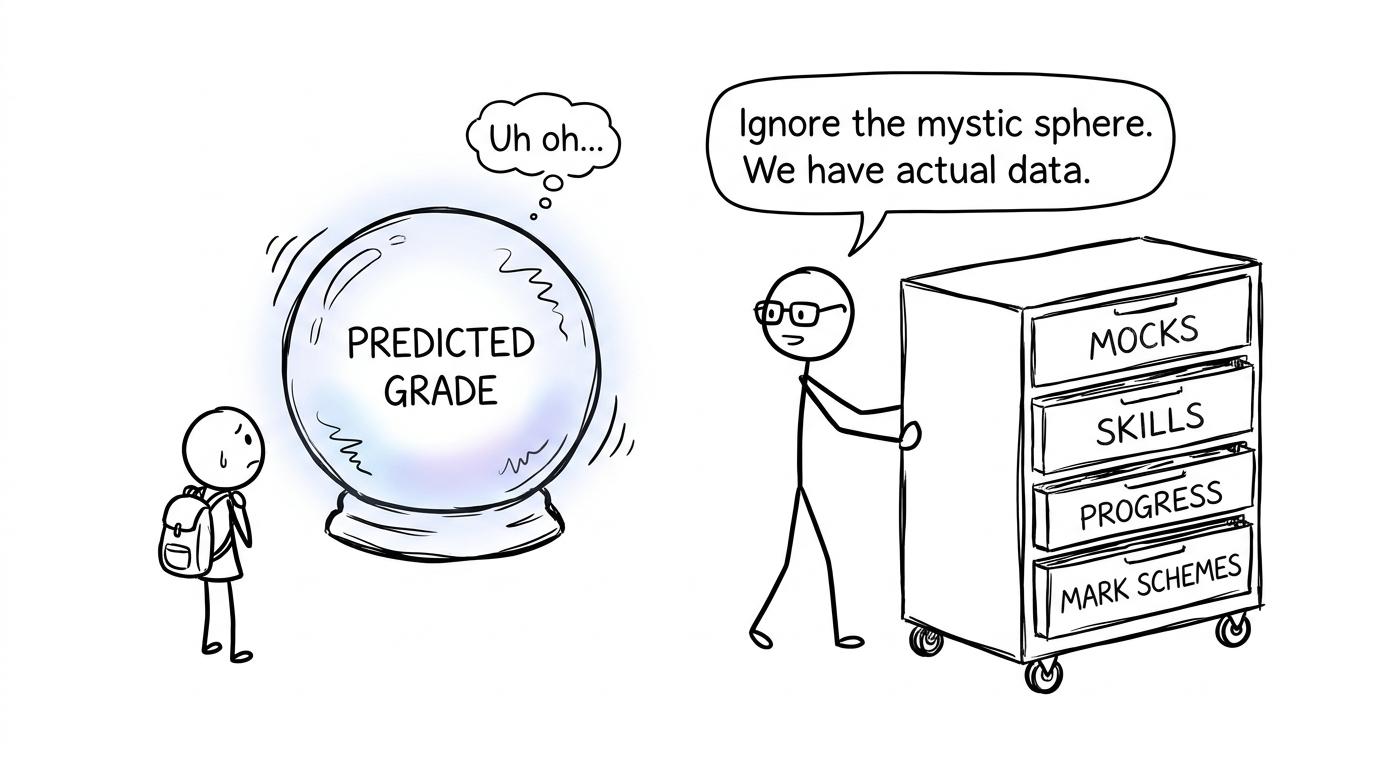 A crystal ball loses an argument to a teacher's evidence cabinet
First, confirm which Bengali qualification you take
Students sometimes use “GCSE Bengali” as a general label, but qualification details matter. The current AQA GCSE Bengali specification has code 863886388638. It is a linear qualification, meaning the assessments are completed at the end of the course in the same examination series.
AQA offers:
- foundation tier, covering grades 111 to 555;
- higher tier, covering grades 444 to 999, with an allowed grade 333 for a candidate who narrowly misses grade 444 under AQA's rules.
All four papers must be taken at the same tier. Pearson Edexcel International GCSE Bangla is a different qualification with a different assessment structure, so its marks and boundaries should not be mixed with those for AQA GCSE Bengali.
Ask your school for the exam board, specification code and tier. This is the language equivalent of checking your board before choosing a maths paper. The GCSE Maths revision hub uses the same principle by separating resources according to board and course.
What evidence do teachers actually use?
There is no single national calculation that every school must use for an ordinary GCSE predicted grade. Schools may have their own assessment calendars and reporting policies. However, reliable predictions tend to draw on several recognisable forms of evidence.
Mock examinations and timed assessments
Mocks are useful because they can reproduce important examination conditions: independent work, a time limit, unseen questions and consistent marking. Current Ofqual resilience guidance asks centres to retain mock evidence completed in exam-like conditions in case examinations cannot proceed nationally. That guidance is not itself a universal formula for routine predictions, but it confirms why controlled assessments are valuable evidence.
A mock covering several skills will normally reveal more than a short vocabulary quiz. Teachers should still consider whether the mock sampled enough specification content and whether each skill was assessed fairly.
Speaking assessments
Speaking cannot be inferred safely from writing. Teachers may use formal speaking mocks, role-play practice, prepared tasks and recorded or observed conversations, depending on their school's approach.
The AQA criteria reward more than memorised vocabulary. Relevant features include communication, knowledge and use of language, range and accuracy, pronunciation and intonation, spontaneity and fluency. A polished prepared paragraph does not automatically prove that a student can respond spontaneously.
Reading, listening and writing evidence
Topic tests and exam-style tasks can show whether performance is consistent across the course. A teacher may examine:
- comprehension of spoken and written Bengali;
- accurate retrieval of details and main ideas;
- responses to different question types;
- communication and development of ideas in writing;
- range, accuracy and control of language;
- translation skills where required by the specification.
Classwork and homework may support the judgement, particularly when they show a clear pattern. Their evidential strength can be lower if students had unlimited time, extensive feedback or outside help. Teachers need confidence that work represents the student's own independent performance.
Progress over time
One result is a photograph. A sequence of results is a film.
If recent controlled work is consistently stronger than early assessments, a teacher may judge that the newer evidence better represents likely examination performance. Equally, one unusually high mark may not outweigh a long pattern unless later work confirms the improvement.
Effort and attendance matter because they affect learning, but they are not substitutes for demonstrated knowledge and skills. A conscientious student is not automatically assigned a higher grade; the prediction should remain anchored in assessable performance.
Why all four skills matter equally
AQA GCSE Bengali assesses four objectives:
- listening;
- speaking;
- reading;
- writing.
Each contributes approximately 25%25\%25% of the qualification. A sensible prediction therefore needs evidence across the full course rather than relying on whichever skill feels most comfortable.
At foundation tier, for example, the raw listening mark is out of 404040 and the raw writing mark is out of 505050, while speaking and reading are each out of 606060. AQA scales these components so that each contributes 606060 marks to the qualification total:
Scaled total=listening scaled+speaking+reading+writing scaled\text{Scaled total}=\text{listening scaled}+\text{speaking}+\text{reading}+\text{writing scaled}Scaled total=listening scaled+speaking+reading+writing scaledThe maximum scaled total is therefore:
60+60+60+60=24060+60+60+60=24060+60+60+60=240This scaling prevents a paper with more raw marks from automatically carrying more weight. When schools build a prediction from component results, they should take the official structure into account rather than simply adding incompatible raw scores.
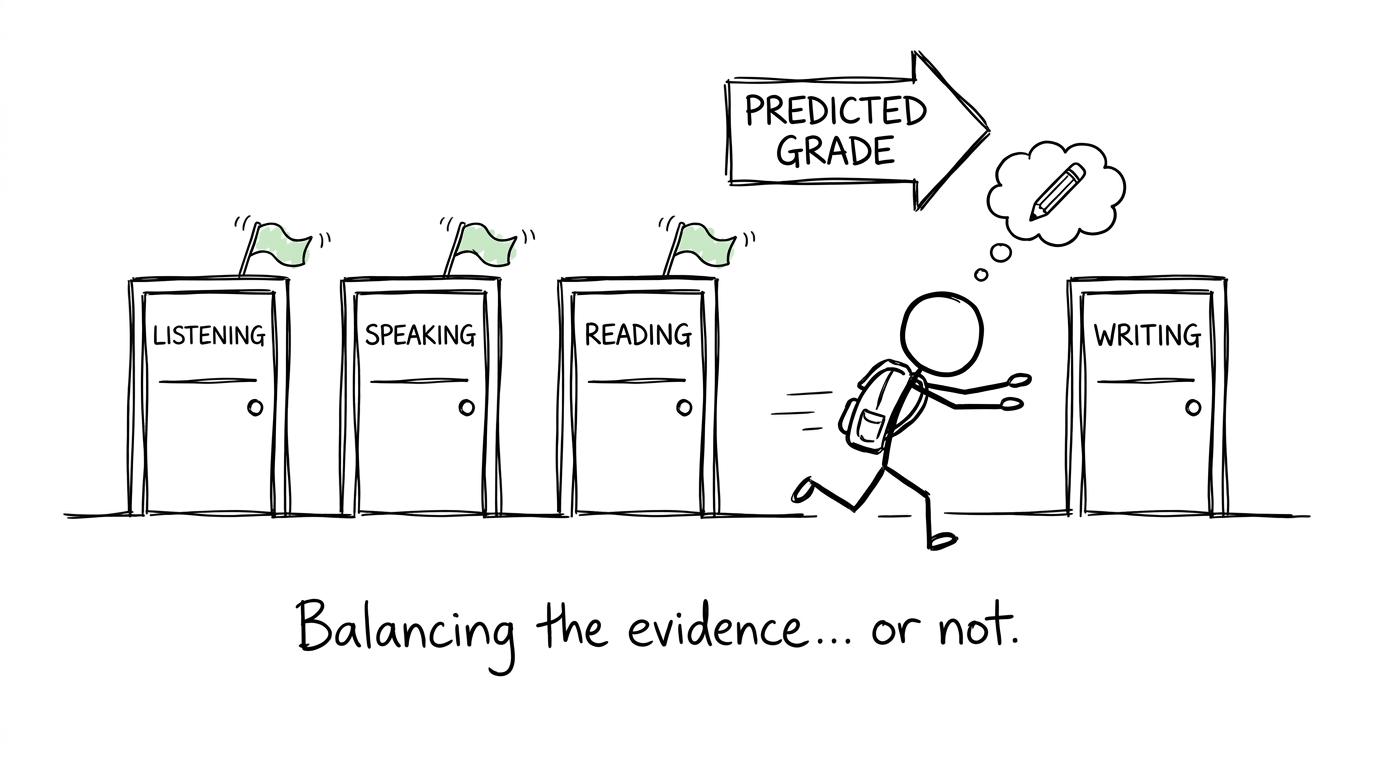 A student discovers that all four language skills want attention
How marks become a predicted grade
After marking the available evidence, a teacher needs to translate performance into a likely overall grade. This is where professional judgement enters.
Historical boundaries can provide context, but they are not permanent targets. Grade boundaries are set for a particular examination series after marking and can move because papers differ in demand. The latest completed summer series available before results day in 202620262026 is June 202520252025; MathsGenie's AQA GCSE Bengali grade boundaries let students inspect the verified historical figures.
A teacher may look at several relevant series rather than treating one past boundary as a promise. They may also consider whether a school assessment was easier or harder than an actual AQA paper, whether it covered the whole specification and whether the student's marks are secure or sitting close to a boundary.
There is normally no legitimate shortcut such as “add one grade to the mock”. Some schools may use target-setting data or expected progress as background information, but a prediction should reflect what the student is likely to achieve, supported by current subject evidence.
Moderation makes the judgement more consistent
Predictions may be reviewed by another teacher, a head of department or a school assessment lead. The precise arrangement depends on the centre.
Moderation can involve checking that:
- common assessments were marked consistently;
- teachers applied the same mark scheme standards;
- foundation and higher evidence was interpreted appropriately;
- unusual circumstances were considered fairly;
- the final judgement fits the school's published assessment policy.
This does not remove professional judgement. It makes that judgement easier to explain and less dependent on one person's impression.
What you can do if the prediction seems wrong
Start with a calm question: What evidence was used, and what would demonstrate the next grade?
Ask to see your component profile rather than discussing only the headline grade. You may discover that reading is already secure while listening or spontaneous speaking is limiting the overall prediction. Request specific criteria: stronger accuracy, more developed responses, better comprehension or greater fluency.
You can also ask:
- when the prediction will next be reviewed;
- whether another controlled assessment is planned;
- how your mock was converted into a grade;
- whether your tier remains appropriate;
- which work best represents your recent standard.
A prediction should not be negotiated as a reward. The productive route is to produce better evidence.
That principle transfers directly to maths. Use AQA GCSE Maths past papers or the OCR GCSE Maths revision area, complete work independently, mark it carefully and let repeated results show your current level.
Common mistakes to avoid
Treating one mock as the entire prediction
A substantial mock can be influential, but teachers may have several valid sources of evidence. Ask what else was considered before assuming one difficult day fixed the outcome.
Comparing raw marks from different skills
The papers have different raw totals, while each skill contributes approximately 25%25\%25%. Scaling and assessment conditions matter.
Using another qualification's boundaries
AQA GCSE Bengali and Pearson Edexcel International GCSE Bangla are not interchangeable. Check the qualification title and code before interpreting a mark.
Assuming historical boundaries will repeat
Past boundaries are context, not a forecast. They belong to specific papers and examination series.
Producing lots of unauthenticated work
Ten heavily supported homework tasks may reveal less than one properly controlled assessment. Reliable evidence needs to show what you can do independently.
Confusing a prediction with a final awarded grade
Your final GCSE grade normally comes from the formal assessments marked and awarded through the exam board. A school prediction does not cap the result you can earn.
Turn prediction anxiety into useful evidence
A predicted grade becomes less mysterious when you see it as a summary of evidence. For GCSE Bengali, that evidence should reflect listening, speaking, reading and writing, interpreted through the correct tier, specification and assessment criteria.
The same habit strengthens maths revision. Begin with the MathsGenie revision planner, learn weak topics through free revision lessons, then test them with practice questions. Use GCSE predicted papers as rehearsals rather than fortune-telling, and use Edexcel GCSE Maths mini tests when you need shorter checks.
Finish each cycle with a mark scheme or video solution: attempt, mark, identify the weakness, practise and retest. Predictions look forwards, but improvement is built backwards: one clear piece of evidence at a time.