

Foundation vs Higher Maths: Which Tier Is Best?
Foundation vs higher maths explained for GCSE students and parents, including grade ranges, boundaries, risks and how to choose the right tier.
A parent sits beside a GCSE student at the kitchen table. Between them is a practice paper, a calculator and one question that suddenly feels larger than the exam itself: foundation or higher?
The short answer is this: choose foundation tier if a secure grade 444 or 555 is the realistic goal; choose higher tier if the student has a credible chance of grade 666 or above and can cope confidently with harder questions. Foundation can award GCSE maths grades 111-555. Higher can award grades 444-999, with a limited grade 333 available just below the grade 444 boundary. The school makes the final entry, but it should discuss the decision with the student and parent.
The best choice in the foundation vs higher maths decision is not the tier that sounds more ambitious. It is the tier that gives the student the strongest chance of earning the grade they need.
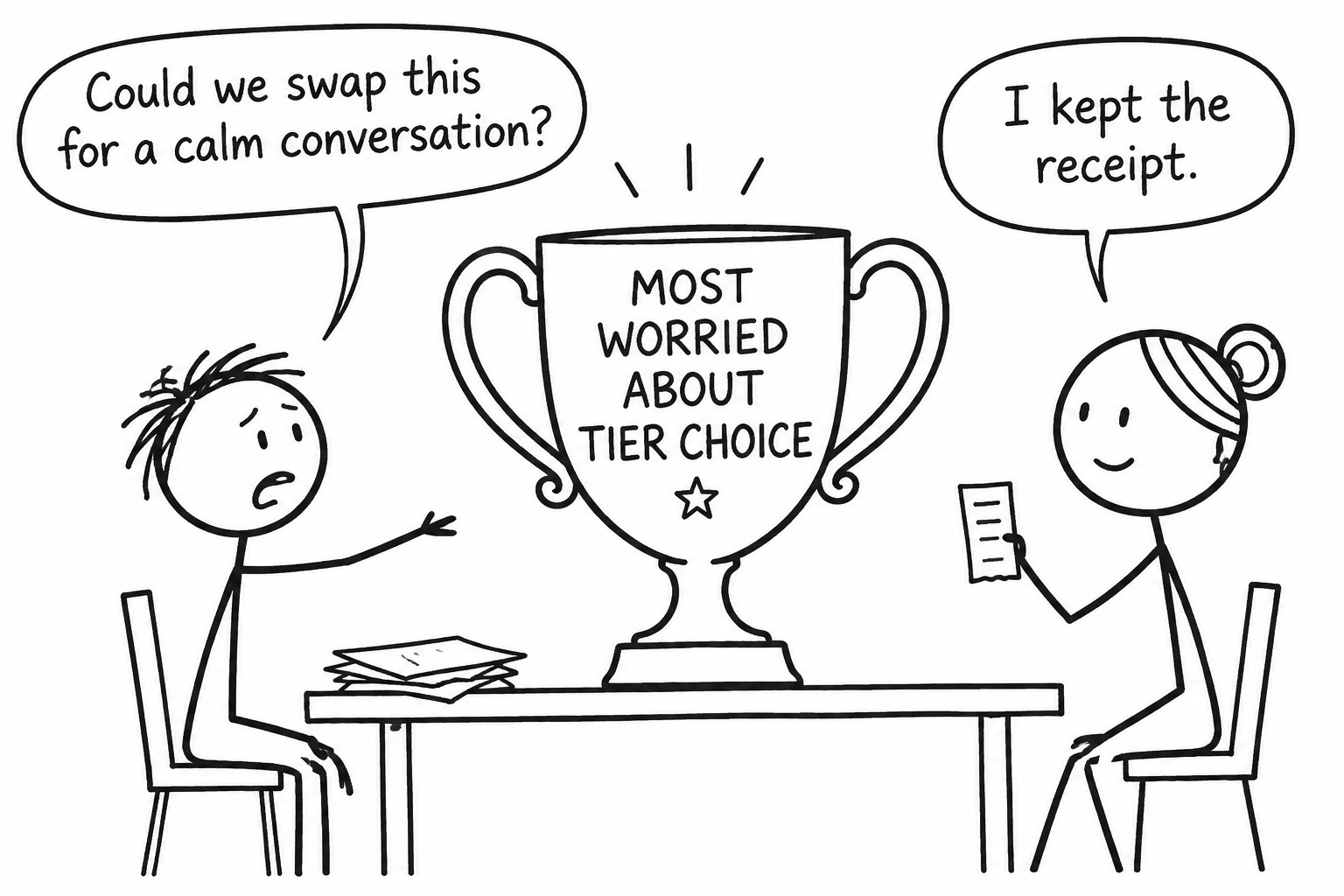 A student and parent replace tier-choice worry with a calm conversation
Foundation vs higher maths at a glance
| Question | Foundation tier | Higher tier |
|---|---|---|
| Available grades | 111-555 | 444-999, with a limited grade 333 below the grade 444 boundary |
| Highest possible grade | 555 | 999 |
| Best suited to | Students working towards grades 111-555 | Students with a realistic route to grades 666-999 |
| Main advantage | More accessible papers and a clearer route to grades 444 and 555 | Access to grades 666-999 |
| Main risk | A student cannot earn above grade 555 | A student who falls well below the grade 444 standard may receive an unclassified result |
A sensible checklist is:
- What grades is the student achieving across several recent assessments?
- Are those papers completed under timed conditions?
- Which grade is needed for sixth form, college or an apprenticeship?
- Does the student understand foundation content securely?
- Can they make meaningful progress on higher-only topics?
- What does the maths teacher recommend, and what evidence supports that view?
What is the difference between foundation and higher GCSE Maths?
Both tiers assess GCSE Mathematics, but they are designed for different grade ranges. The decision applies to specifications offered by exam boards including Edexcel, AQA, OCR and Eduqas, although schools should always check the precise rules of their chosen specification.
Foundation tier contains more questions aimed at the lower and middle parts of the GCSE grade range. This does not make it an easy paper. A student aiming for grade 555 must perform strongly because grade 555 is the ceiling.
Higher tier includes more demanding algebra, geometry, ratio, probability and problem-solving. Its early questions are intended to be accessible, but the paper becomes substantially harder. A student does not need to answer everything to earn a good grade, yet they must remain composed when some questions feel unfamiliar.
That emotional difference matters. One student may see an unanswered final page and assume the whole exam has gone badly. Another may recognise that the paper is designed to stretch students up to grade 999 and continue collecting available marks. Tier choice is partly about knowledge, but it is also about how reliably that knowledge survives under exam pressure.
When foundation tier is the better choice
Foundation is often appropriate when a student is consistently working around grades 111-444, or when securing grade 444 is more important than preserving access to the top grades.
It may also be suitable when gaps in core skills are limiting progress. Those skills include fractions, percentages, ratio, negative numbers, equations, graphs and basic geometry. They appear throughout GCSE Maths, so improving them can unlock marks in several topics at once.
Consider a hypothetical student currently moving between grades 333 and 444. On higher papers, long stretches of inaccessible questions may prevent them from demonstrating what they know. On foundation papers, the same student may have more opportunities to build marks steadily. Foundation is not a retreat from ambition. It can be the more intelligent route to the required result.
Students can identify these gaps through the free GCSE Maths revision resources, then use topic videos and practice questions to repair them.
When higher tier is the better choice
Higher tier is necessary for any student aiming above grade 555. It is usually the better option when the student is already achieving secure grade 555 results and shows evidence of moving towards grade 666 or higher.
A single excellent test is not enough. Look for a pattern across class assessments, mock exams and timed practice papers. The student should be able to handle core content accurately while also making progress on more complex algebra and multi-step problems.
Higher tier may be worth keeping when a student is near the grade 555-666 range and improving steadily. That judgement should consider the time remaining, the student’s workload and whether the missing knowledge is concentrated in a few teachable topics or spread across the course.
Use GCSE Maths past papers to test that judgement under realistic conditions. Mark the paper, record lost marks by topic and revise the patterns rather than isolated mistakes.
How GCSE maths grade boundaries affect the choice
GCSE maths grade boundaries are not fixed percentages. Awarding organisations set them after each exam series, so a boundary from one year should not be treated as a promise for another year.
For example, Ofqual’s guidance published on 101010 February 201720172017 used a hypothetical illustration in which a student scoring 50%50\%50% on a foundation paper might be better placed there than on higher tier. The useful lesson is not that grade 444 always requires 50%50\%50%. It does not. The lesson is that raw percentages from papers of different difficulty cannot be compared without context.
When reviewing a dated past paper, use the grade boundaries for that exact exam board, tier, series and paper set. Better still, focus on raw-mark trends. If a student’s score rises across several equivalent papers, that is stronger evidence than one estimated grade.
The grade ranges create an important asymmetry:
- Foundation protects access to grades 111-555, but caps the result at grade 555.
- Higher opens grades 666-999, but creates greater risk for students working below grade 444.
This is why neither tier is automatically safer. Safety depends on the student’s current evidence and required destination.
A practical way to decide
Begin with three timed papers or substantial assessments rather than one. Use papers suited to the tier currently being considered.
After marking each one:
- record the total raw mark;
- classify errors as knowledge, method, accuracy or exam technique;
- identify the topics costing the most attainable marks;
- note whether the student finished in time;
- compare performance across the three papers.
Then ask a more useful question than, “Which tier are you in?” Ask, “Where are the next 101010 marks most likely to come from?”
If those marks sit in foundation topics such as fractions, ratio, percentages and basic algebra, revise them first. If the core is secure and the lost marks are clustered in higher content, higher tier may remain realistic.
Maths Genie’s GCSE revision page organises lessons by grade, helping students move from secure foundations towards harder material. Maths Genie exam papers then provide the test: can the knowledge be used independently, under time pressure?
Parents can help by keeping this process factual. Replace “You should be doing higher” with “What do the last three papers show?” Pressure becomes a plan when it is attached to evidence.
Common mistakes when choosing a tier
Treating foundation as a failure
A grade 444 or 555 earned through foundation is the same GCSE grade as one earned through higher. The tier is not printed as a separate measure of personal worth. The outcome and the student’s next-step requirements matter more.
Choosing higher because it leaves every door open
Higher only leaves doors open if the student can access enough of the paper. A theoretical chance of grade 777 is not helpful when the evidence points towards difficulty securing grade 444.
Looking at one mock result
Mocks can be affected by illness, anxiety, unfinished teaching or an unusually strong day. Use several pieces of evidence and inspect the actual scripts.
Comparing percentages from different tiers
A mark on a higher paper is not directly equivalent to the same percentage on a foundation paper. Paper difficulty and grade boundaries differ.
Revising only the hardest topics
Students sometimes jump to advanced content because it feels like proof that they belong on higher tier. Yet reliable marks often come from mastering recurring skills. Accuracy with number, proportional reasoning and algebraic manipulation supports both tiers.
Make the tier decision serve the student
The foundation vs higher maths choice can feel permanent long before it actually needs to. Schools often review entries as evidence develops, although their internal deadlines and exam-board entry arrangements will affect when changes can be made. Ask the school when its decision will be final.
The calmest approach is also the most rigorous: define the grade needed, examine several timed assessments, find the topics losing attainable marks and agree a review date. Ambition matters, but ambition works best when it has evidence beneath it.
Start with Maths Genie Lessons on the topics that move marks most. Use the videos, practice questions and answers to strengthen weak areas, then return to past papers and measure what changed. The right tier is not a label. It is the route that gives the student the best chance to show what they know.















