

Foundation or Higher for Your GCSE Maths Resit?
Should you sit foundation or higher for your resit? Compare grade limits, content and risk to make a practical GCSE maths resit tier decision.

A GCSE maths resit rarely exists on its own. It sits beside a college course, employment, travel and everything else that changed after Year 11. That makes the tier decision feel unusually important: should you sit foundation or higher for your resit?
The practical answer is this: choose foundation if your main goal is a secure grade 444 or 555 and you perform more consistently on foundation papers. Choose higher if you need a grade 666 or above, or if reliable timed evidence shows that higher gives you the better route to your target.
This is not a verdict on how good you are at maths. It is a decision about which paper gives your current knowledge the best chance of becoming marks.
Your tier decision checklist
Before agreeing to an entry, ask:
- What grade do you actually need for your next step?
- What did you score on recent full, timed papers from both tiers?
- Where did your marks come from, and where were they lost?
- Can you complete enough of a higher paper without guessing?
- Does your college or employer require a grade above 555?
- What does your tutor recommend after reviewing your scripts?
A remembered feeling from the summer exam is useful context, but it is weaker evidence than a recently marked paper.
What foundation and higher tiers allow
For GCSE Mathematics, foundation tier awards grades 111-555, while higher tier awards grades 444-999. There is also a narrow provision for grade 333 on higher tier when a candidate falls just below grade 444. The exact boundary changes between exam series, so it should never be treated as a safety net.
Both tiers assess genuine mathematical understanding. Foundation is not simply an easy version of higher. Its papers concentrate more heavily on the core content, but questions can still combine topics, require reasoning and expose insecure arithmetic.
Higher tier includes additional content and places greater demand on algebra, reasoning and multi-step problem solving. It is the only option if your required grade is 666 or above.
| Your position | Tier worth considering |
|---|---|
| You need a secure grade 444 | Usually foundation, unless current evidence strongly favours higher |
| You are targeting grade 555 | Compare timed papers from both tiers carefully |
| You need grade 666-999 | Higher |
| Higher papers contain large sections you cannot begin | Foundation may offer a clearer route to grade 444 or 555 |
| Foundation papers are consistently near the top of grade 555 performance | Discuss moving to higher with your tutor |
Your exam board and centre make the formal entry, so confirm the tier and entry deadline with them rather than assuming it has carried over from Year 11.
Follow the evidence, not the identity
Imagine a post-16 student called Sam. This is a hypothetical example, but the situation is common. Sam received a grade 333, now attends college and needs a grade 444 for progression. They remember being entered for higher tier at school and feel that moving to foundation would mean going backwards.
But an exam tier is not a permanent label. It is a route through a particular assessment.
Sam completes one recent foundation paper and one recent higher paper under comparable conditions. The important comparison is not just the total. Sam also records:
- questions attempted;
- marks lost through arithmetic;
- topics that stopped progress;
- time left at the end;
- marks available from methods, even when answers were unfinished.
If the foundation paper produces a more dependable grade 444 across several papers, foundation is probably the rational choice. If Sam is comfortably handling the accessible higher questions and needs room to reach grade 666, higher may be better.
One paper can be unusually friendly or difficult. Use several papers, including the non-calculator and calculator formats used by your board, before drawing a conclusion. MathsGenie's GCSE maths past papers give you suitable material, while the AQA GCSE Maths grade calculator can help AQA students interpret a complete set of marks using the relevant boundaries.
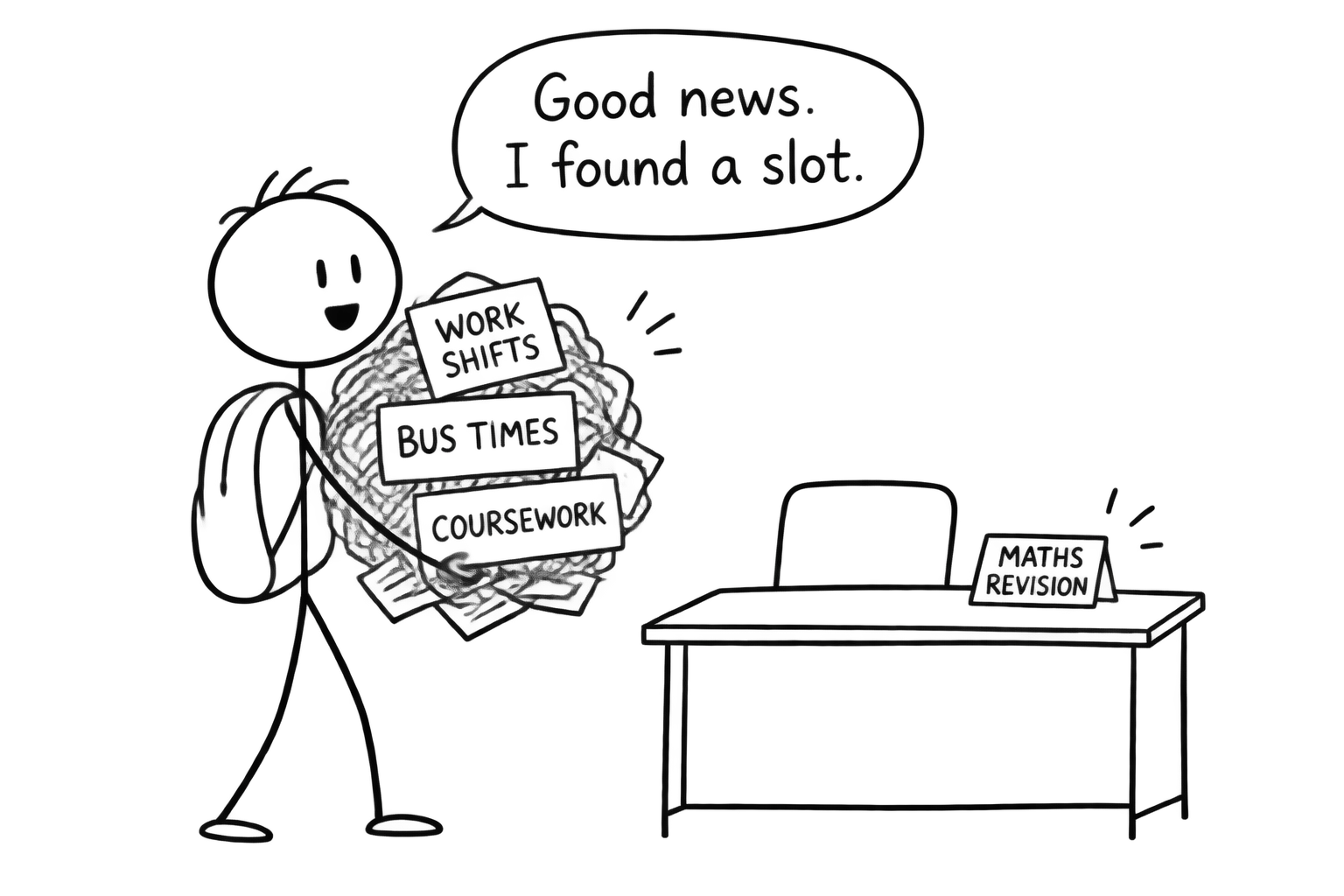 A post-16 student finds a tiny space for maths revision among work shifts, bus times and coursework
When foundation is usually the stronger choice
Foundation often makes sense when the immediate purpose of the GCSE maths resit is to secure grade 444, especially if higher papers currently contain too many inaccessible questions.
The advantage is not that foundation requires no preparation. It is that more of the paper may sit within a realistic revision range. A student who can attempt nearly every question has more opportunities to recover from one mistake.
Foundation may suit you if:
- your target is grade 444 or 555;
- core number, ratio, percentage and basic algebra skills still need consolidation;
- you repeatedly leave substantial parts of higher papers blank;
- timed foundation results are more stable;
- a grade above 555 is not required for your next course or career step.
Do not rely on the idea that a particular mark always secures a grade. Grade boundaries vary by exam board and series. Mark complete papers, check the relevant boundaries, and look for a margin rather than aiming at the smallest possible pass.
When higher may be the right resit tier
Higher is necessary if your next step requires grade 666 or above. It can also be sensible for a grade 444 or 555 candidate whose algebra and problem solving are stronger than their previous grade suggests.
Consider higher if:
- you need grade 666-999;
- timed papers show secure performance on the early and middle sections;
- you can use methods even when you cannot finish a question;
- your mistakes are concentrated in a few repairable topics;
- your tutor has evidence that your previous result understated your current level.
Higher should not be chosen because it feels more respectable. Nor should it be rejected because the final questions look intimidating. You do not need every mark. You do need enough accessible marks, gathered reliably across the full set of papers.
Plan for the November resit as a post-16 student
A November resit has a shorter preparation window than the summer series. Availability, entry arrangements and deadlines must be confirmed with your school, college or exam centre. Do not plan around an assumed date or assume every centre accepts private candidates.
Post-16 revision also needs to fit adult-shaped constraints. Four focused sessions can be more useful than a vague intention to revise all weekend.
A practical weekly cycle is:
- complete one timed paper or targeted paper;
- mark it honestly with the mark scheme;
- sort lost marks into knowledge, method, accuracy and time;
- revise the two topics with the greatest realistic return;
- answer fresh questions on those topics;
- revisit them several days later.
Use the MathsGenie GCSE revision resources to move from a weak topic into a revision lesson, video and practice questions. Once the individual skill feels secure, return to mixed questions. That final step matters because the real exam does not tell you which method to use.
Common mistakes when choosing a resit tier
Choosing from pride or embarrassment
Foundation and higher are assessment routes, not rankings of intelligence. Choose the route aligned with your required grade and current evidence.
Comparing raw marks without context
A mark on foundation cannot be compared casually with the same mark on higher. Use complete papers, the correct mark schemes and boundaries from the relevant exam series.
Using only one practice paper
One paper can exaggerate confidence or anxiety. Look for a pattern across several properly timed attempts.
Revising everything equally
A resit timetable is limited. Begin with topics that recur, unlock other skills and are close enough to secure. Then test them in mixed papers.
Ignoring your actual progression requirement
A grade 444 may satisfy one course, while another route may ask for grade 555 or 666. Check the requirement directly before selecting a tier.
Make the decision measurable
The best tier is not the one that sounds more ambitious. It is the one that gives you a credible path to the grade you need.
Speak to your resit tutor, sit comparable papers and review the scripts rather than just the totals. Then turn that evidence into revision. On MathsGenie, you can use free lessons, practice questions, past papers, mark schemes and video solutions to close specific gaps instead of restarting the whole course.
When you know which topics are costing you marks, use the MathsGenie Mock Exam Builder to build a targeted practice paper. That changes the question from “Am I a foundation or higher student?” to the more useful one: “Which marks can I secure next?”















