Fluent Before Starting GCSE German? What You Need
Fluent before starting GCSE German? Discover the vocabulary, grammar and study habits you actually need, plus how to balance German with GCSE maths.
The word fluent can make GCSE German feel more intimidating than it is. It suggests effortless conversations, instant translations and an enormous vocabulary acquired before the first lesson has even begun.
So, do you need to be fluent before starting GCSE German? No. Fluency is not an entry requirement. The course is designed to develop your listening, speaking, reading and writing over time. However, your school may expect some Key Stage 3 German, and a class starting from scratch may need to move quickly. The important question is not whether you are fluent. It is whether you are willing to practise consistently.
For students balancing German with GCSE maths, English and science, that distinction matters. You do not need to arrive finished. You need a realistic starting point and a repeatable revision routine.
Your GCSE German starting checklist
Before beginning the course, it is helpful, but not always essential, if you can:
- recognise common greetings and classroom instructions;
- introduce yourself using short sentences;
- understand that German nouns have grammatical gender;
- use a few high-frequency verbs in the present tense;
- recognise basic question words;
- spell familiar words and pronounce common letter combinations;
- look up an unfamiliar word accurately;
- practise briefly and regularly without waiting to feel confident.
If most of that is new, you can still begin. You will simply need to build the foundations alongside the GCSE content and check that your school supports beginners.
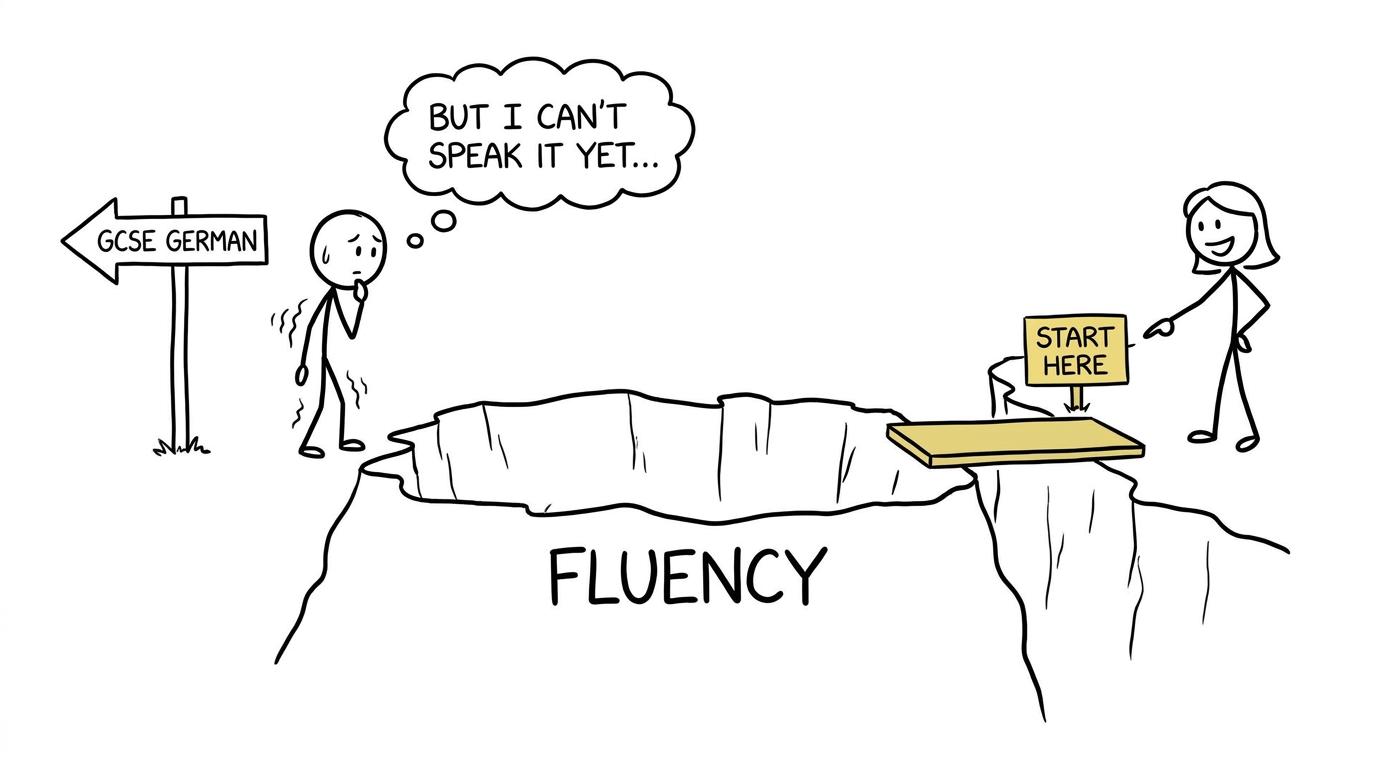 A student discovers that fluency is not a moat they must cross before beginning GCSE German
What prior knowledge do you actually need?
Official GCSE qualifications do not generally require you to hold an earlier German qualification. That does not mean every school teaches its course as a complete beginner course, though. Entry policies, timetables and teaching plans are set locally.
Many schools introduce German during Key Stage 3 and then build upon that knowledge at GCSE. In such a class, the teacher may expect students to recognise everyday vocabulary and basic sentence patterns. Another school might offer an accelerated course suitable for committed beginners. Before choosing the subject, ask the German department one direct question: Does this class teach from scratch, or does it assume Key Stage 3 German?
That answer is more useful than a vague judgement about whether you are “good at languages”.
Vocabulary foundations
You do not need thousands of words before your first GCSE lesson. You should aim to become comfortable learning and recalling vocabulary in both directions: German to English and English to German.
Early knowledge in areas such as family, school, home, food, free time, travel and opinions will make lessons easier. More important than the exact number of words is your ability to revisit them. Vocabulary forgotten and relearned is not evidence of failure. It is a normal part of building long-term memory.
Current GCSE specifications use defined vocabulary and thematic contexts, although details depend on the exam board and examination year. Your teacher should tell you whether you are following AQA, Pearson Edexcel or another relevant specification, such as Eduqas in Wales. Always use the vocabulary list and assessment guidance for your own course.
Grammar foundations
A beginner does not need complete mastery of German grammar. It is useful to understand that German sentences are built according to patterns rather than translated word by word from English.
The most valuable early topics include:
- personal pronouns;
- present-tense verb forms;
- common irregular verbs;
- noun gender and articles;
- basic word order;
- negatives;
- question formation;
- simple ways to express opinions and reasons.
You will later develop a wider range of tenses and more complex structures. Do not delay starting because cases or word order look difficult. In maths, algebra becomes manageable by learning one rule and applying it repeatedly. German grammar benefits from the same patient approach.
Pronunciation and listening
You are not expected to sound like a native speaker. Clear, intelligible pronunciation is the useful goal.
Some students postpone speaking until they believe every sentence will be correct. That usually makes speaking feel harder. Begin by repeating short phrases, listening for familiar sounds and recording yourself when appropriate. A small amount of regular listening helps you connect the words you recognise on a page with the faster version you hear aloud.
What GCSE German will ask you to do
GCSE German develops four broad skills: listening, speaking, reading and writing. Exact tasks, timings and arrangements depend on the exam board, tier and specification followed by your school. Reformed specifications in England have also changed for recent teaching and examination cohorts, so use current information rather than an older sibling’s revision notes.
Broadly, you will need to:
- understand spoken German and identify relevant details;
- respond orally to prompts, situations or discussion topics;
- read passages and interpret their meaning;
- communicate ideas in writing;
- apply vocabulary and grammar accurately;
- work within the requirements of foundation or higher tier where applicable.
This is why fluency is the wrong test. GCSE assessment rewards specific, teachable skills. A student who knows how to retrieve core vocabulary, manipulate familiar structures and respond carefully to a task can make strong progress without holding effortless conversations.
Starting GCSE German from scratch
If your school confirms that beginners can join, spend the early weeks creating a compact foundation rather than attempting to learn the whole course immediately.
Learn useful language in small groups
Start with words and sentence structures that can be reused across topics. Opinions, reasons, time phrases, connectives and common verbs are valuable because they help you communicate more than one isolated fact.
Avoid collecting long lists simply because they look productive. A shorter set that you can recall, spell, hear and use is more valuable than a large set you have only read once.
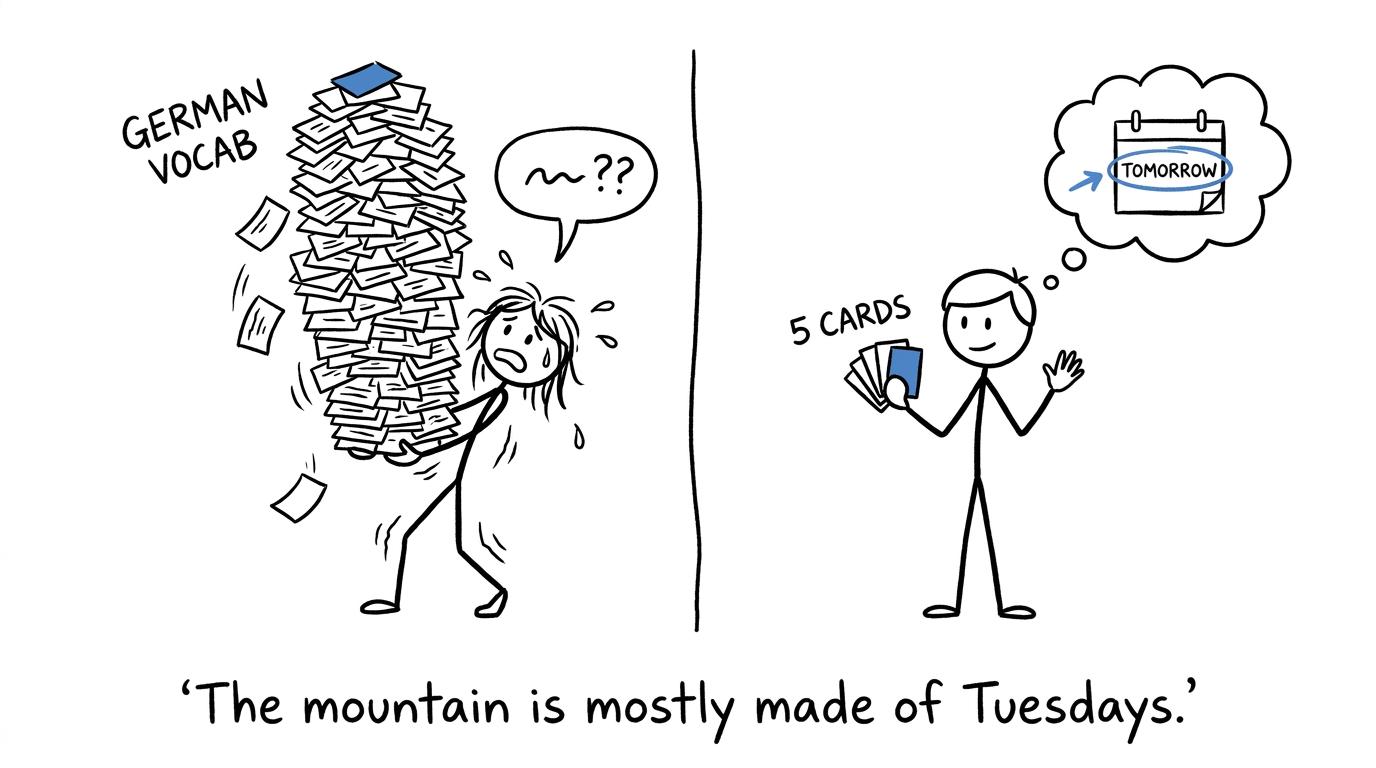 A vocabulary mountain turns out to be built from ordinary days of short practice
Build a regular listening habit
Listening improves through repeated exposure. Use audio supplied by your school or exam board, replay short sections and focus on identifying known words before worrying about every missing detail.
At first, German may sound like one continuous stream. With repetition, boundaries begin to appear between familiar words. That change can feel sudden, but it is usually the result of many uneventful practice sessions.
Write early and accept correction
Short writing gives your teacher something concrete to correct. It reveals whether a problem comes from vocabulary, verb forms, spelling or word order. Corrections are most useful when you act on them: rewrite the phrase, say it aloud and retrieve it again later.
Do not memorise long paragraphs without understanding how they work. An exam task may alter the context or tense. Flexible sentence patterns are safer than a script that only fits one question.
Speak before you feel ready
Speaking practice should begin with manageable language. Read phrases aloud, answer familiar questions and gradually extend your responses. Hesitation is part of learning, not proof that you started too late.
Ask your teacher how speaking is assessed for your specification and cohort. Current arrangements and task formats should be checked against the official course documents rather than assumed from old revision videos.
Balancing German with GCSE maths revision
The hidden challenge is often not German itself. It is fitting another subject into a crowded week.
Treat German vocabulary and maths practice as different kinds of revision. Languages benefit from frequent retrieval and exposure. Maths requires retrieval too, but also needs uninterrupted time for solving questions, checking methods and learning from mark schemes.
A sensible routine might use short German sessions on several days and protected blocks for maths questions. Keep the plan small enough to survive a busy week. MathsGenie’s GCSE maths revision resources organise topics by grade, making it easier to choose a precise task instead of vaguely deciding to “revise maths”.
If you are rebuilding core numeracy, begin with the grade 1 GCSE maths topics, grade 2 revision resources or grade 3 maths topics. Students aiming to secure a standard pass can focus on the grade 4 revision topics before moving to the grade 5 maths resources.
Higher-tier students can target gaps through the grade 6 GCSE maths topics, grade 7 revision resources and more demanding grade 8 maths topics. The principle is the same in both subjects: identify the next useful step, practise it and return later to check that it has stayed with you.
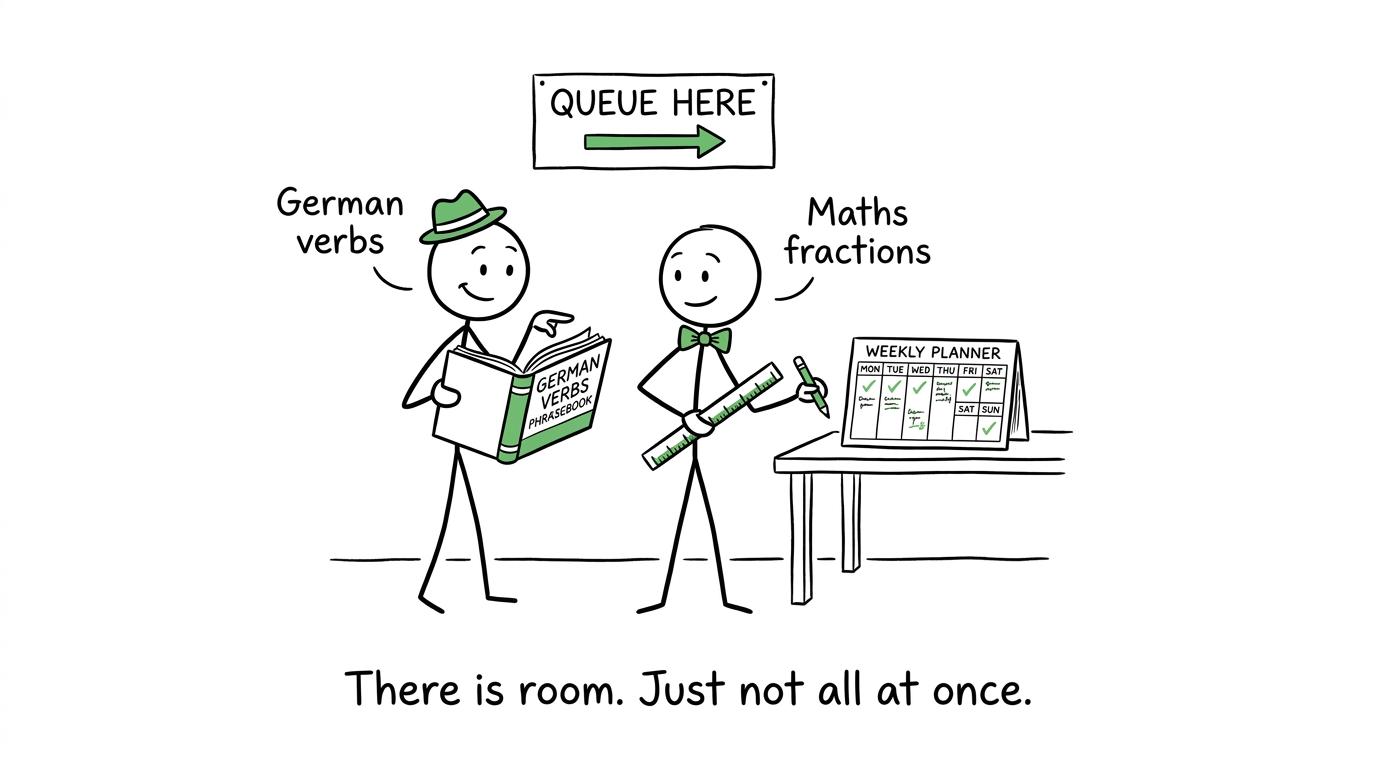 German and maths wait politely for their places in a realistic weekly revision plan
Common mistakes when preparing for GCSE German
Waiting to become fluent before joining
Fluency is an outcome of sustained language learning, not a ticket required at the entrance. Find out what your school expects and prepare for that specific starting point.
Ignoring the school’s course structure
A qualification may have no formal prior-learning requirement while a particular class still assumes Key Stage 3 experience. Speak to the department before making plans.
Learning vocabulary only by recognition
Recognising a German word is easier than producing it independently. Practise both directions and include spelling, pronunciation and use in a sentence.
Avoiding speaking because mistakes feel embarrassing
Silence prevents useful feedback. Start with short, controlled answers and let accuracy develop through correction and repetition.
Sacrificing every other subject
Beginning German from scratch may require extra attention, but abandoning maths revision creates a different problem. Use a weekly planner, define small tasks and keep both subjects moving.
Revising without checking the specification
Exam tasks and vocabulary requirements can change. Use the specification, guidance and materials for your exam board and examination year. For maths, pair topic revision with GCSE maths past papers so that practice eventually reflects full exam conditions.
You need a starting habit, not fluency
You do not need to be fluent before starting GCSE German. You may need some prior German if your school’s course assumes it, but genuine beginner routes can exist where the timetable and teaching plan support them. Check locally, then concentrate on core vocabulary, basic grammar, regular listening and the willingness to speak imperfectly.
The broader lesson applies to maths revision too. Progress rarely begins with confidence. It begins with a task small enough to complete today.
Use MathsGenie to keep that part of your GCSE workload clear and manageable. Choose a revision lesson, answer the practice questions, complete the mini tests where available and then move towards past papers, predicted papers, mark schemes and video solutions. Add those tasks to your revision planner, protect the time, and let consistency do the work that panic never can.