

Extra Practice Material for GCSE Biblical Hebrew
Extra practice material GCSE Biblical Hebrew advice: learn what to request, how to ask confidently and how to balance practice with maths revision.
Revision can create a peculiar kind of hesitation. You know that another translation, vocabulary test or unseen passage would help, yet asking your teacher feels as if it might reveal that you have not done enough already.
It usually reveals the opposite. Asking for extra practice material GCSE Biblical Hebrew students can use is worthwhile when the request is specific, polite and supported by evidence of your own effort. The best approach is to show what you have completed, identify the skill you need to improve and ask whether suitable material already exists. You are requesting direction, not asking your teacher to rescue your revision.
This matters especially when Biblical Hebrew sits beside maths and several other GCSE subjects in your timetable. More material is not automatically better. The goal is to find the right task, complete it carefully and learn from the result.
A quick checklist before you ask
Before approaching your teacher, check that you can answer these questions:
- What material have you already completed?
- Which part of Biblical Hebrew is causing difficulty?
- Do you want vocabulary, grammar, translation, comprehension or literature practice?
- Have you corrected your previous work?
- Are you asking for an existing resource rather than demanding a new one?
- When will you complete it?
- How will it fit around your GCSE maths revision and other subjects?
If your answers are clear, your request will sound purposeful rather than performative.
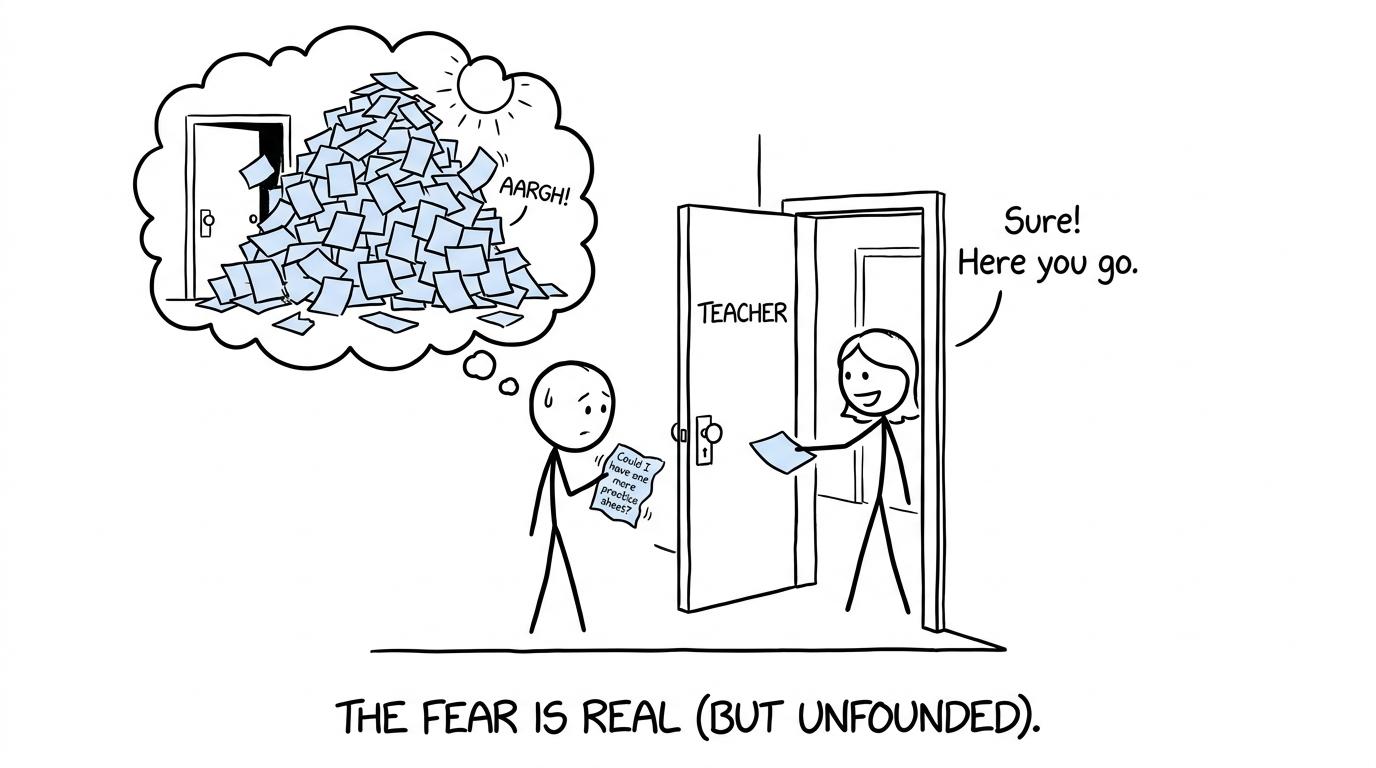 A student imagines an avalanche of worksheets while preparing to ask for one useful practice sheet
Why asking for extra Biblical Hebrew practice is worthwhile
GCSE Biblical Hebrew is a specialist qualification. OCR's specification assesses language and literature through externally examined written components, so students need more than general familiarity with the subject. They must retrieve vocabulary, recognise grammatical forms, translate accurately, understand passages and respond appropriately to prescribed literature.
Your school should always use the current specification, prescribed texts and assessment information when deciding what to teach. This is important because a random passage may be interesting without closely matching the demands of your course.
Teacher-selected practice has three particular advantages.
It can target the exact weakness
A student who says, "I need more Hebrew," has identified a feeling. A student who says, "I keep confusing similar verb forms in unseen translation," has identified a problem.
That distinction changes the quality of the material a teacher can recommend. Depending on your needs, the most useful resource might be:
- a short vocabulary retrieval test;
- sentences focused on a particular grammatical feature;
- an unseen prose passage;
- timed comprehension questions;
- an extract from the prescribed literature;
- a past-paper section; or
- a correction task based on previous errors.
Focused practice also takes less time than completing whole papers indiscriminately. That leaves space for maths, science and your other GCSE subjects.
It can be closer to the examination
A teacher can tell you whether a resource reflects your specification and current set texts. They may also know which tasks are too easy, unnecessarily obscure or written in a style that does not resemble your examination.
This does not mean every practice activity must copy an exam paper. Vocabulary recall and grammar drills build the knowledge needed for longer responses. However, some practice should eventually require you to select and apply that knowledge under timed conditions.
It creates a useful feedback loop
The real value of an extra task appears after you complete it. You can compare your answer with available guidance, mark what you can, record uncertain points and bring one or two focused questions back to your teacher.
The same principle makes GCSE maths past papers valuable. A paper is not merely a test of where you are. Its mark scheme and solutions show you what to change next.
How to ask without sounding as though you are not trying
The safest approach is simple: show effort before requesting more help.
Begin with what you have done
Take your completed work, correction notes or vocabulary record with you. You do not need to deliver a speech. One sentence establishes that you have started independently:
I have completed the translation we were given and corrected the vocabulary errors I could identify.
This is more convincing than saying you have revised "quite a lot" because it gives your teacher something concrete to respond to.
Name one precise difficulty
Follow your evidence with a narrow diagnosis:
I am still losing accuracy when I identify verb forms in unseen passages.
You might instead mention vocabulary retrieval, sentence structure, translation into natural English, comprehension or a particular part of the prescribed literature. Avoid claiming that you are weak at "everything". Even when revision feels overwhelming, the next useful action is usually specific.
Ask for guidance, not unlimited work
A thoughtful request might be:
Is there an existing worksheet, past-paper section or short passage you would recommend for that skill?
This wording matters. It recognises that teachers have limited time and may not be able to create individual resources. It also gives them several ways to help: they can provide material, point you towards a resource already available or suggest that correcting earlier work would be more useful.
Some examination material may be held securely or reserved for mock examinations, so your teacher may not be able to share every paper. A refusal to provide a particular resource is not a refusal to support you.
Suggest a realistic next step
Finish by explaining what you will do:
I can complete it by next Thursday and mark what I can before asking about the questions I still do not understand.
That sentence communicates independence. You are not asking your teacher to supervise every stage; you are asking them to help you choose the right stage.
If speaking after a lesson feels difficult, a short message containing the same three elements works well: what you completed, what you found difficult and what kind of resource you are requesting. Follow your school's normal communication policy rather than expecting an immediate reply outside lesson time.
What extra material should you request?
The best request depends on the reason you are losing marks.
| Revision need | Useful material to request |
|---|---|
| Vocabulary is slow to recall | Short cumulative retrieval tests or vocabulary lists organised by the course |
| Grammatical forms are being misidentified | Focused recognition exercises followed by brief translation tasks |
| Unseen translation feels overwhelming | Short, level-appropriate passages before full timed sections |
| English translations are too literal | Passages with guidance on accuracy and natural expression |
| Comprehension answers miss details | Exam-style questions with an available mark scheme |
| Literature knowledge is insecure | Questions based on the current prescribed texts |
| Timing is the main difficulty | A suitable timed section rather than another untimed worksheet |
Ask for the smallest resource that addresses the problem. A ten-minute retrieval test completed and corrected may achieve more than an untouched booklet containing fifty pages.
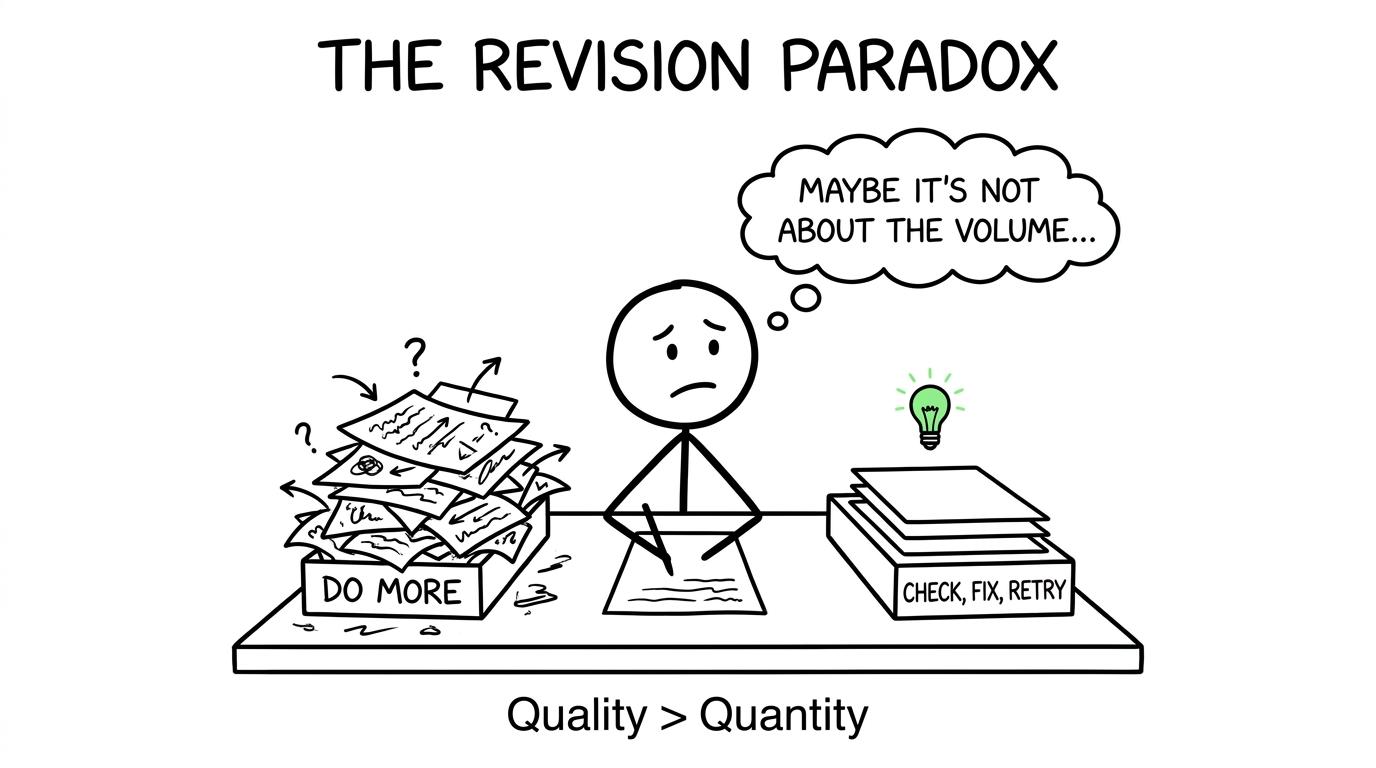 Two revision trays contrast doing more work with checking, fixing and retrying
How to use extra practice material properly
Extra material only becomes revision when it changes what you can do.
Attempt it without excessive support
Choose conditions that match the purpose. If you are learning a new construction, using notes may be appropriate. If you are testing recall, close the vocabulary list. If you are preparing for examination timing, remove the support that will not be available in the exam.
Write down the conditions you used. A high mark achieved with notes and unlimited time provides different information from the same mark achieved independently.
Mark, classify and revisit errors
Do not merely count mistakes. Classify them. Useful categories might include:
- vocabulary not known;
- grammatical form misidentified;
- word or phrase omitted;
- English expression unclear;
- passage misunderstood;
- literature detail not recalled; or
- time used inefficiently.
Then choose one response for each repeated error. This could be adding a word to your retrieval practice, reviewing a grammatical rule or retrying part of the passage after a short interval.
Maths revision works in much the same way. MathsGenie's foundation mini tests and higher mini tests help students isolate gaps instead of repeatedly sitting full papers without addressing them.
Return with a better question
"I do not understand this sheet" gives your teacher little diagnostic information. A marked attempt lets you ask something narrower, such as why your identification of a particular form led to an inaccurate translation.
You are then showing the most valuable kind of effort: not flawless performance, but an attempt followed by reflection.
Balancing Biblical Hebrew with maths revision
Students preparing for grades 999 to 111 examinations rarely have the luxury of revising one subject at a time. The danger is allowing the subject that feels most urgent to consume every available evening.
Plan practice by outcome rather than by pile size. A balanced session might contain one focused Biblical Hebrew task followed by one maths topic or mini test. On another day, you might complete a timed Hebrew section and use a shorter maths retrieval activity.
For maths, begin with the MathsGenie GCSE revision resources, where topics are organised by grade and supported by videos and exam-style questions. As examinations approach, use predicted maths papers as additional practice rather than as a claim about exactly what will appear.
Past papers should remain central because they show the established style and breadth of assessment. Video solutions and mark schemes can then help you identify why marks were lost. Students considering maths beyond GCSE can also explore the free A Level maths revision resources, but the immediate priority should remain the course currently being examined.
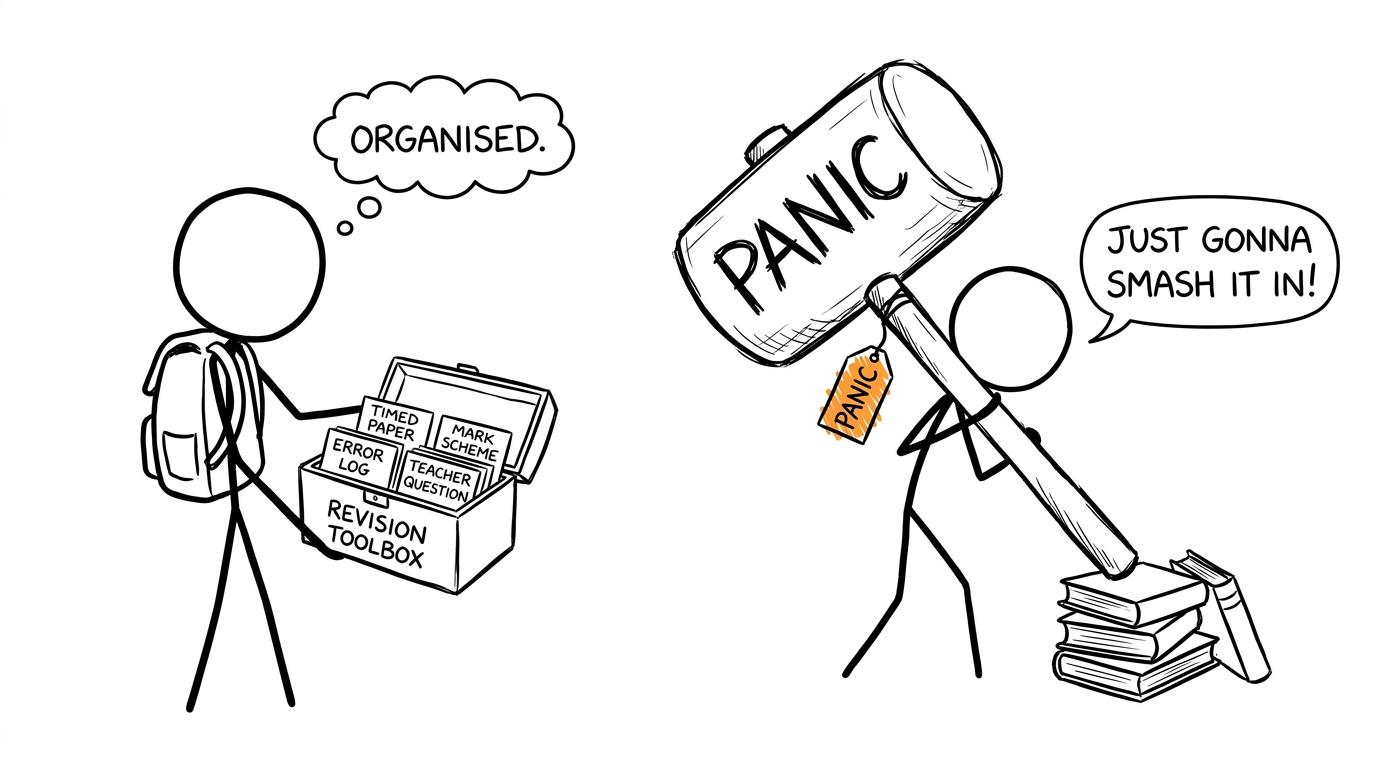 A revision toolbox is more useful than a giant hammer labelled panic
Common mistakes when requesting more material
Asking before using existing resources
If unfinished classwork and uncorrected tests are already in your folder, begin there. Your teacher may reasonably direct you back to them because old mistakes often provide the most personalised practice available.
Requesting an entire pack without a purpose
A large pack can create the appearance of ambition while making it harder to begin. Request one topic, passage or paper section linked to a recognised weakness.
Treating quantity as proof of effort
Five hurried translations are not necessarily better than one careful attempt followed by correction and a retry. Count lessons learned, not pages completed.
Expecting instant individual marking
Ask whether a mark scheme, answer guidance or brief feedback is available. Teachers may not have time to mark unlimited optional work, particularly during mock and examination periods.
Ignoring the current specification
Use material that matches your qualification, prescribed literature and assessment demands. GCSE Biblical Hebrew should not be treated as if every historical worksheet or unrelated language exercise is automatically suitable.
Forgetting to act on the answer
If your teacher recommends a resource, complete it within the agreed period. Returning with a marked attempt makes future requests easier because it demonstrates that their guidance was used.
Make the request, then make the material count
Asking for extra GCSE Biblical Hebrew material does not make you look lazy when your request contains evidence, precision and a plan. Show what you have tried. Explain where you are getting stuck. Ask for a manageable resource and take responsibility for completing and reviewing it.
The deeper lesson applies across revision: progress rarely comes from collecting more paper. It comes from closing the loop between attempt, feedback and another attempt.
Use your teacher's guidance to sharpen your Biblical Hebrew preparation, then bring the same method to maths with MathsGenie's free revision lessons, practice questions, mini tests, past papers, predicted papers, mark schemes and video solutions. Start your MathsGenie GCSE revision and make every practice task answer one clear question: what should I improve next?











